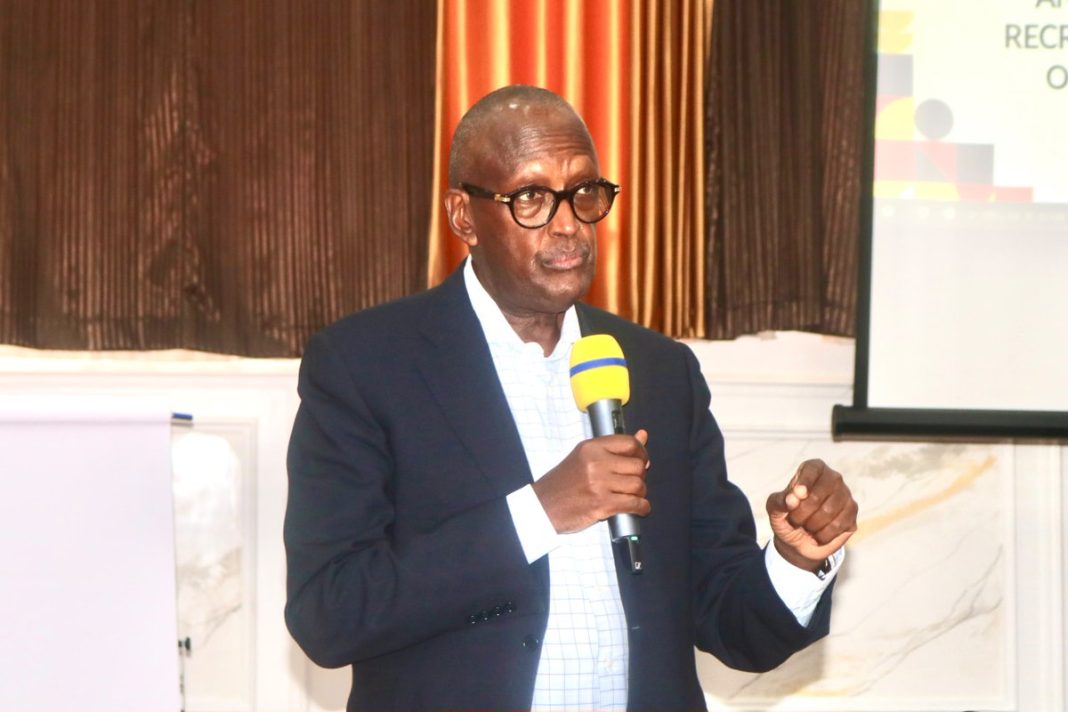
Minister of Gender, Labour and Social Development Lt Gen (Rtd) Henry Tumukunde has challenged the National Social Security Fund (NSSF) to use its growing financial strength and recent reforms to extend social security coverage to millions of Ugandans currently outside the formal savings system.
Tumukunde made the call as NSSF marks 40 years since its establishment under the NSSF Act of 1985, describing the Fund as a multi-trillion-shilling institution that has evolved into an important pillar of Uganda’s social protection system and economic development.

In a message published in NSSF’s special 40th anniversary edition of Savings Digest, Tumukunde congratulated the Fund’s Board, management, staff and members for the milestone, while urging stakeholders to focus on the large population of workers who remain without formal social security protection.
“What began as an idea in the late 1960s and was concretized into the National Social Security Fund (NSSF) Act of 1985 has now become a multi-trillion-shilling, dynamic, and innovative institution that is a model social security fund in Africa,” Tumukunde said.
NSSF has grown substantially over the past decade. Its audited financial statements show that total assets increased from Shs22.13 trillion in June 2024 to Shs26.01 trillion by June 2025.

The Fund has since continued to position itself as one of Uganda’s largest institutional investors, with its investments spread across fixed-income securities, equities and real estate within the East African region. NSSF says its membership has grown to more than 3.4 million Ugandans, with over 113,000 employers, while the members’ fund has surpassed Shs32 trillion in its latest 40th anniversary publication.
The growth has also been accompanied by increased earnings. During the financial year ending June 2025, NSSF reported record earnings of Shs3.52 trillion, up from Shs3.2 trillion the previous financial year, while member contributions rose from Shs1.93 trillion to Shs2.13 trillion.
However, Tumukunde said the Fund’s impressive growth should not overshadow the much bigger challenge of reaching workers in Uganda’s informal and emerging sectors.
According to the minister, Uganda’s working population is estimated at about 15 million, while the Uganda Registration Services Bureau has about 850,000 registered enterprises. This leaves millions of workers outside the formal social security net.
“While the achievements of the last 40 years should be celebrated, it is prudent to remind ourselves that the total working population currently stands at about 15 million, while the Uganda Registration Services Bureau puts the number of registered enterprises at about 850,000,” he said.
He added,“This means that a significant number of workers remain out of the formal social security net.”
Tumukunde said government has introduced reforms intended to remove barriers that previously limited NSSF’s ability to expand its membership and introduce products targeting different categories of workers.
Among the measures he highlighted is the National Social Protection Policy and Strategy, which provides for both contributory and non-contributory social protection arrangements, including income support for vulnerable groups and social insurance mechanisms to cushion people against economic and social risks.
He also pointed to amendments to the NSSF Act passed in 2022, which expanded the Fund’s scope and removed some of the legal and operational barriers to broader coverage and product innovation.
Another major development has been the NSSF Voluntary Membership Regulations issued in 2024, which opened membership to Ugandans who are not necessarily covered through compulsory employer-based contributions.
Under the mandatory scheme, eligible employees contribute five per cent of their gross monthly salary while employers contribute 10 per cent, according to NSSF. The Fund is regulated by the Uganda Retirement Benefits Regulatory Authority, while policy oversight is exercised by the ministries responsible for Gender, Labour and Social Development and Finance.
Tumukunde said the reforms should now be matched with aggressive efforts to bring workers in the informal economy, young people and those employed in emerging industries into the social security system.
He identified oil and gas, technology and agricultural modernisation among the sectors that could provide new opportunities for NSSF to grow its membership and mobilise long-term savings.
“The Fund must now take advantage of opportunities occasioned by a growing economy, young population, and new productive sectors like oil and gas, technology, and agricultural modernization,” Tumukunde said.
NSSF’s long-term ambition is to reach about eight million Ugandans over the next 10 years, according to its strategic direction. Its Vision 2035 also targets assets of Shs50 trillion and social security coverage equivalent to 50 per cent of Uganda’s working population.
The Fund’s transformation has seen it move beyond simply collecting mandatory contributions to becoming a major source of long-term domestic capital. Its investments generate income through interest, dividends and real estate, helping grow members’ savings while also contributing to Uganda’s economy.
In the financial year 2024/25, NSSF’s interest income rose to Shs2.88 trillion, dividend income reached Shs238.14 billion and real estate income stood at Shs16.64 billion.
The Fund has also paid billions of shillings to qualifying members through retirement and other benefits. NSSF says it has paid more than Shs8 trillion in benefits and has never failed to pay a qualifying member.
Tumukunde further grounded Uganda’s social security agenda in international human rights principles, noting that social security is recognised as a fundamental human right under the Universal Declaration of Human Rights and the International Covenant on Economic, Social and Cultural Rights.
He said government, through the Ministry of Gender, Labour and Social Development and in partnership with other institutions, is committed to ensuring that access to social security becomes a reality for more Ugandans.
“The government, through my ministry, and working with other government partners, is committed to making this right a reality for all Ugandans in our lifetime,” Tumukunde said.
He called on employers, workers, government agencies, private-sector players and other stakeholders to support the expansion of the social security system.
“I invite every stakeholder to play their role in supporting the Fund and the government in fulfillment of this mandate,” he said.
NSSF’s 40-year journey began with the formalisation of Uganda’s national social security framework through the 1985 legislation, following earlier efforts to establish a national social security system dating back to the 1960s. The Fund has since grown from a relatively small institution into one of the country’s most significant pools of long-term domestic savings.
As it enters its next phase, the central challenge for NSSF is therefore no longer simply growing its assets, but ensuring that the benefits of long-term saving reach a much larger share of Uganda’s working population, particularly those employed outside the traditional formal sector.