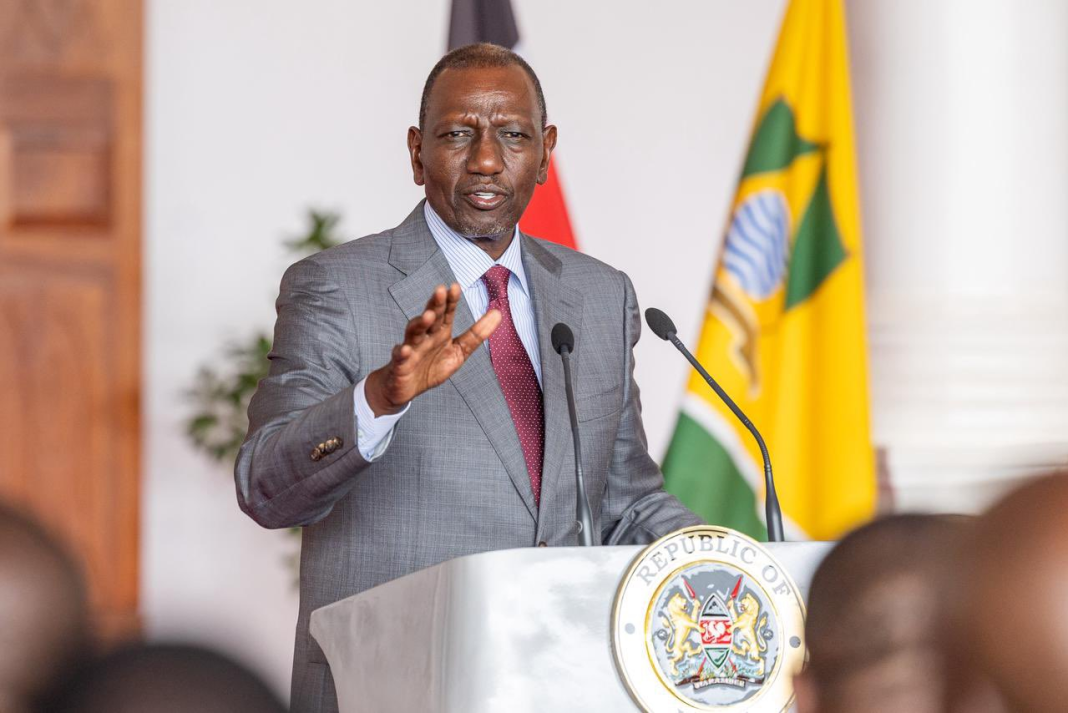
Kenyan President William Ruto has revealed that Kenya’s Government-to-Government (G-to-G) fuel importation model is better than the system currently used by Uganda and argued that the arrangement has eliminated brokers and enabled the country to secure petroleum products at a lower cost.
Ruto made the remarks while defending Kenya’s fuel importation arrangement following renewed debate over the G-to-G deal after President Yoweri Museveni questioned Uganda’s previous procurement of petroleum products through intermediaries in Kenya.

Ruto said Kenya had got one of the most important aspects of fuel importation right by ensuring that there were no brokers between the country and petroleum producers.
“I can tell you with clarity, if there is one thing we got right, is to make sure that our fuel has no brokers in between. We are dealing with companies that are producers,” Ruto said.
His comments came after Museveni said Uganda had previously been buying petroleum products through middlemen in Kenya, a system he said was contributing to higher costs.

Museveni said the issue was first brought to his attention around 2019 by Kenyan politician and former minister, the late Cyrus Jirongo, prompting him to question why Uganda was buying fuel through traders instead of sourcing directly from refiners and bulk suppliers.
“When we took over Government in 1986, we entrusted administration to technocrats. However, a Kenyan senator (former minister) alerted me that Uganda was buying petroleum products through middlemen in Kenya. Unbelievable!” Museveni said.
Museveni said Uganda subsequently intervened in the procurement process and secured a new arrangement that he said had substantially reduced the prices paid for petroleum products.
“After intervention, Diesel has come down from USD118 to USD83 per metric tonne (from about Shs465,000 to Shs327,000), Petrol from $97.5 to $61.5 (from about Shs384,000 to Shs242,000) and Aviation fuel from $114.25 to $79.25 (from about Shs450,000 to Shs312,000),” he said.
In a statement marking his 82nd birthday, Museveni said Uganda eventually linked up with Vitol in 2023 after years of efforts to change the way petroleum products were sourced.
“I want to thank H.E. Ruto because he prevailed over some actors in Kenya who were trying to resist. That is how we got our new arrangement, and the Kenyan Government allows us to pump our products through the Kenyan oil pipeline, in which the Kenyan Government allowed us to have shares of 20.15%,” Museveni said.
“We are very happy with the Kenya Government of President Ruto on this matter,” he added.
Uganda’s model has instead shifted towards greater involvement of the Uganda National Oil Company, which has taken a central role in importing petroleum products directly from bulk suppliers.
Museveni also said Uganda needs to strengthen its strategic fuel reserves as the country develops its petroleum resources and prepares for increased activity in the oil sector.
“Today, I broke ground for the 320-million-litre Kampala Storage Terminal in Mpigi. As we develop our petroleum resources, we must strengthen our strategic reserves,” Museveni said.
The Kampala Storage Terminal is expected to strengthen Uganda’s capacity to store petroleum products and improve the country’s preparedness for supply disruptions as demand for fuel continues to grow.
Museveni also said Uganda was working with Tanzania and other East African countries to strengthen regional petroleum security, noting that Tanzanian President Samia Suluhu Hassan had sent a delegation for discussions on the matter.
“I am also happy that H.E. Samia Suluhu Hassan sent a delegation as we work with Tanzania and the rest of East Africa to strengthen our petroleum security,” he said.
Uganda remains heavily dependent on the regional petroleum infrastructure through Kenya, with most of its imported petroleum products entering through the Port of Mombasa and being transported through Kenya’s pipeline and road networks.
Kenya introduced its G-to-G petroleum importation arrangement in 2023 after the country experienced foreign exchange pressures and concerns over fuel supply. The system involves government-backed arrangements with major international oil suppliers and was presented by the Kenyan government as a way of securing reliable fuel supplies while reducing pressure on the country’s demand for dollars.
Kenya’s Energy and Petroleum Cabinet Secretary Opiyo Wandayi has also defended the arrangement, saying it was introduced at a time when the country faced a serious shortage of US dollars that threatened fuel supplies and wider economic activity.
Ruto said the Kenyan system should ultimately be judged by the cost of delivering petroleum products rather than criticism of the arrangement.
“We can prove everybody with facts. Facts. So I want to challenge those who are telling us that there is a problem with our fuel importation,” he said.
Ruto said the arrangement had helped Kenya overcome serious shortages that affected the country after he assumed office in 2022, when a shortage of foreign currency had disrupted fuel supplies.
“When I came into the office, the first group of people when I was elected, before even I left Karen, was oil marketers because our fuel stations had gone dry, because there was a shortage of dollars. We had a problem. We have sorted out that problem in a permanent way,” he said.
Ruto said Kenya now has a fuel importation system that he considers more efficient and cost-effective, challenging critics to compare the actual landed cost of petroleum products in Kenya and Uganda.
“Check the landed cost of petrol products coming to Kenya and going to Uganda. Which one is cheaper? Just go check. It’s not for me to tell you. The answer is there. We have a better model than even what Uganda is using today,” Ruto said.
He further argued that petroleum products destined for Kenya arrive at the Port of Mombasa at a competitive cost compared with products supplied to other countries in the region.
“Our fuel products arrive in Mombasa cheaper than the fuel products going to other countries. So we know what we are doing, my friends,” he said.
Ruto also said Kenya’s model had attracted interest from other African countries, naming Malawi and Burundi as countries that had approached Kenya to understand how the arrangement works.
“Malawi came to ask us, Burundi came to ask us, how we are doing it,” he said.
The two countries therefore continue to depend on much of the same regional petroleum infrastructure while pursuing different approaches to procurement and supply.
The debate comes as Uganda seeks to expand its petroleum storage capacity and strengthen its role in the regional fuel supply chain, while Kenya continues to defend its G-to-G model as a mechanism for securing fuel supplies and managing foreign exchange pressures.
Ruto then posed a direct comparison between the two systems.
“Which one is better? Which one delivers our products cost-effectively?” Ruto asked.