
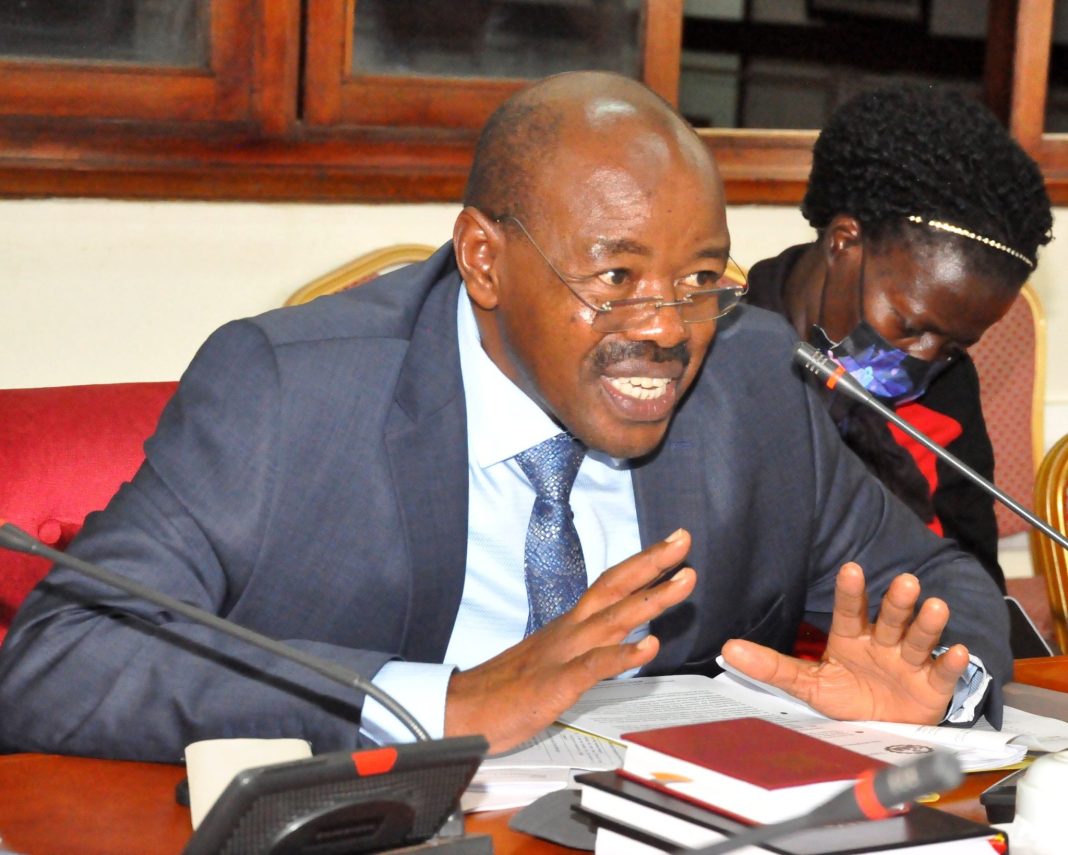
The Government wants Parliament to authorise access to Ugandans’ individual bank accounts to strengthen tax enforcement, Finance State Minister Amos Lugoloobi has told MPs.
Lugoloobi said the Government would continue seeking parliamentary approval for the proposed access, which he said was separate from the ongoing transition from Tax Identification Numbers (TINs) to National Identification Numbers (NINs).

“You have since refused to accept that, but we shall continue coming until you allow us access to your individual bank accounts,” Lugoloobi told Parliament.
The minister made the remarks while presenting a statement on the integration of NINs into the tax administration system, a reform intended to eliminate duplicate taxpayer records, improve identification and strengthen compliance.
However, the proposal would give tax enforcement a more direct connection to individuals’ financial information, making the legal safeguards governing access to bank records central to Parliament’s consideration of the request.

Lugoloobi clarified that linking a person’s TIN to their NIN does not automatically give the Uganda Revenue Authority (URA) access to their bank accounts. He said separate legal authorisation would be required.
“The NIN identifies the person. The tax law determines whether that person has a tax obligation and how much tax, if any, is payable,” Lugoloobi told MPs.
The clarification means that obtaining a national identification number does not, by itself, create a tax liability. Whether an individual owes tax depends on the applicable tax laws and their circumstances.
The transition follows amendments to the Tax Procedures Code Act in 2025 that provide for the use of NINs as tax identification numbers for individual taxpayers. The Government says the change will simplify taxpayer registration and make it easier to match individuals with their tax records.
Figures presented by Lugoloobi show that URA had approximately 5.7 million registered taxpayers as of June 30, 2026, including about 5.4 million individuals. Of these, approximately 3.3 million were considered active, while 2.1 million records were inactive or difficult to trace.
During the 2025/26 financial year, URA identified 191,813 duplicate records and 51,993 changes in its taxpayer register, highlighting the challenges associated with maintaining accurate taxpayer information.
By September 30, 2026, the authority had linked 2,130,814 NINs to TINs out of 5,405,148 individual taxpayer records, representing approximately 39.4 per cent of the register.
The integration is being implemented in phases, beginning with matching existing TINs to NINs, followed by identity verification and the updating of taxpayer profiles. During the transition, verified taxpayers can continue accessing their accounts using their existing TINs or their linked NINs.
The proposed access to bank accounts is a separate issue from this identification exercise. While the Government says it wants stronger enforcement against tax non-compliance, access to banking information must be exercised within the law and subject to applicable confidentiality requirements.
URA’s taxpayer rights framework recognises protections relating to privacy and the confidentiality of taxpayer information. Parliament therefore needs to establish the legal basis, conditions and safeguards that would govern any expanded access to individual bank accounts.
These include clarifying when bank information may be requested, what authorisation would be required, how the information would be protected and what remedies would be available if the powers were misused.
For the Government, the objective is to improve tax compliance and identify taxable income that may not be properly declared. For taxpayers, the critical issue is ensuring that enforcement powers do not result in unjustified access to private financial information.
The proposed authorisation would therefore place Parliament at the centre of determining how far the tax authority may go in accessing bank records while protecting the rights of individuals.
Lugoloobi said the Government would continue pursuing the approval as URA implements the transition to a unified taxpayer identification system.