
Uganda will host a three-day National Industrialisation Conference from November 18-20, 2026, as the government moves to expand local manufacturing, attract investment, increase exports and create jobs through industrial development.
The conference, organised by the Ministry of Trade, Industry and Cooperatives in partnership with the Uganda Development Corporation (UDC) and the United Nations Industrial Development Organisation (UNIDO), will take place in Kampala under the theme, “Celebrating Uganda’s Industrial Growth.”

The event will coincide with the commemoration of Africa Industrialisation Day on November 20 and celebrations marking 10 years since UDC was re-established in 2016.
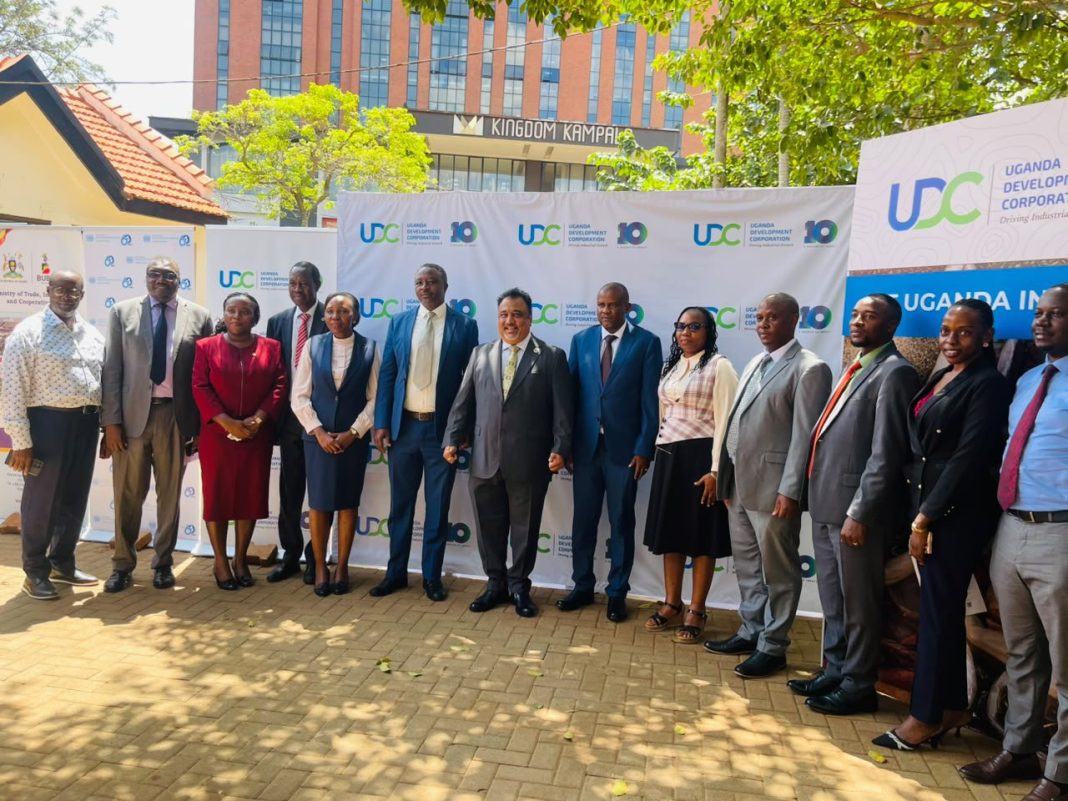
Launching the conference at Uganda Media Centre on Wednesday, Trade Minister Sanjay Tanna said industrialisation remained central to Uganda’s economic transformation agenda, particularly under the government’s Ten-Fold Growth Strategy and National Development Plan IV.
“Uganda’s ambition to achieve a $500 billion economy under the Ten-Fold Growth Strategy places industrialisation at the centre of its economic transformation agenda. The private sector remains the primary engine of growth, while the government is committed to creating an enabling environment that promotes investment, innovation, enterprise development and competitiveness,” Tanna said.

He said the conference would bring together policymakers, manufacturers, investors, researchers and other industry players to translate national economic targets into practical investments, stronger manufacturing capacity and expanded markets.
Tanna said Uganda’s industrial sector had grown considerably since 1986, when the country had only 81 industries, compared with more than 12,000 formal manufacturing industries currently.
The sector contributed an estimated 24.9 per cent of Uganda’s Gross Domestic Product in 2025 and registered annual growth of 6.4 per cent. It employs more than 1.8 million Ugandans, consumes over 70 per cent of the country’s electricity, and accounts for 33 per cent of the total tax revenue collected by the Uganda Revenue Authority.
Manufactured products contributed 24.6 per cent of Uganda’s total merchandise exports in 2025, reflecting the growing contribution of local industries to the country’s trade performance.
Uganda’s economy has grown from $3.9 billion in 1986 to $61.9 billion in 2025, while Gross National Income per capita has risen to $1,389, placing the country above the threshold for lower-middle-income economies.
Tanna further revealed that exports of goods and services had increased by 204 per cent, from $5.93 billion in 2022 to $18.04 billion in 2026, driven by strong performance in gold, coffee, cocoa, sugar, fish and manufactured products.
Exports from free zones reached $1.37 billion, while foreign direct investment stood at $3.2 billion.
“Uganda is now a net exporter of goods that we used to import, such as soap, sugar, milk, salt, cooking oil, soda, beer, cement, steel and paper. In the past 15 years, we have added over 31 new value-added products to our export basket,” Tanna said.
He identified agro-processing, iron and steel, gold, copper, cement, fertilisers, automobiles, pharmaceuticals, electrical and electronic products as priority industries government intends to strengthen.
Among the interventions being implemented are the establishment of industrial parks, improved access to financing, investment in modern manufacturing technologies, reduced electricity tariffs for large industrial consumers and expansion of markets through regional and continental trade agreements.
Uganda currently has eight operational industrial parks out of the 22 planned across the country. According to Tanna, the operational parks have attracted domestic and foreign investments worth US$5.8 billion and generated more than 163,010 jobs.
He said government had reduced electricity tariffs for high-energy industrial consumers to 5.7 US cents per kilowatt-hour, while resources had been earmarked to improve electricity transmission infrastructure and reliability.
On financing, Tanna said the Uganda Development Bank had accumulated capital of approximately Shs1.6 trillion, while government was targeting to increase UDC’s capitalisation to Shs5 trillion within five years to support industrial investments.
He added that Uganda was pursuing opportunities under the East African Community, Common Market for Eastern and Southern Africa and African Continental Free Trade Area to expand markets for locally manufactured products.
The African Continental Free Trade Area provides access to a continental market of approximately 1.4 billion people, with a combined Gross Domestic Product exceeding $3 trillion.
Meanwhile, UDC Executive Director Patrick Birungi said the corporation was using its 10th anniversary to showcase its contribution to industrial development and outline its investment priorities for the next decade.
Birungi revealed that UDC had invested in 28 companies over the past decade, contributing to more than 5,799 direct jobs and several thousand indirect employment opportunities.
He said enterprises supported by the corporation purchase more than 35,000 tonnes of agricultural produce annually from farmers, pay approximately Shs138.45 billion to farmers and local suppliers, generate $14.22 million in export earnings, and contribute more than Shs30 billion in taxes to the government each year.
“These figures tell a bigger story about the impact of industrial investment. They demonstrate how UDC-supported enterprises connect farmers to markets, strengthen local supply chains, generate foreign exchange, support livelihoods and contribute to national revenue,” Birungi said.
He said the corporation intended to use the conference to move discussions about industrialisation beyond policy statements towards tangible investments, business partnerships, financing opportunities and market access.
As part of activities leading up to the conference, UDC has organised visits and commissioning ceremonies to showcase projects within its investment portfolio.
On November 5, a groundbreaking ceremony will be held for Pamoja Packaging and Industrial Solutions Limited in Mukono to mark efforts to strengthen local packaging manufacturing.
On November 6, Bukona Fuel Blending Limited in Malaba will be commissioned, while a production line at East African Medical Vitals Limited in Namanve will be commissioned on November 10 to boost domestic production of medical supplies.
UDC also plans a groundbreaking ceremony at Masheda Feeds Limited in Mpigi to support the expansion of local animal feed manufacturing.
Birungi said the projects were part of emerging investment priorities targeting animal and fish feeds, packaging materials, ethanol-based fuel blending, medical gloves and personal protective equipment.
The corporation is also seeking to develop plug-and-play industrial hubs to provide accessible production infrastructure for small and medium-sized enterprises and strengthen financing through the Industrial and Economic Development Fund.
“As we celebrate UDC@10, we are proud of the progress made, but even more determined about the work ahead. In the next decade, UDC will aspire to be the anchor of Uganda’s industrialisation agenda. We intend to catalyse entire value chains, unlock new industries, mobilise and crowd in private investment, and support Ugandan enterprises to become more competitive and sustainable,” Birungi said.
The conference will also focus on showcasing Uganda’s productive capacity, mobilising investment, expanding market access, promoting sustainable industrial infrastructure, encouraging technology adoption and strengthening collaboration between government and the private sector.
Africa Industrialisation Day, commemorated annually on November 20, was adopted by the Organisation of African Unity Assembly of Heads of State and Government during its 25th Ordinary Session held in Addis Ababa, Ethiopia, on July 26, 1989.
The Uganda Development Corporation was re-established in 2016 under the Uganda Development Corporation Act, with a mandate to facilitate and promote the country’s industrial and economic development.
Tanna called on Ugandan manufacturers, investors and business owners to participate in the conference and take advantage of the investment and market opportunities available in the country.