Stanbic Bank
Stanbic Bank
23.6 C
Kampala
Stanbic Bank
Stanbic Bank
Home Blog Page 1104

US$4.8b needed for drafting of EAC political confederation constitution

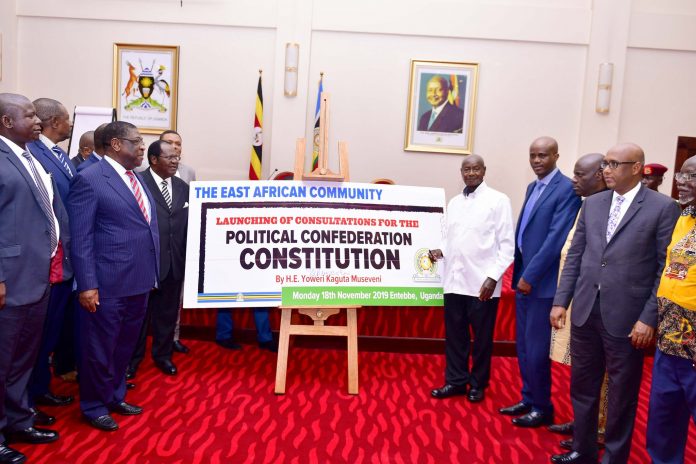
President Museveni launched national consultations for EAC Political Conferderation Constitution

The EAC Secretary General Amb. Liberat Mfumukeko days ago said the drafting of the East African Community (EAC) Political Confederation Constitution requires US$4.8 billion (about Shs17.760 trillion)

“It is an expensive project requiring substantial financial investment. So far, we have been behind the schedules in the process due to insufficient financial allocation for this project. In our estimation, the process of drafting the Constitution will require resources to the tune of US$4.8 billion,” Mfumukeko said on Monday at the launch of the National Stakeholders Consultations in Entebbe.

The SG urged the Summit of EAC Heads of State to consider a special funding arrangement to enable the completion of the project in good time, adding that the National Stakeholders Consultations would ensure participation of EAC citizens in the integration process and particularly the Political Federation pillar.

“The drafting of the EAC Political Confederation is being undertaken by a team of Constitutional Experts nominated by the Partner States. The 18-member team is chaired by Justice Dr. Benjamin Odoki, the Chief Justice Emeritus of the Uganda. He said the Confederation Constitution development process was projected to be completed in 2022 with its adoption by the Summit.

President Yoweri Kaguta Museveni who was chosen by his EAC peers to spearhead the drafting of the constitution launched the National Stakeholders Consultations in Entebbe.

He underscored the importance of the EAC attaining a Political Federation, adding that the Political Confederation was a transitional model to the Political Federation as enshrined in the Treaty for the Establishment of the EAC.

Museveni said that the Political Federation would re-energise efforts to promote the prosperity of all East Africans which can be attained through trade and economic growth.

He said that the Political Federation would also guarantee the strategic security of smaller member countries of the Community against external threats.He further cited fraternity of all East Africans noting that the peoples of the East African region share similar cultures, languages and origins with Kiswahili as a lingua franca.

Justice (retired) Odoki, disclosed that the team had already completed a comprehensive study of various confederations around the world for purposes of appreciating the concept and practice of confederations.

Odoki further said that the team had also finalised a study and analysing of the EAC establishment.

The Political Federation is the fourth and ultimate pillar in the EAC integration process after the Customs Union, the Common Market and the East African Monetary Union. In May 2017, the Summit of EAC Heads of State agreed on the Political Confederation as a transitional model to the Political Federation.

In February 2018, the Summit through the Council of Ministers constituted a team of 18 Constitutional Experts and Legislative Draftspersons to draft a Constitution for the Political Confederation. The team was tasked with developing a Draft Constitution for consideration by the Summit. At its 20th Ordinary Meeting held in Arusha, Tanzania in February 2019, the Summit requested the team to provide it with a preliminary report by November 2019.


Stories Continues after ad

Africa: Urgent action needed to mobilise domestic resources as tax revenues plateau

Africa needs to boost tax collection efforts in order to fund development

The average tax-to-GDP ratio for the 26 countries participating in the new edition of Revenue Statistics in Africa was unchanged at 17.2 percent for the third consecutive year in 2017. This was lower than the averages for Latin America and the Caribbean (LAC) at 22.8 percent and for the OECD at 34.2 percent, underlining the need for urgent action to enhance domestic revenue mobilisation in Africa.

The 26 countries covered in Revenue Statistics in Africa 2019, released Tuesday in Tunis at the African Union’s 13th Session of the Committee of Directors-General of National Statistics Offices, represent nearly three-quarters of Africa’s GDP. The report shows that tax-to-GDP ratios varied widely across these countries in 2017, ranging from 5.7 percent in Nigeria to 31.5 percent in the Seychelles. This fourth edition has grown from 21 to 26 countries and includes Equatorial Guinea, Madagascar, Mauritania, Nigeria and the Seychelles for the first time.

While tax revenues plateaued as a percentage of GDP for the Africa (26) in 2017, non-tax revenues (primarily rents and royalties from natural resources, as well as grants) continued to decline and were lower than tax revenues in all but three of the 26 countries: Botswana, the Republic of the Congo and Equatorial Guinea. Between 2010 and 2017, an increase in tax revenues equivalent to 1.9 percent of GDP on average was offset by a decline in non-tax revenues from 7.5 percent of GDP to 5.7 percent of GDP.

African economies continue to rely heavily on taxes on goods and services, which accounted for 53.7percent of total tax revenues across the 26 countries. Within this category, value-added taxes (VAT) accounted for 29.4 percent of total tax revenues. Meanwhile, corporate income taxes (CIT) generated 18.6 percent of total tax revenues – a higher proportion than in LAC and in the OECD – and were equivalent to 2.8 percent of GDP in 2017. This is the same level as in 2016, halting the decline in CIT as a percentage of GDP since 2013.

Overall, the tax structure across participating countries has evolved over the past decade, with VAT and personal income tax (PIT) accounting for a higher proportion of revenue generation in 2017 relative to 2008, on average. However, PIT (15.4 percent of total tax revenues) and social security contributions (8.1 percent of total tax revenues) remain low in Africa. Reforms to broaden the personal tax base, remove harmful and regressive subsidies, and expand social insurance coverage can assist in domestic resource mobilisation efforts while contributing to inclusive growth.

Enhancing the efficiency of VAT systems can also provide higher and more sustainable revenues, and improve distributional or environmental outcomes. Environmental taxes are found to represent a small but increasing share of tax revenues in Africa and can have an important role in raising revenues and encouraging the transition to a low-carbon economy. Property taxes are shown to be much lower in Africa than in LAC and in the OECD but have the potential to play a key role in funding better local services. Equally, improvements in governance and spending may also lead to higher revenues by improving tax morale and making citizens more willing to pay taxes.

A special feature assesses the potential impact of the African Continental Free Trade Area (AfCFTA) on the level and structure of tax revenues, drawing on the detailed data on these revenues in this report. While AfCFTA is likely to strengthen Africa’s economic growth and increase tax revenues in the medium-to-long term, the elimination of taxes on trade within the region will likely reduce revenues in the short term. Trade taxes accounted for 11.8 percent of total taxation on average in 2017 across the 26 countries in this report.  Low-income and least developed countries in the region tend to rely more on trade taxes and are more vulnerable to the short-term impact of reduced trade taxes, underlining the importance of the flexibility mechanisms envisaged by the AfCFTA.

Revenue Statistics in Africa is a joint initiative between the African Tax Administration Forum (ATAF), the African Union Commission (AUC) and the Organisation for Economic Co-operation and Development (OECD) and its Development Centre, with the technical support of the African Development Bank (AfDB), the World Customs Organisation (WCO) and the Cercle de Réflexion et d’Échange des Dirigeants des Administrations fiscales (CREDAF) and the financial support of the European Union.

The topic covers countries of; Botswana, Burkina Faso, Cabo Verde, Cameroon, Republic of the Congo, Democratic Republic of the Congo, Côte d’Ivoire, Egypt, Equatorial Guinea, Eswatini, Ghana, Kenya, Madagascar, Mali, Mauritania, Mauritius, Morocco, Niger, Nigeria, Rwanda, Senegal, Seychelles, South Africa, Togo, Tunisia and Uganda.

Stories Continues after ad

Six technology trends will spawn countless new ventures

Martin Zwilling

By Martin Zwilling

A tidal wave of valuable data is surging from the Internet and connected devices today, and the volume is growing exponentially each year. It’s enough to drown any business which tries to fight it or ignore it, and it’s an opportunity to ride higher and faster than even the successes of Google and Facebook, for those startups that use it as their driving force.

Per the latest study by networking giant Cisco, the world’s yearly mobile data traffic has grown 17-fold over the past 5 years, reaching 11.5 exabytes per month at the end of 2017, of which more than half was video. According to the classic book “Data Crush,” by Christopher Surdak, data in all formats will soon be the largest source of new opportunities for startups, or death.

According to what I see, as outlined by Surdak, this data surge is being driven by the following six technological and social trends:

Mobility: smartphones, tablets, and the “Internet of things.” Smartphone penetration in the U.S. exceeds 80 percent of all mobile phone owners, and these generate more data from their non-phone functions than voice. In addition, more people now own cell phones than toothbrushes. All devices are becoming self-aware and Internet connected.

Virtual living: the rise and growing dominance of social media. Facebook has created an environment where millions of people can hold billions of conversations with people and companies, transforming how people expect to interact with each other and the world. For startups, this is an engagement opportunity worth billions of dollars.

Digital commerce: infinite options for buying goods and services online. Data-enabled shopping has completely changed our purchasing experience, has undermined some of the greatest brand names, and has created some new brands, like Amazon, that now dominate. There is still infinite room for new startup sales modes and models.

Online entertainment: millions of channels, billions of actors. With the adoption of the Internet, digital entertainment has rocketed across the world, changing how people entertain themselves. YouTube is now the 800-pound gorilla of entertainment. Online gaming has moved from the geeks to the mainstream. The audience is now the actors.

Cloud computing: the death of dedicated infrastructure. More and more company and personal services are being virtualized to the Cloud. Many companies are already seeing their computing costs drop by thirty percent as they move in this direction, providing new startup opportunities with the Everything as a Service (EaaS) trend.

Big data:” learning from the flood. Big data is mining the storage for knowledge. This gives rise to the personalization and customization that we all want. Analytics will soon drive nearly all business decisions for any company that wants to remain relevant to its customers. Startups are in the best position to provide the analytics, and use them first.

As an entrepreneur, what steps can you take to help your business not only survive the data hurricane, but to thrive under these new and challenging conditions? Surdak emphasizes that the goal is to either mitigate some of the pressure caused by data growth or to put that pressure to work for you in growing your startup and remaining competitive:

  • Focus: play to your strengths. Determine your core business strategy and resolve to remain true to it. Make strategic versus opportunistic decisions.
  • Accelerate: speed is life in this new world. Look for and reward quantum changes, like cutting cycle time in half, in your processes, products, and services.
  • Data enable: use metrics and measurements. Extend data metrics into non-traditional channels, such as email, internal social media, and customer collaboration platforms.
  • Quantification: big data, bigger results, and controls. Startups should seek to continually improve performance through statistical analysis and predictive monitoring.
  • Gamify: engagement to get what you pay for. Use internal collaboration platforms, then extend to online customers through your website, blogs, and social media.
  • Crowdsource: putting your audience to work beyond customers. Look beyond today’s requirements for entire new market opportunities.

You need to start now to understand the trends and specifics of the information tidal wave that is building up in front of us. Use the steps outlined here to stay ahead of it, and use its power to propel your startup into the future, ahead of your competition. The possibilities are endless, but the downside will be painful.

The Writer is Veteran startup mentor, executive, blogger, author, tech professional, professor, and investor. Published on Forbes, Entrepreneur, Inc, Huffington Post, etc.

Stories Continues after ad

Mourinho appointed new Tottenham Hotspur head coach

Jose Mourinho

Jose Mourinho has been appointed as Tottenham Hotspur’s head coach, succeeding Mauricio Pochettino after his departure on Tuesday.

“I am excited to be joining a Club with such a great heritage and such passionate supporters,” Mourinho told Spurs’ official website. “The quality in both the squad and the academy excites me. Working with these players is what has attracted me.”

Chairman Daniel Levy added: “In Jose we have one of the most successful managers in football. He has a wealth of experience, can inspire teams and is a great tactician. He has won honours at every club he has coached. We believe he will bring energy and belief to the dressing room.”

Spurs are the Portuguese’s third Premier League club, having won three top-flight titles in two spells with Chelsea before lifting the EFL Cup and UEFA Europa League trophies in two-and-a-half years at Manchester United.

He started his managerial career at Porto, winning the UEFA Europa League and Champions League in successive seasons before taking over at Chelsea in 2004. After back-to-back Premier League titles in three years at Stamford Bridge he moved to Inter Milan and won the Champions League in a treble-winning 2009/10 season at San Siro.

Mourinho subsequently managed Real Madrid to the LaLiga title, before returning to Chelsea to lift the 2014/15 Premier League Trophy.

The 56-year-old then took charge of Man Utd between May 2016 and December 2018.

Mourinho will make his managerial debut with Spurs when they travel to West Ham United on Saturday.

They are looking to improve upon their current position of 14th and ending a five-match winless run.

Stories Continues after ad

Standard Chartered unveils Coffee Banking

Guests at the launch of coffee banking

Standard Chartered Bank Uganda has today unveiled Coffee Banking, a concept which enables clients to enjoy premium coffee while banking. This is the first of its kind in the financial services sector in Uganda.

The Bank has partnered with Endiro Coffee to launch the new banking innovation in Uganda. The Endiro brand has positioned itself as one of the premier coffee brands in Uganda, leading the way in serving high quality, single village-lotted and ethically sourced Ugandan coffees to the public.

The coffee shop has been set up right within the Bank’s lavish, state-of-the-art and spacious Speke Road Banking Hall located at its Headquarters.

During the unveiling of the concept dubbed Coffee Banking Dr. Robin Kibuka, the Board Chairman, Standard Chartered Bank had this to say:

“I am delighted that we have added a feature to our brick and mortar facility that will further improve our clients’ experience. The Endiro coffee outlet within our Speke Road Banking Hall has been set up to offer additional convenience to our clients. We have over the years redefined and demystified banking by first and foremost making it more experiential and customer centric with warm banking halls, first class ambiences and user-friendly facilities that are designed to improve clients’ experiences.”

He said customers are served while seated due to Q-matic machines installed to improve efficiency and ensure they do their banking while comfortable. We are committed to ensuring that a visit to any branch is an unrivalled experience akin to the hospitality business. I am delighted to add that today we are providing all our visiting customers free Endiro products. Customers will enjoy free coffee and mochas among others and we hope they will continue to enjoy the experience as they undertake their banking operations.”

The Managing Director of Endiro Coffee Ms. Gloria Katusiime while unveiling the capabilities and offer of the coffee bar that has been placed within the Bank had this to say:

We are very grateful to Standard Chartered Bank for this great opportunity and partnership. I want to assure you that Endiro Coffee is the right partner and has so much in common with Standard Chartered Bank. We share similar values such as exceptional client service, responsiveness, innovation and a wide range of products that meet various clients’ tastes and preferences.”

“We are proud to be associated with the Bank and our commitment is to provide the highest quality products and customer service that meet or exceed the Bank’s client needs. At this outlet we shall be offering coffees and snacks during the normal Bank opening hours. We welcome all customers to try out our products and give us feedback to ensure we consistently meet their expectations.”

The Coffee Banking innovation that Standard Chartered Bank has unveiled in partnership with Endiro is a new way of banking that provides a holistic and transformative experience as the Bank continues to differentiate itself and offer luxuries and convenience to all its customers across all segments.

Stories Continues after ad

Museveni appoints new UNOC Board

Emmanuel Katongole

President Yoweri Museveni has reappointed six of the current members on the board of Uganda National Oil Company (UNOC) even though he has included a new face.

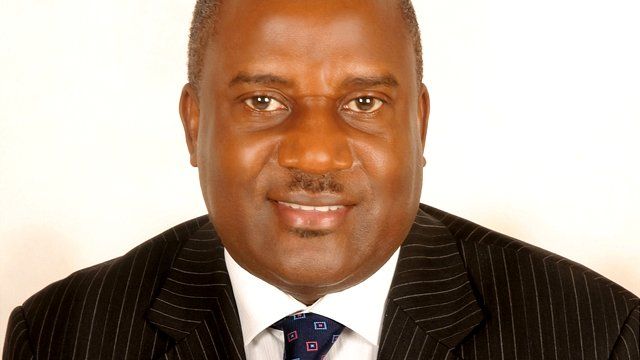
Those confirmed on November 12, 2019 for a second five-year term is; Emmanuel Katongole (Chairman). Other board members are; Eng. Irene Pauline Batebe, Francis N. Twinamatsiko, Godfrey Andama, Stella Marie Biwaga, Francis Nagimesi and Zulaika Mirembe Kasajja who replaces Grace Tubwita.

Katongole, an economist and businessman is most famous for the role he played in setting up Quality Chemical Industries Limited (now known as Cipla Quality Chemical Industries Limited (CQCIL)), a leading pharmaceutical company making and supplying triple-combination anti-retroviral drugs.

Others

Francis Nagimesi is a former chief executive officer of the defunct Coffee Marketing Board of Uganda; Francis Twinamatsiko is a principal economist in the Ministry of Finance and Economic Development (U); Irene Pauline Batebe is a chemical/refinery engineer in the Petroleum Directorate of Uganda; Godfrey Andama, is a senior geoscientist; and Stella-Marie Biwaga, is a lawyer working with FIDA, Uganda while Zulaika Mirembe Kasajja is a city lawyer working with a reputable law firm.

The first board was formed in July 2014 though it was inaugurated by Museveni in October 2015. The members will now have to wait to be approved by parliament, Museveni having forwarded their names and curriculum vitae for vetting.

Stories Continues after ad

African Energy Chamber set to release the much awaited 2020 Africa Energy Outlook

Development of energy is key priority for Africa's development

The African Energy Chamber will be issuing this month its first Energy Outlook for 2020, in times when the global energy industry is going through an important period of transition.

The outlook is the result of a strong regional and international cooperation between actors of the government, public and private sector across sub-Saharan Africa. It gathers the latest data available on sub-Saharan Africa’s hydrocarbons markets, and benefits from insights of key local, regional and international companies, experts and economists.

The Africa Energy Outlook 2020 will notably shed light on improving African business and legal environments, give strategic insights into sub-Saharan Africa’s production outlook, highlight the growing role of gas in Africa’s ongoing energy transition, map out the continent’s energy infrastructure outlook, and share key investment outlook for crude oil and natural gas across the continent.

“At such a pivotal moment of transition, leadership and initiative are required to position African businesses and their communities at the heart of the extraordinary development which the energy industry promises to deliver over the next decade,” said Mickael Vogel, Director of Strategy, African Energy Chamber. “This outlook is part of that effort. We are providing a comprehensive look at the oil and gas sector across sub-Saharan Africa, with a focus on key strategic and operational developments in the industry for 2020 as well as identifying opportunities for investment,” he added.

“This Outlook is a strategic yearly initiative of the African Energy Chamber to provide all interested stakeholders and investors with a tool to navigate sub-Saharan Africa’s rapidly developing energy markets,” said Verner Ayukegba, Senior Vice President at the Chamber. “Being the fastest-growing energy network on the continent, it is our responsibility to mobilize our partners around such research and analysis which benefits everyone involved in shaping the future of Africa.”

The Africa Energy Outlook 2020 will be released later this month and be available online for free to all AEC partners and stakeholders.

Stories Continues after ad

Museveni rejects renewal of Bemanya contract, says he is in conflict with ‘granddaughter’ Anite

Rejected Mr. Bemanya.

President Yoweri Museveni has directed Justice and Constitutional Affairs Minister Maj. Gen. Kahinda Otafiire to nominate someone else for the post of Administrator of Uganda Telecom Limited but not Twebaze Bemanya.

In a letter dated November 9, 2019, says he tired of the endless fights and tensions generated by both Mr. Bemanya and Anite. However, Museveni says is a very active Mwijukuru (granddaughter)

“I have received your letter of November 6, 2019, about the Administrator of Uganda Telecom Limited (UTL), whose time is expiring but you want to renew the contract. Mr. Bemaya is always in conflict with Minister Anite. Hon. Anite is one of our very active Baijukuru” reads the pressident’s reply to Gen. Otafiire.

President Museveni continued “In the interests of cohesion, get another administrator. It is easier that way. Going on with endless tension is not good management”. He wrote in a letter that was also copied to his Vice President, Prime Minister, Attorney General, Minister of Finance, Planning and Economic Development and Minister of State for Privatization and Investment, Ministry of Finance, Planning and Economic Development.

Stories Continues after ad

Global leaders pledge US$2.6 billion to eradicate Polio

POLIO

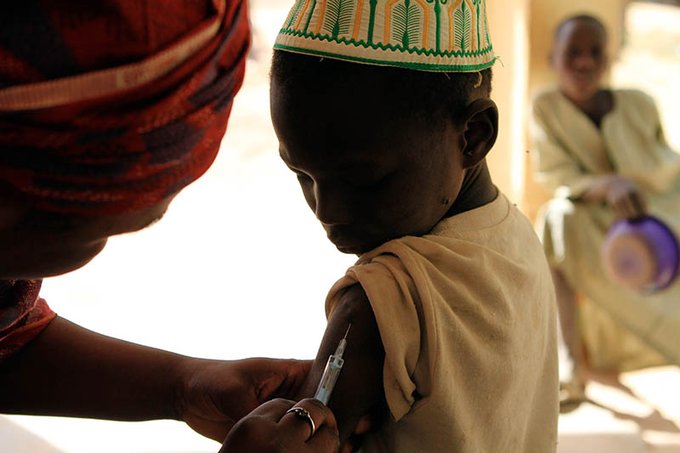
Global leaders have affirmed their commitment to eradicate polio and pledge US$2.6 billion as part of the first phase of the funding needed to implement the Global Polio Eradication Initiative’s Polio Endgame Strategy 2019-2023.

This pledging event comes on the heels of a major announcement last month that the world has eradicated two of the three wild polio virus strains, leaving only wild polio virus type 1 (WPV1) still in circulation.

Additionally, Nigeria the last country in Africa to have cases of wild polio has not seen wild polio since 2016 and the entire WHO African region could be certified wild polio-free in 2020. Thanks to the dedicated efforts of health workers, governments, donors and partners, wild polio only circulates in two countries: Pakistan and Afghanistan.

“From supporting one of the world’s largest health work forces, to reaching every last child with vaccines, the Global Polio Eradication Initiative is not only moving us closer to a polio-free world, it’s also building essential health infrastructure to address a range of other health needs,” said Dr Tedros Adhanom Ghebreyesus, Director-General of the World Health Organization and Chair of the Polio Oversight Board.

“We are grateful for the generous pledges made today and thank governments, donors and partners for standing with us. In particular, I would like to thank His Highness Sheikh Mohamed bin Zayed Al Nahyan, Crown Prince of Abu Dhabi for hosting the GPEI pledging moment and for his long-term support for polio eradication.” He said

Barriers to reaching every child including inconsistent campaign quality, insecurity, conflict, massive mobile populations, and, in some instances, parental refusal to the vaccine have led to ongoing transmission of the wild poliovirus in Pakistan and Afghanistan.

Further, low immunity to the virus in parts of Africa and Asia where not all children are vaccinated has sparked outbreaks of a rare form of the virus. To surmount these obstacles and protect 450 million children from polio every year, governments and donors announced significant new financial commitments toward the $3.27 billion needed to support the Polio Endgame Strategy.

Pledges are from a diverse array of donors, including: US$160 million from the host of the pledging moment His Highness Sheikh Mohamed bin Zayed Al Nahyan, Crown Prince of Abu Dhabi; countries, including US$215.92 million from USA, US$160 million from Pakistan, US$105.05 million from Germany, US$84.17 million from Nigeria, US$10.83 million from Norway.

US$10.29 million from Australia, US$7.4 million from Japan, US$2.22 million from Luxembourg, US$1.34 million from New Zealand, US$116,000 from Spain, and US$10,000 from Liechtenstein; GPEI partners, including US$1.08 billion from the Bill and Melinda Gates Foundation and US$150 million from Rotary International; philanthropic organizations, including US$50 million from Bloomberg Philanthropies, US$25 million from Dalio Philanthropies, US$15 million from the Tahir Foundation, US$6.4 million from the United Nations Foundation, US$2 million from Alwaleed Philanthropies, US$1 million from the Charina Endowment Fund, and US$1 million from Ningxia Yanbao Charity Foundation; and the private sector, including US$1 million from Ahmed Al Abdulla Group, US$1 million from Al Ansari Exchange, and US$340,000 from Kasta Technologies. Earlier this month, the United Kingdom announced it would contribute up to US$514.8 million to the GPEI.

“We are proud to host the GPEI pledging moment in Abu Dhabi and thank all the attendees for their continued commitment to the eradication of polio,” said Her Excellency Reem Al Hashimy, UAE Cabinet Member and Minister of State for International Cooperation.

“Since launching in 2014, the Emirates Polio Campaign has delivered more than 430 million polio vaccines in some of the most remote areas of Pakistan.  We remain firm in our mission to reach every last child and believe together we can consign polio to the pages of history.”

In addition to overcoming barriers to reach every child, this funding will ensure the resources and infrastructure built by the GPEI can support other health needs today and in the future.

Polio workers deliver Vitamin A supplements, provide other vaccines like those for measles and yellow fever, counsel new mothers on breastfeeding, and strengthen disease surveillance systems to anticipate and respond to outbreaks.

As part of its commitment to advance gender equality and women’s empowerment, the GPEI is also working to ensure equal participation of women at all levels of the programme.

The future of polio eradication hinges on support and engagement at all levels of the programme – from individuals to communities to local and national governments to donors.

If the strategies needed to reach and vaccinate children are fully implemented and funded, we are confident that we can deliver a world where no child lives in fear of polio.

Stories Continues after ad

Boeing’s 737 loses title of world’s most popular jet to Airbus’ A320

The aircraft compared

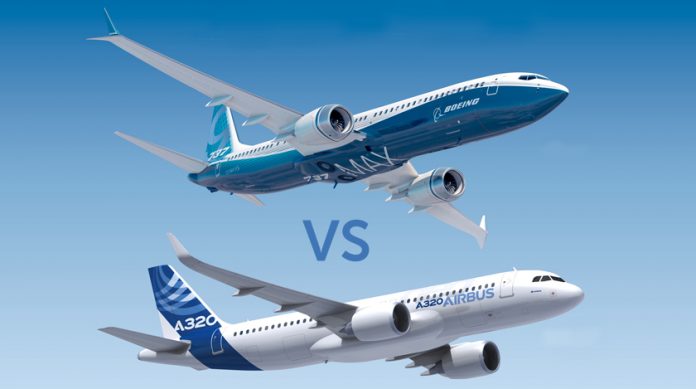
The European plane maker Airbus has just got ahead of its American rival, with its A320-family aircraft seizing the title of the world’s best-selling narrow-body airliner from Boeing’s scandal-plagued 737 and 737MAX models.

In the decades-long race between Airbus and Boeing, the Seattle-based company seems to be slipping from the top spot as its star airplane, the single-aisle 737, isn’t the most popular jet anymore. It has been the best-selling commercial aircraft of all time during five decades of its history, but the domination seems to be fading away.

As figures from both aviation giants reveal, the A320 – and its variants – had attracted a total of 15,193 orders, overtaking the similar-class 737, which has 15,136 on the books as of October.

Boeing, however, is still ahead of Airbus in terms of actual deliveries, but the gap is closing rapidly. In October alone, the Toulouse-based company shipped 77 aircraft to its customers, 59 of which were A320s, while their American rivals had only delivered 20 jets.

Stories Continues after ad