Stanbic Bank
Stanbic Bank
18.1 C
Kampala
Stanbic Bank
Stanbic Bank
Home Blog Page 1190

EADB holds training for public sector officials and lawyers in extractive industry

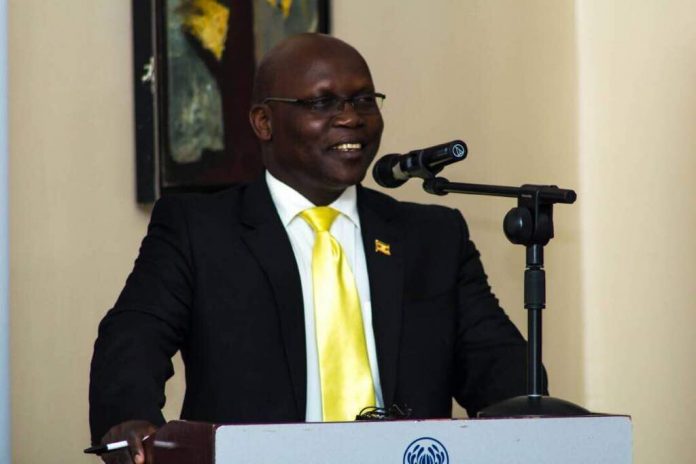
John Omenge, PS Ministry of Mining (right) flanked by Julius Muia, PS Treasury and Vivienne Yeda of East Africa Development Bank jointly address media during the opening of the East Africa Development Bank International negotiation skills workshop at Fair view hotel, Nairobi.


The East African Development Bank (EADB) this month hosted two events to develop the East African extractives industry in Nairobi, Kenya.

Phase one of the workshop started from August 2-3, 2019 where EADB hosted permanent secretaries and other senior government officials from across East Africa to train them in negotiating contracts better as pertains to natural resource management in the extractives industries. Lawyers from DLA Piper implemented the workshop.

From August 5-9, 2019, the EADB also hosted public sector lawyers and legal professionals in the extractive industry to boost them with greater negotiation skills.

The workshops were the seventh and eighth of their kind, hosted by the EADB, in partnership with law firm DLA Piper, as part of a series to develop natural resource management in East Africa to ensure that the region maximizes its benefits from the exploration, exploitation and extraction of its own resources.

Speaking at the opening of the event, EADB’s Director General Ms. Vivienne Yeda noted that ‘it is increasingly critical that host countries are able to derive tangible benefits from the exploitation of their natural resources.’

‘Natural resources are a public good that if well managed have the potential to drive economic development, and if well invested can actually reduce income inequality and spur meaningful job creation. If national governments benefit from royalties and taxes stemming from the mining sector, and if these dividends are well invested into human capital development and economic diversification, then the windfalls from natural resource discoveries can be used to catalyse socioeconomic development and to develop a strong economic base for East Africa to grow.’

Yeda further emphasized that ‘in addition to developing local value addition, export revenue and skilled job creation, both foreign and domestic mining companies should be compelled to operate according to strict environmental and social standards’, whilst ‘national governments must be compelled to invest to ensure that natural resource wealth is distributed evenly and that the benefits accrue to current and future generations, even after East Africa’s natural resources have been depleted’.

Principal Secretary to the National Treasury (Kenya), Dr. Julius Monzi Muia, was also present at the launch and expressed his delight at, and thanked EADB for, the initiative. In explaining the infamous resource curse, Dr. Muia explained that ‘well-structured government policy relating to natural resource exploration, exploitation and exportation can prevent an economy from experiencing the infamous resource curse and can instead leave an economy better off, with more resources to invest in healthcare, education, infrastructure and a diversified economic base, that will in turn promote job creation and cement the gains to sustainable economic growth.’

Dr. Muia further expressed that ‘it is critical that we, as civil servants, all work together to maximize the benefits accruing to our local economies and populations from natural resource rents’, noting that ‘mining agreements typically constitute substantial and long-term investments and are complex to structure, requiring specific attention to environmental and social issues, land issues, the protection of artisanal miners in the establishment of multinationals, taxation, royalties and value addition’ and that the finiteness of natural resources requires East African legal professionals and policymakers to ‘ensure that we fully utilize the potential benefits accruing from a onetime endowment from the onset.’

The training series is organised by EADB and facilitated by global law firm, DLA Piper. It has been designed for public sector lawyers and legal professionals involved in negotiating transactions and drafting agreements on behalf of Governments in extractive sectors and other large-scale projects. The latest trainings were the seventh and eighth in the series following from recent trainings in Dar es Salaam, Tanzania and in Kigali, Rwanda.


Stories Continues after ad

How closure of Crane Bank Limited became curse for BoU, Dfcu and city lawyers

ON THE FIRING LINE: Governor Mutebile and former deputy Louis Kasekende.

Bank of Uganda (BoU) closed seven commercial banks during the period 1993 to 2016, mainly on account of undercapitalization. But it was the closure of Crane Bank Limited (CBL) and its subsequent sale in January 2017 that would trigger an audit of BoU on closure of the same defunct banks whose owners now want financial compensation.

However, the controversial sale of CBL at only Shs200 billion to Dfcu bank was the highlight of the processes where BoU closed and sold off assets of the seven banks. CBL sale led to job losses, resignations, transfers and, reputation damage, to mention but just a few, in regards to BoU, Dfcu bank and law firms such as MMKAS Advocates,   AF Mpanga, Advocates and Sebalu & Lule Advocates.

The closure of CBL particularly affected certain individuals in BoU, Dfcu bank and the law firms in many ways that have changed public perception about them:

Emmanuel Tumusiime-Mutebile’s image tarnished, loses trust

Emmanuel Tumusiime-Mutebile was first appointed BoU Governor on January 1, 2001. In his tenures he has had issues with Members of Parliament where at one point, the MPs thought he had undermined their legislative role of oversight when he said he only fears God and President Museveni.

But the closure of CBL on October 20, 2016 will always remain the day to remember for Tumusiime-Mutebile as long as he lives. First he assured the public and the media that no employee of former CBL would lose their jobs as he transferred it to Dfcu bank. That assurance never came to pass as a Dfcu bank started laying off the employees a few months after the taking over its former rival. Former employees would later drag BoU and Dfcu bank to court for compensation. And that meant portrayed Tumusiime-Mutebile as a person could not be trusted.

The sale of CBL to Dfcu bank exposed Tumusiime-Mutebile as a bad manager, especially when he and his team claimed to have spent Shs478 billions of taxpayers’ money on CBL in receivership liquidity support yet he could transfer its assets at Only Shs200 billion, sadly BoU failed to account for all the money injected in CBL while in receivership yet at the same time wanted to recover it from CBL shareholders, a calculation MPs on COSASE saw as fraud.

Dr. Louis Kasekende unlikely to be promoted

An established economist and BoU Deputy Governor, Kasekende was expected to replace his boss Tumusiime-Mutebile who has a few months to retire. Now analysts close to the appointing authority say the anticipated promotion is unlikely to happen. This is because Kasekende and Tumusiime-Mutebile are majorly blamed for the mess in the closure of CBL and other banks. The two are accused of failing to supervise their juniors during the processes to close CBL and other banks. The issue became prominent when they could present all required documents to COSASE during the BoU probe over closed banks. It should be remembered that Kasekende worked hard to fail Auditor General’s probe of BoU until he was overruled by Speaker of Parliament Rebecca Kadaga.

Insiders say it is unlikely Kasekende will even remain in that capacity as Deputy Governor following the recent report that revealed that he and Tumusiime-Mutebile were leading cliques of staff in the performance of official duties. A new face is likely to replace outside of BoU Tumusiime-Mutebile.

MS Justine Bagyenda sacked before her official retirement

Justine Bagyenda, now enjoying her retirement, was the BoU executive director, bank supervision who played a big role in the closure of CBL. But her boss Tumusiime-Mutebile would later fire her as scandals in the closure of CBL kept emerging. She would rush to the IGG for help but not much was done for her as Tumusiime-Mutebile and IGG Justice Irene Mulyagonja went public bashing each other over Bagyenda’s sacking. She was replaced by Dr. Tumubweinee Twinemanzi who Tumusiime-Mutebile picked from Uganda Communications Commission, even though a recent report said he didn’t have any banking experience prior to being appointed to that job.

Ben Sekabira fails to replace Bagyenda

At the time of the closure and sale of CBL, Ben Sekabira, the current BoU Director Financial Markets Development Coordination, was director commercial banking and played a huge role in the sale of CBL as he worked hand in hand with his boss Bagyenda. He had hoped to succeed Bagyenda but his hopes were dashed away after CBL sale scandals emerged. He would later reveal during COSASE that CBL only needed Shs150 billion to remain afloat much as BoU injected Shs478 billion in the bank during receivership. Interestingly, Dfcu bank would post Shs114 billion for the first half 2017, up from Shs23 billion in the same period of the year 2016. The sharp increase was largely attributed to acquisition of CBL assets.

On the Dfcu bank side, the controversial acquisition of CBL created instabilities in its operational processes as shareholders disagreed on how that business was acquired. That would lead to the resignation of former MD Juma Kisaame following a series of revelations that showed he didn’t handle CBL transactions in the best way. He was replaced by Mathias Katamba on January 2, 2019.

Further, Agnes Tibayeyita Isharaza who had been serving as Dfcu’s Chief Legal officer and company secretary resigned and joined the National Social Security Fund (NSSF). With Dfcu embroiled in several legal battles following the controversial take-over of Crane Bank in January 2017, Isharaza’s position had become a hot seat for her to endure. Insiders say she blamed for offering poor legal advice in that transaction, that could see the bank lose billions of shillings in court battles with the Ruparelia Group that used to own defunct CBL.

Enter Jimmy Mugerwa’s recall to Tullow Oil plc in London

Jimmy Mugerwa, the former Managing Director of Tullow Oil Uganda who was days ago recalled to Tullow Oil plc headquarters in London, was also the Chairman of Dfcu bank and as such participated in the controversial acquisition of CBL in 2017. However, negative media reports on that transaction threatened the image of Tullow Oil plc, given that Mugerwa’s name in the local press kept emerging as CBL sale scandals continued. The solution was to recall Mugerwa to London and was replaced by Mariam Nampeera Mbowa who now is expected to look after the company’s interests in Uganda’s oil & gas sector, as it negotiates a farm down of its discovered oil blocks with the government of Uganda.

Conflicted law firms of MMAKS Advocates MMKAS Advocates, AF Mpanga, Advocates and Sebalu & Lule Advocates exposed

The three Kampala law firms were exposed and ordered by court not to ever represent any side in cases involving the Ruparelia Group, the three firms having worked for the same company. It should be noted that MMKAS Advocates were also hired by BoU as transaction advisors in the sale of CBL whereas Sebalu & Lule Advocates are accused of misguiding Dfcu bank in the transfer of Meera Investment Limited.’s leasehold properties that CBL was using as banking halls. The exposure of the three firms has tarnished their image and eroded their credibility.

The affected names aside, watchers are wondering whether the controversial closure of CBL has become a curse that is now haunting key players in the transaction now expected to be battled in court between CBL shareholders and BoU which is demanding about Shs397 billion from CBL shareholders who also want BoU to compensate them about Shs28 billion.

Stories Continues after ad

Criminals invade Buwaate, Kungu suburbs as residents are helpless

Patrick Onyanga, police Spokesperson for Kampala Metropolitan said the police will hunt the criminals down.


Hard core criminals have invaded Kampala outskirts of Buwaate and Kungu causing havoc on residents throughout the nights.

According to reports, several families have been attack around the fast growing suburb of Buwaate and these criminals start their activities as early as 4pm targeting residents who are returning from work.

They also target early dwellers especially women who go early for shopping in markets and those who drop children in schools around the two areas.

Eagle Online has established that since last Saturday in the village of Seeta in Buwaate side of Kasangati Town Council boarding Greenhill School, four people have been attacked. On Saturday, a lady reurning from a wedding reception is said to have been attacked at her gate the moment the boda-boda rider dropped her, they descended on her beating before taking her bag while another lady was attacked on Sunday morning on her way the market.

“We are not sleeping, we are living in fear as if there is no presence of government in our area, we fear moving late but again we can’t get out early. Our appeal is that government should come to our rescue otherwise this is going hinder our ways of living and work” Ms Norah Namuddu told Eagle Online. Adding “Even yesterday we didn’t sleep as gunshots were heard several times in Buwaate”

Another resident told this website that a man in his early 30s was hacked on Monday and is nursing wounds. It is said the man was attacked at around 11pm as he walked to his home from work.

When contacted by Eagle Online, Kampala Metropolitan Spokesperson Patrick Onyango said as police they hadn’t registered cases but promised that police would step in the hunt the criminals.


Stories Continues after ad

Munyonyo Commonwealth, Speke Resort scoops world luxury hotel 2019 award


Munyonyo Commonwealth and  Speke Resort have been awarded 2019 winners of World Luxury hotel award.

Both properties belong to city money mogul Sudhir Ruparelia and were recognized in 2018 by Booking.com with a prestigious global award.

The hotel has received the Guest Review Award for 2017.

Booking.com is an online OTS (Booking engine) where people go to book for hotel services around the world. Established in 1996 in Amsterdam, Booking.com has grown from a small Dutch startup to one of the largest travel e-commerce companies in the world. Part of Booking Holdings Inc.

Booking.com now employs more than 15,000 employees in 198 offices, in 70 countries worldwide.
While giving out this award, Booking.com looks at properties with an average review score of 8.0 and 10.

In their remarks booking.com said that Munyonyo Commonwealth Resort has offered great guest experiences and that the Guest Review Awards are a great way to showcase the achievement. Munyonyo Commonwealth Resort: 16 years of unequalled service

Stories Continues after ad

My ex-lover leaked nudes – Ebonies girl Becky Jjuuko apologises

Becky Juuko

The Ebonies girl, Sulayina Nangendo commonly known by her stage name Princess Becky Jjuuko, has apologized to her fans and Ugandans for the nude photos of her that leaked days ago, forcing police to look for her whereabouts.

Last week, Princess Jjuuko become a topic of discussion on various social media platforms with many comparing her nudes with other celebrity nude pictures that have ever seen on internet.

This prompted Kampala metropolitan police spokesperson, Patrick Onyango and Anti-pornography committee led by Annet Kezabu to t hunt for Becky to explain the hectic issue at hand.

Accompanied by the director of Uganda’s best known drama group and East Africa’s leading drama and Television group, Sam Bagenda aka Dr. Bbosa, she interfaced with police and Anti-pornography committee and apologized for the catastrophic incident that puzzled her leaders in the group.

The acknowledged recording herself and taking nude pictures and said they were no leaked by herself but her Ex-lover who did want her to move “ Am sorry for everything but the pictures were not published by me but mu ex- boyfriend who didn’t want me to move on. Am sorry to all my fans, I did it in love but this will never happen again,” she said.

Her nudes’ follows juicy Martha Kay’s well posed pictures and massage video that trended on various social media platforms in June. Till now, the well connected social media comedian and photographer is still handing.

Becky joins a list of Bukedde TV news anchor whose sex tape leaked in 2015, singer Desire Luzinda, herbalist Sylvia Namutebi aka Maama Fiina, Judith Heard and Martha Kay among others.

Stories Continues after ad

Fufa, gov’t and Uefa partner to give street kids football skills

Children-playing


National football governing body, the Federation of Uganda Football Associations ( Fufa) has partnered with the European Football Associations (Uefa) in a bid to equip street kids in Uganda with football skills.

The project named Football in Community is supported by the Government of Uganda through the Ministry of Gender, Labour and Social Affairs.

In a bid to get the necessary personnel to impart the skills into this vulnerable group, FUFA and UEFA have organised a trainers’ training course, which started on Tuesday at Fufa Technical Centre, Njeru.

The course that attracted 22 coaches from across the country is conducted by UEFA coach instructors Hesterine De Reus assisted by Liebeth Migchelsen both from Netherlands.

Ronnie Kalema, who is coordinating the project on behalf of FUFA, said the course is aimed at straining those who will handle the children.

“The UEFA instructors are here to train a group of trainers and these will acquire the skills on how to handle kids from the streets in matters to do with football skills,” Kalema is quoted by fufa website.

Kalema said the Government of Uganda through the ministry of Gender, labour and social affairs, has already availed 100 street kids, who are being well handled in other rehabilitation aspects at a centre in Mutundwe.

The week long course will climax on Saturday with the official launch of the project still in Njeru.


Stories Continues after ad

Amendment of NSSF Act 2019: The issues at hand for national debate

Mr. Richard Byarugaba, NSSF Managing Director who is credited for the smooth running of the fund.


The object of the National Social Security Fund (Amendment) Bill, 2019 is to address the gaps that have been identified in the current law.

The policy behind the Bill is to expand social security coverage by making contributions to the National Social Security Fund (NSSF) mandatory for all workers in the formal sector and also allowing workers in the formal and informal sectors to make voluntary contributions to NSSF. In addition, the Bill seeks to enhance the spectrum of benefits available to workers and to improve management of the National Social Security Fund.

An Act to amend the National Social Security Fund Act, Cap. 222 also seeks to; establish a stakeholder board, empower the Fund to recover from a third party any sum owed to a defaulting contributing employer to cover any contribution, penalty or interest, provide for midterm access to voluntary contributions to provide for a five year tenure for the managing director and deputy managing director.

It also seeks to empower the Minister to prescribe a threshold of expenditure by the Fund prior to approval of the annual budget by statutory instrument, empower the Board to use in-house expertise and fund managers in the investments of scheme funds, including lending to Government, empower the board to introduce new benefit,  in consultation with the Minister,  provide for the payment of an annual levy by the Fund to the Uganda Retirement Benefits Regulatory Authority and for related matters.

Defects in the existing law:  The current law was enacted in 1985 and does not adequately address emerging challenges in the management of social security in Uganda. The proposal to amend the NSSF Act particularly arises from the need to streamline the management of the Fund to expand the scope of social security coverage and benefits. The Act in its current state does not make express provision for the representation of workers, employers and other stakeholders on the board of directors. The appointment of the Managing Director and Deputy Managing Director by the Minister without the role of the board undermines the ability of the board to supervise them.

The Act provides for taxation of contributions and scheme income which does not promote the culture of domestic long term savings that is critical for sustained economic transformation. In addition, whereas the filing of annual returns by employers is important for purposes of monitoring workers’ contributions, failure to do so is not an offence under the Act. Therefore, ensuring compliance in the absence of legal sanctions is difficult. Finally, the fines of ten thousand shillings in the Act can no longer serve the purpose for which they were imposed. There is need therefore to amend the law to address the above defects.

In addition, expenditure by the Fund is subject to approval of the annual budget by the Minister. However, the Act does not make provision for a window for limited expenditure prior to approval of the annual budget by the Minister.

Besides, despite the high cost of private fund managers, section 33 of the Uganda Retirement Benefits Regulatory Authority Act, 2011 requires that all funds of a retirement benefits scheme should be invested through a private fee charging fund manager yet some of the investments like the buying and selling of Government Securities-.can be done more cost effectively in-house by National Social Security Fund.

Taxation

The Act provides for taxation of contributions and scheme income which does not promote the culture of domestic long term savings that is critical for sustained economic transformation. However that hit retirement age of 60 years will not have their benefits taxed.

In addition, whereas the filing of annual returns by employers is important for purposes of monitoring workers’ contributions, failure to do so is not an offence under the Act.

Therefore, ensuring compliance in the absence of legal sanctions is difficult. Finally, the fines of ten thousand shillings in the Act can no longer serve the purpose for which they were imposed. There is need therefore to amend the law to address the above defects.

Stories Continues after ad

Mr. President, cash handouts is good politics but bad economic policy for a nation

Mr. Tumushabe


By Godber W. Tumushabe


Dear President Museveni, I send you greetings and best wishes for good health.

I haven’t written on these pages for a while. Have been quite busy as well making my small contributions on how to make our country better. Because I assume that no matter our policy differences , making Uganda better should be the collective aspiration of each one of us who call Uganda home.

Mr. President, I was smoked out of my current hustles by your letter dated August 6, 2019 which was published on the State House website on August 11, 2019. First of all, I wish to congratulate you for a well written letter. I found it well researched, logically written with a profound depth of historical analysis.

While I often browse through some of your recent writings because of their repetitiveness in both narrative and content, I was curious to read this essay word by word because I had thought that you would help me understanding how your recently concluded taxpayer funded countrywide election campaign would move over 68% of our Nation’s households from substance into a monetary economy. I should pause and congratulate you for getting endorsements from across the country. Since nobody could become wealthy simply by your talk, I take it that you were the only winner from the trip picking up endorsements from all the regions of Uganda.

Otherwise, the contents of your letter and the analysis therein was so provocative that I thought I should spare a some moments and pen some reflections here. I found your letter and most of what you stated there to be exactly the problem that our country is confronted with 57 years after independence and in the 34th year of your presidency. Why do I saw this?

  1. PATRONAGE MAY BE GOOD POLITICS BUT IT DESTROYS A NATION TO ITS CORE

Mr. President, I find it patronising to continue addressing Ugandans as “Bazzukulu” or the new characterisation you adopted in this your new letter as “Buzzukulu”. The people you are characterising as such are adults, educated, some have children and others run successful business and other ventures. This patronising language is a killer for our country. Traditionally, when we visited our grand parents, We expected to eat good food, eat yellow bananas, sweet potatoes cooked in a traditional pot, etc. and so on. Shwenkuru’s as you like characterising yourself were the conscience of the family telling truth to power. Mr. President, reading your letter to these young Ugandans, both the narrative and the content look clearly patronising, diversionary at best and economical with the truth at worst.

The young people that you patronise as your Bazzukulu may enjoy the patronage for the crumbs at the dining table. But the cult-like patronage is slowly but surely crushing their spirits. I have interacted with colleagues from Equatorial Guinea, Cameron, Chad and come to appreciate that the most destructive thing that a leader can do to a nation is to crush the spirits of her people.

  1. REPEATING SAME SOLUTIONS TO OLD PROBLEMS IS NOT GOOD POLICY.

Mr. President, your essay sent me scratching my head on why you are using politicking to confront real economic challenges that require real economic policy solutions. Let me share a short story to explain my point. In 2007, you visited a mango farm of a young man by the names of Philbert Aryatunga or Rubaya, Kashari. Philbert is now about 30 years which means he was born approximately 4 years after you fundamental change speech at the steps of our parent on January 26, 1986. During your visit, you promised to support Philbert’s business by providing water for irrigation. In 2007, Philbert had opened up 5 areas of a mango plantation. Today, he has a plantation of 20 areas. Since then, all that Philbert has received is a barrage of your aides pretending to deliver your pledge and ending up doing nothing. Today, as you burn our hard earned tax money campaigning across the country, Philbert is there stack with mangoes that he can’t find a market for. Your letter provoked me to check with Philbert again and he told me he asked your people for a fruit dryer, a cooler track, etc. Nothing! Nothing has ever been provided. Philbert is now stack with over 30,000 mango seedlings and your OWC people can’t procure them for distribution. Most probably, they are busy reporting to you how they have delivered millions of ghost seedlings.

Mr. President, all that you prescribe in your essay was well laid out in your government policy document called Plan for Modernisation of Agriculture (PMA) which you personally launched in August 2000. You have since then bastardised the entire policy package and reduced it into political campaign slogans – bona bagagaware! Prosperity for all! OWC, blah blah blah. Just so you know Mr. President, there are millions of Philbert’s in this our country. All they need is a President that inspires them to think big, dream big and act big. They don’t need political slogans. They need public policies that support what they do to be able to succeed and to contribute to building our country. And they need a president who doesn’t spend all his time telling them how they are lucky to be alive or that becoming a president is the most difficult thing in life. No sir! They need a president who inspires them, gives them hope and tell them each one of you can be president of Uganda.

Sir, if you check your travel schedule you may help me authenticate this story: that not far back, you commissioned a fruit factory along Isingiro-Kaberebere road. You gave a one Dr. Kalema UGX2 billion for this project. My sources tell me this factory shut down months after you left. Uganda tax payers lost money. Now you are planning to pump more money into the vampires den.

Like Philbert, I am farmer. I grow Matooke and I am now venturing into coffee farming. I fully understand Philbert’s pain. I am not sure you do sir.

  1. IT IS DISHONEST TO BLAME COLONIALISM FOR ALL OUR FAILURES.

From a humanistic perspective, I can understand your attempt to blame everything that is not going right in our country on colonialism. That is standard for most leaders on the African continent. Especially those who were born before independence and are hanging on to power even in their advanced age. European colonialism was here in Uganda until 57 years ago. Amin was here only for 8 years almost 40 years ago. Mr. President, you have been our president for the last 34 years and you think the 68% households that are still in subsistence are because of colonialism and Idi Amin and Obote? Surely!

So we can’t increase coffee production or tea production or whatever because of colonialism? Or because of Idi Amin? Surely? Mr. President, check your statistics again. At independence in 1962, we were producing 2 million (60- kgs) bags of coffee annually. By 1970, coffee production had increased to 3 million bags (that means within just 8 years, Obote Government had increased coffee production by 1 million bags). As you admit in your essay, even with Amin’s failed leadership, coffee “limped” on at 2 million bags per year. In 1986, we were producing 2.392 million bags. After 34 years of recovery under your leadership Mr. President, we have only increased coffee production to just 4.305 million. In 8 years, Obote’s government increased coffee production by over 10 million bags. In 34 years (with all the technological changes and pumping in billions of taxpayer money), your Government has increased coffee production by a mere 1.913 million bags? And you are suggesting we are supposed to be celebrating this as an accomplishment? Seriously, Mr. President. You really think we should be celebrating that we produce very little of everything and we count that as progress and transformation? Mr. President, why do African rulers like celebrating marginal achievements? I have failed to figure out why. Especially knowing you as someone who used to be a BIG thinker and at some point during your presidency you inspired many of us.

  1. YOU ARE DESTROYING OUR COUNTRY BY PERPETUATING A CULTURE OF HANDOUTS AND PATRONAGE

Mr. President, I find your politics of creating this and that fund quite frightening. So you have OWC, women, youth, micro-finance and innovation funds. So now you want to add: value addition; mayoga and leaders Sacco fund. Oh my foot! So what exactly are the women and youth and everybody else doing with those funds if they are not doing value addition? What does the innovation fund do if it’s not supporting innovation? I am tempted to believe that either you are working with people who are deeply dishonest to the core or you personally are involved in a scheme of deliberate deception which constitutes good African politics but not good economic policy. While you are claiming to awaken the 68% of our citizens, I see what you are doing with all these Ponzi schemes as to give our people sleeping pills or put them on oxygen. One of the things that you may want to find out Mr. President is that most Ugandans: Me, Philbert and many others I know who are doing productive economic activities have never accessed these funds you talk about. All that Ugandans need is investing in our nations economic infrastructure – transport, irrigation, storage, processing etc to get Ugandan’s to thrive. Like your colleague Gen (Rtd) Muntu likes to say, Ugandans are smart people. They don’t need handouts. They need a hands up.

  1. BUILDING INFRASTRUCTURE IS GOOD POLICY BUT ON ITS OWN, IT’S NO PANACEA TO TRANSFORMATION

Allow me to acknowledge and appreciate your steadfastness and consistency on sustaining the stance on public investment in infrastructure, especially improving our Nation’s road network. The obscene stealing of our hard earned tax money aside, I applaud you for keeping the government focussed investment in infrastructure. It is the right thing to do because it opens up economic opportunities for many people and many areas. Of course, smart and efficient governments would pursue this infrastructure development agenda with more discipline and commitment to economic transformation. I can fully understand that such discipline is simply unrealistic when a president of a country (whether you, me or someone else) is operating in a regime survival mode – the situation in which you are.

But kindly don’t praise-sing these things. You don’t have to be running around the country sir commissioning every small thing here and there. I could be wrong but I got this impression that when you get a president commission 50 kms of a road, or a factory that hardly employs 1,000 people or a district building that looks like an 18th century penthouse, you begin to lower the imagination of our young people. You know for many of us, you represented our idea of what BIG looked like. Big vision, big imagination, big thinking, dreaming big! It’s frightening that electoral politics is consuming you and has modified you from the Big thinker to thinking everything small. It’s so frightening for a generation that has to compete against global giants in all forms – economic, political, technological, security, etc.

Mr. President, one last point on this infrastructure thing: Sometime back (it must have been 2008 or thereabout), I visited Malabo, the capital city of Equatorial Guinea. Your good friend Obiang N’Gwema now in power for close to 40 years has really done a wonderful job building the most impressive road network in Malabo. But just so you, more than 60% of the estimated 1.2 million Equatorial Guineans live below the poverty line. Poverty can be very defiant when you approach it with a deceptive heart. Obiang’s roads have refused to change the fortunes of the ordinary people of EG. I am sharing this so that in case your roads behave like those of Obiang N’Gwema, you don’t get disappointed.

  1. 68% IS NOT SOME ABSTRACT STATISTIC THAT YOU JUST WISH AWAY

Mr. President, I am not sure if you know what this 68% percent you are talking about. This is not some statistics produced by UBOS that you will run from West Nile to Karamoja to Kigezi to Toro and then to Buganda talking to your political friends and then the problem goes away. No sir. These are men and women, and young people who can’t find a job and children who live on the margins of our broken education system. These lives are trapped between broken politics, an oppressive economic system and a non-existent social support system. Every penny you spend in these campaigns disguised as wealth creation tours, you are cheating these people. Every Shs.300,000= you paid for the vote from your supporters, a young person went without a job. For all the fuel you burnt as you traversed the country, you were burning so many coffee seedlings and so many factories and so many jobs.

I know you are a busy man Mr. President. I better shut up and stop the \rambling. Admittedly, your essay is overly provocative for what I see as your analysis of paralysis especially on colonialism and for the wrong prescriptions you are providing to transform 68% subsistence households – something that has been staring in your eyes for for now 34 years. I want to suggest to you two BIG ideas that I believe you can think about to get our country on a better development trajectory:

  1. LET’S BUILD ECONOMIC GEOGRAPHIES AS THE PILLARS FOR THE ECONOMIC TRANSFORMATION AND SHARED PROSPERITY OF OUR COUNTRY AND OUR PEOPLE

I see that your political campaign this time round took the form of regions and this is a good thing. I take that to imply that you, like me understand that these district-size villages into which you have mutilated our country may make political sense but do not make economic sense. I want to plead with you that you use the political capital that you have as our president to reorganise our country into economic geographies by investing in building our regional economies. When I was in primary school Mr. President, we learnt about the Industrial economy in Busoga, the livestock economy of Teso, the cotton economy of Lango, the tobacco economy of West Nile, and of course the coffee economy of Buganda, etc. Mr. President, we can invest in these regional economies and make them pillars of local economic transformation and national economic development. To do this, you will need to become a president who talks less and does more. Who understands that it is more powerful to be president of an economically powerful country than being a president of millions of begging people. You will need regional governments that have dedicated budgets to invest in building local economic infrastructure and not taxpayer funded SACCOs. You will need more Philbert’s and less of the politicians that you were meeting during your tour.

  1. GET UGANDANS TALKING TO EACH OTHER AGAIN

Mr. President, I implore you to use that power of the presidency to get Ugandans talking again. For far too long, we are talking at each other. You politicians are even making it worse by shouting at each each. A distorted and rigged electoral system can not be a pathway to a future that we desire or that you wish for the generation that you refer to as Buzzukulu. I believe that in the Uganda National Dialogue lies the opportunity for us to talk about the future of a country that we want. Our diverse nationalities – the Karimojong, the Ateso, the Batoro, the Acholis and the Langis and the Banyankole and the Kigezi nation and all the other Ugandan nationalities are the pillars upon which we can build a new Uganda as well as new economic geographies that can become pillars of an economically robust country.

Mr. President, great nations are built by selfless statesmen and stateswomen. They are never built through patronage and transactional politics. Politics of mpa nkuhe are too petty and destructive. And lest I forget. You have made a great contribution to our country and to our continent. But when the contemporary history of our country is written, you will not be remembered for the roads and bridges and dams and factories you commissioned. You will be remembered for whether you left Uganda a united and harmonious nation or not. From my view point, there is growing uncertainty on the horizon. The future is increasingly becoming unpredictable. The confidence of our people is increasingly being eroded. The young men and women of our nation are drifting into survival model. The current situation can only be sustained for so long but not for ever. And dialogue is the only pathway to create winners on all sides.

I hope you aides will get to you my humble letter. And that you can find a moment to read through it and reflect on the observations and proposals herein. I am also taking the opportunity to share with you some of my gardens. Gardens that are growing and expanding without any of those funds.

For God and My Country


Stories Continues after ad

Equity Bank in dilemma as gov’t asks for financial details of critical NGOs

Equity-Bank


The Government of Uganda, through the Financial Intelligence Authority (FIA) has written to Equity Bank Uganda, ordering the commercial institution which is now in dilemma, to disclose financial details of 13 Non-governmental Organisations (NGOs) that have been critical of government especially on its political and human rights records.

The NGOs targeted by government through the FIA are; Action Aid International Uganda, Citizens’ Coalition for Electoral Democracy in Uganda, Alliance for Campaign Finance Monitoring, Ant-Corruption Coalition Uganda, National-Non-Governmental Organization Forum, Human Rights Network Uganda, National Democratic Institute.

Others targeted are; Great Lakes Institute for Strategic Studies, Foundation for Human Rights Initiative, Democratic Governance Initiative, Kick Corruption out of Uganda, National Association of Professional Environmentalists and African Institute for Energy Governance.

FIA Executive Director in his letter dated August 8, 2019 to Equity Bank Uganda says, his agency is reviewing certain transactions involving accounts of entities mentioned above.

“The purpose of this communication therefore is to request you search your databases and avail us account opening documents, bank statements for the last three years and any other information available to you linked to each of the above listed entities for our future review,” Asibo said.

An official from Equity Bank said management was consulting their legal team on the latest directive from the FIA. “We are discussing the issue with our legal team on the way forward,” he said when asked if the bank has complied with the directive.

This is not the first time NGOs are being asked to reveal their accounts details. In October 2017, about 25 non-governmental organisations were asked to provide financial information to their regulator, the NGO bureau.

State minister for Internal Affairs Obiga Kania said then that while NGOs are by law required to declare their funds to Bank of Uganda (BoU), government had realised that they under-declare and spend more money on what he called “subversive” activities, including laundering.

During that year five bank accounts belonging to the charity, ActionAid Uganda in Standard Chartered bank were frozen by BoU on orders of government.

BoU  said then that the police were investigating ActionAid Uganda for alleged conspiracy to commit a felony and money laundering. But the NGO community said then the claims were unfounded and were only are part of a witch-hunt targeting NGOs for political reasons.

Action Aids Uganda country director, Arthur Larok said in a statement then that: “We would like the public to treat the allegations against ActionAid with the contempt it deserves. We shall push back, together with our numerous partners the sad trend in our country that the allegations against ActionAid optimise.”

Dr Livingstone Ssewanyana, executive director of the Foundation for Human Rights Initiative, said then that his organisation and were asked to produce their financials to the bureau detailing their sources of income.

“This is even when most [of us] have updated our details already submitted to the bureau,” Ssewanyana said.

Great Lakes Institute for Strategic Studies and Uhuru Institute were searched by police recently and some of their files taken.

Ssewanyana said then that: “This shows a backlash characterised by suppression of freedom of expression, association and assembly. NGOs pose a major threat to the undemocratic practices of government. That is why they have become prime targets of the armed forces and other government agencies.”

In the recent years, government has come up with several measures to narrow the space in which NGOs and human rights organisations operate. The NGO Act, 2016 was seen as one such a measure to restrict their operations.

The searches and demand for financial details are all part and parcel of a larger plot to stifle NGOs’ participation,” said Ssewanyana.

There have also been a number of break-ins at different organisations where their files and computers have been taken. Police promises to investigate but there have been no reports made public.


Stories Continues after ad

Liverpool, Chelsea clash in UEFA Super Cup

Super cup trophy
 

Liverpool and Chelsea are eyeing some early-season silverware as the Premier League rivals meet in the 2019 UEFA Super Cup in Istanbul on Wednesday.

Jurgen Klopp’s Liverpool have a settled look and are hoping momentum will carry them through this campaign on the back of their victory in the Champions League final in June, a triumph which ended a seven-year trophy drought.

In contrast, Chelsea have lost star man Eden Hazard since winning the Europa League and replaced the departed Maurizio Sarri with the relatively inexperienced Frank Lampard in the dugout.

Lampard’s managerial career at the club he served with such distinction as a player began with a 4-0 humbling at the hands of Manchester United on Sunday.

It is little wonder that Liverpool are favourites to win the Super Cup for the fourth time in Wednesday’s match, at the home of Besiktas on the European side of the Bosphorus, which kicks off at 1900 GMT.

Their last victory in the one-off showpiece came in 2005, just after their stunning win over AC Milan to win the Champions League in Istanbul.

“We won one competition last year, that’s all. This team is built for being successful and that is what we try to do. Tomorrow (Wednesday) night is another chance for us,” insisted Klopp.

However, the German warned his team to be wary of a new-look Chelsea, whose performance against United was generally accepted to be far better than the final result suggested.

“If people really think that Chelsea is not a real challenge then I can’t help these people,” Klopp said.

“They are really strong and young and fresh, and everything is exciting in the moment because Frank is there, new, the club legend.

“It will be really interesting, and for us it’s a really important game.”

Lampard himself played in two Super Cup defeats as a Chelsea player in the early part of this decade, and he knows how big a lift it would be for his side to come out on top in Turkey.

A transfer ban has prevented him from strengthening over the summer and he has instead given a chance to youth, with Tammy Abraham and Mason Mount, aged 21 and 20 respectively – both hoping to keep their places after starting at the weekend.

“I’ll pick the best team to win the game, regardless of age. Mason Mount deserved his chance on absolute merit as opposed to age,” Lampard said.

“I will have no fears to play young players, it’s important at a club like Chelsea that we do that, but they need to deserve the chance.”

N’Golo Kante is a fitness doubt after a summer plagued by problems, while Lampard admitted that neither Willian nor Antonio Rudiger is ready to start.

Meanwhile, recent signing Adrian will be in goal for Liverpool in the absence of first-choice ‘keeper Alisson Becker, who is out with a calf injury.

It will all be watched over by Frappart, the 35-year-old Frenchwoman who is no stranger to the spotlight, and her two assistants, compatriot Manuela Nicolosi and Ireland’s Michelle O’Neill.

Frappart took charge of the women’s World Cup final last month and earlier this year she became the first woman to referee a men’s match in Ligue 1 in her home country.


Stories Continues after ad