Facebook Twitter
  • Home
  • Politics
  • Business
  • Investigation
  • Opinion
  • Magazine
  • Education
  • Health
  • Regional
  • Games & Sports
Search
Stanbic Bank
Stanbic Bank

Eagle Online

Eagle Online

27.2 C
Kampala
Facebook
Instagram
Linkedin
Twitter
Stanbic Bank

Eagle Online

  • Home
  • Latest
    • Politics
    • World
    • Africa
    • Regional
  • Opinions
    • Our Take
  • Money
  • Games & Sports
  • Arts
    • Gossip
    • Health
    • Travel
    • Entertainment
  • Magazine
Stanbic Bank
  • Home
  • Latest
    • Politics
    • World
    • Africa
    • Regional
  • Opinions
    • Our Take
  • Money
  • Games & Sports
  • Arts
    • Gossip
    • Health
    • Travel
    • Entertainment
  • Magazine
Home Blog Page 1212

Rebalancing the Global Economy: Some Progress but Challenges Ahead

By
Guest Writer
-
July 21, 2019
Gita Gopinath, the John Zwaanstra Professor of International Studies and of Economics at Harvard University was recently appointed as Chief Economist with the International Monetary Fund, IMF. Here she is seen in her Littauer Building office. Kris Snibbe/Harvard Staff Photographer


By Gita Gopinath

Following the global financial crisis, overall current account surpluses and deficits fell sharply from about 6 percent of global GDP in 2007 to about 3.5 percent in 2013. Since then, as shown in our new External Sector Report, global current account imbalances have declined only slightly to 3 percent of world GDP in 2018, while rotating toward advanced economies and away from emerging economies, including China whose current account is now broadly in line with fundamentals.

Trade actions and tensions have so far not significantly affected global current account imbalances, as trade has been diverted to other countries with lower or no tariffs. Instead, as highlighted in an earlier blog, these trade tensions and related uncertainties are weighing on global investment and growth, especially in sectors most integrated into global supply chains (where production is carried out across multiple countries).

Despite the narrowing of global current account imbalances, stock imbalances (measured as the sum of countries’ net foreign assets and liabilities) have continued to increase, as creditor countries have run surpluses and debtor countries have run deficits for the most part. At 40 percent of GDP, stock imbalances have reached a historical peak and are four times larger than in the early 1990s. Moreover, gross external debt liabilities of sovereigns and corporates have risen sharply in some economies in recent years, supported by benign global financing conditions. This entails financial stability risks not only for borrowers in deficit countries but also savers in surplus countries.

Risks from external imbalances

External imbalances are not necessarily a cause for concern, as there are good reasons for countries to run deficits and surpluses at certain points in time. For example, it is natural for young, fast growing economies to run deficits and borrow from aging advanced economies with weaker growth potential. But just as over-indebted households may lose access to credit if their earnings become insufficient to repay their debts, economies that borrow too much and too quickly from abroad may become vulnerable to sudden stops in capital flows. This would, in turn, negatively affect creditor economies as they would suffer losses on their external assets. Therefore, the challenge lies in determining when they are excessive or pose a risk.

Using a combination of numerical tools and country-specific insights, we estimate that about 35–45 percent of overall current account surpluses and deficits were excessive in 2018. Excessive current account surpluses remained centered in the euro area (driven largely by Germany and the Netherlands) and in other smaller advanced Asian economies (Korea and Singapore), while excessive current account deficits remained concentrated in the United Kingdom, the United States, and some emerging market economies (Argentina and Indonesia).

After many years of excess current account surpluses, China’s external position moved to become more broadly in line with fundamentals in 2018. This decline reflected a combination of structural factors and expansionary credit and fiscal policies, but also greater exchange rate flexibility and the associated real appreciation over the last decade.

Risks from the current configuration of external imbalances are generally contained, at least in the near term as current account deficits and debtor positions are largely concentrated in advanced economies that issue reserve currencies. That said, not everyone is immune. An intensification of trade or geopolitical tensions—with negative repercussions for global growth and risk appetite—could affect economies that are highly dependent on foreign demand or external financing.

Over the medium term, in the absence of corrective policies to reduce imbalances, trade tensions could become entrenched. Moreover, a further increase in countries’ external debts in key countries could trigger costly disruptive adjustments that could spill over to the rest of the world.

That’s why both surplus and deficit countries must work together to reduce excess global imbalances in a manner supportive of global growth and stability.

How to tackle imbalances

Many countries are now near full employment and have limited room to maneuver in their public budgets. So, governments need to carefully calibrate their policies to achieve domestic and external objectives. Countries with excess current account deficits, like the United Kingdom and the United States, should adopt or continue with growth-friendly fiscal consolidation, while those with excess current account surpluses, like Germany and Korea, should use fiscal space to boost public infrastructure investment and potential growth.

Moreover, carefully tailored and sequenced structural policies should play a more prominent role in tackling external imbalances, while boosting domestic potential growth. Reforms that encourage investment and discourage excessive saving—for example through the removal of entry barriers or stronger social safety nets—would support external rebalancing in excess current account surplus countries. Reforms that improve productivity and workers’ skill base are appropriate to promote exports in countries with excess current account deficits. Even economies with external positions that we assess to be broadly in line with fundamentals, like China and Japan, need to adopt policies that address domestic imbalances and prevent a resurgence of external imbalances; this requires structural reforms that facilitate competition in sectors like services.

Exchange rate flexibility remains key to facilitating external adjustment. As highlighted in this year’s analytical chapter, varying features of international trade, including the extent of integration into global value chains and trade invoicing in a dominant currency like the US dollar, can weaken some mechanisms of external adjustment and limit the benefits of exchange rate flexibility in the short term. So, exchange rate flexibility may need to be supported with other policies that bolster the export response, including through improved access to credit and transportation infrastructure. Allowing exchange rates to play their role, however, remains key to deliver durable medium-term rebalancing.

More generally, all countries should avoid policies that distort trade, as they tend to come at the expense of global trade, investment, and growth. Instead, surplus and deficit countries should work toward reviving international trade and strengthening the rules of the multilateral trading system that have served the global economy well over the past 75 years.




Stories Continues after ad

10 ways your startup co-founder is like a good spouse

By
Guest Writer
-
July 21, 2019
Martin Zwilling


By Martin Zwilling


As a long-time business advisor and angel investor, I’m a believer that “two heads are better than one” in building a new business. Very few entrepreneurs have the range of skills and experience to be the solution creator as well as business creator, or operational as well as sales leader. The challenge is to recognize and recruit that ideal partner match early with minimal cost and risk.

In fact, I would broaden the definition of partner from co-founder to “business partner.” The reason is that good attributes apply equally well to “external” partners, as they do to internal partners, like a co-founder or CTO. A good overall example is the synergy between Google co-founders Sergey Brin and Larry Page, as well as long-time Executive Chairman Eric Schmidt.

In all cases, the challenge is the same, of finding people that you can work with and enjoy in the business relationship. The relationship has to have trust, communication, and respect in order to work. Otherwise, like a marriage, it will be doomed to constant conflict, second guessing, and unhappiness. So the following traits have to apply to both sides of the partnership to work:

Capable of working collaboratively. Some people are too independent to be partner material. If they or you find it hard to trust others, love to work alone, always have to be in control, or insist on micro-managing, it may be time for change or looking elsewhere.

Neither partner needs to be managed. Good partners are people who are confident in their own abilities, and willing and able to make decisions, take responsibility for their actions, and able to provide leadership, rather than require leadership.

All partners have compatible work styles. Most entrepreneurs work long hours and weekends to get the job done. If you team with a partner who likes to sleep late, and reserves the weekend for other activities, the partnership will likely not work.

Agree on a common vision and commitment. It doesn’t take long to sense someone’s real commitment, or vision and desired outcome of a joint project. Is your project seen by both as an end in itself, or a means to another end? Conflicting visions won’t work.

Believe in similar values and goals. If one of your core values is exceeding your customer expectations for quality and service, and your potential partner ascribes to the low cost, high profit mantra, a successful partnership is highly unlikely over the long-term.

Operate with a comparable level of integrity. High levels of integrity are important in business, but more important is your level of comfort with your partner’s integrity. This is a critical element of a good relationship, but a tough one. This is probably the best place to apply your “gut” feeling.

Brings complementary skills and experience. If both of you are experts at software development, even though one loves design and the other loves coding, that still won’t get the marketing done. Look at the big picture first of development, finance, and marketing/sales.

Feels a real passion and love for their role. The passion has to be in the business context – meaning results oriented, customer oriented, and sensitive to competition. In many cases, experts with academic or research credentials are not good partners for a business venture.

Believe in the same ethical and diversity boundaries. How the leaders of your company handle adherence to the spirit as well as the letter of the law will be seen by all employees, customers, and investors. Ethics and the view of personal boundaries should be explored fully.

Carry minimal historical baggage. Partner decisions are more important than team member hiring decisions. Thus you should do the same or more due diligence on educational background, previous work, and references. Look impartially from all angles and do the follow-up on all relevant previous roles.

Beyond the core team of two or three startup partners, every startup should seek to “outsource” the rest of their strategic requirements to external business partners. It’s faster and cheaper than building a large team in-house, and usually more effective.

By using this checklist, you should be able to objectively match potential partners with your own needs and expectations. Then, as I always recommend, it’s time to establish a formal agreement or contract to cement the partnership. With that, you will have a strong foundation for success, as well as a great working relationship for the next thirty years.

The writer is a veteran startup mentor, executive, blogger, author, tech professional, professor, and investor. Published on Forbes, Entrepreneur, Inc, Huffington Post.


Stories Continues after ad

Museveni commissions first greater Kampala road project

By
Geoffery Serugo
-
July 21, 2019
President Museveni arrives in Bunamwaya to commission Kabuusu-Bunamwaya -Lweza road.


President Yoweri Museveni on Friday commissioned the construction of the Kabuusu -Bunamwaya-Lweza road in Makindye Ssabagabo, the first project under the proposed Greater Kampala Economic Development Strategy.

Construction of the road, estimated to cost Shs97 billion, is funded by the World Bank through the second phase of the Kampala Institutional Infrastructure Development Project 2 (KIIDP 2). The road covers 2.66km in Kampala and 5.4km in Wakiso district.

Works on the road began in May, 2019 and the project is being undertaken by China State Construction and Engineering Corporation Ltd. It is expected to be completed within 15 months. The road which is currently leveled, will be paved with covered drains, raised pedestrian walkways and solar street lights with traffic signal functions at Kabuusu and Lweza junctions.

According to Kampala Capital City Authority (KCCA), 208 people are affected by the project, 198 of whom offered part of the land without compensation. KCCA spokesperson Peter Kaujju, said the authority would work with the leadership of Wakiso district to implement the project.

The road will serve as an alternative route to Kajjansi and Entebbe connecting to major highways like Kampala Northern bypass and Entebbe Expressway.

The Minister in Charge of Kampala Beti Olive Kamya said that the project is a great start of the cooperation between Kampala and Wakiso, which forms part of the metropolitan area for the capital city. She says that the two districts cannot work in isolation because Wakiso not only surrounds Kampala but hosts millions of people that work in the city.

Makindye Ssabagabo, Emmanuel Ssempala Kigozi, welcomed the development saying it would improve the welfare of the people. He says that in working with Kampala, emphasis should be put on Wakiso because it hosts households that conduct business in Kampala and asked the government to construct more drainage channels in the Municipality to control flooding.

A total of 26 km roads are lined up for construction by KCCA in the second phase of the KIIDP 2 project which is worth 262 billion Shillings altogether.


Stories Continues after ad

UPDF battle group feted for role in peacekeeping in Somalia

By
Our Reporter
-
July 21, 2019
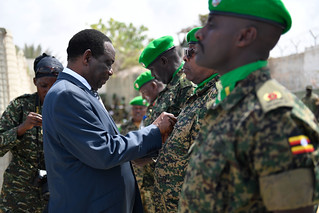
Ambassador Francisco Madeira, the Special Representative of the Chairperson of the AU Commission (SRCC) for Somalia, pins a medal on a Ugandan soldier during a medal award ceremony for Ugandan soldiers serving under the African Union Mission in Somalia (AMISOM), who have completed their tour of duty in Somalia. The event took place in Mogadishu on July 18, 2019. AMISOM Photo / Ilyas Ahmed

The African Union Mission in Somalia (AMISOM) has awarded medals and certificates to a Ugandan battle group for its contribution to peace and stability in Somalia.

The officers, belonging to Uganda People’s Defence Force (UPDF) Battle Group 25, operated in Eljale, Bufow, Marka, Shalnabot, Qoryoley and Mashalay among other areas in South West State.

“During the last 12 months, you have managed to implement the programme of the African Union Mission in Somalia (AMISOM) by going to your Forward Operating Bases (FBOs) to fight the enemy and bring peace and stability to the residents of Sector One,” said the Special Representative of the Chairperson of the African Union Commission (SRCC) for Somalia, Ambassador Francisco Madeira, who presided over the medal award ceremony.

“The African Union is in Somalia not for any other purpose other than helping to liberate this country from the scourge of a ruthless and destructive Al-Shabaab,” Ambassador Madeira added.

The SRCC commended the battle group for promoting dialogue and reconciliation among communities residing in its area of operation and also thanked them for rehabilitating flood water channels in Marka town and providing medical support to locals.

AMISOM Deputy Force Commander in charge of Operations and Plans, Maj. Gen. James Lakara, lauded officers of Battle Group 25 for supporting and mentoring Somali National Army (SNA) personnel in the Lower Shabelle region.

“The battle group was deployed to Lower Shabelle and was headquartered in Eljale, that covered areas of Shanlabot, Mashalay, Qoryoley, Marka, and were mentoring Somali National Army officers in Elsalid and Barire,” said Maj. Gen. Lakara.

The battle group commander, Col. Paul Muhanguzi, thanked the AMISOM leadership for their guidance and support which he said enabled the contingent to achieve its mandate.

“Battle Group 25 supported the Somali National Army in capturing Marka, which is the second largest city in the region. The 25th battalion has also supported and nurtured the local forces who were later recruited into the ranks of the Somali NISA (National Intelligence and Security Agency) force,” said Col. Muhanguzi.

The officers took over from Battle Group 28 and were responsible for maintaining peace and security in parts of south west Somalia.


Stories Continues after ad

DFCU Bank hacking scandal: Three officials grilled at CID as accomplices reported fled country

By
Our Reporter
-
July 19, 2019
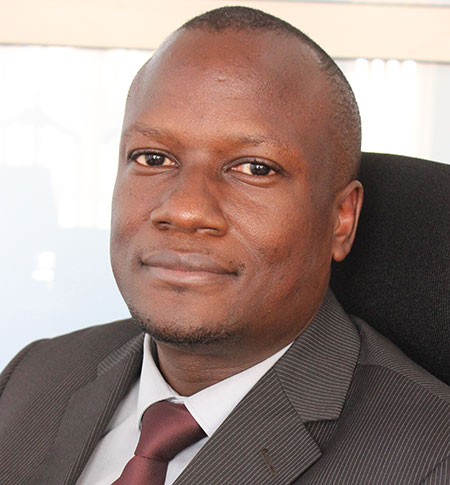
Mathias Katamba, Dfcu bank MD


Three Dfcu bank officials have appeared at the Criminal Investigations Directorate (CID) in for interrogation in connection to the theft of unspecified amount of money from the bank.

Charles Twine, the CID Spokesperson confirmed that the three officials whose names remain anonymous for now were interrogated a day ago.

Twine said the officials were grilled after top managers of the bank lodged by the complaint.

“The Dfcu case was formally reported here and investigations are ongoing, he said, adding that, “Some three people were picked, interrogated and released on bond. Because this is a crime that was committed electronically.”

Although Twine declined to reveal how much money was stolen, a forensic audit involving police detectives showed that about Shs10b had illegally been withdrawn from the clients’ accounts.

He also said detectives and their cybercrime team have already picked the logs and are analyzing them to establish how the fraudulent transactions were done.

Police said some of the suspects in the crime are not workers of the bank and are actually outside the country.

“They were within the bank and others outside. They gave in their story but with electronic offences we don’t rely on stories. There are people were vigorously looking for and one of them is outside the country. We shall use the normal process to trace for him and bring him back,” Twine said.

Early last week, this website reported that the heist was masterminded by insiders and outsiders who are well conversant with modern technology used by several banks.

Police has urged Dfcu bank customers to be patient because steps are being taken to ensure culprits are brought to book.

Corroborating on the same, Dfcu bank management on Monday confirmed that Police were notified on the high-level fraud and that bank staffs are being investigated.

“In May 2019, the bank detected a case of fraud that immediately reported to the police (CID HDQTRS GEF 604/2019) and investigations are ongoing,” reads a statement released by the bank.


Stories Continues after ad

Fenix reaches 500,000 customers in six African markets and announces new team

By
George Mangula
-
July 19, 2019
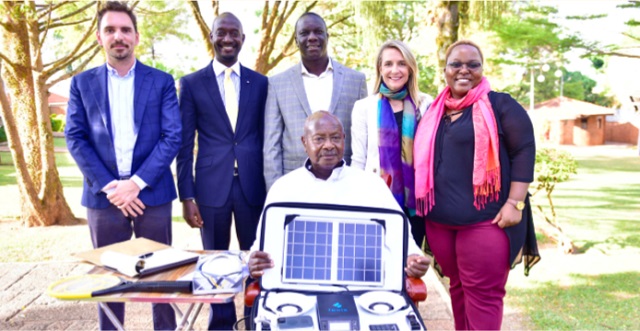
Finex International executives with President Museveni.

Fenix International, a company of ENGIE, offering Solar Home Systems across Africa has appointed co-founder and current COO Brian Warshawsky to the role of CEO to drive the next phase of the company’s ambitious growth plans. Warshawsky is succeeding Lyndsay Handler who has been with the company for 7 years and served as CEO since 2016. Warshawsky is well-placed to lead the company, having previously spent 5 years at Apple as part of the iPod Operations team before co-founding Fenix International in 2009. Having worked as COO with Fenix from inception, Brian has a deep understanding of the business from product design to manufacturing, country operations, distribution and last-mile customer experience.

Ivan Topalov, who previously served as Corporate Finance Director has been promoted to Chief Financial Officer following the departure of the previous CFO, Josh Romisher, in June. The company has also appointed a new Head of Customer Credit, Alison Boess, reporting to the CEO.

Yoven Moorooven, CEO of ENGIE Africa, said, “Brian is a highly regarded leader with the right mix of skills and experience to lead this new chapter for Fenix as we continue to establish ourselves as the market leader across Africa. With commercial operations in Uganda, Zambia, Ivory Coast, Nigeria, Benin and Mozambique, Fenix is growing from strength to strength. Under Brian’s leadership I’m incredibly excited for the future of our decentralized energy offering in Africa.” 

He continued, “I join everyone at ENGIE and the Fenix team in thanking Lyndsay, Jit and Chris for their many years of dedicated service and commitment to the Fenix Mission. Under their leadership, Fenix transformed millions of lives across the continent and built an inspiring team that is driven to succeed.” 

Brian Warshawsky, newly appointed CEO commented, “While it is difficult to say goodbye to such incredible colleagues and collaborators through so many years, I’m proud to be able to continue their legacy. On behalf of the Fenix team I would like to thank Jit for his technology leadership and the work he did to build Fenix Power, our next generation solar home system platform. I would like to thank Chris for his commercial and marketing leadership as Fenix grew from a few customers in Uganda to 500,000 customers across 6 countries in Africa. And I would like to especially thank Lyndsay for leading Fenix through so many milestones, most recently the ENGIE acquisition and establishing Fenix as the strongest off-grid solar home system company in the industry.”

He added, “Backed by a world class product, a world class team and with the full support of ENGIE, I am excited for what we will do to take our life changing product to customers across the continent. We are now set for an exciting future as we continue our expansion across Africa and achieving universal energy access for all.”

Lyndsay Handler added, “Building Fenix from 2011 to 2017 and accelerating our growth following the acquisition by ENGIE in 2018 has truly been an honour. Together, we have delivered clean, affordable energy to over 500,000 households or 2.5 million people in six countries across Africa. I am especially proud of the way we built a passionate Fenix team based in Africa who are deeply committed to our mission, values, and customers. Looking ahead, I am happy to pass the torch to our co-founder Brian and I am confident that the entire team will put the customer first in all that we do in Fenix’s next chapter. I hope that Fenix will continue to create new products and drive forward innovation so that clean energy is affordable to all at the last mile.”

Stories Continues after ad

Legislators, civil society want enforcement of strict broadcasting guidelines

By
Isaiah Mwebaze
-
July 19, 2019
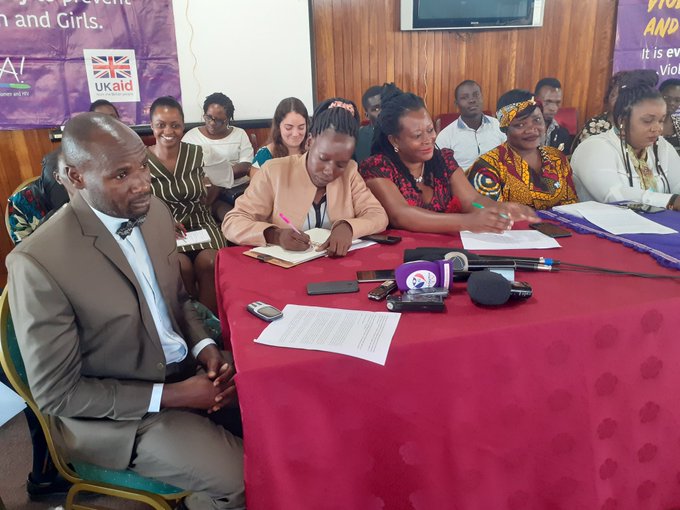
Members of Parliament and other guests.


Legislators and women rights’ activists have asked the Uganda Communications Commission (UCC) and Uganda Media Council to enforce professional code of ethics on all media houses in the country.

Members of the civil society said that some media houses need to avoid broadcasting or publishing content that negatively portrays women and erodes their dignity and that of their families.

The call was made in the wake of utterances by Pastor Aloysius Bugingo that his Teddy was suffering from incurable ailments.

“A case in point is seen in the recent case of Pastor Bugingo’s repeated negative utterances against his wife on social media channels that has continued to get to the public including children,” said Angella Asiimwe, the Program Officer Akina Mama waAfrika during a press conference held at Parliament Thursday, 18 July 2019.

Asiimwe and several leaders of civil society organizations under the Domestic Violence Act Coalition joined MPs under Uganda Women Parliamentary Association (UWOPA) to make a call to curb violence against women and girls in the country.

Mbwatekamwa Gaffa noted with concern that UCC had exhibited selective deterrence of broadcast and publishing of events that breach minimum broadcasting standards.

MPs called for an urgent consideration of the Marriage and Divorce Bill, which they said would provide a potential solution to domestic violence against spouses in marriages.

“We have laws on marriage and laws on divorce, so Parliament sought to merge them in the Marriage and Divorce Bill. But the aspect of bride pride in the bill took it a step back,” said Kamateeka.

The civil society members urged Parliament to prioritize the passing of the bill that would define a dignified process of marriage and divorce, with a call for continued public support.

“We recognize the considerable progress Uganda has made in legislation to address violence of women. We commend the Ministry of Gender for promoting the National Policy for Preventing Gender Based Violence, which will make Uganda a safer place for women and girls if implemented,” said Grace Nakirijja, the Programs officer Centre for Domestic Violence Prevention.

The Domestic Violence Act Coalition condemns demeaning sexist behavior towards women by their estranged intimate partners, to uphold their dignity at all times.


Stories Continues after ad

Judiciary launches  book on economic, social and cultural rights

By
Geoffery Serugo
-
July 19, 2019
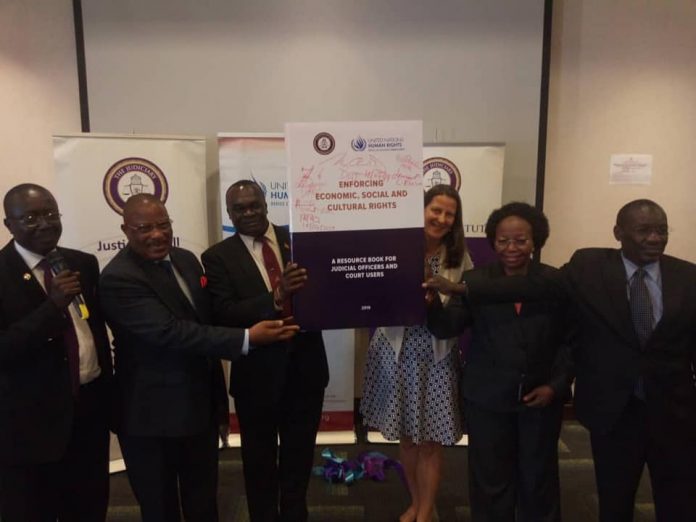
Officials launching the book.


The Deputy Chief Justice, Alfonso Owiny Dollo, has launched a Resource Book on Economic, Social and Cultural Rights (ESCR).

The launch was one of the highlights of a two day Training Workshop on the book usage for Judicial Officers at the Lake Victoria Serena in Kigo.

A cross-section of Judicial Officers is took part in the workshop, held under the theme: Strengthening Rule of Law and Accountability for Human Rights Violations.

Speaking during the launch, then Justice Dollo the manual is an important tool in ensuring human rights and environmental justice. “The manual is intended to reinforce the credibility and capacity of human rights defenders of grassroots groups, social movements, NGOs, academic centers, the private sector and the courts of judicature”, he said.

Justice Dollo observed that ESCR is an important tool that helps to unite women and men, migrants and indigenous people, youth and elders, of all races, religious, political orientations, and economic and social backgrounds, in the pursuit of a common realization of universal human freedom and dignity.

He also advised all the participants to utilize the book to promote the rule of law in Uganda.

The DCJ equally commended Dr Christopher Mbazira, the consultant, for producing a great publication as well as the Judicial Training Institute for supervising the consultancy.

Stakeholders in the Justice Law and Order Sector are also taking part in the workshop which is supported by the United Nations Human Rights.


Stories Continues after ad

Gov’t to increases fines and penalties for traffic offences

By
Geoffery Serugo
-
July 19, 2019
Minister Azuba


Government has introduced new traffic and road safety proposals intended to strengthen road transport regulation and management but will see an increase in fines and penalties for traffic offences including a 10-year jail time for death from reckless driving.

The proposals are contained in the Traffic and Road Safety Act 1998 (Amendment) Bill, 2019, presented to Parliament by Works Minister, Eng. Monica Azuba.

The Bill seeks to amend the 1998 Traffic and Road Safety Act taking into account new and emerging trends and dynamics in road transport and road safety management, the increased number of road users, and the need to conform to the regional and international agreements Uganda is signatory to.

In the amendment, government proposes that a convicted offender leading to the death or causes injury to a person will be liable to 10  years in prison.

“A person who causes the death of any person by reckless driving of a motor vehicle, trailer or engineering plant commits an offence and is liable, on conviction, to imprisonment of not exceeding 10 years,” reads part of the Bill.

The current law provides for a penalty of a maximum of Shs5 million or five years imprisonment upon conviction.

The Deputy Speaker, Jacob Oulanyah, referred the Bill to the House Committee on Physical Infrastructure, which according to the Rules of Procedure, has 45 days within which to report to the plenary.

The Minister said that the current law does not provide the definition of careless, reckless and dangerous driving, which would be required to guide Police in their application.

In the Bill, reckless driving refers to disregard of the rules of the road or driving without proper caution. Reckless driving includes driving over the prescribed limit, failing to use signals, disobeying traffic signs and signals, driving into another lane and distracted driving. It also includes using a hand held mobile phone, driving without due care and attention or reasonable consideration of other road users; driving while under the influence of a drink or drugs; and failing to stop for a pedestrian at a designated pedestrian crossing.

In another departure from the existing law, motorists will be required to carry their original driving licenses, or permits at all times while driving.

“A person shall not drive any class of motor vehicle, trailer or engineering plant on a road unless he or she holds and is in physical possession of a valid driving license or a valid learner driving license endorsed in respect of that group of motor vehicle, trailer or engineering plant,” reads the Bill.

The Bill also forbids a person to engage in the repair, trade, manufacture, deal in new, second hand or reconditioned motor vehicles, trailers or engineering plant without having an approved place of business or in possession of a license issued by government. The Bill further provides a fine of Shs2 million or a one-year imprisonment for the offence.


Stories Continues after ad

Kabaale Industrial Park construction: UNOC and Bunyoro Kitara Kingdom agree to work together

By
Our Reporter
-
July 19, 2019
UNOC and the Cabinet of Bunyoro Kitara Kingdom agree to establish a working group for Kabaale Industrial Park (KIP)


The management of Uganda National Oil Company Limited (UNOC) led by the Chief Executive Officer, Eng. Dr. Josephine Wapakabulo and the Cabinet of Bunyoro Kitara Kingdom (BKK) led by Prime Minister Owek.Andrew Byakutaga Ateenyi  have agreed on the long-term cooperation as the construction of Kabaale Industrial Park (KIP) takes shape.

The two parties have agreed to establish a working group for Kabaale Industrial Park (KIP) which will address key issues and opportunities arising from the region.

The parties recently held a meeting that took place on the request of Bunyoro Kingdom following UNOC’s participation in the 25th Empango (Coronation) Anniversary held on June 11, 2019 at Karuzika Palace, Hoima.

Eng. Dr. Josephine Wapakabulo welcomed the Prime Minister of Bunyoro Kingdom and his Cabinet and reiterated the commitment to continue cooperation with the Kingdom.

She said the meeting was a chance to present the projects being handled by the UNOC and opportunities these projects present.

Owek. Byakutaga extended appreciated UNOC’s cooperation with the Bunyoro Kitara Kingdom, particularly UNOC’s support to the last two (Empango) Coronation Anniversary celebration.

He said that the visit to UNOC was specifically to acquaint his Cabinet with the activities of UNOC and explore ways of collaboration and partnerships.

He said the Bunyoro Kitara Kingdom was aligning activities with all the players engaged in the development of Bunyoro Kitara Kingdom.

UNOC shared their plans to establish a liaison office in the community going forward in order to improve awareness of the UNOC business operations and enhance stakeholder engagements with the communities and buy-in.

UNOC was established under Section 42 of the Petroleum (Exploration, Development and Production) Act and Section 7 of the Petroleum (Refining, Conversion, Transmission and Midstream Storage) Act, both of 2013.

UNOC was incorporated under the Companies’ Act of 2012 as a limited liability company wholly owned by the Government of Uganda.

The Company’s overall function is to handle the Government of Uganda’s commercial interests in the petroleum sector and to ensure that the resource is exploited in a sustainable manner.


Stories Continues after ad
1...1,2111,2121,213...2,378Page 1,212 of 2,378
Eagle Online

© Eagle Online. All rights reserved.

Facebook
Twitter

About Us

  • About us
    • Our Staff
    • History
  • Employment Opportunities
  • Contact Us
  • Privacy Policy
  • Eagle Online

Popular Category

  • News13757
  • Business3332
  • Games & Sports2356
  • Africa1078
  • Entertainment933
  • Health700

Editor Picks

Gov’t to spend Shs56.9b on LC1, LC2 elections

February 25, 2026

Special Wildlife crime unit, police arrest suspected trafficker as they recover 154 kgs of raw elephant ivory

February 24, 2026