Stanbic Bank
Stanbic Bank
26.7 C
Kampala
Stanbic Bank
Stanbic Bank
Home Blog Page 1409

UNBS’s 2018 Christmas and New Year Message

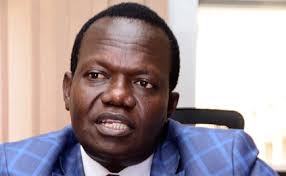
UNBS Eexcutive Director Dr Ben Manyindo

By Dr. Ben Manyindo

Warm and heartfelt greetings from the UNBS family- you partner in quality and standards.

As we approach the end of the year, we need to thank the Almighty God for his grace and mercy he has granted Uganda National Bureau of Standards (UNBS) in 2018 despite the many challenges including the loss of our 3 dear staff. To many people, this is the time they have been looking for, a time to re-unite with old friends, a time to travel to the village to catch up with our roots and for the majority, a time to shop and make merry. For Corporates like UNBS, it is a time to reflect on our contribution to the mission of the organization and indeed to the country. It is Christmas season 2018.

From the consumer perspective, there are many players who are positioning themselves to take advantage of the season and make quick money without due consideration to others and more so the consumers health, safety and value for money. What a selfish motive we tend to have at this time of Xmas. It is that time of the year more than any other time, businesses increase their advertising and sales promotion to encourage customers to buy their goods or services.

UNBS would like to sound an alarm and wake up call for extra consumer vigilance while procuring children toys, Xmas lighting, fuel, meats, skin lotions and dyes, discounted items, Xmas hampers, cheap bargains, un-processed drinks and foods among others.

Let us be extra vigilant while we shop, lest we are cheated.

Some consumer tips from Uganda National Bureau of Standards (UNBS).

Buy UNBS certified locally manufactured products. Get UNBS APP from Google Play store and verify UNBS certified brands.

Shopping for products that are of quality and making comparisons to find the most reasonable prices offered by different business establishments are the ways to go. Buying cheap can be expensive and disastrous to your life or property. Your decision to buy must be informed by reasonable assurance of quality, durability, performance, and usefulness, value for money, alternatives and price of goods or services.

Don’t shop in a rush and become confused.

Avoid buying from hawkers.

For pre-packaged goods, check expiry dates, integrity of the package, and labelling among others

Make use of the UNBS toll free line 0800 133 133 to report substandard goods on the market.

FIVE KEYS TO SAFE FOOD

Image result for 5 KEYS TO SAFE FOOD

The staff of UNBS have given their best in 2018 and our clients and stakeholders have been supportive in our work of consumer protection, fair trade facilitation and adding value to business growth of Uganda.

We pledge for better services in 2019.

Stories Continues after ad

Six local startups to benefit from World Bank project

Swipe2pay is one of the startups

Uganda will be represented by six startups among 100 firms from across the continent that were Thursday announced as winners of The Next 100 African Startup Initiative.

The Next 100 African Startup Initiative is a project funded by The International Finance Corporation (IFC), which is part of the World Bank.

The selected startups are attending the Africa 2018 Forum in Sharm El Sheikh, Egypt, which started Friday and will end on December 10, 2018.

The event will be graced by the presidents of Zimbabwe, Nigeria, Rwanda, and Togo.

The six Ugandan startups are Xente, ZimbaWomen, Swipe2Pay, e-fundi, Four one Financial Services and Superchillo Investment Ltd.

e-fundi is a company started to help drivers locate nearby professional mechanics and garages when traveling long distances and they suffer mechanical problems.

Tryphine Kemigisha, the founder of e-fundi says she got the idea of starting the company after a problem she encountered with her uncle while traveling upcountry.

Their vehicle suffered a mechanical injury and it took them 2 days before getting it resolved. In the process, thieves attacked them and stole some of the property that belonged to the World Food Program which her uncle had carried. He lost the job and trouble began.

e-fundi services can be accessed through a mobile application and website.

Superchillo Investment Ltd. and ZimbaWomen are social enterprises designed to help farmers and women respectively.

Xente, Swipe2Pay, and Four one Financial Services are fintech companies. (Click on each for more details from our previous reports.)

The Next 100 African Startup Initiative — which the IFC runs in co-operation with the Egyptian Ministry of Investment and International Cooperation (MIIC) — aims to provide up-and-coming small businesses with funding and advice.

According to data provided by IFC, most of the startups that won are from North Africa (36), which is followed by West Africa (35). East Africa which had 19 was led by Kenya (7), followed by Uganda (6), Ethiopia (1), Tanzania (2) and Zambia (3).

Central Africa sent six and South Africa will be presented by four.

The selected firms are from 25 countries and operate across more than 12 sectors which include big data and analytics, logistics, health and wellness, edtech and cleantech.

Stories Continues after ad

FDC makes changes in leadership positions

Kaps Fungaroo replaces Wadri

The opposition Forum for Democratic Change (FDC) party has sacked senior party leaders affiliated to former President, Gen. Mugisha Muntu.

The party in a special National Council sitting held on Friday at its Headquarters in Najjanakumbi, Kampala made the changes in the National Executive Committee affecting over a dozen positions.

The party deputy president for Eastern Uganda, Alice Alaso has been removed and replaced by former Busia Municipality MP, Taaka Kevinah Wanaha, a close ally of Secretary General Nandala Mafabi.

Busongora North MP, William Nzoghu is the new deputy president for Western region replacing little known Patrick Baguma.

Arua Municipality MP, Kassiano Wadri has been relieved of his duties as Deputy Mobilizer for Northern Uganda and replaced by Obongi county MP, Fungaroo Hassan Kaps.

The FDC vice chairman for Central region, Rajaab Kaay has been replaced with Kibuuka Mukalazi, whereas Tugume Moses replaced former Leader of Opposition, Winnie Kiiza’s husband Yokas Bihande as deputy mobilizer for Western.

Kawempe south MP, Munyagwa Mubarak, who is expected to take leadership of COSASE committee at Parliament, has also replaced Alex Gitta as deputy mobilizer for Central in the changes announced on Friday.

Former FDC Spokesman, John Kikonyogo has become the new deputy spokesman replacing Jinja West MP, Paul Mwiru and city lawyer Isaac Kimmezze Ssemakadde given the newly created position of Deputy Legal Secretary.

Meanwhile Dr. Dominic Wakabi replaced Namutamba Zanubia as Deputy Secretary for Health and Namwanga Rukia replaced Mesearch Nuwabiine as Deputy Secretary Local Government.

Ouma Denis is the new Deputy Secretary for PWDs filling position which fell vacant following the death of Substantive Secretary Noah Muhwana.

Kasozi Robinson got the new appointment of Secretary for Veterans, Ex-Service Men and Pensions deputized by Betty Nabudde.

Former Makerere University Guild President, Oneklit Denis Amere replaced former Ngora MP, Stephen Ochola as the Deputy Secretary Industry and Trade.

Ssebuffu Harriet replaced Sandra Katabarwa Ngabo as Deputy Secretary for Culture, Ethics and Religious Affairs and Walid Mulindwa Lubega was ratified as National Youth Leader having been given powers by the Youth Extra Ordinary Delegates Conference sitting of 29th November 2018.

Adyaka Judith and Chemonges Joseph Alfred were given the newly created positions of Deputy Secretary for Agriculture and Deputy Secretary for elders respectively.

Stories Continues after ad

Why team management by fear is bad for any business

Martin Zwilling

By Martin Zwilling

Despite the ease of communication through social media, new tools, the popularity of fearless independence and #MeToo, I still see many business organizations that are less than productive due to fear. Yet in my work as an advisor to senior executives, I find that many fail to see reality in their own organizations, and have no idea whether they are part of the problem or the solution.

I finally found some real guidance on this challenge in a new book, “The Fearless Organization,” by Amy C. Edmondson from the Harvard Business School. She presents a wealth of case studies on the pain and business losses from this type of leadership and culture, and provides some practical guidance on how to change it to a more psychologically safe and productive workplace.

If you are one of those leaders or team members who really wants to change things, here are some key indicators of the problems that I have seen, and some pragmatic guidance on how to get things moving in the right direction:

Team members fail to speak up for fear of retribution. Hearing too much silence in your organization is a dangerous sign. This reticence to speak up, for fear of being embarrassed, intimidated, or penalized, can lead to widespread frustration, anxiety, depression, or even physical harm to others. Team members just don’t feel protected.

Changing this culture has to start from the top. You as a team leader or executive have to openly invite participation from every team member, and respond positively in tone and actions when people actually do speak up. Show humility and appreciation for all input.

People show excessive confidence in authority. In some organizations, especially medical and highly technical ones, authority and reverence are well understood and tightly linked to one’s place in a strict hierarchy. Deference to the leaders can become the default mode of operation, suppressing valuable input, to the detriment of everyone.

The solution here is to hire and surround yourself with people who bring strong complementary skills to the table, as well as high confidence and self-esteem. In my experience, leaders who hire helpers rather than real help are breeding this problem.

A culture of silence where leaders fail to listen. Often employees learn to stay silent when they see that voicing concerns or ideas is futile. In fact, they usually give up not just their voice but also their entire psychological engagement with your company. Evidence of not listening includes interrupting feedback, being defensive, or no evident follow up.

You can reverse this culture by asking for opinions or updates at the end of meetings – then pause and ask again, so they know you are sincere. Also, you must be available and approachable. Mingle with employees. Ask questions, listen to responses. Be conscious of your eye contact, facial expression and tone of voice.

Impossible stretch goals are never challenged. Performance goals set without team member input, and without support and feedback, are a sure sign of managing by fear. Most people feel that unattainable targets led to the serious problems at both Wells Fargo and Volkswagen a couple of years ago. Both are still struggling to change their culture.

The solution is to communicate what you want – early and often – once is not enough for people to take you seriously. Then ask for input, listen to the evidence, and provide feedback based on what you hear. Be fair and consistent, with no excuses or emotion.

You only hear the good news from team members. How many times have you chopped people off at the knees for being the bearer of bad news? Team members learn quickly, and the message spreads, that problems must be buried, and people are berated or penalized for surfacing tough issues. It’s fair to ask for solutions, in a positive way.

Actually, the best approach is to ask the hard questions to get to the heart of a problem in a non-threatening fashion. Hard discussions can be the most productive, as well as more satisfying to team members, if they feel they are being heard and can make a difference.

Psychological safety is a workplace state in which people feel confident expressing themselves and comfortable calling attention to problems without humiliation or retribution, where colleagues trust and respect one another. In today’s complex world of constant change, collaboration in a fearless organization is the only way to survive and thrive, and only you can build it.

The writer is a veteran startup mentor, executive, blogger, author, tech professional, professor, and investor. Published on Forbes, Entrepreneur, Inc, Huffington Post.

Stories Continues after ad

Global status report on road safety 2018: Over 1.35 million people die in accident

Carnage: The Gaaga bus in which was involved in accident where 22 people perished.

The Global status report on road safety 2018, indicates that the number of annual road traffic deaths has reached 1.35 million implying that nearly 3 700 people die on the world’s roads every day.

Globally, pedestrians and cyclists represent 26 per cent of all death, with those using motorized two or three wheels comprising 28 per cent. Car occupants make up 29 per cent of all deaths and other remaining 17 per cent are unidentified road users. Africa has the highest proportion of pedestrian and cyclist mortalities with 44 per cent of deaths.

According to the Director General, World Health Organisation, Dr Tedros Adhanom Ghebreyesus, Road traffic injuries are now the leading killer of people aged 5-29 years, the burden is disproportionately borne by pedestrians, cyclists and motorcyclists, in particular those living in developing countries.

The report suggests that the price paid for mobility is too high, especially because proven measures exist. Such measures include strategies to address speed and drinking and driving, among other behaviors.

The report highlights that safer infrastructure like dedicated lanes for cyclists and motorcyclists, improved vehicle standards such as those that mandate electronic stability control and enhanced post-crash care can play critical roles in scaling down on the number of accidents.

Drastic action is needed to put these measures in place to meet any future global target that might be set and save lives.

He said tens of millions more are injured or disabled every year, people who suffer life-altering injuries with long-lasting effects and the cost of emergency response, health care and human grief is immense.

Dr Tedros said Development is an opportunity for low- and middle-income countries to avoid the costly mistakes made in the past by high-income countries. We need to create cities and transport systems that reduce reliance on cars.

“We must apply the lessons we have learned about safe road design. With the right leadership and investment, countries can build in the safeguards and best practices to save lives,” he added.

He said sustainable road safety must be planned and requires long-term investment and private sectors, international donors and other stake holders need to work together to make things happen.

Stories Continues after ad

Uganda making good progress against gender based violence-Principal Judge

The Principal Judge, Yorokamu Bamwine, has revealed that Uganda is making good progress in the fight against Gender Based Violence (GBV).

Remarking at the second National Symposium on Justice for Women and Girls at Hotel Africana, Bamwine said Uganda has laws and clear strategies however, the challenge is in implementation of the legal framework to create a conducive environment for women and girls to access justice more effectively and efficiently.

“There are poor case handling methods, including exhibit mishandling, poor statement recording and other outdated evidence admission requirements such as trials within Trials before evidence of a child of tender years and or confession statements can be made part of the record,” he said at Hotel Africana

He noted with concern that there are delays in investigation, prosecution and adjudication of Sexual and Gender Based Violence (SGBV) crimes.

“In spite of the setbacks, the Judiciary is in the process of setting up a specialized GBV Court. Courts are effective in that Judiciary staff have specialized skills and the use of innovative ways to expedite trials,” he said.

Bamwine said there is a need to strengthen stakeholder engagement through offering support to District Chain-linked Committees saying they have a big role to play in the fight against GBV through mobilization of resources, ideas and even sensitization of the populace.

The President Uganda Law Society (ULS), Simon Peter Kinobe, called upon the State to enhance its responsibility in protecting the rights of women and the girl child, since statistics in Uganda show that the rate of violence is increasing by 16.7 per cent.

He pledged that ULS continues with advocacy to ensure women and girls have access to justice.

Stories Continues after ad

Bagyenda usurped powers of BoU governor to sell off Global Trust Bank

Embattled former Executive Director in charge of Supervision at Bank of Uganda Justine Bagyenda.

By George Mangula

The former Bank of Uganda (BoU) executive director of supervision Ms Justine Bagyenda usurped powers of the Governor Prof. Emmanuel Tumusiime-Mutebile and used a draft agreement to sell off assets of Global Trust Bank Uganda (GTBU) to its competitor DFCU Bank, it was established Friday.

Cosase Chairman Abdu Katuntu, said that by signing on the draft sale agreement, Bagyenda assumed the powers of the BoU Governor and his deputy, which he said is unconstitutional. Katuntu noted that with such happenings, every BoU staff could easily become governor if the Constitutional provisions are not followed.

The BoU legal counsel Margaret Kaggwa Kasule said Bagyenda used a draft agreement when asked if the agreement between BoU and DFCU Bank was genuine. This was after Bagyenda insisted that the agreement was a BoU official document.

Ms. Bagyenda said she was helped by Ben Sekabira, the BoU Director, Financial Markets Development Coordination, in negotiations that led to the transfer of GTBU to DFCU Bank, whose former Managing Director, Juma Kisaame was involved and signed the agreement to acquire its competitor then.

The Auditor John Muwanga’s report on seven defunct commercial banks faults BoU for transacting business of GTBU without any minutes of the meeting that approved the sale as well as not following the laid-down principles and guidelines.

“Mr. Ben Sekabira agreed with the report, when asked by MPs on Cosase committee whether they were minutes published prior to the sale of GTBU. “I vividly remember myself and Mrs. Bagyenda. Bagyenda was the chair of the meeting and she was my boss. I don’t remember seeing minutes being taken,” Sekabira replied when asked the BoU staff that attended the meeting and whether minutes were taken. “Like practice has been, such meetings are not minuted. You discuss and know where you stopped,” he added to the amusement of the legislators.

Sekabira, the BoU Director, Financial Markets Development Coordination, who is the only BoU staff that has witnessed the seven banks liquidated, said he was not officially assigned but was only invited by Bagyenda to participate in negotiation meetings to sell off GTBU. The meetings went on for days without the knowledge of Tumusiime-Mutebile or his deputy Dr. Louis Kasekende.

And the governor Tumusiime-Mutebile has denied ever authorizing Bagyenda to sell off assets of GTBU, disclosure that exposed how BoU is disorganized in running its assigned activities. Some disclosures on the matter seemed to be new to him, as his body language portrayed.

MP Katuntu said Bagyenda signed informally and casually the sale agreement that transferred GTBU assets to DFCU, since there were no minutes taken. “That will be interrogated and we shall come to the conclusion,” he added.

Sophia Kironde Iwumbwe, who is BoU Assistant Director Commercial Banking Inspections (Onsite) denied allegations that she was involved in GTBU sale negotiation meetings as well as participation in the identification of the acquirer (DFCU Bank).  She gave her responses on oath, just like Bagyenda, Sekabira and Counsel Kasule who also said she never participated in negotiations meetings apart from drawing the terms of the agreement.

Ms Kironde said at the time of the sale of GTBU, she was an examiner-in-charge at BoU where her role at the time was to verify the accuracy of numbers of GTBU assets and make weekly monitoring reports until the time the decision was made to close bank on July 25, 2014. Verification of accuracy of the numbers.

Among shareholders of DFCU Bank are staff members of BoU under Bank of Uganda Staff Retirement Benefits Scheme which commands 0.59 percent of the shares of DFCU Bank. MPs reasoned that that creates conflict of interest.

Other shareholders include; Arise BV (58.71%), CDC Group of the United Kingdom (9.97%), National Social Security Fund (Uganda) with 7.69%, Kimberlite Frontier Africa Naster Fund (6.15%), Two undisclosed Institutional Investors (3.22 %), SSB-Conrad N. Hilton Foundation (0.98%), Vanderbilt University (0.87%), Blakeney Management (0.63%) and retail investors (11.19%) BoU staff are investors in Stanbic Bank and Bank of Baroda, according to Oscar Edwin Kiiza, BoU’s Assistant Director Pension Administration & Financial Reporting. That makes BoU a regulator and the regulated at the same time, which MPs said is a problem in form of conflict of interest.

The MPs also established Dr William Kalema sits both on the boards of BoU and DFCU Bank which creates another conflict of interest. BoU said it is against its guidelines for a regulator to be on the side of the regulated as well.

Stories Continues after ad

Express FC suspend captain due to misconduct


Express football club have indefinitely suspended the club captain Julius Ntambi due to indiscipline and misconduct on grounds of alleged match-fixing.

The information was released by the club chairman Kiryowa Kiwanuka in a letter dated 6th December indicating that the captain has been suspended indefinitely from the club.

The letter reads;

“In Express FC’s drive to excellence, discipline in its facets shall be and remains fundamental building block.

Express maintains a policy of zero tolerance to indiscipline.

Mr. Julius Ntambi’s conduct has been found wanting in several aspects and it’s now the subject of investigation.

We therefore inform the Express family and entire footballing fraternity that, Mr. Ntambi has been suspended indefinitely, as investigations into the alleged indiscipline and misconduct are concluded.”

Ntambi was named the club captain at the beginning of this season. He has previously featured for URA FC, Kira Young and for Cranes in the 2014 CHAN tournament in South Africa.

The Red Eagles next game in the StarTimes Uganda Premier League is against Kirinya Jinja SSS on Saturday 8th December at the Mighty Arena, Jinja SS.Dr

Stories Continues after ad

President Museveni to launch state house anti- corruption unit

President Yoweri Museveni


President Museveni is on Monday set to launch state house anti- corruption unit that was instituted in June this year on grounds that he is frustrated by the inspector general of government’s (IGG) office in the fight against the vice.

The instituted team is led by former Secretary General of Uganda National Teachers Union (UNATU) and a member of central executive committee of national resistance movement (NRM) James Tweheyo, Ms. Martha Asiimwe and sister Akiror.

Museveni’s move come at a time when Parliament’s Committee on Commissions, Statutory Authorities and State Enterprises (Cosase) in grilling bank of Uganda’s official over corruption and dubious ways taken in the closure of seven commercial banks starting with Teefe bank in 1993.

The committee will directly be reporting to the president who will intervene and draw final decisions for suspects to produce in court among other measures.

Museveni vowed that, in order to speed up in monitoring economic production and service delivery, his government will offer bicycles to parish chiefs saying it is quite and health for him to peddle around to monitor and inspect.

The IGG Irene Mulyagonja lauded president Museveni for such intervention noting that the committee will help in establishing corrupt officials that could be hiding behind him.

Senior officials who have been tried over corruption: former ministers, Herbert Kabafunzaki, Eng. Abraham Byandala. Others are former National Social Security Fund boss, David Chandi Jamwa, the former Permanent Secretary of the Ministry of Public Service Jimmy Lwamafa, former Principal Accountants, Godfrey Kazinda and Christopher Obey among others.


Stories Continues after ad

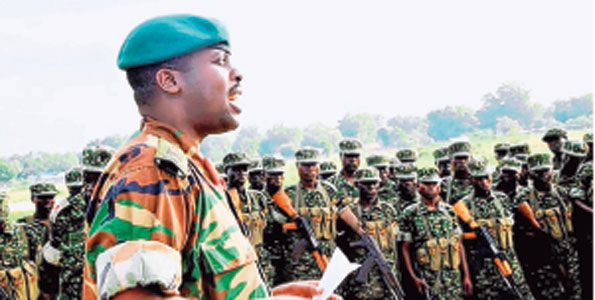
Gen David Muhoozi flags off Uganda Battle Group 26 to Somalia

NEW CDF: General David Muhoozi

The Chief of Defence Forces (CDF), Gen David Muhoozi has implored Uganda Battle Group 26 (UGBAG XXVI) to ensure vigilance and maintain discipline during their mission in Somalia.

Gen Muhoozi made the remarks at Peace Support Operations and Training Centre (PSO-TC) in Singo, Nakaseke District as he flagged off UGABAG XXVI.

The group is under the command of Col Toffa Magino and will be deployed in Somalia with an intent of neutralizing Al-Shabaab threats and help restore peace and stability in in the country.

“Fighting in Somalia is not a picnic. Dose and Al-Shabaab will finish you,” Gen Muhoozi cautioned adding that “Fighting Al-Shabaab is a manageable mission if soldiers work hard, keep to what they were trained on, and sticking to the rules of engagement (ROE).

The CDF further urged soldiers to know their responsibility whether in a section, unit or formation, and put their background in minds. He reminded them to always protect each other’s back using the attained pre-mission training and Operations experience.

The Chief of Staff Land Forces Brig Leopold Kyanda on behalf of the Commander Land Forces Maj Gen Peter Elwelu commended Battle Group for enduring the long attained pre-mission training.

He noted that the force is well prepared and ready for deployment for AMISOM.

The Commandant of the Peace Support and Training Centre (PSO-TC) Singo Brig Jackson Bakasumba lauded the UPDF leadership for her support towards stabilizing Somalia in the spirit of Pan-Africanism by deploying the Battle Group.

Brig Bakasumba observed that soldiers are well prepared and as it has been in the past and will work hard to keeping Uganda’s flag shining.

The flag off function was attended by Development Partners, Community leaders, PSO-TC staff among other invited guests.

Stories Continues after ad