Stanbic Bank
Stanbic Bank
17.7 C
Kampala
Stanbic Bank
Stanbic Bank
Home Blog Page 1596

Regional funder commits $1.05m for data collection

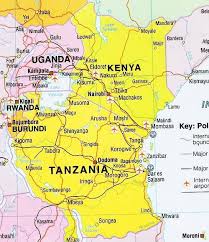
Map of East Africa

TradeMark East Africa (TMEA) and the Northern Corridor Transit and Transport Coordination Authority (NCTTCA) have signed a financing agreement worth US$ 1.05m to enable the agency to collect and analyse data on transportation of goods and persons along the corridor, information that will be vital for decision making.

Acording to a release the TMEA was represented by Country Director for Kenya, Ahmed Farah, while NCTTCA was represented by Ag. Executive Secretary, Fred Tumwebaze, and the money will be disbursed to the NCTTFA Secretariat over a 3-year period (2018 – 2021).

The Northern Corridor is a key transport route in East and Central Africa. The main Northern Corridor artery is served by a combination of transport modes and infrastructure facilities that include: the Maritime Port of Mombasa; road network; rail network; inland water routes; inland container depots; and, an oil pipeline. All these form part of the Northern Corridor infrastructure used in facilitating the flow of goods across Member States.

It is estimated that of 96% of goods from the Port of Mombasa are transported by road leaving the remaining percentage to be through the railway mode, inland waterways and pipelines.

NCTTCA member countries include Kenya, Uganda, Rwanda, Burundi, South Sudan and the DR Congo.

NCTTCA oversees the corridor monitoring framework known as Northern Corridor Transport Observatory, which is a performance monitoring tool that informs interventions geared towards reducing costs and delays of transportation and other related logistic a, challenges.
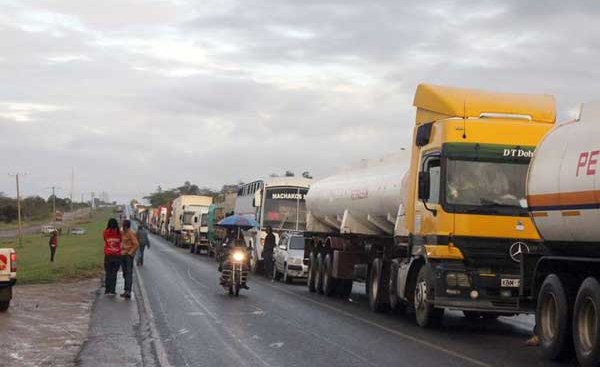
Traffic on the Nortthern Corridor in Kenya

With the new financing, the Authority will improve monitoring of the Northern Corridor performance with regards to movement of people and goods.

It will adopt modern technologies, including mobile based and online systems, to enhance its capability to monitor trade and transport flows, bottlenecks and impact of interventions.

Data collected will support evidence-based advocacy and decision making. This initiative will complement monitoring the implementation of the Mombasa Port Charter.

NCTTCA collects data from over 20 stakeholders in all the member countries, the contributors being revenue authorities, roads authorities, ports and railway authorities, transport associations and private sector institutions closely affiliated to trade and transport.

An alternative transport network serving the landlocked Great lakes region is through Tanzania, in the Central Corridor. The 1,400 km-long corridor uses lake transport on the Lake Tanganyika to Kigoma in Tanzania, and then road or rail to Dar-Es-Salaam on the Indian Ocean.


 

Stories Continues after ad

UK MP implores Museveni to quit

Paul William

The United Kingdom Member of Parliament (MP) for Stockton South Dr. Paul Williams has urged President Yoweri Museveni to leave power, saying that the Ugandan leader is ‘a barrier’ to development.

Dr. Williams asked the UK International Development Secretary Penny Mordaunt to use the Commonwealth Heads of Government Meeting (CHOGM) to tell President Museveni that it’s time to go. President Museveni is in United Kingdom for the 25th Commonwealth Heads of Governments Meetings (CHOGM)

According to Dr. Williams, Museveni has been in power since 1986 and one of the good governance pointers includes the President leaving office.

However, Dr. Williams has thrown a spanner in the wheels of this prickly issue, presidential press secretary Don Wanyama taking to social media and saying: “Dr. Paul Williams still possesses a colonial mentality where he thinks Western metropolis should determine what happens in Africa.”

Mr. Wanyama added: “Paul Williams show Ugandans some respect. We know what’s best for us. Have you stopped to ask how long the Queen has been on the throne?”

In his reply Dr. Williams wrote: “Still? I wasn’t even born when there were colonies. Nope – it’s just about good governance and telling millions of Ugandans that the world is with them.”

Immediately after tweeting, Wanyama replied saying, “you might want to know that president Museveni was voted by millions of Ugandans. I guess from your perspective they don’t count. You have no right to stand on imaginary Mt Sinai and issue edicts to us. We might have failed on colonialism but we shall resist neo-colonialism.”

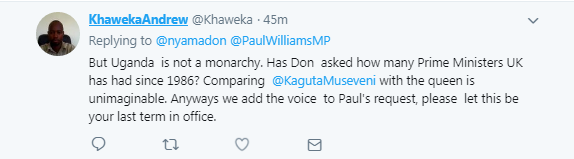
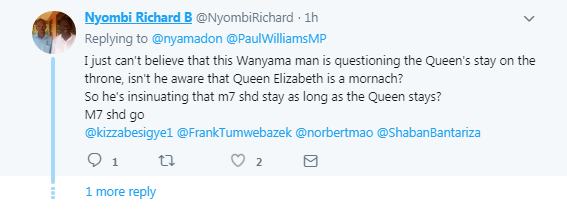
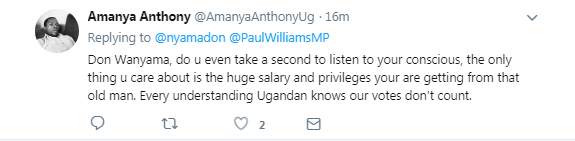
However, Wanyama’s exchanges attracted mix reactions from Ugandans.

Ivan Okuda: If a 3rd world country can’t breathe without foreign aid as we saw with Uganda when donor aid was withdrawn following the anti-gay law debacle, shouldn’t Paul whose tax his government uses to sustain basic social services and development projects here have a say? He should! Everyday! Louder!

Don Wanyama: Oh! What you call foreign aid is actually recovery of what was stolen from us during the exploitation ages. Can Belgium give aid to Congo? C’mmon!

Kevin Martin: Replying to @nyamadon and @PaulWilliamsMP We all believe in change and change is inevitable. We need to have a Constitution not bent to the will of individuals and give chance for the peoples voice to be heard. The economy and country are in dire need of a new direction #CallForChange


Stories Continues after ad

Coca-Cola celebrates success of 2000 jobs for youths

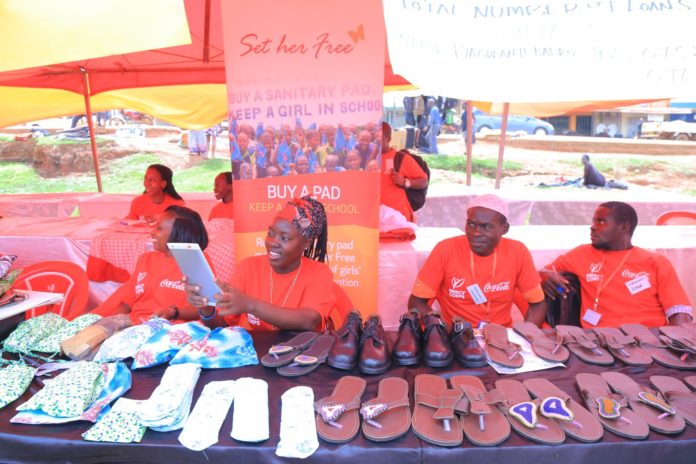
The youths from Kawempe and Wakiso exhibit some of their work

Coca-Cola Africa Foundation and Century Bottling Company together with Mercy Corps are celebrating the benefits of the YES! Initiative, which skills youths in a bid to fight unemployment.

Launched in 2015, the three-year program has provided training and links to both employment and entrepreneurship opportunities for over 2000 youths in Kawempe Division, Kampala and parts of Wakiso District.

The project used community-run ‘YES HUBS’ which offered training focused on job readiness, life and technical skills and financial literacy and provided the youth with the opportunity to join peer networking and savings groups.

Together with other private sector partners, YES! created opportunities for youth to realize new and more secure livelihood opportunities.

Speaking on behalf of the Coca-Cola system in Uganda, Maureen Kyomuhendo, the Public Affairs and Communications Manager Coca-Cola Beverages Africa Uganda noted that youth employment is the bedrock of long-term economic health, social cohesiveness and sustainability around the world.

“While 10-12 million young Africans enter the workforce each year, less than half this number of employment opportunities are available. Against this backdrop, The Coca-Cola Africa Foundation (TCCAF) partnered with Mercy Corps and other partners in different Countries to launch the Youth Empowered for Success (YES!) Program; a bold initiative that has enabled youth across Africa to access new economic opportunities including jobs, skills training, mentorship and financial services. In Uganda, we are excited to be celebrating over 2000 youth in the 1st three years of the project,” Ms. Kyomuhendo noted.

In his message, Conrad van Niekerk, the Managing Director Coca-Cola Beverages Africa Uganda commented: “I would like to applaud our partners – Mercy Corps and the youth here in Kawempe & Wakiso that participated in the program for demonstrating to the World that youth empowerment can be achieved. Seeing what the youth have showcased today – a lot of effort was put in through their hubs”.

The end game, which is about driving economies and promoting a positive narrative around youth as entrepreneurs, innovators, economic leaders, and employers has been achieved.

The challenge is to ensure that the empowerment will have a lasting ripple effect across their families, communities, businesses, countries, and globally – which is what Coca-Cola seeks to do”.

On our part, we shall continue to identify and embrace opportunities which will empower more youth, he concluded.

Mercy Corps thanked The Coca-Cola Africa Foundation and Century Bottling Company for the partnership, with Sean Granville- Ross, the Mercy Corps Regional Director, overwhelmed by the accomplishment of the youth beneficiaries.

He applauded the commitment of all the partners and invited everyone to learn, mingle, network, engage and be inspired by all that can be accomplished when youth, the private sector and communities come together to create a brighter future.

Different youth groups, in their ‘hubs’ showcased their businesses and skills that they attained through the YES! Program.

Stories Continues after ad

Uganda tea exports increase by 12 percent

Tea ready for export

Uganda’s tea exports increased 12.4 percent in April 2018 to reach 839,824kgs up from 747,003 kgs exported in the same month last year, according to the latest East African Tea Export Auction report.


However, despite an increase in supply, prices increased to US$1.6 (Shs5, 808) up from US$1.3 (Shs4, 700) per kg.

Tea prices, according to the players in the tea industry, have been stable in the last three-years, even though they expect some increase in the near future.


Regionally, tea exports at the Mombasa Auction have increased, according to the East African Tea Export Auctions report that was released after tea auctions held between April 9 and 10.

All the other five EAC countries of Kenya, Rwanda, Burundi, Tanzania and Mozambique registered a growth in exports at the tea auction. The increase, the report says, is attributed to the growth in demand and a rise in the production of the crop.

According to the report more than 7.4m kgs were sold up from 6.4 million bags sold around the same time last year. This indicates an increase of 8.2 per cent.

The other countries, including DR Congo, Malawi, Madagascar and Ethiopia registered no trade.

According to the report, Kenya exported 5.7m kgs compared to 5.4m kgs it exported last year.

Rwanda, Burundi and Tanzania exported 401,000kgs, 196,632kgs and 280,496 kgs, respectively.  Mozambique exported 25,772 kgs up from 8,408kgs indicating a 67 per cent increase.

The weekly tea auction in Mombasa is an important reference point for the global tea industry. It takes place on Mondays and Tuesdays for secondary and primary grades respectively.

In the auction, the teas are sold under the factory marks (gardens) and sorted into the various leaf size known as grades. Each batch of a single leaf grade is given a unique invoice number before being packed into a standard paper sacks.

And each tea factory is represented by a selling broker who is responsible for cataloguing the teas for sale. The buyers in the auction are categorized differently.

Those that buy and ship individual lots on client’s orders, those who buy teas for blending and the ones that buy on their accounts either for stock or trading.


Stories Continues after ad

EALA passes Oaths Bill with amendments

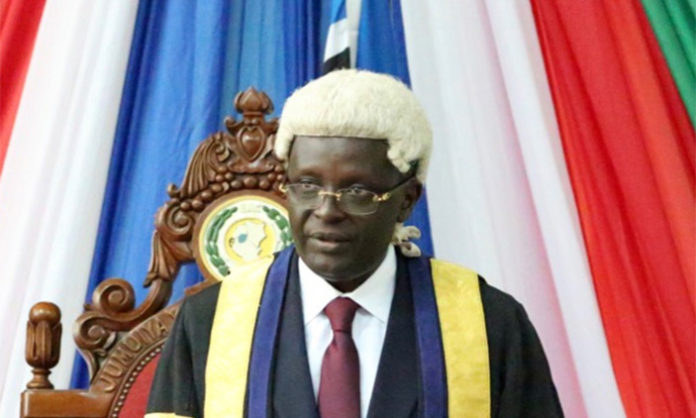
EALA Speaker Martin Ngoga

The East African Legislative Assembly (EALA) late yesterday extensively debated and passed the East African Community Oaths Bill, 2018, paving way for employees of the Community and persons giving evidence before the East African Court of Justice, the Assembly and related quasi bodies to swear oath of affirmation.

The debate, which resumed following its interruption on March 15, 2018, was preceded by the presentation to the House of the Report of the Committee on Legal Rules and Privileges Committee by Chairperson, Fatuma Ndangiza (Rwanda).

At debate, the Assembly stated the Bill lacked provisions for sanctioning individuals who violate the oath or affirmation, lie under oath or disclose pertinent and confidential information and called for the Committee on Legal, Rules and Privileges in consultation with the Chairperson of the Council of Ministers to include the requisite penal provisions.

The EAC Oaths Bill, 2018 is important to the Community because it legislates for the oaths or affirmation to be taken by people employed by or provides service to the Community, as well as to individuals giving evidence before the East African Court of Justice, the Committee of the East African Legislative Assembly and Quasi-Judicial Bodies of the Community.

According to Article 72 (1) of the Treaty for the Establishment of the East African Community, requires all staff of the Community to pay allegiance to the Community and provides in part that “in the performance of their functions, that staff of the Community shall not seek or receive instruction from any Partner State of from any other authority external to the Community.

The report observes that the laws providing for oaths do not ordinarily provide for sanctions against the breach of the oath or affirmation. Members further observed that penalties for breach of confidentiality or secrecy are usually provided for by either the penal or criminal laws of a jurisdiction or specifically provided for in laws relating to protection of confidentiality or secrecy.

The Oaths Bill, 2018 seeks to provide for the obligation to take oaths or affirmation and to prescribe the actual oaths or affirmations. To include sanctions in the Bill would be going into territory that should be the subject of another law on confidentiality, it adds.

The report notes that until a specific law on confidentiality information or secrecy is developed, there are other laws in the Community and in the Partner States that may be used to punish those that breach confidentiality, including the EAC Staff Rules and Regulations, Rules of Procedure of the East African Court of Justice, the East African Legislative Assembly (Powers and Privileges) Act, 2003 and the Rules of Procedure of the East African Legislative Assembly.

Stories Continues after ad

CSOs implore govt to increase funding for pests and diseases control

Food-Rights-Alliance-ED-Agnes-Kirabo

A local civil society platform, the Civil Society Budget Advocacy Group (CSBAG), has expressed worry that government has allocated inadequate funds towards the fight against pests and diseases for the financial year 2018/19.

Presenting a ‘position paper’ on the agricultural sector Ministerial Policy Statement (MPS) for the fiscal year 2018/19 to the agriculture committee of parliament, the members said that Shs12.5b is required to sustain the fight against the fall army worm, but that only Shs2.5b had been allocated, creating a funding gap of Shs10b.

CSBAG also said that Shs 10b is required to sustain the testing of various tick resistant cleaning Acaricide through NARO and ongoing research in developing Acaricides that are suitable for Uganda, but that the ministry of agriculture had only got an allocation of Shs4b, creating a gap of Shs6b.

“Shs8b is also required to support the ongoing research in vaccine production for livestock disease control and no allocation is proposed in the MPS for FY2018/19,”Agnes Kirabo, a member of CSBAG, told the legislators.

They further said that Shs12b is also required for assorted animal vaccines to control the spread of livestock diseases, but that only Shs5b had been allocated, creating a funding gap of Shs7b. It should be noted that the annual loss in the priority crops due to pests are estimated at $35-200m(bananas) $60-80m (cassava),$10m (cotton) and $8m (Coffee). This is according to the agricultural risk assessment study by IFAD . “We therefore recommend that an addition of at least Shs20b be allocated to ministry of agriculture for this function in order to safe guard the investment in the sector across the sub sector,” Kirabo said.

Extension workers

The CSOs also implored government to expedite the provision of Shs16b for the recruitment of 1,968 extension workers to achieve the targeted 5,000 extension workers in the district local government. They also proposed that Shs10b additional funding be allocated as non-wage bill to support the newly recruited extension workers and at least Shs3b to skill the recruited extension workers and safe guard the quality of services provided to farmers.

“Parliament should task ministry of agriculture, to harmonize functions and roles based on mandates to avoid competition, contradiction, duplication, waste of resources and confusion of farmers,” Kirabo noted.

On research, the Group appealed to the government to consider prioritizing research as a critical function to realize the objectives of the sector and specifically increase access to critical farm input to increase production and productivity. They s noted that during the FY 2016/17, NARO was allocated only Shs85.9bn and Shs84b in the FY 2017/18 and it is likely to be allocated Shs69b in the FY 2018/19, which according to the Group is not enough for the over 10 NARO institutions for research.

 Irrigation

They recommended that the government harmonizes the function of water for production between the ministry of agriculture and the ministry of water to realize efficiency of resources. According to the CSOs, there was overwhelming evidence of animal deaths and crop failure in the FY 2016/17 due to the prolonged drought.

To their dismay however, only Shs0.884b has been allocated to the department of agriculture infrastructure and water for production, with the biggest portion being donor funded. In their position paper, the members also raised concerns about the limited climate change mitigation and adaptation interventions, to which they implored the government to develop clear interventions of mitigating climate change impacts especially in Buvuma.

CSBAG also said that the agriculture sector has potential to contribute to GDP growth, exports, employment and poverty reduction, if it is adequately funded.

The committee commended the CSOs for their ‘rich position paper’, which the committee vice chairperson Robert Miggadde said will be used to inform the final budget report for the committee.

Francis Gonahasa, a committee member, implored the government to always pay attention to CSOs concerns, adding that they are key stakeholders in enforcing development.

“The government should look at CSOs not as opponents, let us use the information you give us to make government deliver better,” the MP said.

Stories Continues after ad

Commonwealth Foreign Ministers discuss security

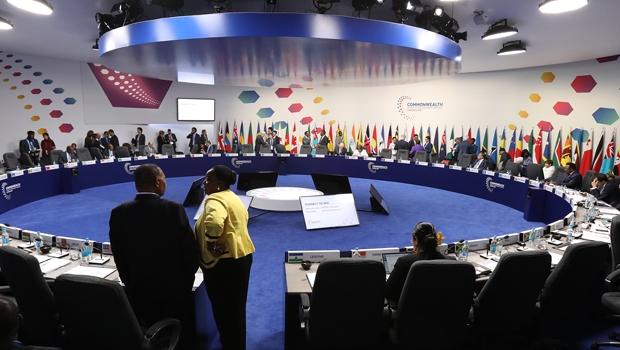
CHOGM Forerign ministers meet in London

Ministers and senior officials from the 53 Commonwealth nations met yesterday at Lancaster House in London ahead of the Commonwealth Heads of Government Meeting (CHOGM) today, and discussed how member states could work even closer together on sustainability, fairness, security and prosperity.

Among the topics were how member states could collaborate to tackle the existential threat of climate change and the adoption of the Commonwealth Blue Charter on ocean governance.

The meeting came ahead of Thursday’s CHOGM that Uganda’s President Yoweri Museveni is attending and addressing the ministers, Secretary-General Patricia Scotland said: “It is really exciting because every foreign minister around that table said they were wholly supportive of the Blue Charter and they intended to recommend it the heads. The Secretariat, with all our member states, has worked really hard to present it as a solution to some of the challenges we face. It’s a proud moment for all our 53 countries and it is a proud moment for the Secretariat. We’ve got our fingers crossed that when our leaders see this, they will celebrate with us.”

Ministers were also shown the new Innovation Hub, which was launched on Monday, and the toolkits aimed at sharing best practice around the Commonwealth.

Ministers’ views on all the topics which were discussed will now feed into the main CHOGM conference, the theme of which is ‘Towards a Common Future’.


Stories Continues after ad

Peace at Makerere as Council bows to students’ demands

Makerere University Administration Building

Makerere University has bowed to students demands and shelved the proposal to increase tuition for some undergraduate programmes. This followed a two-day sustained strike that had the police intervene with teargas.

The university took the decision Wednesday during a meeting that had in attendance the Vice Chancellor Professor Barnabas Nawangwe, student leaders, Kampala East Regional Police Commander Wesley Nganizi and other staff.

Under the proposed tuition fees structure for the academic year 2018/2019 that starts in August, the University Council had hiked tuition fees for postgraduate and some undergraduate programmes.

The university council, before the students’ strike, had proposed that Post-graduate diploma and master’s degree students pay a minimum of sh5m per year while doctoral students were expected to pay sh7m for any given programme.

It said, over the past years, post-graduate students at the university have been paying fees ranging between sh1.7m (for a postgraduate diploma in education) to sh5.7m per year.

The other issue of contention is that the students are against the university’s offer Shs450 per day as food allowance and want the university to continue serving them food at their halls of residence.

The suggestion to scrap off evening programmes did not also go well with students and the general public who accused the university’s administrators of trying to deny Ugandans chance to study, especially the working class.

“This is to inform you that following consultations with the chairperson of Makerere University Council, it has been agreed that the new fees for selected programmes in the College of Health Sciences, College of Veterinary Medicine, Animal Resources and Bio Security and College of Humanities and Social Sciences be suspended until consultations are made with the students guild for their input,” reads part of the letter signed by Prof. Nawangwe.

Addressing fellow students at the university, Papa Salim Were, the guild president, urged them to suspend the strike, saying that the administrators had addressed most of the issues made them to opt for what he called a ‘peaceful strike’.

“We have come up with a committee which is going to discuss with the administrators and revise all the policies which were suggested,” Were said. “All the students who were arrested were released, but we are not happy with the police. They mishandled us, yet we were peaceful,” he said.

This the first major strike since Prof. Nawangwe assumed office as VC.

While giving his inauguration speech on September 14, 2017, Prof. Nawangwe promised so many reforms. Under Academic reforms, Prof. Nawangwe said, they would restructure all courses and programmes to make them more practical and relevant to the needs of society, operationalize e-learning and distance education and aggressively move towards increasing the proportion of graduate students.

“We will gradually manage undergraduate student numbers and aggressively increase the graduate student numbers to enhance research capacity and output leading to increased innovation,” he said.

Analysts now say the fees increments goes against such reforms especially it would bring down the number of post-graduate students, he had suggested to increase.

In November 2016, President Yoweri Museveni, who is the Visitor of the university appointed the Visitation Committee led by the late Dr. Abel Rwendeire, to visit, study, make a situational analysis on causes of endemic strikes, assess progress on the implementation of previous reports, conduct an appraisal of the integrity of finance management and establish the student and staff numbers.

The Committee would then adopt an integrated approach to address the task including among others; desk reviews of relevant documentation, stakeholder interface, financial and other relevant audits, benchmarking and dialogue with the public.

Having established the issues, the committee presented a report to Museveni, saying it was  designed to enable Uganda’s higher education subsector in general and Makerere University in particular to address the developmental challenges of this country, the region and Africa.

However, the effective and efficient implementation of these recommendations, they said would require collective effort from Government, Makerere University and other stakeholders including students.


Stories Continues after ad

Police arrests man responsible for hate massages between Itesots and Japhadola

Andrew Ofumbe. Photo Credit, KMP.

Police has arrested a man responsible for a series of offensive Facebook posts about Itesots and Japhadola in Tororo district that fuel up tribal sentiments on a daily.
Following a report of a series of offensive online posts relating to the two rival tribes from a Facebook page alleged to be belonging to 100.2 East FM Midundo Zaidi an investigation was sanctioned by Uganda Communication Commission.

According to Kampala Metropolitan Police, after a few months, police traced the Facebook page to having been created and managed by a 31 years old Andrew Ofumbe a former employee of the same radio station.

He had created a parody account with similar features as that of the prominent radio station which was used to spread divergent views and ignite hatred between the two different tribal groups in Tororo District.
“We have arrested him and charged him of offensive communication under the Communications Act. He has since been taken to Tororo Police Station where he shall then be arraigned before courts of law.” A police statement reads.

“We hope that the arrest of this individual sends a clear message that police will not tolerate any form of activity which could incite hatred and provoke offensive comments on social media.”

Stories Continues after ad

Ugandan troops feted by AMISOM for distinguished service

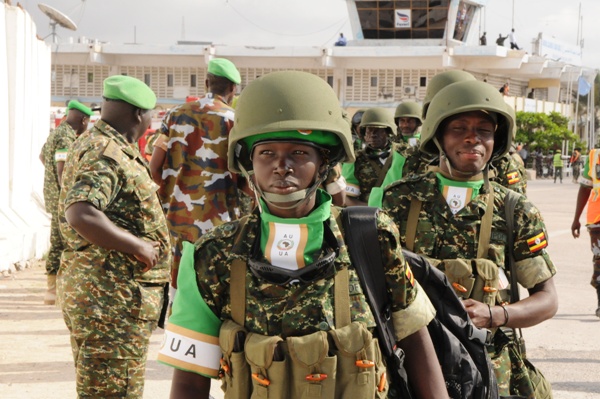
UPDF soldiers in Somalia

A contingent of Ugandan soldiers has been feted by the African Union Mission in Somalia (AMISOM) for distinguished service, at a medal awards ceremony held in Somalia’s capital Mogadishu.
The soldiers, who have completed their tour of duty, are part of battle group 21 of the Uganda People’s Defence Force who were tasked with securing Mogadishu and neighbouring regions.
The AMISOM Deputy Force Commander in charge of Support and Logistics, Maj. Gen. Salvator Harushimana, while commending the outgoing troops, reiterated the commitment of the African Union towards ensuring a safer and stable Somalia. He lauded he troops for performing their duties with diligence. “During their stay, they performed their duties with dedication and a high level of professionalism. They did not only represent Uganda well but also made the African Continent proud,” Maj. Gen. Harushimana noted.
The Deputy Force Commander said the battle group participated in many operations, ranging from conducting combat operations against the Al-Shabaab to securing the Main Supply Routes, by conducting regular patrols and escorting vehicles carrying humanitarian relief aid.
Uganda’s Deputy Ambassador to Somalia, Maj. General Nathan Mugisha, who was the chief guest at the medal awards ceremony, called for more investment in social amenities critical for the survival of the populations to help supplement efforts being made by the military to stabilize the country.
Maj. Gen. Mugisha also noted that there is need to enhance governance, justice and rule of law and humanitarian support in liberated areas to enable residents lead a normal life.
He commended the Somali National Army for remaining resolute in face of multiple challenges and urged the international community to aid the force in its efforts to secure the country.
“I would like to thank our friendly forces, with whom we have been fighting here trying to bring peace to Somalia; the many contingents. But also the Somali National Army with whom we have really struggled, given the fact that they are less provided, given the fact that they have so many challenges; we thank them and we encourage them to maintain the spirit,” Maj. Gen. Mugisha stated.
The Contingent Commander of the Ugandan troops, Brig. General Paul Lokech, applauded the outgoing troops for their selfless service commitment to secure the Horn of Africa country.
Said Brig. Gen. Lokech; “You have shown the international world that Africa can make it possible. When we were coming here in 2007, we were told by the Western media that this mission would fail on arrival; but today, its 10 years and we still moving forward, carrying the flag of the African mission, and carrying the flag of Uganda.”
Brig. Lokech also paid tribute to fallen soldiers who lost their lives in the quest for peace in Somalia saying they will forever be remembered for their bravery. “To all our comrades who died in combat, they died for a purpose and we shall never, ever forget them,” he said.
In his remarks, the battle group commander, Col. Chris Ogwal, commended his troops and their counterparts from the Somali National Army for their diligence and commitment to service.
Col Ogwal appealed for more investment in quick impact projects, noting that the lack of basic health services presents the biggest challenge to improving living standards of the Somali population.
“I want to thank the Somali people, especially the people we interacted with, the civilian leadership in the areas where we were working; local leaders, the police and the military personnel. In this area, I really want to give thanks to Afgoye police and the police in Lafoole,” Col Chris Ogwal stated, adding that the officers in the two police stations had been very cooperative and were always available to help in times of need.

Stories Continues after ad