Stanbic Bank
Stanbic Bank
24.3 C
Kampala
Stanbic Bank
Stanbic Bank
Home Blog Page 1604

Canadian firm hires top deal maker ahead of funding Uganda cobalt

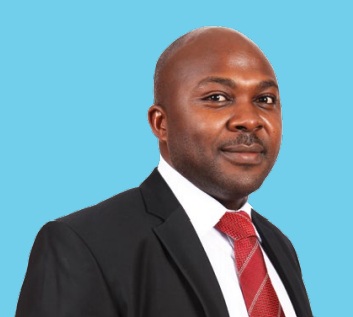
Mahendra_Naik

Canada’s M2 Cobalt has appointed a top deal maker of mergers and acquisitions as the company prepares for what could be an aggressive foray into Uganda’s cobalt industry, the company said in a statement to the media.
The company said the appointment of Mahendra Naik as an advisor to its board of directors “brings a wealth of expertise in helping to grow junior resource companies into world players.” According to his profile, Naik is a Chartered Professional Accountant and was one of the founding directors and key executives for IAMGOLD Corporation, a listed gold mining company with a market capitalization of $3 billion.

As chief financial officer for IAMGOLD, Naik is said to have put together US$550m in major debt and equity financings in the 1990s. He is said to understand Africa’s mining industry quite well. The appointment of Naik comes right after M2 Cobalt embarked on its exploration programme for cobalt in Bujagali in eastern Uganda and in Kilembe in the western after assembling teams at its mining sites.

Among other activities, M2 Cobalt also launched aerial drone surveys over its mining sites, with a high resolution magnetic and electromagnetic airborne survey planned for its Kilembe property. In a company statement, Dean Besserer, the technical advisor and manager of the exploration program, is quoted saying: “This is an exciting time for M2 Cobalt as the next phase of exploration commences.
Uganda is vastly under-explored, and the Company has designed a comprehensive exploration program within its very large land package… Some of our licenses are very close to, and are on trend with, the former producing Kilembe mine which was historically a significant producer of high-grade copper and cobalt.”
In January, M2 Cobalt Corp. completed the acquisition of seven exploration licenses that span 1,564 square kilometers for a cash consideration of $1.1 million and some shares. The money, on top of some shares in the company, was given to the earlier shareholders of the mining licenses, who are listed as 1126302 B.C. Ltd.

Five of these licenses are in the Bujagali property and stretch 1,371 square kilometers, while the other two are in Kilembe, totaling 193 square kilometers. In coming to Uganda, M2 Cobalt will try to achieve what Kasese Cobalt Company Limited failed to do – to turn cobalt resources into the lucrative mineral that it is.

Kasese Cobalt Company Limited collapsed after a drop in prices on the international market and the depletion of copper tailings from the neighbouring Kilembe Mines Limited. The increasing popularity of electric cars and electronics has turned around the fortunes of cobalt, with demand expected to jump 40 per cent in 2018.

Apple is now trying to skirt the bloody hotspots of DR Congo, one of the main producers of the mineral, to get the cobalt directly from certified miners. BWW and Volkswagen are said to be increasing their budgets for the purchase of cobalt. The Economist magazine recently reported that “each new electric vehicle uses about 10kg of cobalt.” A tonne of cobalt now goes for just over $85,000, up from $30,000 a decade back.

Stories Continues after ad

Levy new social media tax on Facebook… not users

Mr. Muwema

By Fred Muwema
I’m not a fan of lugambo (idle talk) on any day, but I hear that the Government of Uganda will levy a tax on social media users who engage in too much of it, in the hope that Shs400 billion will be generated every year. It is not proven that Ugandans use social media mainly for idle talk, though I don’t think there is much benefit in going down that road.

Whether this tax is supposed to stop or promote lugambo, I can’t say. What I know is that this supposed idle talk earned social media giant Facebook about $ 5.85 billion in advertising revenue from overseas users in 2017 which is about a fifth of Uganda’s GDP standing at $ 25.53 billion (2016). Almost three million of the users who generated this income were from Uganda. Like they say, there is a silver lining on every dark cloud but it appears government is handling this dark cloud of social media from the wrong end of the stick. It is my argument that by proposing a further tax on social media users instead of the social media platform owners, the Government of Uganda has missed the silver lining. Other countries are handling this complex subject of digital taxation on social media in a superior way.

Even though Uganda is entitled to formulate its own policies, it should deconstruct its approach to this social media tax on users and allow to be persuaded by best practices elsewhere. There is a raging debate in many jurisdictions (Uganda appears to be missing out on this debate since it is busy chasing Users) where the question as to where the tax value is created rather than where the taxes are paid is guiding the conversation. Our government must realize that in this global digital economy, social media users are playing a key role in generating value for digital companies and it is against these companies that it should seek most of the taxation and not the users. Other governments around the world which are open to a more progressive outlook to these things are pushing to rewrite their tax rules to capture tax from Technology Companies like Google, Facebook, and Amazon etc which may have no representative offices, or other physical presence in a country, but are accruing profits through large numbers of online Users.

In the story carried in the Wall Street Journal of the 12th December 2017 under the title “Facebook to Give Countries a chance to Tax its profits from local Ads”, it was reported that Facebook had become the latest US Tech Giant to bow to pressure from foreign governments to simplify its tax structure and potentially pay more income tax overseas. Mr. Dave Wehner, Facebooks Chief Financial Officer was quoted as saying that “moving to a local selling structure will provide more transparency to governments and policy makers around the world.” Already many countries in the European Union and others in Asia like Indonesia, are proposing a tax on big internet companies to make up for income tax they would pay if they reported their profit in the countries where they do business.

Before chasing after struggling Ugandans to collect what would be an unconscionable double consumption tax, the Government of Uganda must insist on getting its pound of flesh tax from the social media giants rather than the Ugandans who don’t have much flesh left.

Based on the provisions of our Income Tax Act Cap 340, I maintain that Facebook and other social media platforms which are non-resident in Uganda but derive business income from Uganda when our users contribute to the their advertising portfolio against which advertisers pay millions of dollars every year, should pay income tax proportionate to the number of users who generate it here.

These companies cannot deny that some of their income is derived from Uganda because under S. 79 Income Tax Act, income is derived from sources in Uganda to the extent to which it is a royalty arising from the disposal of industrial or intellectual property used in Uganda. My interpretation of this provision is that the profiled data base of social media Users in Uganda when used to generate Advertising revenue for Facebook, or Twitter is copyright/intellectual property used in Uganda. On this basis, I see no reason why government should not at least make an effort to collect taxes on this royalty income earned by the social media companies other than engaging in an exercise which looks like an attempted rearguard action to shut down social media in the long run.

Even if these companies may contest the taxation on various technical grounds as they are want to do, there would be enough precedent to be drawn from other countries to levy the income tax. The other benefit of such a move is that it would inform government policy better and probably lead to appropriate amendment of our tax laws to cover any gaps presented by this phenomenon of e-commerce transaction taxation instead of throwing our taxation in a topsy turvy situation.

Otherwise insisting on taxing social media users in a country where one of the regulators of social media, NITA-U developed guidelines in July 2013 to assist government ministries and departments to use social media as a tool for engaging with the citizens of Uganda, will be self-defeating of government’s own policies.

If government is afraid to confront Facebook and other social media giants and scoop some deserved taxes, it can seek an East African or African Union approach to the issue. I am sure other African countries which have hitherto been collecting nothing from the social media giants would like to emulate the Europeans and Americans and collect something for their treasuries. This may look difficult yet it is achievable and a more patriotic thing to do as a country.

Fred Muwema
Managing Partner
Muwema & Co. Advocates

9th April, 2018

Stories Continues after ad

DStv and GOtv roll out FIFA World Cup programme

Phoebe Nakabazzi (L) DStv Marketing Manager and Albert Nga, GOtv Marketing Manager display the FIFA 2018 World Cup fixtures with SuperSport annoucing broadcasting all 64 matches

MultiChoice Uganda has revealed its preparations for the upcoming FIFA World Cup in Russia, aimed at attracting massive watching.


The world’s best footballers on the world’s best sports broadcaster! This is the promise from Super Sport, which will broadcast an unprecedented offering of World Cup football, beginning in June.


Addressing media at the MultiChoice Head office, Phoebe Nakabazzi , DStv Marketing Manager said: “In mid-April, the switch will be flipped to a 24-hour World Cup channel (SuperSport 13), allowing fans an appetiser of the 2018 FIFA World Cup – to come two months later from the heart of Russia. Packed with legacy content, highlights, documentaries, FIFA films, classic matches and interviews, the channel will also feature warm-up matches to prepare every football fan for the tournament that traditionally gets the world talking.”


From June 14 until the final in Moscow on July 15, MultiChoice will present an unparalleled viewing experience of the 2018 FIFA World Cup for DStv and GOtv customers across all platforms.

Senegal, Nigeria, Egypt, Tunisia and Morocco will be spearheading the African challenge come June.

All 64 matches of the 2018 FIFA World Cup will be available on all DStv packages.

Ms Nakabazzi added: “What’s more, DStv customers will be treated to two 24-hour pop-up channels (SuperSport 13 and 14) dedicated entirely to the tournament with live match commentary options in Pidgin and Swahili. Coverage will be integrated into a multi-platform offering that includes traditional television, on-the-go via the DStv Now app and online at supersport.com. There will also be regular news updates on the popular Blitz channel.”

Also at the press conference, Albert Nga, GOtv Marketing Manager said: “GOtv Max, Plus and Value packages will show 64 matches and 56 matches respectively while GOtv Lite customers can also catch highlights on Blitz”.

“This is a comprehensive offering that reflects the global reach and excitement on the world’s number one game.  Few events enthral people in every corner of the earth, but the World Cup does so. We’ll be pulling out all stops to tell the story of the 2018 edition in rich colour and language,” Mr. Nga added.


Stories Continues after ad

Indian firm to continue reviewing Umeme’s concession

UMEME CEO Celestino Babungi

India’s Tata Consulting Engineers, which is currently assessing whether Umeme Limited has satisfied government’s conditions, is expected to continue with its assignment even though a recent letter written by President Yoweri Museveni, called for the cancellation of the power firm’s 20-year concession.

According to a recent report, Tata, which was commissioned by the Electricity Regulatory Authority, is analysing the performance of Umeme, especially its investment in network. The Indian company is expected to hand over the report to ERA in the next two months, and the regulatory authority is expected to use the contents of the report to set parameters for Umeme Limited for the next six years starting 2019.

Tata’s assessment comes at a time when a number of businessmen are thought to have gotten the President’s attention to cancel Umeme’s contract. The lobbyists, according to different sources, are said to have peddled lies and half-truths, the effect of which culminated in President Museveni’s recent contract cancellation letter.

Negotiations between ERA and Umeme over new terms of its concession, which is expected to wind up in 2025, are slated to start in July this year. Some of those negotiations are expected to focus on how the two calculate the investments that are supposed to be recouped from the power tariff, which is currently a bone of contention.

The process of reviewing Umeme’s contract is critical and nearly everyone should be interested because it ultimately determines how much is paid for electricity. In 2011, ERA hired South Africa’s Parsons Brinckerhoff Africa (PTY) Ltd (PB) to review Umeme’s performance. The report produced questioned some of Umeme’s investment figures, which were to be recouped from the power tariff.

The report showed that there were less investments by Umeme than what was being factored into the tariff. Umeme disputes the contents of that report. Nevertheless, ERA used some of PB’s findings to justify its push for a modification of Umeme’s license.

The financial impact of PB’s report came to light recently when Umeme released its accounts for 2017, where it showed that it had recorded an impairment provision of more than US$31m due to the modification of its license.

The modification of Umeme’s license, which was done in May last year, means the company lost some revenue that it used to make from the capital investments it made in energy purchases from Uganda Electricity Transmission Company Limited.

Umeme’s net profit for 2017 dropped to US$9.8m from US$38.6m in 2016 partly due to the high financing costs, the sources said.


Stories Continues after ad

Govt, investors ready to sign US$4b Hoima oil refinery agreement

An Oil rig site

Uganda is set to formally sign the contract for the construction of the US$4 billion oil refinery as early as April 10, 2018, sources involved have indicated.

The Ministry of Energy and Mineral Development officials together with the Albertine Graben Refinery Consortium, which is led by General Electric, initiated the refinery contract on March 28, 2018, different sources have confirmed.

The contract will include the construction of a 211-kilometre petroleum products pipeline from Hoima to Buloba, which is located northwest of Kampala. The signing of the contract will end a more-than-five-year struggle by the Uganda government to get a company to invest in a refinery, whose return on investment has been questioned.

The refinery will be built under a public-private partnership, favouring the consortium with a 60 per cent shareholding while the government, through the national oil company, will retain the other 40 per cent, the sources said. Uganda is expected to invite East African states to buy into its 40 per cent stake, with Tanzania earlier committing to taking up about seven per cent of this stake.

There appears to be a slight change in the setup of the consortium, sources say. The original consortium was made up of General Electric, Saipem SPA from Italy, Yaatra Ventures from the United States of America and Intra-continental Asset Holdings. However, there is a company called Lionworks, which has replaced Intra-continent Asset Holdings.

“The profile of the consortium looks quite weak and there are some doubts it can pull off a USD4b project. There is little independent publicly-available information about Intra-continent Asset Holdings and Lionworks. Questions are bound to be asked as to how this consortium will be able to attract the capital and expertise to build the refinery,” an analyst said.

However, in October, the Albertine Graben Refinery Consortium had posted a US$2m commitment bond with government ahead of the signing of the Project Framework Agreement (PFA). Up to 70 per cent of the financing of the refinery will be through debt with the other 30 per cent coming in as equity from the project Oil and Gas partners.

In August last year, the government announced that it had “agreed core project terms” for the refinery project. It was noted that after the signing of the PFA, the consortium would be required to finance all pre-Final Investment Decision activities up to US$100m. The Pre-FID activities, according to the terms of the arrangement, include market studies, logistics studies, technology licensing, refinery configuration studies, Environmental and Social Impact Assessment, and Front End Engineering Design. These activities are expected to start after the signing of the contract.

The major upstream companies operating in Uganda – Total, Tullow and Cnooc – had for long preferred a crude oil export pipeline because they felt the product had a more lucrative market abroad. Uganda’s government thought otherwise, throwing its weight behind the construction of a refinery. Government commissioned a Swiss firm, Foster Wheeler, to come up with a report that offered pointers on how an oil refinery made economic sense, especially from the perspective of creating spin-off industries such as those that make bitumen, which is crucial in the construction industry. Compromises needed to be made. To get the three oil companies to commit investments in the country, the Uganda government agreed to the demands of having a crude oil pipeline. However, it never dropped its ambition of building a refinery.

The structure of having an oil refinery and a crude oil pipeline led to another important negotiation: how much crude would each take and which infrastructure would take the first call on the oil resources. Government settled for a 30,000-barrels- per-day refinery, which would later be ramped up to 60,000. The refinery, it was agreed, would take the first call.

Earlier figures showed that the crude pipeline would carry 120,000 barrels of oil per day, shooting up to 180,000 barrels only after the refinery’s demands had been met. Now, current figures show that the crude oil pipeline will carry about 212,000 barrels of oil per day.

Stories Continues after ad

Sadolin, Seroma give facelift to Archbishop’s Palace at Namirembe

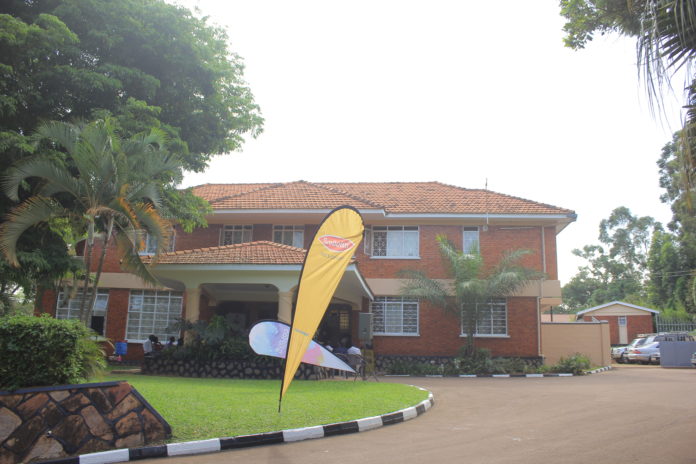
Refursbished palace of the archbishop of Uganda

The Archbishop’s residence in Namirembe has been given a new facelift following a week-long painting of the building by Sadolin in partnership with Seroma Limited.
The painting of the palace which ended on the weekend is part of Sadolin’s continued efforts to contribute to the community. Sadolin contributed a total of 810 liters of paint to the project while partner Seroma Limited financed the logistics for this project.

The inauguration of the refurbished palace was hosted by the Most Reverend, Archbishop of Uganda, Stanley Ntagali at the residence in Namirembe. The function was attended by representatives from the provincial office of the Church of Uganda, Sadolin Paint staff and the Seroma Limited proprietors Mr and Mrs. Robert Sekidde.
Speaking at the event, Archbishop Ntagali thanked Sadolin Paint and Seroma Limited for their heartfelt contribution towards restoring the palace to its original beautiful state saying that the palace is considered a monumental building in the Church of Uganda as a number of Archbishops have lived there. “The palace of the archbishop is not only a home for us that live there, but a home of the Lord and we would not be any more grateful for this kind gesture towards the church,” Ntagali said.

He said that a number of Church of Uganda buildings were in need of a facelift and that he would endeavor during his tenure as Archbishop of Uganda and Bishop of Kampala to make sure that he leaves a larger number of them refurbished.
Mr. Ashish Devani while speaking at the event said that Sadolin through its social responsibility looks to continuously support refurbishments of monumental structures so as to preserve the history of the country. “Ours is a small contribution and we are delighted to partner with Seroma Limited for this project and also contribute to the preservation of the monumental structures of the Church of Uganda,” he said.
Speaking on behalf of Seroma Limited, Mrs. Margaret Sekidde said that the company always works on the service of the Lord and as soon as they were appointed as part of the renovation committee of archbishop’s palace, chose Sadolin as the strategic partner for the project. “We are happy to see that this project has come to fruition and thank Sadolin for their contribution,” she said.
The Archbishop’s Palace is the formal the residence of the Archbishop of the Church of Uganda. The residence is located on Plot 836, Willis Road, Namirembe.

The Dedication stone of the Archbishop’s residence was laid by The Most Rev. and Rt. Hon. The Lord Archbishop of Canterbury Dr. George Leonard Carey and was assisted by the Most Rev. Livingstone Mpalanyi Nkoyoyo, Archbishop of the Church of the Province of Uganda on May 8, 1998 after major renovations and extension of the residence which had started in 1994. Until April 2018, the residence was last refurbished in 2012.
The palace has so far been home for the following former Archbishops; The Most Rev. Janani Luwum , The Most Rev. Livingstone Mpalanyi Nkoyoyo , The Most Rev. Henry Luke Orombi and The Most Rev. Stanley Ntagali.
Sadolin has a rich history that started when Gunnar Sadolin founded Sadolin Farver in 1907 – a concern focused on artist’s paints and printing inks. Five years later in 1912, Sadolin Farver merged with Holmblad to create an organisation with paint manufacturing capabilities.

Between 1912 and 1987, Sadolin & Holmblad underwent significant expansion – first through the production of synthetic organic pigments in 1923 followed by the introduction of a chain of independent paint shops to drive the growth of the Sadolin brand. Akzonobel – previously known as Nobel Industries – acquired Sadolin & Holmblad in 1987 and is the proud custodian of the Sadolin brand in East Africa and across multiple markets internationally.
On the other hand, Seroma Limited is a leading distributor of building and construction materials in Uganda with over 7 branches in the different parts of Uganda. The founders at the back of their mind had a major aim of knowing God and making Him known through business (Psalm 24:1).

Stories Continues after ad

BOU keeps key lending rate at 9 per cent

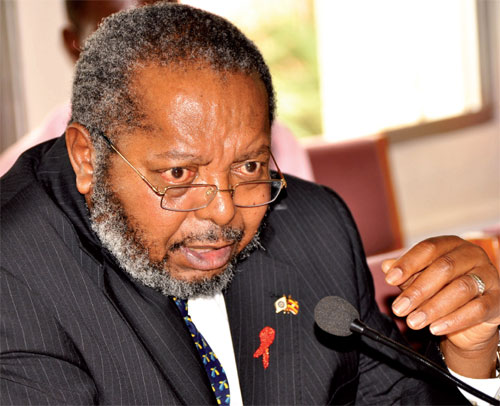
BoU Governor Emmanuel Tumusiime-Mutebile.

Uganda’s central bank-Bank of Uganda has left its key lending rate unchanged at 9.0 per cent, saying that risks to inflation were balanced and inflation was expected to rise gradually.
In February, BOU cut its benchmark lending rate by 50 basis points to 9.0 per cent, its lowest ever, saying lending for small businesses remained costly despite recent policy easing.

BOU governor Prof. Emmanuel Tumusiime-Mutebile while addressing the media in Kampala said that inflation was expected to rise to around 5 per cent by the end of 2019.
“The economic growth outlook is more positive than was forecast at the Monetary Policy Committee (MPC) meeting of February 2018 and there are signs of increased business confidence,” he said.
According to Uganda Bureau of Statistics, inflation plummeted to 2.0 per cent year-on-year in March from 2.1 per cent the previous month as some food prices declined.

The governor said gross domestic product was projected to grow at an average 6.5 per cent in the next three years. The output gap was estimated at about minus 2.0 per cent in fiscal year 2016/17 (July-June), but the gap was expected to close in 2018/19.

He said the forecast gradual recovery of GDP is premised on favourable external scenario, strong private and public investments, improved agricultural productivity, and the absence of significant macroeconomic imbalances.
Mutebile said that there was growth in all major sectors of the economy: the agricultural sector grew by 6.1 per cent in 2017 from -0.4 per cent in 2016, the service sector grew by 8.1 per cent from 4.5 percent while the industry registered a slight growth from 4.2 in 2017 to 4.4 per cent in 2018.

There are nonetheless downside risks to this outlook, as indicators of aggregate demand including fiscal absorption and private sector credit growth remain weak,” he said.

Stories Continues after ad

Crested Cranes drops out of Africa Women Cup

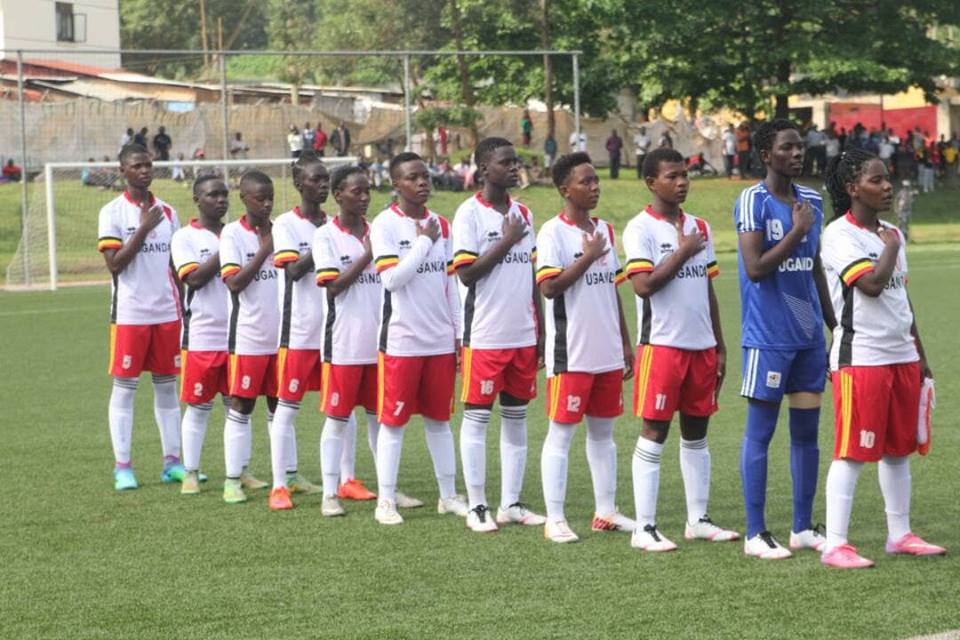
Crested-Cranes-technical team at bench watching the game

Uganda Crested Cranes succumbed to Kenya’s Harambee Starlets on Sunday, ending their dream to represent the country at the women’s continental tournament in Ghana.

The country’s female football side faced a tough challenge on their second leg with their neighbors to the East albeit showing some toughness in the first half of the game.

In the early hours of the game, the Crested Cranes threatened Kenya’s back line with genius attacking from star striker Juliet Nalukenge, who was feeding on crosses from her captain Hasifa Nassuna from the wings.

However, it was Uganda’s lack of sharpness in-front of the goal and poorly coordinated passes on the strike line that made them fail to register on the score sheet in the first half. Kenya’s sticks-lady, Maureen Shimuli, seemed to be on tour.

Uganda’s only highlight of the game came in the 65 minute when Kenya’s Vivian Carzone picked up a free kick at the 18 yard box for open booting Crested Crane’s skipper Nassuna.

Crested-Cranes team before match

Nassuna, however, failed to convert the set piece as move to loop the ball over the four man wall into the net just delivered the ball into Shimuli’s gloves.

Uganda needed a goal to keep their hopes alive for the Ghana Tournament lady’s African Cup after losing to Kenya 1-0 in the first leg of the challenge.

Exhausted and huffing around the pitch by the 70 minute, the Crested Cranes started going for their opponent’s shirts trying to keep up with the threatening pace that strikers like Neddy Atieno and Vivian Carzone had picked.

Cranes Keeper Ruth Aturo, however couldn’t allow a repeat of the first leg. She kept a clean sheet.

“It’s a bad feeling not to win [at] home. We were very wasteful in both halves. We had chances to score, but the Kenyans had the advantages of physique size winning most of the aerial balls especially in defense,” Skipper Nassuna said regrettably.

The aggregate win of 1-0 in favor of Kenya means the Starlets have advanced to face the Equatorial Guinea in the first leg of the African women cup of nations in Ghana.

Stories Continues after ad

Uganda’s Chesang wins Gold at 2018 Commonwealth games

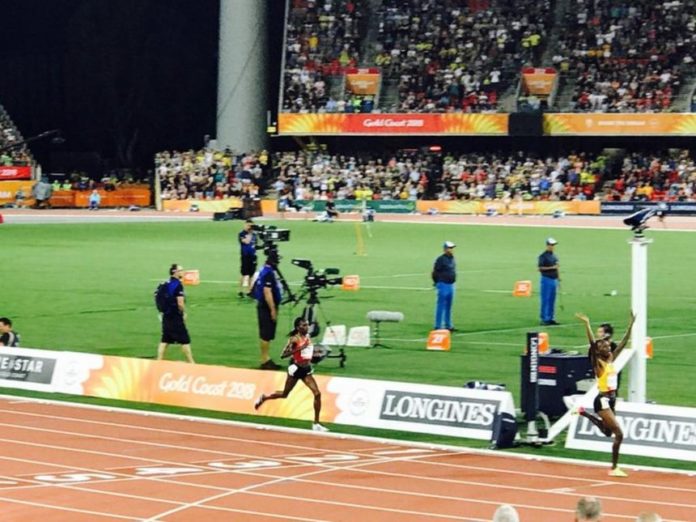
Chesang crosses the line

Stella Chesang has won Uganda’s second Gold medal at the ongoing 2018 Commonwealth games in the women’s 10000m (25 laps) final after clocking a time of 31:45.30.

The 21-year-old long-distance runner beat Kenya’s Stacy Ndiwa who came second at 31:46:36.

Mercyline Chelangat, Uganda’s other representative, finished third and secured Bronze in a time of 31:48.41 while Juliet Chekwel came 7th at a time of 31:57.97.

Stella Chesang won her first national senior title, covering the 10km course in 34:33 at the Uganda cross country championships in 2016.

Joshua Kiprui Cheptegei was Uganda’s first Gold medalist at the men’s 5000m final at the Carrara Stadium on the Gold Coast on Sunday morning.

Uganda now has two Gold and one bronze making it ranked the 14th country in the commonwealth games and the second in Africa behind South Africa which has 4 gold 4 silver and 5 bronze.

Stories Continues after ad

BOU donated Crane Bank to DFCU -Kasekende

Dr. Louis Kasekende.

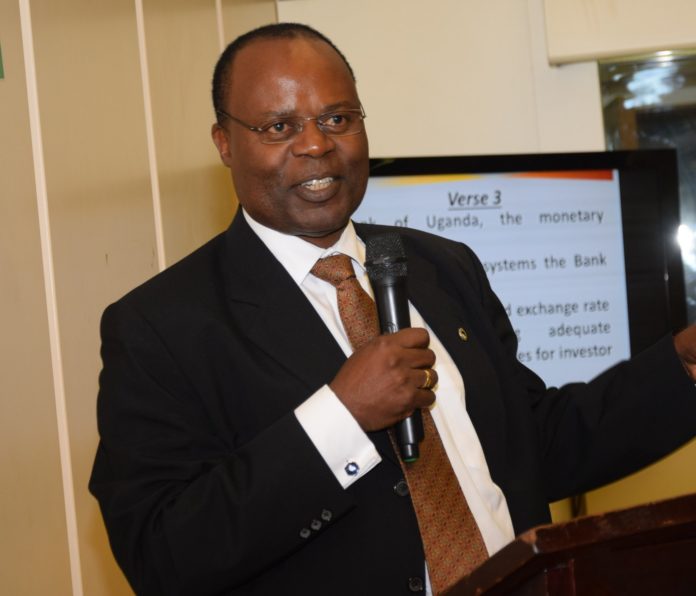
The Central Bank-Bank of Uganda (BOU) did not sell Crane Bank but only gave it freely to DFCU Bank as, Deputy Governor, Louis Kasekende confirmed in a recent speech he made in Kampala while addressing members of the Uganda Securities Exchange (USE).

“The BOU did not sell Crane Bank, because no one would have bought a bank with a negative net worth of this magnitude,” he said. Kasekende claimed Crane had a negative net worth Shs260 billion before it was transferred to DFCU Bank.

But sources say BOU forcefully wrote off Shs600 billion so that they create negative capital, despite shareholders having a paid up capital of Shs350b.

But within the first six months of 2017 after taking over the assets of Crane Bank, DFCU reported a profit of Shs115 billion up from Shs31 billion the previous year. It attributed a huge jump in profits to acquision of Crane Bank assets.

A year later, in its latest financial results released on March 27, 2018 DFCU announced a net profit of Shs127 billion. The bank’s income also doubled over the period to Shs517.3b from Shs257.3 billion the previous year. While assets accumulation jumped from Shs1.8 trillion in 2016 to Shs3 trillion in 2017, and property and equipment from Shs67.1 billion to Shs142.6 billion

DFCU’s impressive financial report has raised eyebrows in the section of the public, asking questions as regards the quick sale of Crane Bank. That DFCU made huge profits after the takeover of Crane Bank is amazing.
What is disturbing the public is that DFCU did not pay cash for Crane Bank, according to the agreement it signed with BOU where it was agreed that it pays over ten quarterly installments over a period of two and a half years, moreover interest free.

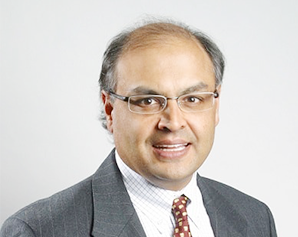
The Crane Bank takeover has been described by some people as asset grabbing by government. Amongst the assets, Ruparelia Sudhir’s lawyers are pointing at the Shs100 billion Crane Bank branches, which legally belonged to Meera Investments Limited which is under Ruparelia Group and had been leased to Crane Bank.
Sudhir’s lawyers say that the terms of the agreement between BOU and DFCU were agreed fraudulently and secretly in documents outside the main sale agreement.

“The net result of these fraudulent side deals was that DFCU got a bank with Shs1.3 trillion of Assets for a net payment of just Shs200 billion (payable under side deals over a period of about 3 years),” reads a memo written by Sudhir’s lawyers, adding that was detriment of the shareholders and other legitimate creditors. That also the deal benefited DFCU and the BOU officials and their transaction advisors.

That a side there is the issue of the cost to innocent taxpayers when BOU sold some liabilities and equal amount of assets to dfcu Bank despite other buyers interested in buying the bank as a whole and on better terms.
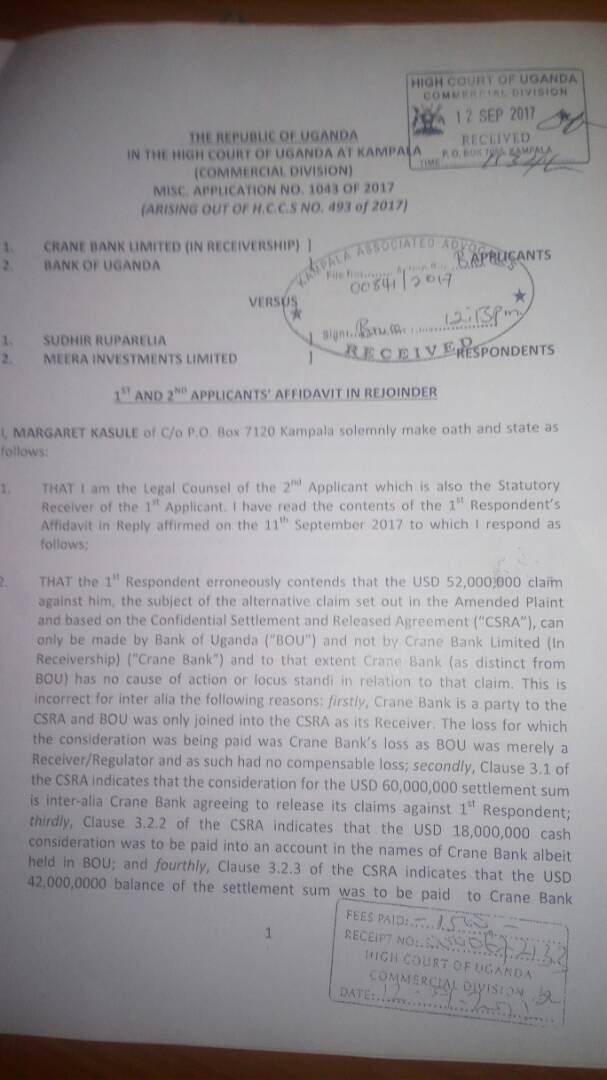
BoU Legal Secretary, Margaret Kasule saw an affidavit in support of BoU saying Crane Bank had never made any loss.
“That I am the legal counsel of the 2nd applicant which is also the statutory receiver of the applicant. I have read the contents of the 1st respondent’s affidavit in reply affirmed on September 11, 2017 to which I respond as follows;

“That the 1st respondent erroneously contents that the $52,000,000 claim against him, the subject of the alternative claim set out in the amended plaint and based on the confidential settlement and released agreement (CSRA), can only be made by Bank of Uganda and not by Crane Bank Limited in the receivership” (Crane Bank) and to the extent Crane Bank (as distinct from BoU) has no casue of action or locus standi in relation to that claim.” Reads Kasule’s affidavit.

Former Executive Director in charge of Supervision Justine Bagyenda in her January 25, 2017 letter to DFCU Managing Director which was titled, compliance accommodations, says “The non- performing loans and advances acquired by DFCU will be managed and reported on separately from DFCU’s pre-transaction balance sheet for a period of at least 12 months”

Stories Continues after ad