Stanbic Bank
Stanbic Bank
18.4 C
Kampala
Stanbic Bank
Stanbic Bank
Home Blog Page 1627

Ugandan Scoops global research award

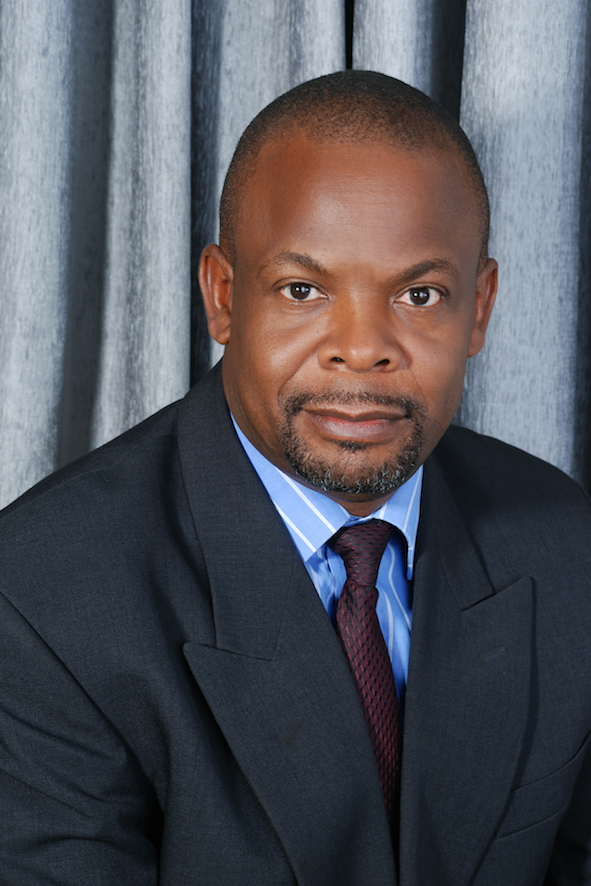
GLOBAL RECOGNITION: Dr. Swaibu Mbowa

Ugandan Senior Research Fellow, Dr. Swaibu Mbowa of the Economic Policy Research Centre (EPRC) has been recognised by the World Bank Group for his role in developing the Risk Impact Assessment (RIA) for Uganda National Fertilizer Policy.

Mbowa got a ‘honorable mention’ in the influential RIAs category and the World Bank says his work is instrumental when carried out through well-conducted analyses, new data and innovative regulatory alternatives.

“This category entails cases where RIA has been able to influence the way policymakers think of a policy problem and has had impact on the regulatory outcome,” says the World Bank.

“Uganda’s RIA had large impact since the country has the lowest uptake of organic and inorganic fertilizer in the world,” it added.

While justifying the honorable mention, World Bank stated: “As the third RIA document produced in the country it will also have immense future impact on the way RIAs is carried out in the country, as it brought lessons on how to deal with diverging stakeholder interests, new ways for policies to set targets, and coordination in policymaking.”

The 2017 Global Regulatory Impact Assessments (RIAs) Awards were organized by the World Bank in conjunction with the Centre for European Governance, University of Exeter, UK.

According to World Bank, the 2017 Global RIA Awards were introduced to encourage teams and public officials who have managed to think outside the box or walked the extra mile to ensure available tools and resources have been used the best way possible in the development of new policies.

Stories Continues after ad

300m Africans now enjoy banking services – report

A new report authored by The Mckinsey Global Banking says Africa’s overall banking market is the second-fastest-growing and profitable of any global region, with over 300 million Africans banked.


According to the report, the number could rise to 450 million in five years.

The report highlights four segments of African markets – from the advanced markets like South Africa and Egypt, to fast-growing transition markets such as Kenya, Ghana and Cote D’Ivoire; sleeping giants like Algeria, Nigeria and Angola to the nascent banking markets like Democratic Republic of Congo (DRC) and Ethiopia.

The report says that Africa’s top quintile banks – the so-called ‘winners’ – are more profitable and over two times faster growing than bottom quintile banks.

Seventy percent of revenue pool growth will occur in the middle segments, defined as earning between USD 6,000 and USD 36,000 in annual income. The mass market – individuals earning less than USD6, 000 per annum – accounts for 13 percent of the growth, but is the fastest growing segment.

Whichever segment banks choose, having the right proposition is key. A survey of 2,500 banking customers in six African countries found that 25 percent of customers choose price as the most important factor in choosing banks. Equally important is convenience, also cited by 25 percent of customers.

Service is the third most important factor, selected by 12 percent of customers. We also find huge cross-sell opportunities – while 95% of Africans have transaction products, fewer than 20 percent have lending, insurance, investment or deposit products.

Forty per cent of Africans prefer to use digital channels for transactions. In four major African countries – South Africa, Nigeria, Kenya, Angola – a higher proportion of Africans prefer the digital channel for transactions to the branch channel.

Given low branch density in Africa, banks need to employ a digital first approach. The report hones in on four themes of innovation emerging in Africa on digital – end-to-end digital transformations (e.g. Equity Bank); partnering with telco companies (e.g. CBA in Kenya or Diamond Bank in Nigeria); building a digital bank (e.g. ALAT in Nigeria); and building an ecosystem (e.g. Alipay in China).

However, it says African banking still has the second highest cost of risk in the world. Poor data availability is part of the problem, with 11 percent of Africans are on credit bureaus, compared to in excess of 90 percent in advanced markets.


Stories Continues after ad

Kiir fires finance minister

SACKED: Former South Sudan Finance minister Stephen Dhieu Dau. Photo credit/gurtong.net

South Sudan president, Salva Kiir sacked the country’s finance minister, Stephen Dhieu Dau.

Salvatore Garang Mabiordit Wol, a former technical advisor in the trade ministry, replaces Dau.

It remains unclear why the South Sudanese leader opted to sack the finance minister, who was appointed in July 2016.

Analysts, however, attribute the president’s unexpected decision to the rising inflation in the country, worsened by the ongoing civil war.

The president, in a separate decree, appointed Erjok Bullen Geu as the deputy commissioner general of the National Revenue Authority.

Stories Continues after ad

Africa trade ministers approve Free Trade Area

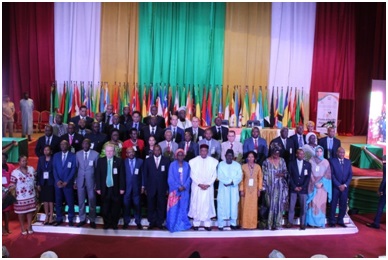
African trade ministers at a past summit

African Ministers of Trade have approved a pact to give local traders access to the continental trade market.

The move is a big achievement for Africa’s regional integration efforts, according to officials who signed the agreement that is now awaiting approval by Africa Heads of State.

Known as the Africa Continental Free Trade Area, the pact is expected to be signed during Extra Ordinary Summit of AU on March 21, 2018.

The ministerial approval came six years after the decision to form the free trade area was adopted during the 18th ordinary session of the Assembly of Heads of State and Government of the African Union held in January 2012 in Ethiopia.

Some of the protocols and annexes in the agreement include Protocol on Trade in Goods, Protocol on Trade in Services and Protocol on Dispute Settlement.

The AFCFTA will bring together 55 African countries with a combined population of more than 1.2 billion people, with a vibrant and growing middle class, and a combined gross domestic product of more than Sh344.08 trillion.

The agreement, once signed by the Africa Heads of State, will improve the regulatory framework of trade in Africa. It will also lead to a reduction of tariff obstacles such as duties and surcharges and non tariff obstacles such as licensing rules and quotas.

Officials say the establishment of a single liberalized market will enhance competitiveness at the industry and enterprise level, enhance value addition of products and exploit economies of scale and optimum utilization of resource.

The establishment of the Continental Free Trade Area provides a comprehensive framework to pursue a developmental regional strategy alongside Boosting Intra-African Trade (BIAT) action plan which targets to double intra-African trade flows by January 2022.


Stories Continues after ad

EADB secures US$15m loan for traders in region

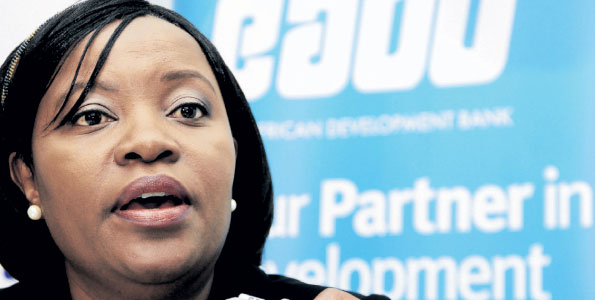
EADB boss Vivienne-Yeda

The East African Development Bank (EADB) has secured a USD 15m loan from the Arab Bank for Economic Development in Africa (Badea) for onward lending to traders in Uganda and other countries in the EA region.

The credit will enable EADB finance imports from eligible Arab exporters to particular importers in the East African Community (EAC) countries.

EADB – owned by Uganda, Kenya, Tanzania and Rwanda, funds regional projects in the infrastructure, manufacturing, agribusiness and education sectors.

“We have continued to build relations with new lenders and development partners. To this end, the Arab Bank for Economic Development in Africa (Badea) has established a line of credit with the EADB of an amount of $15 million,” said EADB director-general Viviane Yeda in a statement.

As at end of 2016, the EAC member states had a stake of 87.3 per cent, with African Development Bank (AfDB) holding most of the remaining shares through its 8.8 per cent shareholding, callable capital, technical assistance and funding lines.

The EADB strategic plan for the period 2016 to 2020 follows a period of business growth over the previous plan period 2011 to 2015 and an in-depth review of EADB operations and related operations policies in 2015.

In December last year, Global Credit Ratings (GCR) affirmed the long-term and short-term national scale ratings assigned to the regional lender of AA+ in Uganda, Kenya, Tanzania and Rwanda and accorded it a stable outlook.


Stories Continues after ad

Report on agro industrialization in final stages

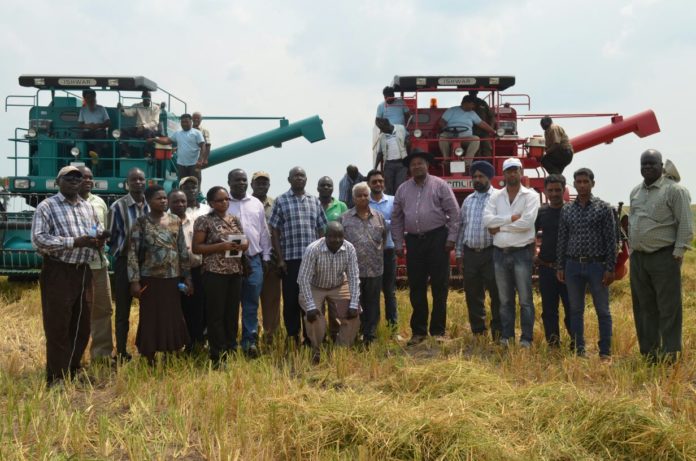
Promoters of agro industralisation drive

The Economic Policy Research Centre (EPRC) is finalising a report on fostering a sustainable agro-industrialization agenda in Uganda.

Agro industrialization is aimed at transforming Uganda into a modern and industrial country through adding value by processing and increasing exports of higher value products.

Speaking during a validation workshop held recently in Kampala, EPRC’s Principal Research Fellow Ibrahim Kasirye said Uganda’s agro industrialization agenda is pivoted in three areas: Agro-processing, distribution, and farm input provision activities, institutional and organizational coordination between agro-industrial firms and farms and parallel changes in the farm sector, such as changes in product composition, technology, and sectoral and market structures.

Once attained, he added, agro Industrialization would propel Uganda’s aspirations of attaining lower middle-income status by 2020, having an industrialised economy and transformed agriculture sector.

However, Kasirye says that missing links in policy coordination, budgeting, structural bottlenecks and knowledge gaps lie amidst agro industrialization agenda.But these call for comprehensive policy implementation plans, sequential budget support to industries that support forward and backward linkages, ease access to finance for local agriculture firms and strengthening of gaps between scientists, policy makers and private sector.

The EPRC agro industrialization study seeks to among others; examine how the current global, continental, regional as well as domestic policy, legal and institutional frameworks support or hinder agro-industrialisation in Uganda and map requisite support services to support agro-industrialization activities.

The study will end with generation of five policy briefs and a final report that shall be shared during the national conference on Agro-industrialisation in April 2018.

The study will also inform the drafting of Uganda’s agro-industrialisation policy and public investment policy.

Government’s agro industrial efforts include the BIDCO for vegetable oil project in Kalangala, the Banana Industrial Development (PIBID) in Bushenyi, Soroti Fruit Factory, Kisoro Potato Processing Industries (KPPIL), Luwero Meat-processing-factory and Operation Wealth Creation (OWC) among others.


Stories Continues after ad

School raises exam registration fees

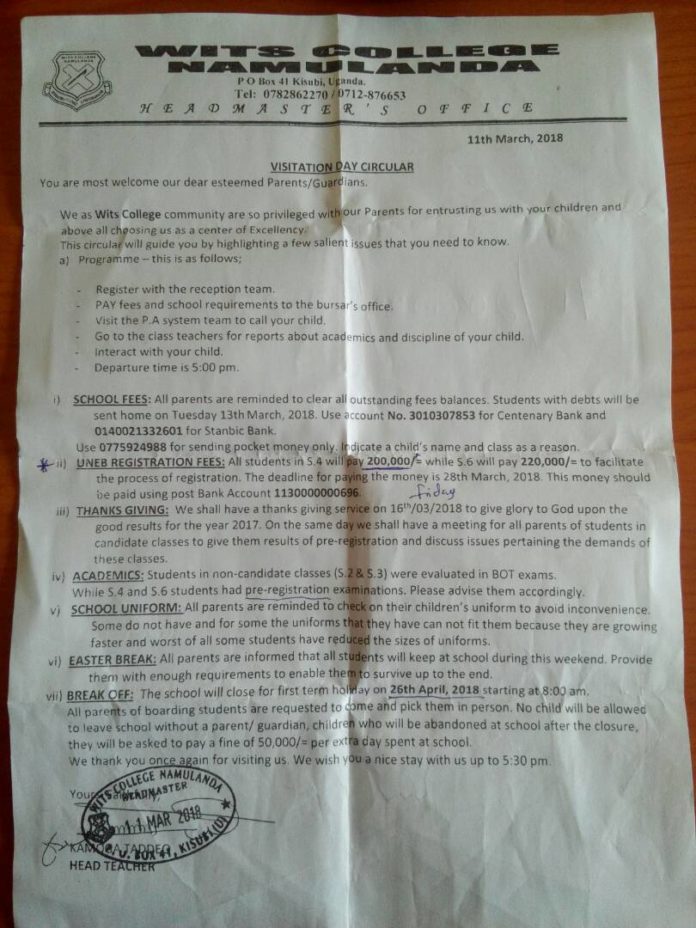
The letter written by school administration to parents

Wits College Namulanda has increased the exam registration fees from the officially announced charges set by the Uganda National Examinations Board (UNEB), for this year’s Senior Four and Senior Six candidates.

This year, while releasing the S4 exams, the UNEB Executive Secretary Dan Odongo disclosed that the examination body charges 34,000 shillings, 164,000 shillings and 186,000 for Primary Leaving Examinations, UCE and UACE, respectively.

The same information is contained in a circular released by UNEB and copied to Head teachers of all primary and secondary schools; District Education Officers; District Inspectors of Schools and the Examination Centre Supervisors.

But according to a visitation day circular that was released by the Wits College administration on Sunday, March 11, S4 candidates will now be required to pay exam fees of Shs 200, 000 and 220,000 for S6, respectively.

‘UNEB REGISTRATION FEES: All students in S4 will pay 200,000/= while S6 will pay 220,000/= to facilitate the process of registration. The deadline for paying the money is 28th March, 2018. This money should be paid…’ the circular indicates in part.

Sources that talked to this website on a condition of anonymity, said Wits College Namulanda has over 200 S4 candidates, adding however, that the centre will only accommodate 91 of them, all paying Shs200, 000, in effect, earning the school administration over Shs3 million more than what is officially provided for.

The sources further said the remaining S4 candidates, whose number is about 100 will then be taken to other centers and charged Shs 280,000, bringing in Shs11 million more. By press time the EagleOnline was unable to establish the number of S6 candidates the school is set to register.

Efforts to contact Wits College administration were futile by press time, but the sources said the issue of charging higher examination fees is rampant, carried out mostly by Head teachers of private primary and secondary schools.

Early this year, the Minister for Education and Sports Janet Kataha Museveni warned and vowed to take action against schools that hike examination dues among other fees.

Similarly, in his submission, Odongo implored schools to always clearly why they are charging more money instead of lumping the charges as ‘UNEB fees’.


Stories Continues after ad

Maj Gen Gwanga fails to turn up for decoration

Major General Kasirye Ggwanga.

Controversial Major General Kasirye Gwanga has today failed to turn up for a decoration function at the Ministry of Defense headquarters in Mbuya.

The outspoken Special Presidential Advisor on Buganda, who is set to retire this year, was last week promoted by President Yoweri Museveni from the rank of Brigadier to Major General.

However, at today’s function officiated at by the Chief of Defense Forces Gen David Muhoozi, Kasirye Gwanga’s name was read but he was nowhere to be seen.

Maj Gen Gwanga, who is said to have retired in 2005 and later recalled by the Commander in- Chief Gen Yoweri Museveni, is serving as a Presidential Advisor on a renewable contract.

Meanwhile, other senior officers promoted and decorated today include Brig Stephen Rwabantu to Maj Gen (Deputy General officer Commanding Reserves); Col Charles Wacha to Brigadier and Director Human Rights and Col Charles Byanyima to Brigadier and Commander Motorized Infantry Brigade.

A total of 1384 officers and men of the Ugandan People’s Defense Forces were promoted and expected to be decorated.


Stories Continues after ad

UNBS urges public against consumption of meat from SA

Some of imported meat sold in supermarkets

The Uganda National Bureau of Standards (UNBS) has warned the Ugandan public against the importation and consumption of meat from South Africa, saying it is not safe right now.

“The Uganda National Bureau of Standards (UNBS) would like to notify the public on importation, sale and consumption of South African processed meat products after a Listeriosis (listeria) outbreak linked to pre-packaged and ready-to-eat meat products. This outbreak has so far killed 180 people in South Africa,” reads part of the notice.

According to UNBS, some of the suspected pre-packaged products from South Africa include ready-to-eat deli meats (polony, ham, salami,), hot dogs, refrigerated pâtés or meat spreads and sausages.

To ensure the health and safety of the public, UNBS indicated it is carrying out market surveillance inspections in all super markets that are said to be main importers of South African meat products, aimed at removing the affected products from the market.

‘Analysis of related products is also being carried out to ensure there has been no cross-contamination’, says the notice.

As a result, UNBS imports inspectors at all border points have been notified to withhold consignments of all pre-packaged and ready-to-eat meat products from South Africa until further notice.

UNBS would therefore like to call upon consumers to avoid buying the above mentioned products originating from South Africa until they have been cleared by UNBS.

According to UNBS, it is mandated to enforce standards to protect consumer health and safety and the environment against dangerous and sub-standard products.


Stories Continues after ad

Gulu communities get free medical care courtesy of Umeme

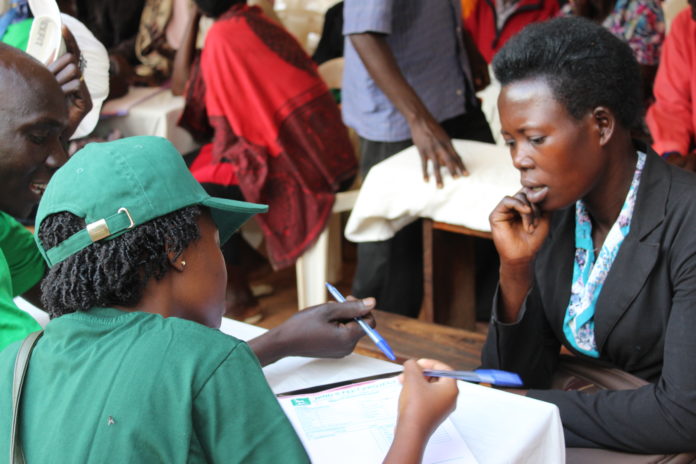
A resident of Gulu being attended to by one of the medics at the camp

Thousands of people residing in and around Unyama sub county in Gulu have benefitted from a health camp organized by Umeme Limited.

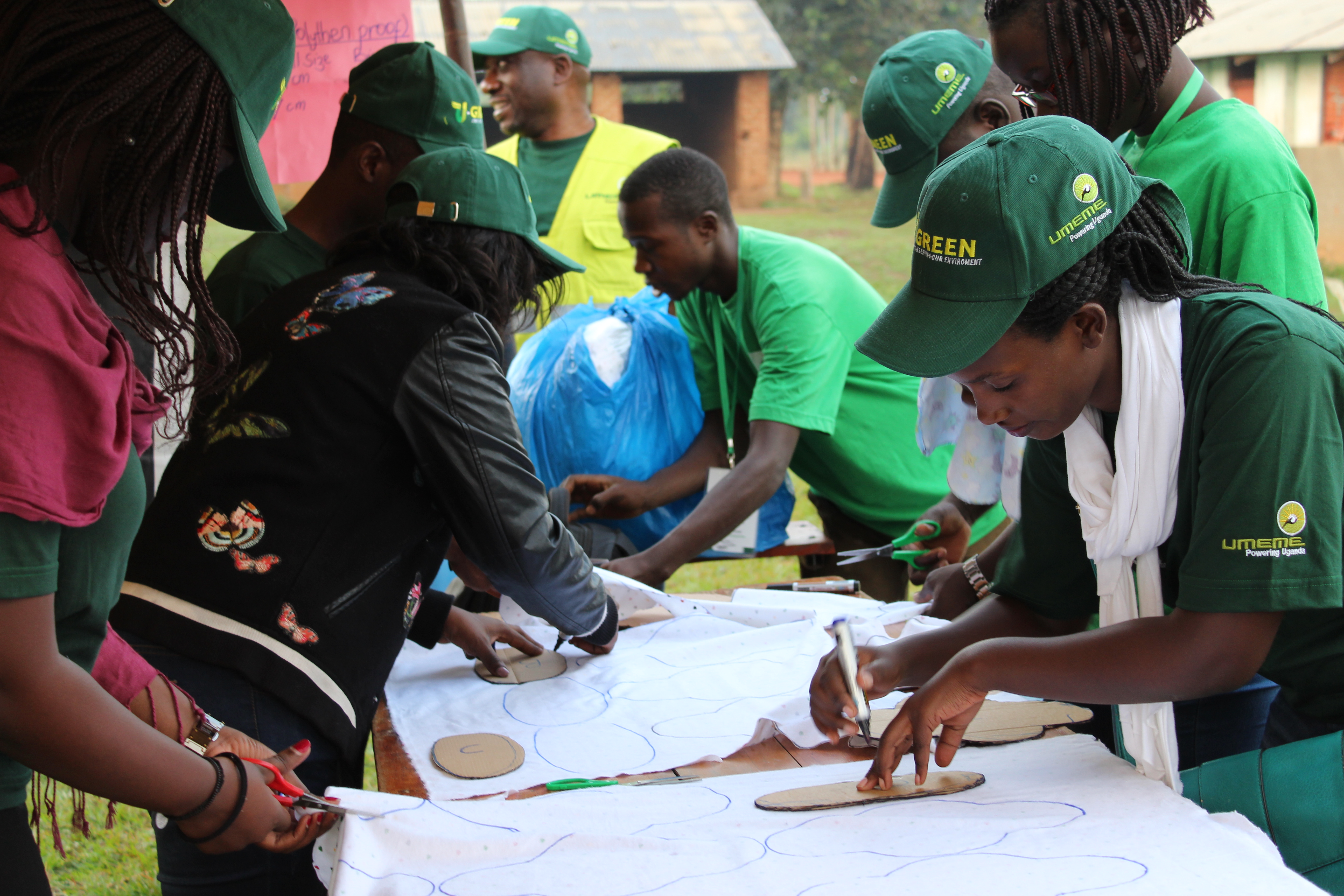
BUSY: Medics in preparation for the camp in Gulu

The day-long camp held on Saturday and conducted in partnership with Hind’s Feet Project, Uganda Cancer Institute, Uganda Red Cross Society and Aids Information Centre, was held at the Pakwelo Primary School, and among the medical services offered were Hepatitis B screening and shots, Dental, eye checkups and general medicine and, screening for HIV and diabetes.

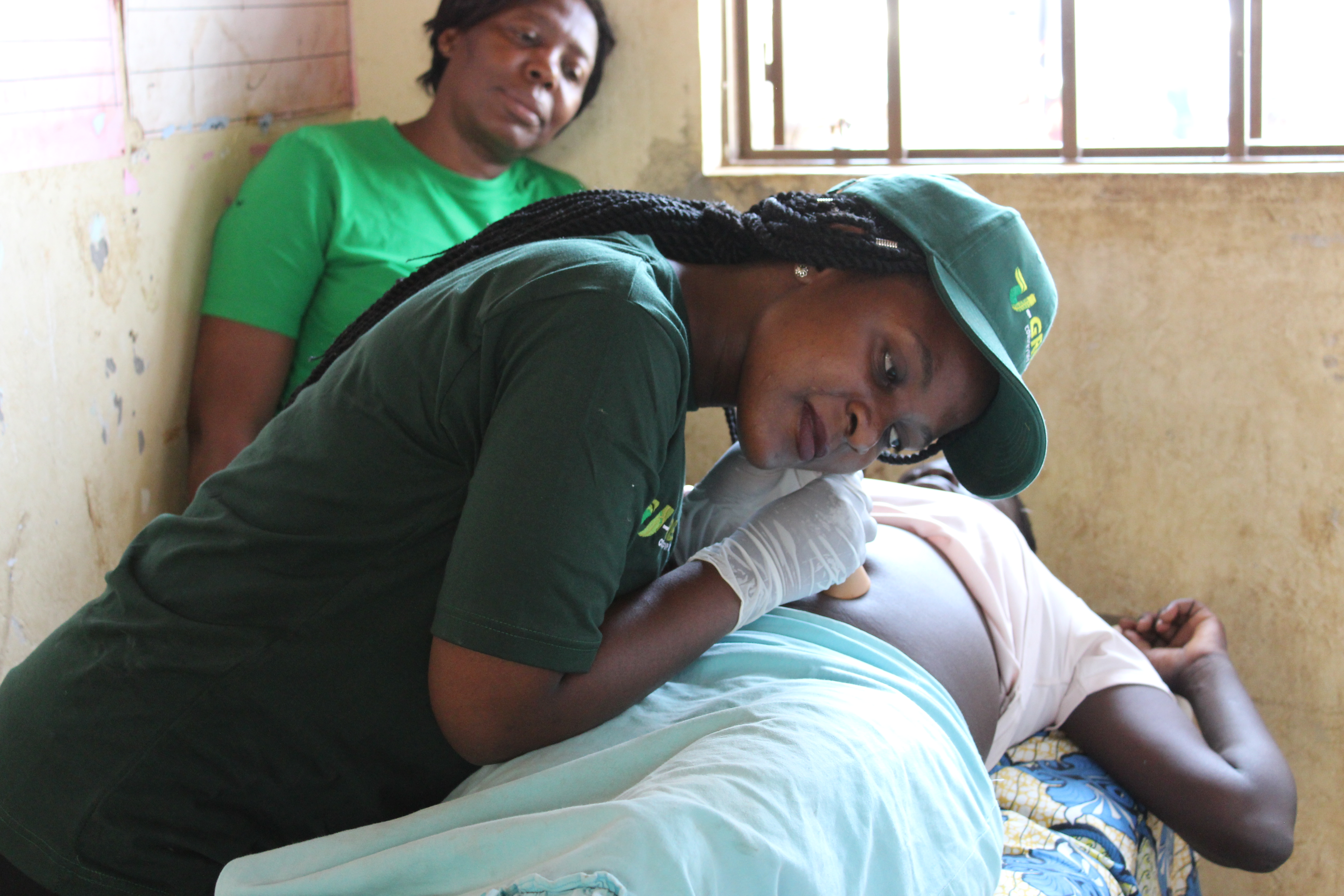
A medic attends to an expectant mother at the health camp in Gulu. Photos/courtesy

Other services include screening and tests for malaria and cervical cancer, safe male circumcision, nutritional consultations, consultations on disease prevention and management and onsite treatment for common illnesses.

“We are always proud to be associated with the communities we serve. It is gratifying to see over 1000 people come in to get access to free medical checkup treatment, counseling and referrals.” Sandor Walusimbi, Umeme Head of Communication, said.

Working closely with Hinds Feet, Umeme will continue to get closer and reach out to disadvantaged communities in Uganda, Mr. Walusimbi added.

Sandra Muhanuka, the Hind’s Feet Project lead, said extending health services to the communities remains a key issue.

“We are delighted that Umeme has continued to partner with us in reaching out to the communities all over Uganda by offering free medical services”, Ms. Muhanuka said.

“By reaching out the community on matters of their health and safety, we hope they will appreciate the safe usage of power by legalizing their connections and save lives,” she added.

Umeme’s involvement in reaching out to the disadvantaged communities with free medical care started last year when two health camps were successfully held in the Elgon sub regions of Busiu and Budadiri.


Stories Continues after ad