By Christine Lagarde
This International Women’s Day is bringing new calls to press for progress on gender parity. Giving women and girls the opportunity to succeed is not only the right thing to do—it can also transform societies and economies.
Unlocking this transformative potential means pushing for more equal opportunities: for example, equality in legal rights for men and women, and equality in access to education, health, and finance. Just as important is the fundamental issue of ensuring a safe environment for all, including protection against harassment.
Our message is clear: Providing legal protection against sexual harassment creates an environment in which women are more likely to be economically and financially active.
In fact, new IMF staff research “What is Driving Women’s Financial Inclusion Across Countries?” finds a link between financial access and protection against harassment. We look at this connection empirically in surveys of 1,000 individuals in each of more than 140 countries.
Legal safety and financial inclusion
Women are less likely than men to gain access to financial services. That is especially so in emerging and developing markets, where financial inclusion scores are about 14 percent lower for women than for men.
Our research therefore looked into what drives access to financial services for women in particular. We found that women who live in countries with stronger protection against harassment, including at work, are more likely to open a bank account, borrow and save, and make use of financial services such as mobile payments.
These links are strong. Financial access for the average woman living in an emerging market or developing country is almost 16 percent deeper—that is, financial inclusion scores are higher—when legal protection is granted. For the average sub-Saharan African woman, the figure is almost 25 percent higher. Eliminating harassment and increasing women’s access to financial services can transform lives.
But the benefits don’t stop there. Promoting equality in opportunities can be an economic game changer. Increased financial access means more economic activity by women, including as entrepreneurs. This translates into higher economic growth and productivity, a more equal income distribution, higher profits for businesses, and greater economic stability.
Significant gaps in legal protection
Our study clearly shows that protecting women against harassment can ignite economic benefits across several dimensions. It is also a moral issue as highlighted by the #metoo movement, which has shown sexual harassment to be pervasive in many countries. Outrage has understandably erupted in many parts of the world.
These discussions are important and overdue, but they are only the tip of the iceberg. A detailed database and reports by the World Bank show that:
• In 2017, almost 290 million adult women were not legally protected from sexual harassment, and more than 360 million women were not shielded from harassment in employment.
• Legal gaps extend to the home. In almost a quarter of countries, there is no protection against domestic violence.
• The lack of legal protection affects girls at an early age. In some countries the legal age of marriage is different for women than for men, and almost 100 million girls are not sufficiently protected legally from being married as a child.
Changing laws is not sufficient—it needs to be complemented by enforcement. Other policies also matter, and governments can act today. For example, fiscal policy can play a larger role through investments in transport safety and sanitation facilities for women and girls, and in support for victims of gender-based violence.
Continue the engagement
Together with our partners, the IMF is committed to working with governments around the world to identify policies that help women realize their potential. Aside from analytical work on the macroeconomics of gender, the IMF is expanding its country-level analysis and advice in this area. So far, we have studied and provided advice on gender equality issues in about one-sixth of our 189 member countries. The issues are multi-faceted, so the policies to address them should be too.
Just this week, we will publish a study on Nigeria showing that reducing gender inequality could increase real GDP growth by an average of 1¼ percentage points annually. We recommend a range of measures, such as strengthening and enforcing legal rights; increasing investment in infrastructure, health, and education; and policies to help reduce violence against women. Our advice to advanced economies also emphasizes the need for policies to help women participate in the economy, including well-designed parental leave, affordable and high-quality childcare, and tax policies that do not penalize secondary earners. And IMF-supported programs in Egypt and Niger include measures to empower women economically, such as investments in public nurseries and better public transport safety.
It is not enough to talk about gender equality on International Women’s Day. We need to continue to work to address this issue and keep it at the top of the policy agenda throughout the year.
We promise we will keep playing our part.
The Writer is the President of IMF
Ending harassment helps the economy too
ICO to celebrate women in coffee value chain
To mark International Women’s Day, the International Coffee Organization (ICO) is celebrating the role of women in the coffee value chain, according to José Sette, Executive Director of the organisation.
Be it in Brazil, Uganda, Burundi, Uganda, Cameroon or Colombia, India or Indonesia, women are playing an increasingly active role in the international coffee industry. According to figures from the Food and Agriculture Organization of the United Nations, women represent 43 per cent of the labour force in agriculture, playing important roles as farmers, labourers and entrepreneurs.
Recent studies suggest that globally 25-35 per cent of coffee farms are in fact headed by women.
It is important to note however, that this achievement on the farm is often combined with the fulfillment of the traditional role of the woman as mother and homemaker. In fact, women working in coffee face even greater barriers than their male counterparts.
Studies also show that female coffee producers have lower yields and lower income than their male peers, as a result of less access to land ownership, credit, markets, technology, seeds, water, information and education and other services. Such constraints are often due to gender norms and cultural barriers.
Experts say closing this gender gap in agriculture, including coffee production, will not only contribute to achieving the UN Sustainable Development Goal on gender equality, but also bring with it wider economic benefits, improved welfare for rural communities as well as higher productivity to help to meet the growing demand for coffee.
“Clearly there is a need for better public policies and provision of services to help overcome the barriers women face across the coffee farming community”, according to Sette.
The ICO is the main intergovernmental organization for coffee, bringing together importing and exporting Governments and the private sector from across the world, to support the development of policies which strengthen the global coffee sector and promote its sustainable expansion for the betterment of all participants.
Mr Sette continues: “In celebration of women’s achievements in coffee and to encourage the wider participation of women in all aspects of the coffee industry, I am delighted to announce on International Women’s Day that this year the ICO will be focusing on ‘Women in coffee’ as the theme for International Coffee Day on October 1, as well as in our wider work programme. It is in all our interests to empower women in the international coffee community. I look forward to working with our Members and partners to help make this happen”.
ICO is the main intergovernmental organization for coffee, bringing together exporting and importing Governments to tackle the challenges facing the world coffee sector through international cooperation. Our Members represent the Governments of 98 per cent of the world’s coffee producing countries and 83 per cent of consuming countries.
Museveni to launch Mbale Industrial Park tomorrow
The development of Mbale Industrial and Business Park starts with its official launch tomorrow by President Yoweri Museveni, a leading proponent of Uganda’s industrialisation project.
Thousands of residents from Mbale town and neighboring districts are expected to attend the launch of the Park that is expected to employ thousands, many of whom will be casual workers.
The 619 acre Mbale Industrial and Business Park is located in Mbale Municipality along Mbale-Tororo Highway. The Uganda Investment Authority has a mandate to establish 22 Industrial and Business parks throughout the country to create jobs and add value to locally available raw materials.
In July, 2017, a consortium of eight Chinese enterprises signed agreements with Tian Tang Group to invest in Mbale Industrial Park, eastern Uganda.
Tian Tang Group was given the mandate to develop the industrial park in order to speed up job creation in the country. The park is expected to house 30 enterprises and create about 12,000 jobs for Ugandans.
The eight companies are to invest in fruit processing and beverage production, rice processing and production, sanitation supplies manufacturing, wood processing and furniture manufacturing, glass manufacturing, household appliances manufacturing and solar pumping systems, among others.
Local investors are also expected to open up shops in the park. It is expected that local artisans as well as automobile repairers will leave the town centre and establish base in the park.
UIA had been having issues with the compensation of land owners but in August last year its Executive Director Jolly Kaguhangire pledged would pay off the remaining claimants in September 2017. The compensation of more than 800 families was to cot Shs4.5b.
The development of the Mbale Industrial and Business Park is expected to provide market for agricultural goods produced in other districts like Butaleja, Budaka, Tororo, Kibuku, Manafwa, Sironko and Bududa, Bulambuli, Sironko, Kumi and others.
In a related development, the other industrial and business parks UIA has established include Kampala Industrial and Business Park (KIBP) – Namanve, Luzira Industrial and Business Park, Bweyogerere Industrial and Business Park, Jinja Industrial and Business Park, Kasese Industrial and Business Park. Others are Soroti Industrial and Business Park and Karamoja Industrial and Business Park.
The establishment of factories and services at KIBP is in high gear with some companies already operating from there, UIA having facilitated the Park with water and electricity, drainage channels, roads and security.
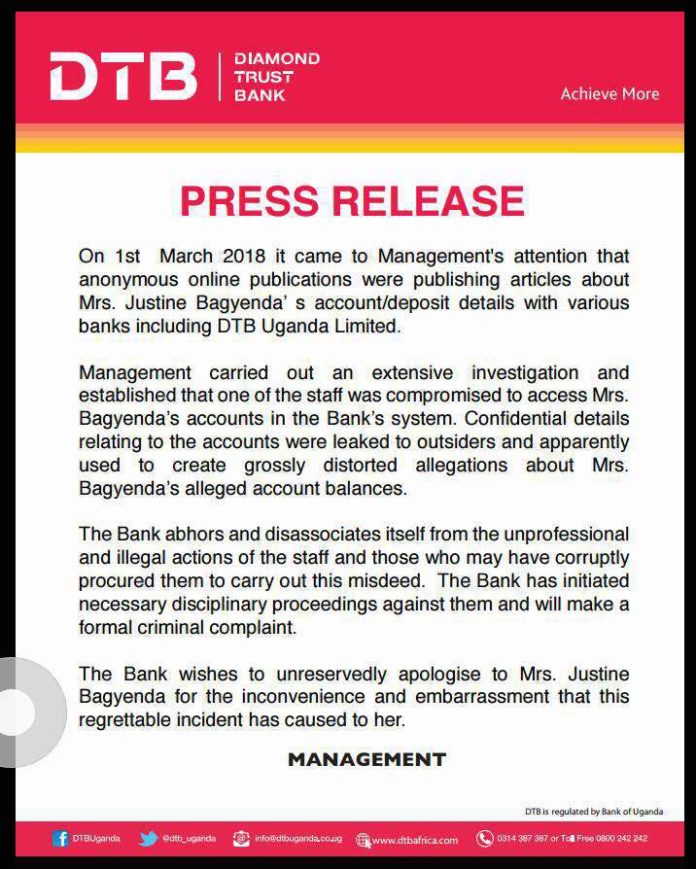
DTB apologizes over Bagyenda’s leaked bank details
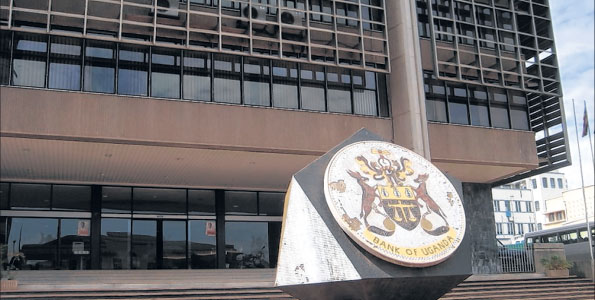
Diamond Trust Bank (DTB) Uganda Limited have apologized to the former Executive Director in charge of Supervision at Bank of Uganda Justine Bagyenda over her leaked bank details.
Last week, we published a series of stories detailing the depths of Ms Bagyenda’s bank accounts she has with the bank, including one about how she has a whopping Shs20b sitting on two different accounts.
The stories prompted the bank to investigate the source of information in the bank, and the investigation, reportedly led them to one of their staff who, the Bank leadership claims, was ‘compromised’ and actively participated in leaking account details of their client.
‘The bank wishes to unreservedly apologise to Bagyenda for inconvenience and embarrassment that this regrettable incident has caused to her’ the DTB wrote.
“On March 1, 2018, it came to management’s attention that anonymous online publications were publishing articles about Ms Justine Bagyenda’s accounts/ deposit details with various banks including DTB Uganda Limited,” the statement adds.
It further reads: “Management carried out an extensive investigation and established that one of the staff was compromised to access Ms Bagyenda’s account in the bank’s system.
“Confidential details relating to the accounts were leaked to outsiders and apparently used to create grossly distorted allegations about Ms Bagyenda’s alleged account balances.”
The bank, without denying the authenticity of the stories, says it ‘abhors and disassociates’ itself from the unprofessional and illegal actions of the staff and those who may have corruptly procured the account details’ to carry out misdeed.
The matter has been referred to police for further investigations with the intention of bringing criminal charges against their staff, the DTB says.
“The bank has initiated necessary disciplinary proceedings against them and will make a formal criminal complaint.
After Eagle Online published investigative stories about Bank of Uganda and its officials from otherwise confidential documents, two officials from different financial institutions (including the DTB staff) were last evening questioned on suspicion of leaking the documents.
According to sources, the seconf person is one Shafiq Mpanga, a Bank of Uganda official who works in the supervision department.
And, with the DTB apology, it confirms our earlier story. Investigations carried out by Eagle Online revealed that Bagyenda had a bank balance of Shs19, 302, 441,183, details of three bank accounts which we obtained.
Earlier the EagleOnline had carried out investigations, establishing that the BoU was embroiled in scandals of overspending, one of them being the Shs4 billion payments to city lawyers handling the court case involving former Crane Bank owners and the Central Bank.
Police infiltrated by ‘weevils’ – Museveni
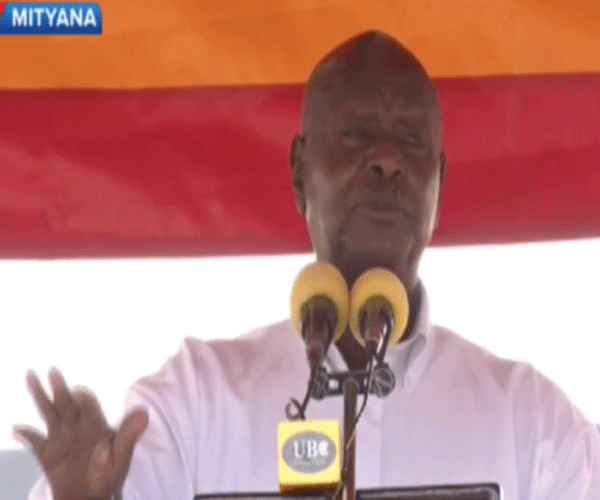
President Yoweri Museveni has castigated the police force for perpetuating crime, describing officers as ‘Kawukumi’ – loosely-translated in English to wit bean weevils.
Speaking at the function to mark the International Women’s Day in Mityana today, Mr. Museveni, who last week fired former Inspector General of Police (IGP) Kale Kayihura alongside security minister Lt. Gen. Henry Tumukunde, emphasized that efforts are underway to address the rising crime rate especially in urban areas, whose victims in the recent past have largely been women.
The President said last year’s murder of women in Entebbe, Nansana and the family attacks that were witnessed in various parts of Masaka were as a result of police being infested with ‘weevils’.
“Some of these killers were being arrested, but our police was starting to get infested by weevils,” said the President, who likes using proverbs.
He also likened hunting criminals in Kampala today to looking for a ‘needle in a haystack’, but reiterated his guarantee that government is investing heavily in equipping the police with modern technology including ‘surveillance cameras’ to help in tracking down criminals, who exploit the rapid development and expansion of urban areas to hide from justice.
Last year, while at the funeral of slain Assistant Inspector General of Police (AIGP) Andrew Felix Kaweesi, who was gunned down by unknown assailants, the President directed the former IGP Kale Kayihura to ‘put his house in order’.
However, this did not add up as crime persisted, with some police officers being accused of conniving with criminals.
“We had a weakness in the Police. There were weevils there,” the President said without revealing naming specific officers.
The President also took swipe at the Uganda Prisons officers who were in charge when two murder suspects escaped during a court session in Masaka a week ago.
The officers, who the President referred to the prison warders as ‘buno obusirikale bwa Prisons’ (these little Prison warders), said they un-cuffed the prisoners and did nothing when they escaped. He also wondered why suspects are un-handcuffed when in court.
“I don’t know where these rules come from. I was never consulted about them,” charged the President.
He added: “These are two men who killed five people. I personally went to Bukomansimbi, and participated in their arrest and we got them all. And here you have four Prison guards, and the judges are sitting there with their wigs, and the guards are there dozing, and the killers are not cuffed!”
When the President looked around for the Commissioner General of Prisons Johnson Byabashaija to give an explanation, he seemed not to be present at the function.
“He must be out there hunting for the escapees,” joked the President before ordering that the men who escaped must be rearrested.
The Prisons spokesperson Frank Baine, has since explained that the escapees, Musa Galiwango and Muhammad Kidawalime took advantage their freed hands and the fact that the court was crowded to run away.
“You know that we are not allowed to hand cuff prisoners in court. So they took advantage and run away. Our officers could not fire bullets because there were many people around court,” said Baine.
The President assured the nation that he wants ensure that the new changes in police and security docket should crack down on criminals.
EU to engage government on electoral reform recommendations

The European Union (EU) is to engage the Uganda government in a bid to strengthen the electoral process and democratic institutions.
The development comes in the wake of the delayed implementation of the 30 recommendations of the EU observation mission report that was published following the 2016 elections.
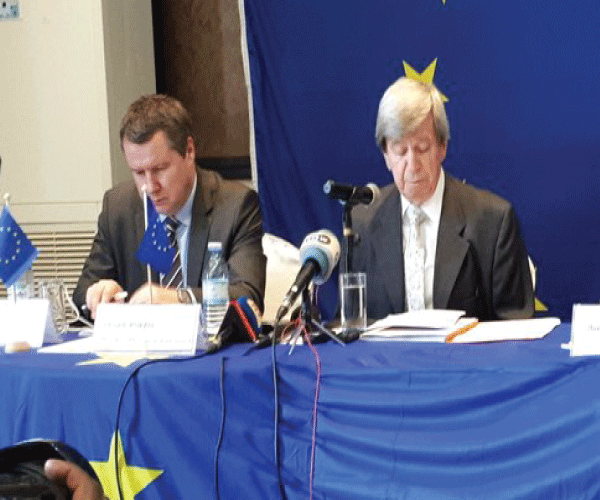
In a press briefing held at Sheraton Hotel, the leader of European Union Election Follow up Mission (EFM) Eduard Kukan said his team met almost all the stakeholders including President Yoweri Museveni, opposition former presidential candidate Dr. Kiiza Besigye, the Speaker of Parliament Rebecca Kadaga, members of the Inter Religious Council of Uganda (IRCU).
They, however, did not meet the chairman of the Electoral Commission Justice Simon Bayabakama, who reportedly declined to meet them.
“The Electoral Commission (EC) lacked independence and transparency, whereupon the elections fell short of international standards for the conduct of democratic elections at key stages, however government has not taken an immediate action,” Mr. Kukan said.
He added: “There is at present a widespread agreement among political actors and the people of Uganda that there is an agenda for electoral reform flowing from a variety of sources however the question is when they be achieved.”
According to Mr. Kukan, the recommendations were meant to enhance the legitimacy and credibility of future electoral process.
“The EU is ready to render a hand for the achievement of electoral reforms,” Mr. Kukan said, adding that instead of implementing the EU recommendations, state actors were so instrumental in creating an intimidating atmosphere for both voters and candidates.
He also noted that police used excessive force against opposition, media and the general public.
Among the 30 recommendations, EU called for establishment of steps be taken to clearly differentiate the state from the ruling party in an electoral context.
Others include constituting an ‘effective sanctioning mechanism against the misuse of state resources, including administrative and security apparatus’.
The report further indicated that the Public Order Management Act (POMA) provisions, interpreted to grant the Police the right to disperse meetings, be repealed.
Two questioned over ‘leaking’ BoU documents to media
After Eagle Online published investigative stories about Bank of Uganda and its officials from otherwise confidential documents, two officials from different financial institutions were last evening held and questioned on suspicion of leaking the documents.
According to sources, the two are Mr Shafiq Mpanga, a Bank of Uganda official who works in the supervision department and the other, a Diamond Trust Bank (DTB) top staff whose names were not readily available.
Information Eagle Online has is to the effect that duo were questioned by both Police and the Banks’s internal security operatives specifically about how bank details of a senior staff got to the press.
Our sources, who spoke on condition of anonymity, said some authorities at the BoU are concerned about how classified information is leaking and want to plug the gap.
There have been reports of bickering among the top management at the Central Bank, with the Governor Professor Emmanuel Mutebile Tumusiime reportedly in conflict with some of the BoU top brass.
This led to a recent re-deployment exercise, where transfers were made including that of Ms Justine Bagyenda, the immediate former Director in Charge of supervision who was retired.
Sources at BoU said she consequently attempted to resist handing over office but the changes took effect Dr. Tumubweine Twinemanzi has since taken over her position.
Prior to that, a group of unknown people had stormed Bank of Uganda with placards demanding for the sacking or resignation of Ms. Bagyenda.
The bank was embroiled in scandals of overspending, one of them being the Shs4 billion payments to city lawyers handling the court case involving former Crane Bank owners and the BoU.
Investigations carried out by Eagle Online revealed that Bagyenda had a bank balance of Shs19, 302, 441,183, details of three bank accounts which we obtained.
The documents we obtained indicated that she made all that money in just six years, from 2013 to this year.
We also unearthed another story of how Ms. Bagyenda, between 2015 and 2017, transacted Shs2bn on her account in Barclays Bank Kampala Road branch, with a serial beneficiary, one Kenny Muwonge.
There was also a search which revealed the property owned in some prime areas of Kampala and other upcountry, some reportedly in her children’s names.
Kept in the kitchen before 1987, now emancipated
By Pinkreal Ninsiima
As the world celebrates International Women’s Day, there is need to look at the nation and world without women. A world without women would be like an empty beautiful house. Women are beautiful creatures always referred to as ‘Mothers of the Nation’. They do sacrifice a lot in their lives to make nations better places to live in.
In Genesis 26, after God created a man, he saw that he was incomplete, lonely and lifeless; He saw something was missing he then decided to create someone different from a man who would bring life and meaning to the otherwise lifeless and meaningless man that looked incomplete.
However much women are considered weak, one should always know women are the strongest and great people and God’s special creation; created for a special purpose. So women deserve to be handled with care, not to be abused and harassed.
The responsibility of nurturing a human being rests on the women’s shoulders. The pain of bringing up a baby into the world after nine months pregnancy, breast feeding, raising the baby from a tender age into an adult are all a woman’s responsibility.
The Constitution of Uganda under Article 33(1) reflects on the purpose of which God created a woman and it provides how women shall be accorded full and equal dignity of the person with men. Under Clause 2 it provides on how the State shall provide facilities and opportunities necessary to enhance the welfare of women to enable them to realize their full potential and advancement. It’s from this Article that women have been granted equal opportunities to serve in different areas of development.
The woman’s movement in Uganda made an unexpected swift and visible entrance onto the political scenes shortly after National Resistance Movement (NRM) took power in 1986, and there’s a popular view that without the NRM the current women’s movement in Uganda would not have been strong as it is today. Others claim that the advances made by women are due to bureaucratic or paternalistic concessions by the NRM administration rather than victories attained through the struggle for emancipation.
As Michelle Bachelete said that, ‘a better Democracy is a democracy where women don’t only have the right to vote and elect but to be elected’, it is evident that women are involved in politics and now hold big positions in Parliament of Uganda and other sectors.
The most powerful woman in Uganda is the Speaker of Parliament of Uganda Rebecca Kadaga, who is the third in line of authority in government, and needless to say, the number of women in politics has increased tremendously since Kadaga was enjoined in the campaign to get women out of the kitchen to the boardrooms.
Women’s participation is essential to gender-responsive governance where women’s voices are heard, policy better reflects their lives and where under representation women interests persists are repeatedly ignored.
In Uganda and Africa as whole, women are the backbone of society and the economy, with many the sole providers for their families. However, they are constantly struggling to gain a seat at decision-making table yet the central role of shouldering the economy and social burden is on them.
Most women have succeeded where men have failed; these women run powerful personal business ventures and most of them are executive directors, managing directors while others are thriving entrepreneurs. Among them is Jenifer Musisi, the Executive Director Kampala Capital City Authority (KCCA), Allen Kagina, the Executive Director of UNRA, Tracy Hawthorn, the operations manager at Ambrosoli International School, Damalie Nagitta, the Dean of Studies at Law School Makerere University and Joyce Tamale, the Managing Director of Uganda Health Marketing Group.
As this year’s theme ‘press for progress’ calls for strong action, let’s look out for those women who are still illiterate about their rights and whose work goes unrecognized. These women work long hours at home that leaves them with little time for income generating activities. They don’t always make decisions about their own employment but rather men encourage them to take long paying jobs or at times prevent them from working.
I, therefore, congratulate all women upon reaching this milestone, and as we celebrate this year’s Women’s Day let us reflect on our past, present and the future.
The writer is a Volunteer at Inter Religious Council of Uganda (IRCU).
FDC candidate wins Kyambogo University guild race
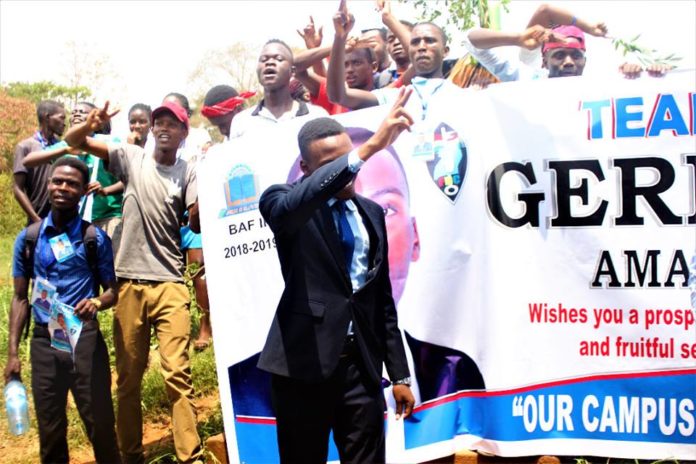
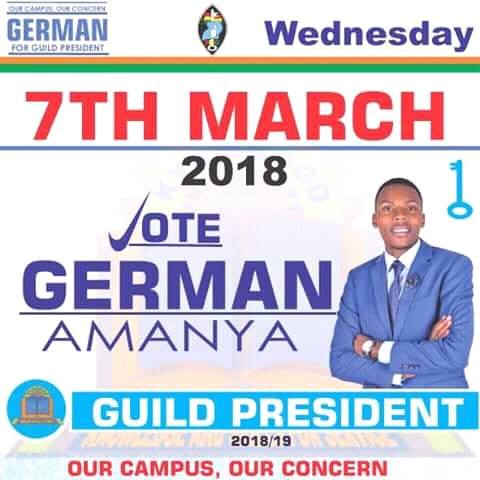
The flag bearer for Forum for Democratic Change (FDC) German Amanya has been elected the new University Guild president for Kyambogo University.
The University’s Electoral Commission Chairperson, Robert Asiimwe said Mr Amanya polled 3,701 votes of the 8,451 ballots cast. He was followed by Mr Paul Opesen with 2,137 votes and Mr Eddy Akena in third position with 1,013 votes.
Others in the race were Mr Joel Ssemuju, Richard Mugisha, Haruna Kilenzi, Abraham Muhumuza, Nasif Lubanga and Frederick Okot.

Mr. Asiimwe declared Amanya elected on Wednesday evening at the Student’s Centre, the official tally centre.
“In accordance with the powers granted to me as the chairperson of the Electoral Commission, I declare Mr. German Asiimwe as the dully elected guild President, having garnered the highest number of votes,” Asiimwe declared.

In his speech after being declared winner, Mr Amanya pledged to improve the sanitation situation and the lighting system at the University.
He also said he will lobby for exchange programmes for students to other universities as well as advocate for the introduction of supplementary exams for final year students who get retakes.
On Tuesday the university had postponed the polls, saying the Electoral Commission wasn’t ready.
This prompted police to fire live bullets and teargas to disperse angry students who were not happy with the university’s decision.
Several students were arrested and locked up briefly at Jinja Road Police station although they were later said to be released. Andrew Mugarura, the Chief Security Officer Kyambogo University, says all students were released.
This compelled the University to reverse its decision and allow the elections to take place as earlier on arranged.
About German Amanya?
Amanya was born in 1997 to Mr. Zepher Abamanya Mrs Jane Kemigisha in Kebisoni Rukungiri District.
He attended attained Primary education at Kebisoni Primary School from 2001 to 2009 where he served as class monitor and deputy head prefect according to source who attended school with him at that time
He was in St. Paul’s Seminary Rushoroza for his Ordinary Level between 2010 and 2013.
At St. Paul’s Seminary Rushoroza, Amanya served in different portfolios including Coordinator Catholic charismatic, altar boy, and football captain and information prefect.
Between 2014 and 2015, Amanya went to Mbarara High School for his A- level where he also served as a Political Editor of Chaapa information desk and the president of the Entrepreneurship students at the school.
Amanya is a second year Bachelor of Accounting and Finance student and Chairperson of School of Management and Entrepreneurship Executive Committee.
At Kyambogo University, he has previously served as the Guild Representative Councillor (GRC) of the School of Management and Entrepreneurship.
Prior to his election as guild President he served as the faculty president, and chairperson of property and establishment committee of Kyambogo University.
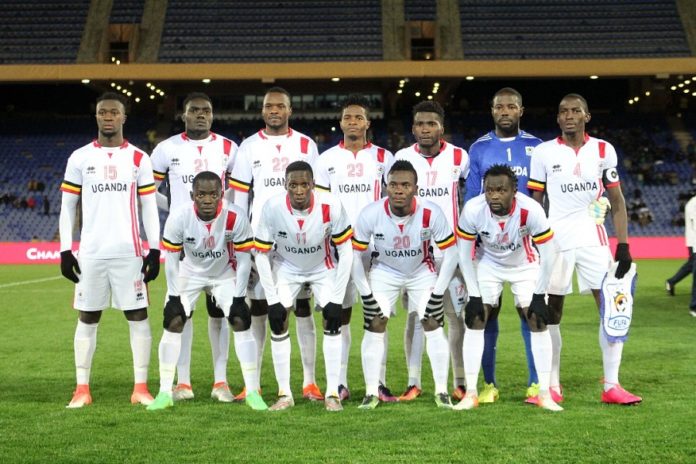
Cranes summons 23 for national team duty
Twenty three Cranes players have been summoned for national team duty in preparation for the two upcoming international friendly matches.
FUFA confirmed one friendly against Malawi on March 27 at Mandela National Stadium, while the other match will be played on March 24 against a yet-to-be confirmed opponent.
Only four of the 23 are locally based players. They are; Nicolas Wadada (Vipers SC), Timothy Awany (KCCA FC), Milton Karisa (Vipers SC) and Abraham Ndugwa (Masavu FC). 14 players are based in Africa while the rest feature for clubs around the globe.
Sadiq Wassa will act as the goalkeeping coach in the absence of Fred Kajjoba who is undergoing a coaching course in the USA.
The players are expected to enter camp on March 19, with training commencing the following day.
The two friendly games will help Cranes prepare for the 2019 African Cup of Nations qualifiers against Tanzania, Lesotho and Cape Verde.
Uganda lead Group L with 3 points after winning the first match against Cape Verde 1-0 last year at the Estadio da Varzea in Praia. Geoffrey Sserunkuma scored the goal seven minutes from time. Tanzania and Lesotho settled for a 1-1 draw in Dar es Salaam.
The second round of the fixtures will be played on March 23, 2018, with Uganda Cranes hosting East African rivals Tanzania as Lesotho plays Cape Verde in Maseru.
The 2019 AFCON tournament will be played in Cameroon between June and July.
Full squad:
Goalkeepers: Dennis Onyango (Mamelodi Sundowns, South Africa), Salim Jamal (El Meriekh, Sudan), Robert Odongkara (St George, Ethiopia).
Defenders: Dennis Iguma (Al Nabi Shayth-Lebanon), Nico Wakiro Wadada (Vipers SC, Uganda), Isaac Isinde Not attached), Brevis Mugabi Yeovil Town, England) Murushid Jjuko (Simba, Tanzania), Timothy Awany (KCCA FC, Uganda), Godfrey Walusimbi (Gor Mahia-Kenya), Alex Kakuba (Feirense-Portugal).
Midfielders: Joseph Ochaya (Lusaka Dynamos, Zambia), Farouk Miya (Sebai FK, Azerbaijan) , Hassan Wasswa (El Geish, Egypt), Khalid Aucho (East Bengal, India), Geoffrey Kizito Baba (Than Quang Ninh-Vietnam), Milton Karisa (Vipers SC, Uganda), William Luwagga Kizito (CSMA Iasi, Romania), Abraham Ndugwa (Masavu FC, Uganda)
Strikers: Emmanuel Okwi (Simba, Tanzania),Yunus Ssentamu (FK Tirana), Edrisa Lubega (Floridsdorfer AC, Austria),Hood Kaweesa (Buildcon FC, Zambia).