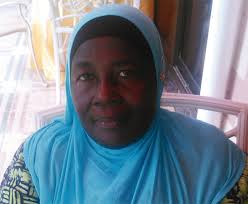
MADE ANNOUNCEMENT: The Minister of Gender, Labour and Social Development, Janat Mukwaya
Uganda will soon sign bilateral labour agreements with Qatar, the United Arab Emirates (UEA) and Oman, the minister of Gender, Labour and Social Development, Janat Mukwaya has said.
The agreements if signed will ensure rights of Ugandan workers employed in the three Arab states in the Middle East.
“Draft agreements have been drawn and presented to the governments of Qatar, United Arab Emirates and Oman for consideration, after which bilateral agreements will also be concluded,” she said on Friday.
Uganda has already signed bilateral labour agreements with Saudi Arabia and Jordan, which she said have eased the conditions of Ugandan workers in those two countries as they are protected by the laws there.
“The bilateral agreements establish a joint monitoring mechanism for purposes of protecting the rights of Ugandan migrant workers,” Ms. Mukwaya said, adding that Ugandan officials visited Saudi Arabia, the UAE and Jordan to check Ugandans working there.
The minister’s revelations came after the parliamentary committee on gender, labour and social development said that over 40 Ugandan workers have died in the Arab world in the past nine months, worrying families which have their relatives working there.
According to minister Mukwaya, the government of Uganda had restricted the recruitment of domestic workers to Saudi Arabia and Jordan as the two countries are the only one in the Middle East that have bilateral labour agreements with Uganda.
She says government on October 12, launched an online system for recruitment, vetting contracts and monitoring of workers deployed in Saudi Arabia. “This system facilities traceability of any worker who is deployed in Saudi Arabia,” she adds.
Uganda is said to export over 50, 000 youthful boys and girls to the Arab world to work as housemaids, guards, waitresses, clerks and drivers.
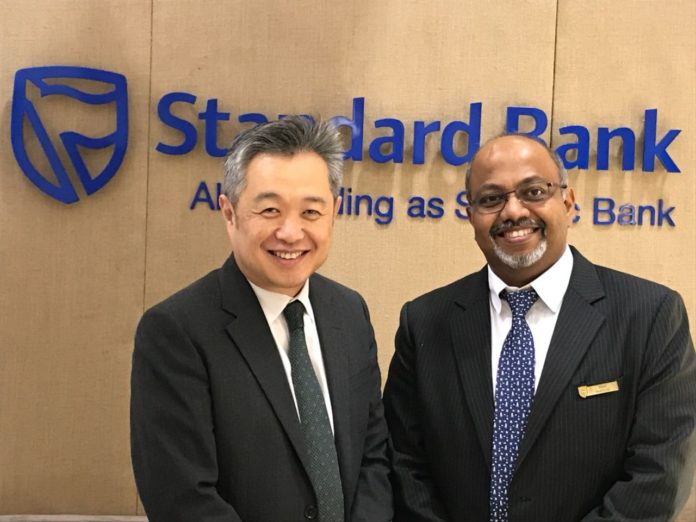
Vinod Madhavan, Group Head of Trade for Standard Bank, with Kah Chye Tan, Chairman, CCRManager
Standard Bank has signed an agreement with CCRManager Pte Ltd, a global trade FinTech company, joining their global innovative electronic platform as the first member bank in Africa.
“We are delighted to have joined CCRManager’s distribution platform, which offers an automated, fast and transparent platform for trade risk distribution and participation,” says Vinod Madhavan, Group Head of Trade for Standard Bank.
“As the first African bank to have joined this network, this presents us with many opportunities, including being able to show African trade risk to international banks that are members of CCRM, and is aligned with our desire to connect Africa to the world,” he added.
CCRManager is a web-based platform that enables banks to manage the entire process of distributing trade finance internationally to other banks, credit insurers, and fund managers.
“CCRManager is delighted to have Standard Bank as its first African member bank,” says Kah Chye Tan, Chairman, CCRManager.
“Africa is a major trade partner for countries all over and trade finance has played an important role in promoting African imports and exports for many decades. We are confident that CCRManager will help Standard Bank with its trade finance for its clients.”
Users of CCRManager are able to list trade assets and contingents for distribution, negotiate deals, and manage supporting documentation in a secure environment.
Users also have access to tools for data analytics, market benchmarking, and pricing indices. In addition, CCRManager provides users with the ability to manage their portfolio, reporting, and compliance activities 24-hours a day.
“This partnership represents Standard Bank’s dedication to leverage world-leading digital platforms that help realise efficiencies in a globally competitive market place,” says Mr Madhavan, adding: “At Standard Bank, we recognise the potential of trade as a key driver for growth, especially in emerging and frontier markets.”
Six people are admitted at Karoli Lwanga Hospital Nyakibale in Rukungiri, following the shooting that erupted when Forum for Democratic Change (FDC) presidential candidate Patrick Amuriat Obol, in the company of ‘son of the soil’ Dr. Warren Kiiza Besigye, was campaigning in the area on Wednesday.
According to sources, those injured include Christopher Muhwezi and David Ayorekire, both of who were shot in the stomach and have been operated upon but are still in the intensive care section.
Others injured include Farouk Bangirana, Narisi Muhumuza, Davison Aryasingura and Julius Turyomunsi Mondo.
On the fateful day, one Edison Nasasira was shot dead, and since then FDC former presidential candidate Dr. Besigye was arrested from Rukungiri and detained at Naggalama Police Station, and will reportedly be charged with ‘causing’ Nasasira’s death.
The shooting in Rukungiri and other incidents involving police brutality come in the wake of Igara West MP Raphael Magyezi tabling a private members bill aimed at removing the presidential age limit enshrined in Article 102 (b) that was set at 75 years in the 1995 Constitution.
Observers say Magyezi’s move is meant to pave way for President Yoweri Museveni, who is the National Resistance Movement (NRM) Chairman, to contest for elections in 2021 when aged 77 years, two years above the current constitutional cap.
Jack Welch, former CEO of GE, once predicted, “When the rate of change outside the company is greater than the rate of change inside, the end is near.” Yet in my role as business advisor, I often see companies naively ignoring this reality. The smarter ones look outside regularly for evidence of impending change, and treat these as opportunities to jump ahead of competitors.
Today, the move to digital technology is driving marketplace change at a seemingly ever-increasing rate. The pervasive Internet and mobile device access allows instant communication of new options, total sharing of customer experiences, and mass customization, on a world-wide scale. No more hiding behind a cultural stereotype, a well-built brand, or a geographic wall.
The question every entrepreneur and business executive should be asking is what are the drivers of the digital transformation, and how can you make them opportunities rather than costs. I found some real guidance on these questions in a new book, ‘ The Digital Helix’ by Michael Gale and Chris Aarons, who have helped change the strategy of dozens of companies around the world.
I endorse their list of the seven key drivers of digital opportunity, how to recognize them, and examples of how forward-thinking companies have capitalized on them, which I paraphrase and summarize here:
Compression of supply and demand enables near instant fulfillment. Historically, many businesses profited from the time lags between supply and demand by exploiting geography, relationships, and buying habits. Today people can find and switch brands based on delivery, prices, and new features, with one or two clicks and minimal risk.
Shifting demographics changes customer needs and expectations. With simpler and cheaper access to information and alternatives, the cultures and generations are rapidly becoming more homogeneous. Demands and expectations change regularly as people learn from others who share their experiences in this new digital age.
Access to more information is leveling the market playing field. Almost anything and everything is available online, and the amount and depth of information is growing exponentially every year. This means market changes in the world today are instantly available everywhere, and quickly change the way we buy, sell, interact, and live.
Pay-as-you-go provides infinite ability to scale every business. Due to the efficiencies of digital, it is now commonplace to have companies with billions of dollars of revenue and valuation, with few employees, and without years of building infrastructure. Witness the exponential scaling of Uber, Pinterest, Airbnb, and other recent unicorns.
New competitors are built to be digital from day one. Think about the up-and-comers during the past decade that have either created new business models or stolen share from established players. Digital gives startups the same power to understand, engage, and look for new opportunities that traditional brands have spent decades building.
The rate of change is extremely exponential. In the past century, the benchmark for disruptive change was about thirty years or so. Now evolutions and even revolutions are happening within years, or at most a decade. In this digital age, you need a business capable of listening, assessing, and adjusting to the early nature of these changes.
The trade-offs between price, efficiency, and innovation have disappeared. Basic business theory states that businesses have three clear paths to success: cut prices, be more efficient, or invest in sustained technological advantages. Digital enables you to do all three simultaneously, and you must build a plan to do so to compete or die.
The message here is not about recklessly abandoning what you have, or taking huge steps into the unknown. Rather, it is much more about building a strategy to recognize change from early signals, and quickly transform your company to gain significant benefits from the change. The alternative is continual catch-up, and your eventual demise. How tired are you feeling today?
Dear all, nearly ten years ago I was in Tharaka, Eastern Kenya, facilitating a meeting among teachers from five countries in Africa on how to integrate culture into the school system. In the end, some of my colleagues from Tharaka, including Zachary, invited me for a great Nyama Choma, roasted goat meat. It was one of the most delicious Nyama Chomas I’ve had. While we were exercising our carnivore selves, Chabari, head of RIDEP Kenya at that time, said: ‘Million, do you know that we will be having an erection in three months’ time?’ ‘What? ´ I stopped my teeth in mid-air, confused and smiling. ‘Yes, we will be having erection in three months’ time,’ he repeated.
Now laughing my eyes out, I asked, ‘why do you have to wait for three months to have an erection?’ Then they all understood why I was confused and we all laughed and laughed. Some Kenyans, and particularly Tharakans, interchange ‘l’ and ‘r’ and that was the cause of the confusion and fun.
That election in 2007, as you all know by now, ended in an ugly way. Kenyans washed their dirty linen out in the open and the repercussion of that event is still reverberating in the corridors of all African countries. The subsequent election divided the Kenyans along ethnic lines and those with the bigger population won.
Even though old enemies who attacked each other are now together in new coalitions, demonstrating that people can rise up above conflict and get together again, the configuration can change again and old enmity can come up. This is in the hands of few cleaver politicians.
I was in Nairobi last week and a re-run of the August Presidential election is coming. The two main parties are NASA and Jubilee. Both coalitions are largely along ethnic lines. What is worrying for me is that the opinion of Kenyans seems to be divided between the two parties along the same ethnic lines. They hate each other so passionately and, although you can find some groups looking at the big picture, for so many their opinion is based on which ethnic group they come from.
Although ethnicity per se can be good for keeping once culture alive and fight together marginalization by bigger ethnic groups, you have to transcend beyond it when it shows signs of embroiling the country into the path of social and economic havoc.
What shocked me more is that those who belong to NASA are even talking off secession. Maybe this is a small element but the talk is there and it is openly discussed.
I have a soft spot in my heart for Kenya, not only because I have so many great Kenyan brothers and sisters but as an Ethiopian, I am very grateful for what Kenya did for those who needed shelter in times of trouble for Ethiopians, serving as a passage to other countries.
If you think the mixing of ethnicity and politics is a Kenyan problem in Africa, you are wrong. My own country Ethiopia is descending into this same quagmire slowly but surely. I grew up in a place called Merkato in Addis and I had friends from most ethnic groups in Ethiopia. Even though my parents come from the two big ethnic groups in Ethiopia, the Oromo and the Amhara, I have never felt particularly akin to either of them.
I have always felt Ethiopian and still do. This does not mean that I condemn those who feel strongly about their ethnic identity. I might have done the same if I was born in one of the ethnic areas. But Ethiopia as a nation state was so deeply ingrained in every one of us until quite recently. Now even the most learned of friends of mine are falling into this endless pit. Think of countries like Nigeria, Cameroon, Uganda, Rwanda, and we see how ethnicity is ruling the day.
I feel that ethnicity is becoming one of the most present and immediate challenges to Africa. I know that the colonial rulers actively created these fissures, both when they were dividing and clumping countries when they apportioned Africa at the Berlin Conference (November 1884 – February 1885) to suit their ruling, and through actively creating dissent among ethnic groups to prolong their plunder. According to some, Colonialism in Kenya allocated different part of the country to different ethnic groups and this has exacerbated the situation. They are still doing that either overtly or covertly in some weaker but rich countries.
I think we need to fight this cancer really soon for so many reasons:
It will cost untold misery to human life. As we have seen so often, women and children pay the heaviest price for the stupidity and self-serving interest of the few.
It will slow our progress to democracy and freedom and opens us up to corrupt and rogue governments who use this situation for their own purpose. Those elites who see benefits will do anything to flame the situation.
It will divide those who could work together for human rights, biodiversity conservation, food system transformation, and so on and weaken the social movement.
It will make us forget that we are all in this together and the cultural, social and environmental fragmentation that will result will only make us weak and vulnerable to exploitation from both inside and out.
Kenya is too big and too dear to fail. Conflict in Kenya will hugely affect the lives of people in Eastern and central Africa. I think the people do not deserve this. I beg my Kenyan brothers and sisters to rise up to the occasion and judge their leaders, not with an ethnic lens but on the basis of their merit. I know most Kenyans are deeply committed to democracy and human rights and some are above this ethnic conundrum and I also know they passionately love their country, so it is important to rise up to the occasion and be leaders.
Please forgive me for saying this as I have limited understanding of your politics but I have been coming to Kenya almost every year for the past twenty or more years and I see the same politicians, simply changing parties and alliances. I do not feel that they are the ones who will bring the required fundamental change for both the people and the biosphere. I feel that there Kenya is calling for another party created to address issues rather than ethnicity.
Kenya has shown to Africa and the world for the first time that the Supreme Court can annul an election. That is a huge example and I was so happy when I heard the news. Not for the opposition which I have zero attachment to but for the exercise of the rule of law. It is a great example to those who trample on the law to keep holding to power. You Kenyans are capable of rising up to the occasion again and showing us that there are higher values than ethnicity when the question is about the survival of genuine democracy and your togetherness.
May God bless Kenya!
Million Bellay works for Alliance for Food Sovereignty in Africa
African Registrars General are meeting in Victoria Falls, Zimbabwe, for the first time to deliberate on how to improve civil registration as part of implementing the civil registration and vital statistics process the continent.
This is in recognition of the fact that the implementation of the African Programme for Accelerated Improvement of the civil registration and vital statistics would not be successfully undertaken by statisticians alone without involving the Registrars General who are responsible for registration of vital events such as births, deaths, marriage, divorce and adoption.
The inaugural meeting of the Registrars, described as historical, proposed the establishment of a “Commission of African Registrars Generals”.
The proposed Commission of African Registrars General will be presented at the 4th conference of ministers responsible for civil registration and vital statistics that will be held December 6-8, 2017 in Mauritania.
Upon endorsement by the ministers, the Economic Commission for Africa (ECA) will be the secretariat of conference of ministers which meets every two years.
Mr. Oliver Chinganya, Director of the African Centre for Statistics, said the gathering of Registrars Generals, the first ever, as a commission will enhance and facilitate the visibility of vital civil registration systems on the continent.
Speaking at the meeting, Mr. Chinganya said the committee was long overdue. He said the committee will help push Africa’s vital civil registration agenda and help to “resolve the scandal of invisibility.’’
The meeting was officially opened by the Victoria Falls Mayor, Mr. Sifiso Mpofu, who urged the Registrars General and others present to come up with effective strategies of elevating vital civil registration to the fore front of development.
“I urge you to fight and make vital civil registration a weapon to protect our population. I plead with you to fight and make vital civil registration a tool for development. Make it a torch bearer to national dignity,” he said.
“Our people should not struggle to acquire national documents. Africa is looking up to you for salvation. It is relying on your expertise and wealth of experience to deliver.”
By 2035, half of Africa’s population will be urban-based, compared to just one third in 1990. This rapid urbanization creates growing challenges in terms of infrastructure and services, but it can also be a driver of industrial development on the continent, under the right policy framework.
The latest Economic Report on Africa by the UN Economic Commission for Africa (ECA), ‘Industrialization and Urbanization for Africa’s Transformation’, makes concrete recommendations for harnessing the rapid urban transition.
During the launch of the report by the ECA in in Kigali Friday, Ms. Giovanie Biha, ECA’s Deputy Executive Secretary, stressed that African urbanization has not been driven by improving agricultural productivity or increased industrial output, as has been the case elsewhere.
“On the contrary it has been dominated by the expansion of the informal sector – often services. To foster enhanced growth and poverty eradication, African countries should put in place industrial policies that will generate the skilled jobs and productivity gains needed for the structural transformation of their economies,” Ms Biha says.
At the same forum Edlam Yemeru, Chief of Urbanization Section at ECA, said there is an urgent need to connect policies and strategies for urban and industrial development for better performing cities and industries.
“Coordinating urban and industrial development is possible by linking economic and spatial policies in the context of national development planning”, said Yemeru
The launch of the 2017 Economic Report on Africa also provided an opportunity to discuss the challenges of industrialization and structural transformation on the continent and for Eastern Africa in particular. In most of the 14 countries covered by the SRO-EA, the share of the manufacturing sector has been stagnant or declining over the past ten years while the services sector has expanded rapidly.
Despite a weak structural transformation process, the long-term growth outlook remains promising in Eastern Africa. The GDP growth rate is estimated at 5.6% in 2017, the same as in 2016. This is down from the exceptional performance of the past five years, with Ethiopia achieving an average annual growth rate of 9.5% and Rwanda 7.2% between 2012 and 2016, but it remains well above the African continent average of 3.1% in 2017.
Andrew Mold, Acting Director of ECA in Eastern Africa, highlighted some of the growth catalysts such as massive investments in infrastructure or dynamism of some service sectors such as trading, finance, and tourism.
However, these increased investments have also started to stretch budgets and structural constraints remain such as weak credit to the private sector or exchange rate volatility, Mr. Mold noted.
As the Uganda government spends billions of shillings in campaigns to bring more foreign investors to the country, some of those here are crying of foul play by making a raft of allegations against the top managers of the Uganda Investment Authority (UIA), the lead agency responsible for investments.
One of the ‘untarmacked’ roads in the Namanve Industrail Park
In August, government on the advice of UIA Board cancelled several leases it had granted to both local and foreign investors in Namanve Industrial Park, and immediately announced it was repossessing the plots lying idle.
The UIA board had held meetings on February 20, 2017 and March 30, 2017 in which they agreed to withdraw the leases, despite investors’ pleas that UIA extends them. The investors, according to the lease terms, were supposed to develop their plots measuring 58.48 acres in total, within five years.
However, sources say that having repossessed the said land, UIA has since embarked on the process of giving it to new investors who, according to government, have money but no land for their projects.
A source told EagleOnline that some of the companies whose leases were cancelled by UIA are stuck with loans they had acquired from commercial banks to start developing their plots.
“Before UIA finally canceled leases, there had been prolonged negotiations between UIA and the affected investors to have their licences renewed but UIA was thinking otherwise,” the source said.
He said that some of the top managers at UIA wanted financial rewards from investors before they could renew their leases, even as the latter had given ‘credible reasons’ as to why they delayed projects. “Some people at UIA wanted ‘kick backs’ though they were not straight forward with the investors. Had some of the affected investors given money to the officials, their leases would have been renewed,” he told EagleOnline Thursday.
The investment and privatisation state minister, Evelyne Anite, when asked Thursday by this reporter as to whether she was aware of the investors’ grievances, briefly took time to respond but later said she has never received any complaints related to corruption at UIA.
“We have put an anti-corruption hotline at UIA and investors should use it when a public official asks for bribes from them,” she said.
She said government remains is committed to fighting corrupt public officials, especially those who frustrate investors.
Some of the investors say much as UIA okayed their ejection from the plots, the regulatory agency had failed to construct access roads, water systems and electricity on some plots, which they say was worsened by a poor drainage system because the area is in the swamp.
“How do you start developing a plot when there is no water on it, no road leading to it,” a disgruntled investor who said he was weighing other options in the EAC region, said.
In August, minister Anite said government had provided water, electricity, roads and other incentives to the industrial park and saw no reason to renew leases of investors who had failed to develop the land as agreed with government. At the time she said 200 other investors were waiting to be given the plots, and added that government wants investors who can provide 200,000 jobs in the industrial park.
Also, according to minister Anite, government is in the process of tarmacking the roads within the park under a proposed Shs500 billion infrastructure project, which factors in well with the affected investors’ claims that some plots had no access.
Meanwhile, another source, speaking on condition of anonymity, said that much as close the cancellation of the leases is said to have been a presidential directive aimed at kicking out ‘speculative investors’, it was ill-advised. “No one has enough capital available all the time. Some people were negotiating loans with the banks before they could begin real work, but UIA could not listen to such,” he said.
Gov’t refusal to guarantee investor loans
In a related development, a top manager at UIA told EagleOnline on phone Friday that that some investors had failed to raise cash for investment on the plots and instead wanted government to guarantee their loans by writing ‘letters of no objection’. This, he said, was unfair to government since the investors at first assured government they had the money to put up industrial plants.
“Government could not guarantee some of the loans because banks could come for government land in case investors failed to pay,” he said, adding that discussions are ongoing to help some of the investors get back land.
The official who spoke via phone on condition of anonymity refuted allegations that UIA officials wanted bribes before they could renew some leases.
“Some investors come in the country with a negative mind, thinking Ugandan officials can be bribed. If indeed we asked for bribes, they should have raised the issue with the police,” he said, emphasising that the investors failed to meet their contractual obligations.
The back and forth engagement comes in the wake of Minister Anite saying in August that the President Yoweri Museveni had given waiver instructions on the US$8,000 premium UIA had levied on the investors to fast-track investments. This, the UIA official said, was an opportunity missed by some investors.
In August Hamza Galiwango, the director of land development at UIA , said 180 land titles given to investors free of charge would be reclaimed in six months if the latter fail to develop them as agreed with government.
At the time Galiwango said there were 85 plots under construction, while 130 repossessed plots were reallocated to new investors by government.
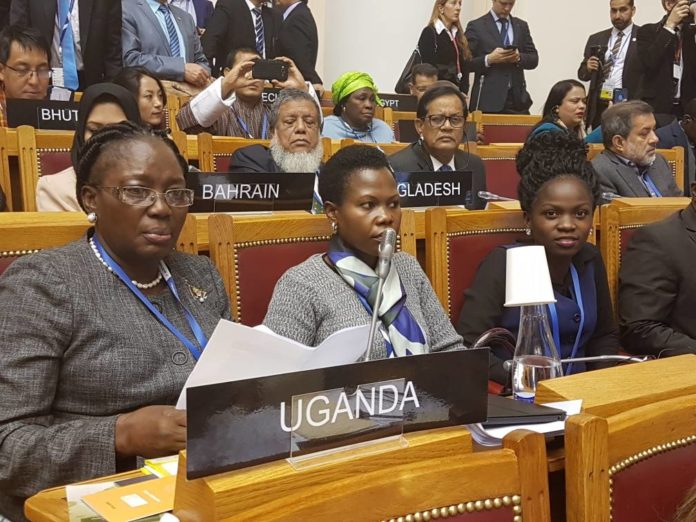
The Speaker of Uganda’s Parliament Rebecca Kadaga, who is the head of the Africa Group
The Inter Parliamentary Union (IPU) has been forced to drop a proposal to debate an item on the rights of homosexuals over objections from the mainly Muslims and African members.
The proposal moved by the IPU Standing Committee on Democracy and Human Rights was meant for consideration during the next Assembly scheduled for March.
The Speaker of Uganda’s Parliament Rebecca Kadaga, who is the head of the Africa Group which brings together African countries, threatened that the group would keep away from the next meeting if the proposal is allowed.
“On behalf of the Africa Group, I express our reservations about this proposal. It is a highly divisive and led to the breakaway of the Africa Church from the Church of England,” she said, adding: “It should not be part of the agenda. If it happens, Africa Group will not attend.”.
The Committee on Democracy and Human Rights is chaired by Ms. B. Tshireletso (Botswana), who said that the proposal had got overwhelming support in the Committee hence the decision to present it to the Assembly.
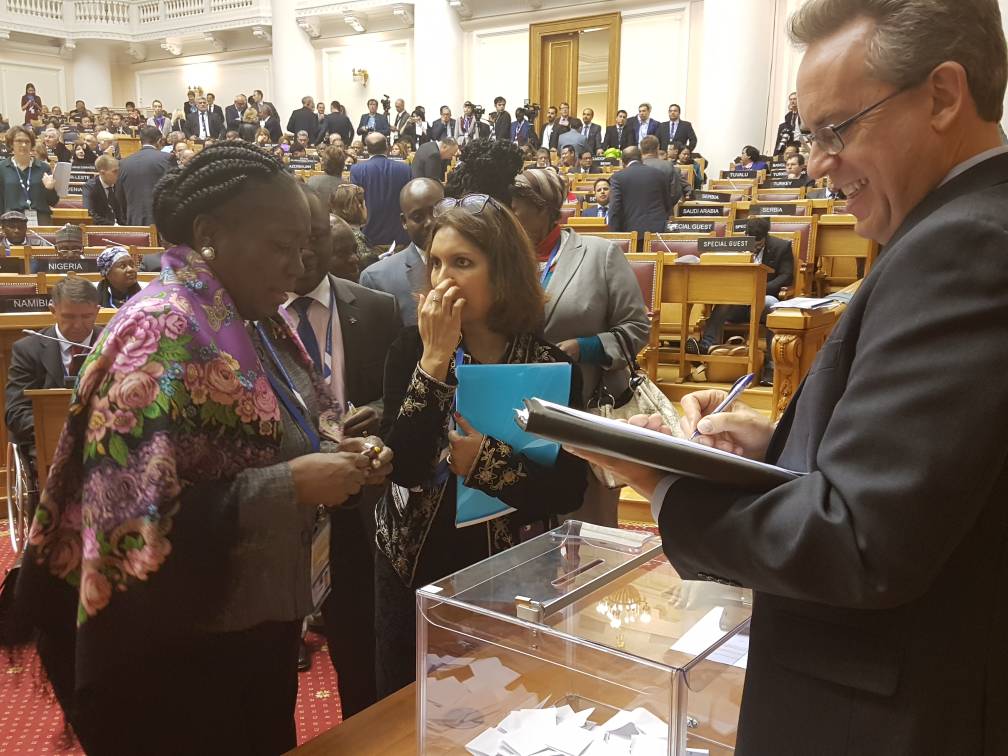
The 137th IPU Assembly and Related Meetings was held in St. Petersburg, Russia, 14th – 18th Oct. 2017.
Legislators from Iran also threatened to stay away from the next meeting. Other legislators from Sudan, Morocco, Benin were against the proposal.
However, even with the objections, the final St. Petersburg Declaration, “underscored the fact that all individuals must be allowed the full enjoyment of their equal and inalienable rights recognized in the Universal Declaration of Human Rights and other international human rights and humanitarian law treaties and standards” including non-discrimination on grounds of sexual orientation.
The Assembly was held under the theme: Promoting cultural pluralism and peace through interfaith and inter-ethnic dialogue.
“National authorities and other key stakeholders must work together to build inclusive societies and combat the dissemination of divisive discourses which can give rise to feelings of insecurity among certain groups and encourage the spread of nationalism, extremism and terrorism,” read part of the Declaration.
The 138th IPU Assembly and Related Meetings will be held in Geneva in March 2018.
Airtel Uganda, Mrs. Remmie Kisakye Kakuru, the Head – Brand and Communication, handing over the cheque to the Awards' organisers
The Federation of Uganda Football Associations (FUFA), this morning, officially launched the 2017 Airtel-FUFA Awards scheduled for December 1, 2017 at Speke Resort hotel, Munyonyo in Kampala, with a Shs100 million boost.
Launched in 2014, the Airtel-FUFA Awards are held every year with the aim of honoring and recognizing Ugandan footballers regardless of their team or club performance. The awards also aim to encourage players to remain disciplined and focused throughout the year.
This year, the awards will see Geoffrey Sserunkuuma, Muzamil Mutyaba and Tadeo Lwanga battle for the top honor, Airtel – FUFA male footballer of the year, while Hasifah Nasuuna, Vannesa Kalungi and Fazila Ikwaput are the nominees for the Airtel – FUFA female footballer of the year.
Speaking on behalf of the FUFA President Eng. Moses Magogo, Rogers Byamukama thanked all the sponsors for their contributions that have been instrumental in planning these awards; specifically, Airtel Uganda for ‘standing with FUFA and believing in Ugandan football’.
“Our objective is to bring these outstanding players to the front, recognize them and award them for their efforts as well as the entertainment throughout the year. This year we will have 11 awards given out,” Byamukama said.
Airtel Uganda, Mrs. Remmie Kisakye Kakuru, the Head – Brand and Communication, who represented her company commended the awards organizing committee for the consistency in holding the awards as well as the media for the job well done in the past and encouraged them to keep it up.
She appealed to the public to vote as many times as possible in the 4 award categories that are SMS based as winners will be chosen according to the votes they received.
“On behalf of Airtel Uganda, I would like to pledge our commitment to continue supporting football in Uganda at all levels,” she concluded, before handing over the cheque to members of the organizing committee.
The 4 sms based awards include the ; Airtel-FUFA Male player of the year, Airtel-FUFA Female player of the year, Fans’ Favorite Ugandan player of the year, Fans favorite player in Other Leagues- outside Uganda. To vote, type FUFA (space) Code of the player and send to 8888.