Stanbic Bank
Stanbic Bank
25.2 C
Kampala
Stanbic Bank
Stanbic Bank
Home Blog Page 1804

Rugby Cranes players named in Africa Gold Cup ‘team of the tournament’

UTILITY PLAYER: Phillip Wokorach who was named to the Team of the Tournament.

The 2017 Africa Gold Cup team of the tournament has been announced after the six-week tournament came to an end, with organisers naming three Ugandan utility players to the ‘Team of the Tournament’.

The six-nation tournament that had teams from Namibia, Zimbabwe, Tunisia, Uganda, Kenya and Senegal participating, played home and away matches, with Rugby Cranes’ captain Brian Odongo, and playing brothers Phillip Wokorach and Michael Wokorach being named in the 2017 Africa Rugby Gold Cup team of the tournament. Phillip Wokorach was also named man of the match on two occasions, against Kenya and Tunisia.

The Rugby Cranes lost one game, drew one and won the rest of their games in the 2017 Rugby Africa Gold Cup competition, ending the campaign with a 38-12 victory over Zimbabwe in Kampala.

­­Champions Namibia dominate the ‘select’ team with eight players, Kenya with three while Zimbabwe got one player on the team. Tunisia and Senegal didn’t get any slot on the team.

Namibia were crowned champions after defeating Kenya 45-7 in Windhoek, going unbeaten in the competition and retaining the title for the fourth year in a row.

Uganda finished on level with Kenya Simbas in the third place on 16 points and will a have a chance to qualify for the 2019 World Cup in Japan when the Gold Cup returns next year in shape of the World Cup Qualifiers.


Gold Cup Team of the tournament:

Casper Viviers (Namibia), Louis van der Westhuizen (Namibia), Brian Odongo (Uganda) , Mahepisa Tjeriko (Namibia), Ruan Ludick (Namibia), Rohan Kitshoff (Namibia), Connor Pritchard (Zimbabwe), Joshua Chisanga (Kenya), Hilton Mudariki (Zimbabwe), Cliven Loubser (Namibia), David Philander (Namibia), JC Greyling (Namibia), Michael Wokorach (Uganda), Darwin Mukidza (Kenya), Philip Wokorach (Uganda)


Stories Continues after ad
DStv to sponsor Express FC for second season

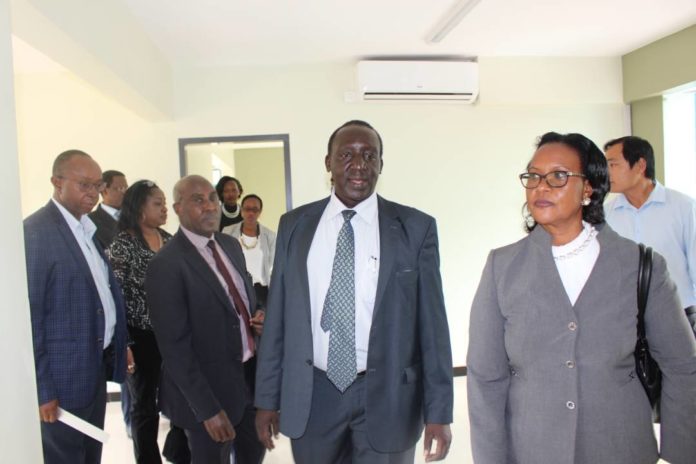
Minister Florence Nakiwala Kiyingi_ the Express FC Chairperson with DStv Marketing Manager Phoebe Nakabazzi

As the countdown to the 2017/2018 Azam Premier League (APL) season nears, DStv Uganda has reaffirmed its continued partnership as title sponsorship holders of Express FC.

Addressing journalists at a press conference, DStv Uganda Marketing Manager Phoebe Nakabazzi, said the sponsorship contract between the two parties is still active.

“We still have an active, running contract with Express FC following our sponsorship announcement last year in October,” Ms. Nakabazzi said, adding: “These first few months of the sponsorship have yielded so much fruit and opportunity for us as a brand. We are excited to continue on this journey with Express FC in boosting the team’s performance in the league”.

Since Express’ inception in 1957, DStv was the first brand name to sponsor Uganda’s oldest team, and the DStv partnership has attracted more sponsors to the club over the last few weeks.

Speaking at the function Steven Musoke, MultiChoice Uganda Chairman said: “We were very clear with what our set objectives towards this sponsorship entailed. We are like-minded brands, with shared values to grow in the various sectors.”

Mr. Musoke added: “As DStv, our commitment to the development of sports in this country is unquestionable. We aim to make a contribution in nurturing talent and the growth of sports. The continuation and reiteration that we are still one with Express is important to us to solidify our confidence in Express as a team.”

Express FC Chairperson Florence Nakiwala Kiyingi thanked DStv Uganda for the kitty provided in the first season of the sponsorship.

“I don’t take this partnership for granted and I would like to acknowledge your contribution in making Express a more amplified team. Without you we wouldn’t be where we are today,” Ms Nakiwala, who is also the State Minister for Youth, said.

Nakiwala handed over a certificate of appreciation to the brand for the first season of sponsorship.

Stories Continues after ad

BUBU policy to improve standards of Ugandan products

VISITED: New York State Judge Frank J. LaBuda

The Buy Uganda Build Uganda (BUBU) policy launched in March this year will improve the standard of goods and services produced in the country, Trade Minister Amelia Kyambadde has said.

Ugandan fabrics

The minister made the remarks as she hosted the New York State Judge Frank J. LaBuda at her offices in Kampala to discuss issues pertaining to development of trade related legal and regulatory framework.

“We want Ugandans to stop referring to Ugandan brands as the inferior brands. We agree that some of them are not yet there when it comes to meeting the required standards, and as Government in partnership with the private sector, we are working towards ensuring that the standards of our products and services improve,” said Kyambadde.

Ugandan made energy efficient stoves

The Minister said that the ultimate goal for BUBU is to change the mindset and attitude of Ugandans towards locally produced goods and services. “Trade starts at home before it goes regional and international, and it is the reason why Government is promoting domestic consumption,” she added.

Government hopes to create jobs through this policy as the economy grows by way of Ugandans consuming the goods and services produced in the country. President Museveni has always argued that buying foreign goods gives the exporting countries chance to create jobs for their people at the expense of Ugandans.

According to the minister, the BUBU policy supports the production, purchase, supply and consumption of local goods and services but also supports the private sector in the development and marketing of Ugandan brands and creating awareness.

Judge LaBudda said that Uganda was on the right track in implementing the BUBU policy which is similar to USA’s campaign ‘Buy American Hire America’.

“The Buy American Hire American campaign has helped US to address the problem of companies that were outsourcing only foreign workers, rendering many Americans jobless,” said Justice LaBuda.

The Buy American Hire American campaign is an executive order that was signed by President Donald Trump with an aim of cracking down on skilled worker visa abuse and forcing US government agencies to buy more domestically produced products.

The two officials also discussed issues on policy formulation, specifically on the management of local content policies and shared experiences on the procedures of developing Government policies, with Justice LaBuda urging the Ugandan bureaucrats to formulate policies within the shortest time possible. She also noted that ‘longer processes kill business’.

Justice LaBuda was in Uganda to undertake a number of judicial related activities and to monitor the activities of Incredible Youth International, an NGO affiliated to Victoria University that is owned by billionaire businessman Sudhir Ruparelia.


Stories Continues after ad

Prof Nawangwe pledges to transform Makerere University

MUK Vice Chancellor Prof. Barnabas Nawangwe.

The newly appointed Makerere University Vice Chancellor Professor Barnabas Nawangwe has said he will hard work to ensure the university becomes the leading institution for academic excellence and innovation in Africa.

Prof. Nawangwe has also pledged to increase the number of graduate students to 30 percent of the total enrolment, up from the current 16 percent, while at the same time strengthening graduate training and research.

The Makerere University Administration Block

In a recent media interview, Prof. Nawangwe said once he takes office next month, he will ensure that the university provides innovative teaching, learning and research services that align well to national and global needs.

The immediate Deputy Vice Chancellor of Fianance and Administration, Prof. Nawangwe says he helped initiate 10 new programmes at graduate and undergraduate levels, increased student enrolment from 800 to more than 3,000 in five years and presided over the formation of the College of Engineering, Design, Art and Technology (CEDAT).

Prof. Nawangwe says that to create flexible teaching and learning programmes at the university, he intends to increase the number of programmes in open, distance and eLearning (ODeL). The university currently has only four programmes using ODeL. He will also increase joint research, technology and innovation transfer initiatives.

According to Prof. Nawangwe, during his tenure as vice-chancellor, he expects to establish at least three satellite and two on-shore branch campuses.

“I will make this possible through a review of academic programmes for relevance and duplication through strategic linkages with professional bodies and other stakeholders,” said Nawangwe adding that he will focus on streamlining and rationalising programmes, such as the internship completed by all second-year students.

He says that he will put in place a tracer study for the college of humanities and social sciences and reduce the number of undergraduate programmes from 400 to 160.

Currently, he said, pedagogical training is only carried out in three colleges and as vice-chancellor he will ensure that he establishes a learner-centred pedagogy and andragogy by increasing the number of staff trained for this purpose.

“My ultimate aim is to achieve a brand name and a great history for the university with the help of a high quality academic staff and … a top quality student body,” said Nawangwe.

Prof. Nawangwe says the university has challenges such as inadequately motivated staff, frequent strikes by students and staff, amorphous administrative structures, and undesirably high staff-student ratios in some units – all of which he will address.

He says Makerere University has a big opportunity as a result of the growing secondary school population in the country and the hunger for tertiary education in Uganda and the region. It also stands to benefit from the growing confidence of the government in Makerere’s capability and the support from the distinguished alumni of the university.

Other proposed academic reforms include the devolution of academic processes to colleges in some cases, and the enforcement of marking deadlines.

However, Prof. Nawangwe knows that being vice-chancellor will not be smooth sailing and he expects to face challenges such as competition from the increasing number of universities and political interference in the university management.

The 62-year-old Nawangwe is a professor of architecture, the only one in Africa, and has served in various high-profile academic positions. He is currently the deputy vice-chancellor for finance and administration at Makerere University. He is also a leading researcher in vernacular architecture and social housing.

He was elected by the 22-member Council to replace outgoing vice-chancellor Professor John Ddumba Ssentamu, whose term expires on August 30.

Prof. Nawangwe was the best out of the three candidates endorsed by the university Senate on June 28, the others being professors Edward K Kirumira and Venansius Baryamureeba.


Stories Continues after ad
Museveni urges youth to monitor budgetary processes

90 per cent of Ugandans want to criticize President Yoweri Museveni.

President Yoweri Museveni has urged Ugandan youth to get acquainted with the government budgeting process.

Presiding over the International Youth Day celebrations held at Bubukwanga Primary School grounds in Bundibugyo district, western Uganda, Mr. Museveni said the youth should use their numbers to pressurize and engage their MPs to budget and prioritize three areas; peace, job creation and infrastructure development, including roads and electricity.

“Youth leaders need to get acquainted with budgeting, because it’s through this process that we are able to put more money in roads and electricity,” he said, adding: “We now spend more than Shs3,000 billion on roads and I can confidently say that we have archived minimum economic recovery.”

The International Youth Day is a global event, celebrated annually on August 12 to recognize efforts of governments in enhancing the widespread response to young people`s needs. It also aims to promote ways to engage the youth in becoming more actively involved in making positive contributions to their countries and communities.

At the celebrations President Museveni also noted that despite government collecting more revenue now, there is need to budget by the book.

“We should budget more for development and not consumption,” he said.

Museveni also cited the contribution of peace to the recovery of cocoa in Bundibugyo, a region that was heaped with loads praise for its high production of the cash crop.

“All these cocoa plantations had been abandoned because of unrest, however we restored peace, and cocoa production is now on the increase. There cannot be development without peace,” Museveni said.

President Museveni also commended the people of Bundibugyo for protecting the environment and asked the youth countrywide to help join in the conservation drive.


Stories Continues after ad

50 Ugandans join Sudhir for son’s wedding in Spain

Partying time, Sudhir and his friends at a social event.

Property mogul Sudhir Ruparelia has organized a week long party for his son Rajiv Ruparelia’s wedding to take place in Spain.

Sudhir flew out of the country last week with a delegation of about 50 other Ugandans and are set to party for a full week. Last year, Sudhir married off his second daughter in London but also threw another party in Kampala for his Ugandan friends.

Mr. Rajiv Ruparelia is set to wed in August 28, in Madrid Spain.

According to sources, the party in Spain starts on August 20 and will run through until August 28, the day Rajiv is set to wed.

Efforts to know the young tycoon’s future wife were fruitless by press time.


Stories Continues after ad

Stop over taxing informal sector-Museveni

90 per cent of Ugandans want to criticize President Yoweri Museveni.

President yoweri Museveni has directed the Prime Minister, Dr. Ruhakana Rugunda to harmonize the taxation of informal sector directing that those involved should pay tax once and more multiple taxation.

In a letter dated July 22, 2017, the president says it is unfair for multiple taxation and therefore, single taxation should apply across the board.

“I am writing through you, to all government agencies on the issue of over taxing our informal business groups (market vendors, gonja sellers, muchomo sellers, Maize sellers etc). It is correct that these operators buy annual license of, may be Shs50, 000 that should be all. Nobody should again charge them daily fees of, for instance, Shs1; 000” reads the letter to Dr. Rugunda.

Mr Museven said that as far taxis are concerned, it should again be one fee for an annual license.

“Once you have that license, you should operate without hindrance on the route for which you were licensed for the whole year. There should be no fees for Kampala, and fees for up country vendors.”

The President further emphasized that it should be one consolidated fee and if the owner of the taxi business makes profit out of the income, then the profit could be taxed and the employees should also pay income tax. “However, daily taxation of operations must stop completely”

He added “The excessive direct taxes for these or any other groups are not correct. Once these groups get some income, they will start spending that is how the government will get taxes through consumption taxes”

Mr. Museveni’s directive comes at the time when taxi operators have just petitioned Parliament through Kira Municipality legislator, Ibrahim Semujju Nganda challenging the issue of several taxation.

Stories Continues after ad

60-year-old lady wins car in Airtel Mega Masappe promo

Airtel Uganda Sales and Distribution Director, Ali Balunywa, (3rd right) pose with the lucky winners of the Airtel Mega Masappe promotio

In an exciting ceremony befitting a wekend, Airtel Uganda has for the sixth time, rewarded subscribers taking part in the ongoing ‘Mega Masappe’ promotion.

The winners received their prizes from a team of Airtel Uganda representatives led by Ali Balunywa, the Airtel Uganda Sales and Distribution Director, with Jovia Tungahurira, a 60-year-old businesswoman based in Bweyogerere, taking home the grand prize of a brand new Toyota Premio. Susan Mpumwire, Ojambo Zakaria and Sebaganzi David took home Shs1,000,000 each, while Joseph Sebyanzi, Nakakande Miyanakawa, Mariam, Namuase and Amkampurira Eva rode off with brand new motor bikes.

Speaking at the prize-giving event, Balunywa congratulated the winners and expressed gratitude to them for taking part in the promotion.

“On behalf of Airtel Uganda, I am honored to be here, rewarding the sixth set of loyal customers and winners in the ‘Mega Masappe’ promotion.

For the past five weeks, we have been rewarding our subscribers and we are always excited to see them in a celebratory mood. Our customers’ loyalty is crucial to our business operations and we are honored to be able to reward them with life-changing prizes.”

“Airtel Uganda is committed to continuously giving our customers an unbeatable experience. We believe that fulfilling this is the reason we’ve remained Uganda’s Number One Smartphone network,” he added.

Balunywa also called upon Airtel Uganda subscribers to participate in the promotion.

‘Mega Masappe’ is a nationwide campaign. We have winners from various regions across Uganda, so my message to everyone is to take part in ‘Mega Masappe’- there are daily, weekly prizes to be won, in addition to the bonus calls, SMS and data bundles that come when one reaches their target.”

As part of ‘Mega Masappe’, subscribers are required to opt into the promo by dialing *162# and selecting option 1 to opt in, option 2 to check target and option 3 to redeem their data bonus – which will be broken down into Voice, SMS and Data at 50%, 10% and 40% respectively. This bonus however does not apply to social packs, quarterly, annual and free bundles.

Mega Masappe promotion subscriber bonus will be given instantly on the achievement of the daily target. For example, if a subscriber’s bonus target is Ushs. 1,000 and they recharge with that Ushs. 1,000, they will receive 100% bonus of the same value under the Voice, SMS & Data split. However, if they recharge with another Ushs. 1,000 on the same day, they will not get a second bonus.
Daily and weekly prizes will be given away every Friday for the 90-days’ duration of the promotion.


Stories Continues after ad

Uganda to benefit from US$1 trillion regional export market

ASSURED UK OF CONTINUED TRADE: The Minister of Trade and Cooperatives,

The private sector stands to gain if Uganda ratifies the US$1 trillion EAC-COMESA-SADC Tripartite Free Trade Area Agreement (TFTA) that seeks to widen the market for the member countries, the Trade Minister Amelia Kyambadde, has said.

Minister Kyambadde says that as Uganda prepares to ratify the TFTA, the region of 26 countries will become its biggest export market, accounting for about 56.1 percent trade.

She however, notes that Uganda lose some revenue due to free entry of goods from partners states.

“By joining a regional integration arrangement, you accept to trade off some revenue losses with the benefits of regional integration, which arise from a bigger market created,” she says.

“The focus in regional integration should not be on revenue losses, but on how to maximize the benefits that accrue from bigger market access”, Minister Kyambadde adds.

Cabinet recently agreed that uganda was ready to start the implementation of the TFTA, which will open up a wider market for Uganda’s products and services in 26 African countries.

The exports will include agricultural and livestock products.

The TFTA has a combined population of 632 million people which is 57% of Africa’s population; and with a total Gross Domestic Product (GDP) of USD$ 1.3 trillion, makes 58% of Africa’s GDP.

With Cabinet approval, Government has started the process of drafting the legal instrument that will form the basis of Uganda’s implementation of the TFTA Agreement. Upon ratification, Uganda will become the second country to ratify the TFTA after Egypt.

But for the TFTA agreement to come into force, 19 Member States (two thirds) out of the 26 must ratify it. It is not clear when a sizeable number of countries will sign the pact as many are still in consultations on how best they can achieve that.

Meanwhile, the Acting Commissioner External Trade, Richard Okot Okello says the cooperation in industrialization among the three Regional Economic Blocs will broaden the manufacturing base for the partner sates and enhance regional value chains which will increase the intra-tripartite trade which stands at only 15 percent.

Okello cautions that for in order for Uganda to benefit from the opportunities that the tripartite arrangement has to offer, the country must be able to meet the challenges of competition and satisfy the requirements of the market.

“This requires us to, among others; to address the supply side constraints by increasing production and productivity and to address the infrastructure bottlenecks that make the cost of doing business high and hinder our competitiveness,” Okot Okello says.


Stories Continues after ad

The impact and benefits of the Single Customs Territory

The Regional Electronic Cargo Tracking System monitors goods cleared under SCT

By Herbert Ssempogo

About five customs entries, customs agents’ fees in two countries, two goods- in-transit guarantee bonds and duplicated customs procedures in Kenya and in Uganda.
That was the inconvenience that characterised cargo clearance before the implementation of the Single Customs Territory (SCT) in 2013.

Steel and Tube Industries’ Aggrey Ijara recollected that back in 2013 he was required to declare each container on  five to seven  customs entries for Mombasa Port,  and two entries for transit and on arrival at Malaba, Eastern Uganda respectively

“The many entries were costly and a lot of time was consumed,” Ijara stated.

Importers paid US$200m fees for clearing agents in Mombasa, a Sh150, 000 (over US$40) bond fee at Malaba and another Sh500, 000 (US$138) for agents in Kampala. This was in addition to two goods –in- transit bonds to deter dumping of cargo in Kenya or Uganda.

The delays and costs were an indictment on revenue authorities, which were failing on the trade facilitation role.

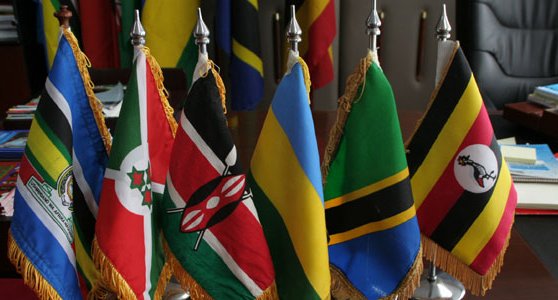
To address these challenges and others that impeded regional trade, the Presidents of the East African Community (EAC) agreed to fast track the implementation of SCT to enable importers declare their goods once on arrival at the first port of entries into the region.

It is a stage towards full attainment of the Customs Union achievable by the removal of restrictive regulations and/or minimization of internal border controls on goods moving between the partner states.

In June 2013, amid a Northern Corridor Presidents’ Summit, Uganda, Rwanda and Kenya heads of state agreed to fast track SCT’s implementation.

During the summit, said Commissioner Customs, Dicksons Katweshumbwa, the Presidents agreed on a destination model of implementing the SCT.

Under the model, Customs clearance is done while goods are still at the first point of entry into the region. The Customs declaration is done only once in destination country.

Other features of SCT are, taxes are paid to respective country of destination while goods are still at the first point of entry, and goods are moved under a single regional guarantee bond-the Regional Customs Transit Guarantee Bond and physical verification of goods done once; at first entry point, originating partner state or destination country.

Also important is the mutual recognition of customs agents in the EAC region A Customs agent licenced in Uganda is now able to clear goods in the customs business systems of any of partner states.

And in what could be music to importers’ ears, goods in transit are electronically monitored by the Regional Electronic Cargo Tracking System (RECTS), with monitoring centers in Kampala, Nairobi and Kigali

SCT is supported by interconnected customs systems of all the revenue authorities and port authorities, this has enabled real time exchange of information. Because of system interconnections, importers are now able to clear port charges online. There is no need to travel to Mombasa.

Four months after the presidential directive, said Kateshumbwa, Uganda in October 2013 piloted with petroleum imports of the biggest fuel dealers namely VIVO Uganda and Total Uganda.

Subsequently, phased implementation commenced in February 2014 with all other fuel imports.

“Phased implementation was to minimize trade disruptions and to provide for sufficient change management for all stakeholders,” Kateshumbwa, a Uganda Revenue Authority official, explained.

In July 2014, all intra region (EAC) cargo traded within EAC partner states (except for selected cargo to Burundi) started being cleared under SCT.

Others thereafter were bulk cargo including clinker, wheat grain,  crude edible oil, steel products, bitumen; containerized cargo including rice, sugar, used clothing & used shoes, dry batteries, beverages, alcoholic drinks, cooking oil cigarettes, neutral spirit, steel products, and then motor vehicle units imported through Mombasa.

Fuel and bitumen imported through the Dar es Salaam, Tanzania followed thereafter. Currently, approximately 50% of customs revenue is collected from goods cleared on SCT, according to Kateshumbwa.

And because of its success, it will be rolled-out on all imports via Mombasa on September 1, 2016, Kateshumbwa disclosed. Dar es Salaam will follow.

Following implementation, importers commend authorities for facilitating trade.

“SCT has reduced paperwork, time and the cost of doing business. We have saved a lot. It used to take a week for the cargo to get to Kampala,” Ijara stated, adding that now it takes two days to get to Kampala.

Mukwano Group of Companies’ BW Rwabogo agreed, saying, “The system is good. We are using less people and documents. I do not see any disadvantages.”

Rwabogo concurred with Ijara on the savings and reduced travel time between Kampala and Mombasa.

Since inception, said TradeMark East Africa’s, Richard Kamajugo, travel time fell from 18 days in 2012 to 4-5 days. Citing fuel, the TradeMark East Africa Senior Director said before SCT, Uganda suffered shortages especially during festive seasons.

“Uganda used to experience fuel shortages around Christmas and prices used to escalate. SCT improved the supply of fuel and Christmas of 2014 was the first time fuel was available in all towns in Uganda within the same price ranges,” he stated.

TradeMark has worked with the EAC Secretariat and the Revenue Authorities to sensitise their staff, stakeholders and the public, and also to develop and document the SCT clearance procedures.
“TradeMark East Africa is still working with the EAC Secretariat and the partner states to further improve the exchange of data between the different customs information technology systems,” Kamajugo added.

In Rwanda, one of the EAC partner states, SCT clearance procedures have been rolled out for all goods imported through both Ports of Mombasa and Dar es Salaam. Another member, Burundi has rolled out SCT only for selected items.

SCT is expected to enhance efficiency as the EAC partner states continue investing in modern information technology systems. This will have long term positive impacts on the clearance times and the cost of doing business in the region.

The Writer is an officer at URA’s  Media Desk, Public & Corporate Affairs

Stories Continues after ad