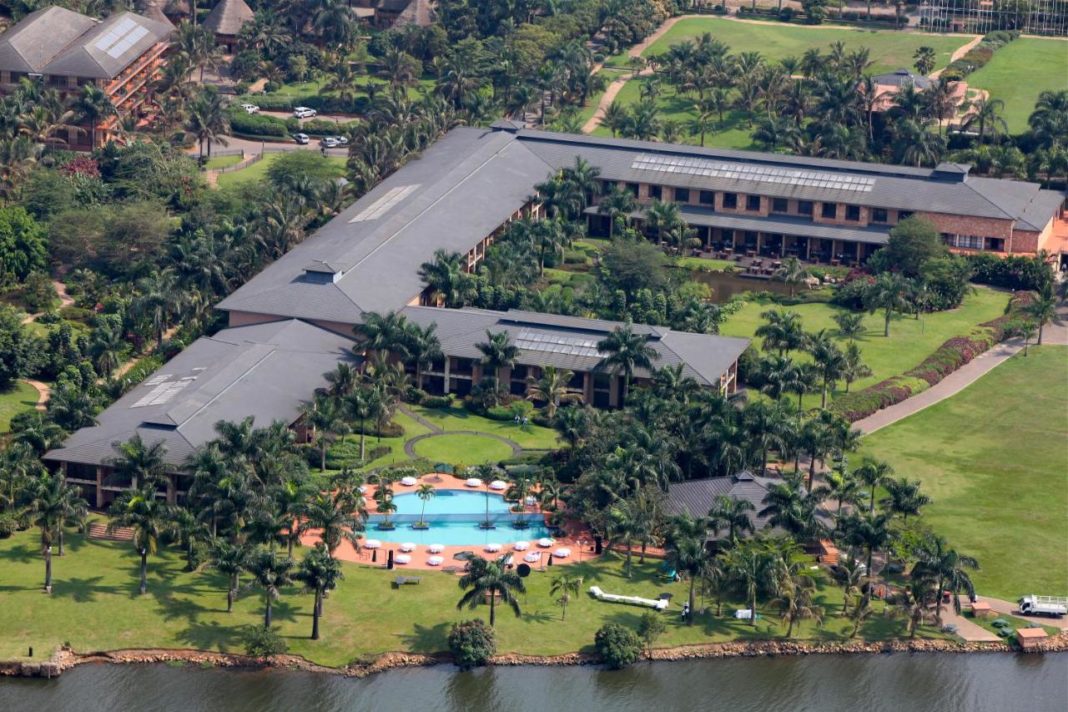
Speke Resort Munyonyo has been ranked among Uganda’s elite five-star establishments in the latest Uganda Tourism Board (UTB) grading and classification of accommodation facilities released.
The resort joins Kampala Serena Hotel, Lake Victoria Serena Golf Resort, and Sheraton Kampala Hotel at the top tier of Uganda’s hospitality sector, reflecting what regulators described as enhanced service delivery, improved infrastructure, and compliance with international tourism standards.

The Uganda Tourism Board said the new classification system is designed to improve service quality, guide investment decisions and strengthen Uganda’s competitiveness as a regional and global tourism destination.
Seventeen hotels were classified as four star establishments, while 23 were graded as three star and 59 as two star facilities, highlighting a structured hierarchy aimed at standardising service delivery across the industry.
Among the four star properties are Four Points by Sheraton Kampala, Hotel Africana, Protea Hotel by Marriott Kampala Skyz, Kabira Country Club, Bunyonyi Safaris Resort and Mestil Hotel.

UTB spokesperson John Simplicious Gessa said the grading exercise is carried out by a multi sector technical team that assesses accommodation facilities against established standards.
“This classification helps us anticipate the type of service a visitor can expect. With this system, clients are unlikely to be disappointed because each category has clearly defined requirements,” Gessa said.
He added that the framework is intended to give both tourists and investors clarity on service expectations and market opportunities.
“By clearly defining the standards for each category, we are giving tourists certainty about what to expect while signalling to investors where opportunities lie. Grading ensures that services meet regional and international benchmarks, which raises Uganda’s profile as a reliable and competitive destination,” he said.
Gessa further explained that the classification follows East African Community guidelines and is applied uniformly across hotels, lodges, motels and cottages, though standards vary depending on the type of facility.
“A lodge may be excellent in its setting, but without features such as a standard reception or additional facilities, it cannot qualify for a five star rating. Each category is assessed based on its purpose and service scope,” he noted.
He also emphasized that only licensed and fully operational facilities are eligible for assessment.
“We do not inspect facilities that are still under construction or those not legally authorized to host guests,” Gessa said.
Under the UTB system, star ratings reflect the quality and range of services offered. One star establishments typically provide basic accommodation and meals, while two star facilities offer improved amenities such as en suite bathrooms.
Three star hotels are expected to have structured departments and stronger staffing levels, while four star establishments provide luxury furnishings, spacious rooms, 24 hour room service, porterage and coordinated interior design supported by high staff to guest ratios.
Five star properties, including Speke Resort Munyonyo, are required to offer world class accommodation standards, exceptional interior design, premium furnishings, highly trained staff and high quality dining services that meet international culinary benchmarks.
The classification also recognises broader hotel categories within the sector, including luxury city hotels, business hotels, resort hotels, boutique properties, lodges, motels and cottages, each assessed based on their function and service environment.
The grading exercise is anchored in Regulation 5(4) of the Uganda Tourism Classification of Accommodation Facilities and Restaurants Regulations, 2014, which seeks to assure consistency and quality assurance across Uganda’s hospitality industry.
According to sector data, Uganda has an estimated 3,850 hotels, though the Uganda Bureau of Statistics places the figure at about 6,000. The Uganda Hotel Owners Association argues that around 1,200 hotels are concentrated in Kampala, making the capital the country’s main hospitality hub.
Jean Byamugisha, the chief executive officer of the Uganda Hotel Owners Association, welcomed the grading exercise but raised concerns over the cost pressures facing operators.
She said hotels are dealing with multiple taxes and licensing fees that continue to strain investment and expansion.
“The tax burden has made it difficult for many small and mid range hotels to upgrade or expand in time for growing demand. Many operators are also unable to access affordable credit for refurbishment or new developments,” she said.
She added that the association is advocating for tax consolidation to improve compliance and enhance sector competitiveness.
Despite the challenges, Uganda’s tourism sector continues to grow.
The Tourism Development Programme Performance Report indicates that tourism earnings reached 4.8 trillion shillings, equivalent to #$1.28 billion, in 2024, representing a 26 percent increase from 2023 and surpassing pre-pandemic levels.
The government allocated Shs430 billion shillings for tourism development in the 2025 to 2026 financial year, reinforcing efforts to strengthen the sector’s recovery and long term growth.