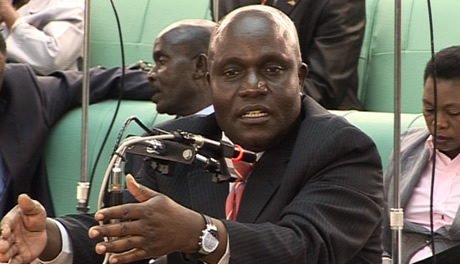
IN COURT: Cyhthia Munangwari, Mathew Kanyamunyu and his brother Jpseph Kanyamunyu, while appearing before the Nakawa Magistrate's Court. Photo/File.
The High Court has disagreed with a lower court on the day on which the Kanyamunyu brothers should appear in court.
Nakawa Magistrates court had in the morning ordered Mathew Kanyamunyu, his girlfriend Cynthia Munwangari and brother Joseph Kanyamunyu to appear in court on January 17.
This followed a request by the State Attorney Rachael Nabwire, who asked Nakawa grade one magistrate Noah Sajjabi for ‘more time’, informing court that they were still carrying out investigations.
The trio is accused of murdering child activist, Kenneth Akena.
However, a few hours after the decision, the High Court in Kampala ordered Luzira prisons authorities to produce the three in court a week earlier, on January 10, for their bail application to be heard.
Initially, the Nakawa Magistrates Court was to commit them to the High Court once investigations were done.
Prosecution alleges that on November 12, while at Game Stores, Kanyamunyu, in company of his girlfriend, allegedly shot Akena whom he accused of scratching his car, and drove him to Norvik hospital, where he died from.
His brother Joseph Kanyamunyu is held on condition that the telecom printouts indicated that he was contacted immediately after the incident, which puts him in position to be having some knowledge on the incident.
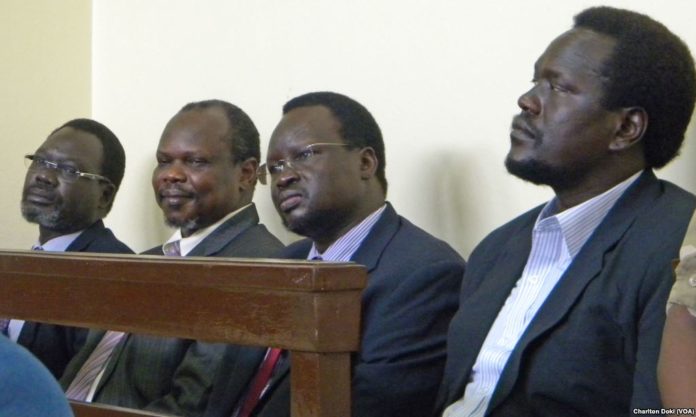
The plane that was hijacked by the South Sudan rebels
The Tanzanian pilot initially detained by South Sudanese rebels after the plane he flew landed in the armed opposition area, has been freed.
A rebel official said Mohammed Nasser and the Payinjiar county commissioner, Peter Gatkoi, who was aboard the chartered plane, were freed on ‘humanitarian’ grounds.
“The Tanzanian pilot who was sent by Juba regime to the SPLM-IO liberated territories without his knowledge, believing he would be harmed for their propaganda purposes, has been released today with his plane on humanitarian grounds,” Garang Mabior, the armed opposition’s director for public relations, said in a statement.
Mabior also dismissed as untrue reports that they had demanded the release of Tanzanian national with the hope that he would be exchanged for rebel leader, Riek Machar’s spokesman, James Dak, who is being detained.
“There was never such a demand. This is just usual propaganda of Juba to think that The United Republic of Tanzania is supporting our movement, when no such thing exists,” the statement further added.
Mabior said the government under President Salva Kiir wanted to create a diplomatic incident. The rebel official did not elaborate on the fate of Panyijiar county Commissioner, Peter Gatkoi, who was on the same plane.
The pilot had, in an earlier interview, blamed the country’s authorities for his woes, saying he was duped to believe Payinjiar county was under the control of government.
Tanzanian President John Pombe Magufuli has sacked the head of the state-run electricity company on Sunday January 1, 2017 after the firm put up tariffs, a move the Magufuli said would cause impasse to his plans to industrialize the country.
Tanzania’s energy regulator on last Thursday approved a power tariff hike of 8.53 per cent by the Tanzania Electric Supply Company (TANESCO), less than half of what the utility said it needed to stem losses.
Magufuli’s office announced the sacking of TANESCO’s Managing Director Felchesmi Mramba in a statement. Hours before the announcement of Mramba’s dismissal the president rescinded the price increase.
“It’s unacceptable that while we are making plans to build manufacturing industries and ensure more citizens have access to electricity…someone else uses his position to increase power tariffs,” Magufuli said in a statement.
Mr. Felchesmi Mramba was sacked as Managing Director of TANESCO.
About 40 per cent of Tanzania’s population of around 50 million has access to electricity and the government is aiming to push that rate up to 75 per cent by 2025.
Since coming into office a year ago, Magufuli has sacked dozens of public officials as part of an anti-corruption campaign and a new drive to root out government inefficiency.
He appointed a lecturer at the state-run University of Dar es Salaam, Tito Esau Mwinuka, as acting managing director of TANESCO.
The power firm had initially sought an 18.19 per cent tariff increase to snap a loss-making trend and clear debts to independent power producers and fuel suppliers.
The tariff hike, which would have taken effect from Jan. 1, 2017 was approved by the Energy and Water Utilities Regulatory Authority (EWURA).
Loss-making TANESCO has warned that its “financial capacity will be paralysed” if the power tariff hike is not implemented.
TANESCO has been unsuccessfully seeking loans from the World Bank, the African Development Bank (AFDB) and commercial lenders to turn the company round.
Despite reserves of over Shs57 trillion cubic feet (tcf) of natural gas, Tanzania has been facing chronic power shortages over the past decade due its reliance on drought-prone hydro-power dams
Fast-rising comedian Ssegujja Herbert popularly known as Mendo or Teacher Mpamire was yesterday recognised in Ghana.
This is after he won the award of ‘Discovery of the year’ at the Africa Youth Awards 2016. The Awards were held yesterday (Sunday) January 1, 2017 in Accra, Ghana.
Launched in 2014, the Africa Youth Awards is a prestige award scheme aimed at appreciating the works of young Africans in Africa and the diaspora.
The awards scheme was inspired by the lack of recognition for young Africans who have selflessly dedicated their lives to making sure the future of Africa is optimistic.
Award celebrations will be on January 22, 2017 during the African Union Heads of State summit at the African Union headquarters in Addis Ababa, Ethiopia.
Sheikh Ahmad Haruna Kasujja Mutakubira who is the new acting Amir of Tabliq Muslim Sect also known as Jamuiyyat Da’áwa Assalafiyya based at Nakasero Mosque has been unveiled
Sheikh Ahmad replaces Sheikh Yahaya Ramathan Mwanje who is now detained at Nalufenye after his arrest a few days after the murder of Maj. Muhammad Kiggundu.
With the arrest of Sheikh Mwange on November 27 the executive of Tabliqs appointed Sheik Kasujja as an Interim leader on December 30. The new Amir (leader) was welcomed by leaders from Uganda Muslim Supreme Council led by Amir Daula Sulaiman Kakeeto and other district Umaras (leaders) across the Country.
However despite all this, they all still pledge allegiance to Muhammad Yunus Kamoga who was arrest in connection to the murders of Muslims clerics who are mainly from a rival Jamiat Islam Assalafiyya which relieved Kamoga from the leadership of the Tabliqs before he formed his own sect.
During the annual East African Dalasa held at Old Kampala Secondary School grounds, the Muslim faithful were graced by the new Amir Sheikh Ahmad Haruna Kasujja Mutakubira, the chief guest was Hajji. Ali Kasirye Nganda Mulyanyama who is the Mayor of Makindye Municipality in Kampala.
The Mayor who had been invited to lead the funding raising for the Ummah House pledged Shs2 million which will be paid in four installments.
Hajji. Kasirye advised Muslims be silent and avoid panic and rush to utter out anything due to anger for their enemy wants to see them desperate.
”Do not waste time visiting President Museveni for attacks of the Mosques by Kayihura but rather ask yourselves if the orders to attack the Kasese were given by the President and then can it be possible to attack a Mosque at Nakasero yet the president has a State House in Nakasere without his knowledge?
In a related incidence the Spokesperson of Jammiat Da’awa Assalafiyya Sheikh Kifampa Siraje Nsambu asked government to return all the money and property stolen from the mosques of kiwatule and Nakasero.
He further condemned the actions of police while labeling Muslims with a bad image and arrests.
Team No Sleep musician, Rodden Y popularly known as Kabako begun the new year a sad man.
Kabako’s vehicle was stolen a few hours to 2017. It was stolen from Freedom City Mall where the artiste had parked as he went on stage to perform.
“My Car (RUNX UAW 311N) Black in Colour as been stolen this morning at 3 am Opposite Freedom City. Whoever comes across it just inform the nearby police or call +256758075456 for your reward.” The musician broke the sad news.
Speaking out today on the progress of the search, the ‘Nanfuka’ singer said their efforts are in vain. “We are still looking for the lost car RUNX in plates number UAW 311N Black in colour.”
Though, they have some clues on where it might be hidden.The car is said to be in areas like Nyanama, Zaana, Namasuba, Ndeeba, Ndejje, Kikajjo, Bunamwaya, Kaboowa, Wankulukuku, KuStar, Kigo, Lubowa, Abaita Ababiri,Seguku, Makindye, Katwe, Kibuye, Salama Road, Mengo, Nateete, Kabusu, Busega, Bulenga, Masaka Road and Mityana Road,” he says.
Spice Diana
“If you stay around the above named areas and you see this car (RUNX 311N) contact police or call on +256776075456. I will be so happy to get my car back.”
The theft followed that of another vehicle belonging to another musician, Spice Diana whose vehicle was stolen earlier from the same venue.
Her stolen vehicle was a Noah Ordinary field touring UAQ 482X, silver in colour. It was also stolen from Freedom City parking.
“I am humbly requesting whoever comes across the vehicle. Please report to a nearby police station or contact 0704205173. A big reward awaits.”
Besigye addressing the media. In the background are party leaders.
Opposition kingpin and Forum for Democratic Change presidential flag bearer in 2016 general elections, Kizza Besigye has said that his party will participate in the upcoming Local Council (LC1) elections.
However, Dr.Besigye told media that they will participate in the elections despite being organized by the current electoral commission that he doesn’t believe in.
“We will participate in the LC1 elections by defiance. Even if Museveni was declared EC Chairman (which he should become anyway), we will go into it,” he said.
“We go for two reasons; to change the mind sets of our people by educating them why Injustice must be defeated and also, it is an opportunity for us to organise and set up grassroots network. What is clear and what we must challenge is the illegality. Lining behind candidates is illegal and we will challenge it, even if it means going to court, we will go”.
Speaking at his first media briefing this year held today along Katonga Road (Former 4GC offices), Besigye has called for the intervention of the international community into Uganda.
On the recent Kasese killings, Besigye said, “We should also invite the attention of International scrutiny of these excesses…. Because we are not a country in isolation. There are international covenants to which we are members. And we are going to be inviting these to apply more scrutiny to what the dictatorship is doing,” said.
However, he added that the current government can have a peaceful exit,
Among the conditions he set for this peaceful exit included a need for setting up of what he called a “carefully mediated dialogue process”.
“The desirable and prudent way to have a transition from the current regime is through a carefully mediated dialogue process. Such a dialogue would engender an audit of the 2016 elections, the necessary constitutional, legal, political, institutional and administrative reforms.
“It would provide for an implementation mechanism for such reforms. And indeed it would culminate in the holding of free and fair elections. If this regime wants a peaceful exit from the conundrum in which it has found itself….”
The GO-Forward candidate being handled a shield and spear in Gulu during 2016 general elections.
Former Presidential Candidate Amama Mbabazi has described 2016 as a difficult year but says he hopes 2017 brings peace.
Mr. Mbabazi who is known for his cool headedness twitted on his official twitter handle “2016 was a difficult year. I wish for 2017 to bring peace and serenity to our country and to the world. Happy New Year.”
Mbabazi started the 2016 on a higher note as he unleashed his intentions to contest for the highest office in the land which he did but midway, he faced upheavals when security led by police blocked him and supporters from the initial launch which he had planned in Mbale. On the same day, he was arrested and taken to Kira Road police station with his daughter where they were kept until dark and released without any charge.
The arrest perhaps the one of its kind in over four decades made many to believe that indeed Mbabazi who had been part of the inner dealings of the ruling party and government had finally fallen-out with his comrade Yoweri Museveni.
However, like it is known to many, Mr.Mbabazi remains reclusive as nobody knows his 2017 plan. He remains a key player in the Ugandan politics and no person should make a mistake of dismissing him based on the 2016 presidential results.
Former Makerere University Spokesperson, Gilbert Kadilo has been appointed as Spokesperson for National Identification Registration Authority (NIRA). After Makerere, Kadilo went to National Forest Authority but with the impending takeover of forests by Uganda Wildlife Authority, Kadilo wouldn’t want to be jobless again and hence the move.
Mr. Kadilo’s appointment took effective late last month and has started work. Kadilo in the interviews tied with Electoral Commission’s Paul Bukenya.
According to sources, Kadilo only beat Bukenya in seniority (experience) otherwise the two gentlemen got same similar marks in interviews.
The other person who applied but wasn’t successful was Helen Kaweesa of Parliament. According to sources, Kaweesa isn’t herself ever since the workaholic Director of Communication and Public Affair, Chris Obore took over the directorate. It is said that after assuming his office, at Parliament Mr. Obore began on the restructuring and in the process took away procurement docket from Kaweesa and thereafter she hasn’t been the same and hence the job hunt.
Happy New Year, again, friends. Thank you for the engagement on my last article published by Eagleonline (www.eagle.co.ug) and on my Facebook page. The response, including from Ugandans in the diaspora, was a cocktail of more reactions than I can share here. I am profoundly humbled you took time to read and engage.
I was particularly intrigued by the rejoinder of Mr Conrad Nkutu, former Managing Director of Monitor Publications Limited who raised points of contention with my write up which he generously described as passionate and faulted for not touching, “ANY of the valid criticisms Andrew made about Kizza Besigye and Forum for Democratic Change (FDC) strategy and performance.”
I had elected to write just one piece (the last I wrote) but Mr Nkutu is an elder and a respectable voice at that. I am therefore not responding to him for I don’t have what it takes to respond to elder Nkutu. All I shall do and I hope this will be my last piece, is attempt to explain some of the issues he raises from my little corner, as and how I see them, as a pint-sized and inconsequential observer of Uganda’s politics whose only crime is being a wiseacre seeking to be heard on matters that our country’s intellectuals alone should discuss.
I apologise for playing around with issues of generals. Elder Nkutu opined that my last article didn’t address itself to Mwenda’s issues about FDC which include:
Lack of parliamentary and Local Council candidates (singular focus on the presidency).
Lack of female and rural support.
Lack of an understanding, discussion of or research into why 32-42 per cent of eligible Ugandans didn’t vote in the last two elections and no plan to turn this around.
Failure to paint a picture of a better future for Ugandans (obsessive focus on pulling Museveni down). (In other words the opposition has no alternative policy agenda around which to rally the voters against Mr Museveni-emphasis mine).
I shall share my take on issues 1, 4 and by default touch on issue 3. I shall leave out issue 2 for I don’t have sufficient evidence to directly answer it and feel it too, can find adequate repose in the issues answered. In so doing, I shall also be able to respond to elder Mwenda’s passionate argument that Kizza Besigye has stifled the institutional growth of FDC and how the party is bleeding from lack of structures, never mind no attempt made to paint a picture of an FDC institutionally grown and rich with structures at least with some kind of working formula and architectural impression of sorts.
Mr Nkutu wrote, “Mwenda’s criticism is that Besigye has been a charismatic mobiliser but has not demonstrated the organizational leadership skills to solve the above problems and that either a public discussion of them compels Besigye to try and tackle them or we discuss leadership options.”
First this school of thought is premised on assumptions that deserve retrospection; the romantic idea that Uganda’s political terrain as we know it today is normal. That we have flourishing multi-party democracy. That there is adequate room for opposition parties to build structures and they are just being lazy, feather brained and failing to measure up to the task. I respectfully disagree.
A bit of background and context. In 2002, Dr. Paul K. Ssemogerere walked to the Constitutional Court and challenged the constitutionality of the Movement Act. The same year, Dr. James Rwanyarare dashed to the same Court and contested the constitutionality of sections of the Political Parties and Organisations Act (PPOA). In summary those two petitions challenged what, for all intents and purposes, was a clever attempt by Mr Museveni to establish a one party state in Uganda so much as to dupe the nation that there was such a thing as the Movement Political System. The court ruled him out of order.
Then he masked his plan under the PPOA. Counsel Peter Walubiri persuaded the Court that by legislating that after registration of the party it can only hold one meeting in the district to elect the district executive and thereafter all structures set up for the purpose are dismantled, the plan, “was to kill parties by alienating them from people so they remain at the district headquarters yet the Movement under the Movement Act had branches from village to the national headquarters.” In the wisdom of the Court, this was, “a monstrosity in a free and democratic society and it shouldn’t stand.”
So the Court thwarted Mr Museveni twice in 2002. We then had a referendum that saw parties return. Museveni was not done. His plan has since continued in different ways. Uganda in form is a multi-party democracy but in substance a one party state or at least, the operating environment makes this the de-facto reality. Let’s evaluate the evidence.
It is the reason why a newspaper which has a duty to be truthful and balanced will be shut for publishing stories deemed anti-regime albeit filling the boxes of journalism. It is the reason KFM as happened in 2006 and Mr Mwenda has spoken about this severally, was shut down for running a tally centre, by the indomitable David Sejusa. It is the reason you have “free media” which actually is only free to the extent that it doesn’t step on some toes of the leopard not really as a matter of national security but regime security.
It is the reason why NGOs, the Church, Mosques, private companies and trade unions are all kept in check through an efficient patronage machine and brute force for those who refuse to play ball. I know of a son of a former minister in the Obote regime who got a job at Bank of Uganda and days into his new office, he was ejected after a tip off from Internal Security Organisation (ISO). He then got a job in one of the banks and the security apparatus followed him there. He would later got, out of frustration, a job out of Uganda. His crime? Being a son to an opponent of the regime.
It is the reason, as Mr Odrek Rwabwogo reminded us in his last missive, parliament like other institutions, exercises delegated power from the military.
Hence you have a single party parliament with a multi-party coating. You can argue the power of the caucus and the majority rule but democracy is also about minority views and rights, the reason our constitution has provisions to this end. The reason we have the Equal Opportunities Commission. Even then, can we say there is such a thing as democracy in the NRM caucus? The rebel MPs who faced the wrath for holding divergent views can tell us. The same is true with cabinet. I know for a fact that at one point in the last cabinet, out of over 70 ministers, only Mr Amama Mbabazi, Betty Bigombe, Amelia Kyambadde and Kahinda Otafiire had the guts to disagree with the President when he went to cabinet. The rest were, “Yes Afande, In fact you have spoken my mind, actually I wanted to say just that, Mr President your wisdom had eluded us all.” This is a few steps away from the situation in North Korea where ministers have to pretend to take notes when the leader is speaking.
And so, I dare ask, if Mr Museveni can limit the level of engagement and divergent views within his own establishment, those keeping him in power, men and women who have walked this journey with him for decades, what shall he not do to those seeking his throne? What?
To those seeking power, we have an attempt at regaining the ground lost to the constitutional Court in the cases cited above by coming up with legislation such as the Public Order Management Act (Prof. Oloka Onyango calls it the Anti-Besigye Act). To those seeking power from him charges of treason, terrorism await them never mind many of them failing to meet the rigorous test of evidence or those accused being forced to seek amnesty, if they are lucky not to have their lives in this world, where we are all visitors, terminated in unmarked detention centres or, worst case scenario, in broad day light during demonstrations where less force could have been used as we saw with Walk to Work demos.
So this is the state of our multi-party democracy wherein we expect the opposition to do miracles. You can speak to judges who will tell you the price of ruling against the state is so high (never mind some bold judgments of our resilient judiciary which are exceptions to the rule). I know for a fact that on two occasions, under the Justice James Ogoola led Judicial Service Commission, Justices Remmy Kasule and Egonda Ntende were scrapped from the list of Supreme Court nominees by none other than His Excellency the President of the Republic. So this is a democracy where Judges pay for their independence and integrity. What shall the system not do to those who from Monday to Sunday, from Kotido to Kabale seek to upset the status quo?
So in as much as the Opposition can do more and better, it is important to factor into consideration these stark realities. I know for instance that some international donors including Ugandans in the diaspora have accountability issues with our opposition and there exist sharp contradictions that better leadership can heal for better organization and better results. However, even if all these were addressed, the same hurdles remain.
Even if Besigye withdrew completely from the scene, anyone else, including Mr Mwenda would face the same obstacles. This was the point I made when Mr Mbabazi took on his boss and many were excited the “man with insider understanding” as Timothy Kalyegira argued, had come to deliver the knockout punch Besigye’s popular support not backed by organizational skills, had denied the opposition. That Mbabazi was going to breathe freshness of better strategic experience, international connections and financial muscle that kept his nationwide structures running. Some of us who said he would meet the same obstacles were called names. We have the benefit of experience now. When Olara Otunnu came back home, some said, “It is game over for Museveni.” Again his better organization was a flag flown wide and far. The regime put him in his place the same way regimes of this nature in Rwanda, Angola, Kenya under Moi, Congo Brazaville, Cameroon under Paul Biya and Zimbabwe do. You’d think the leaders were fed on the same breast milk but it is just the nature of tyranny. The extents might be different but the substance the same.
A hypothesis won’t hurt.In fact, FDC, UPC, DP and CP should mobilise some US $50,000 and pay Mr Mwenda monthly for a period of one year and assign him, with measureable outcomes, to be chief of strategy and Implementation, department of Institutional/Structures Building.
I can predict: 1. Key contacts in NRM will stop taking his calls. 2. Business allies will vanish in thin air. 3. Charges will be brought up against him. 4. He will only hold a few successful meetings. 5. Depending on the level of efficiency, he might as well breathe his last or at least be booked into a safe house, accused of terrorism. 6. His family/friends will be lucky not to be affected. 7. The Independent, his beloved business, will lose advertising from both private and public clients.
So it is easy to swing in an air conditioned office over champagne and make these harsh judgments on the opposition and throw around romantic ideas but the surface isn’t rosy. We are talking lack of BASICS. Bear Minimums. A pretense of democratic competition akin to couples whose marriages have hit what in family law is called irretrievable breakdown, warranting separation or divorce but somehow push on, pretending there is marriage, until the centre stops to hold.
This in my view PARTLY explains why for instance the opposition can only do so much to field candidates in every constituency in a country where the security apparatus and the ruling party are inter-twined. It becomes extremely risky to be in the opposition. Faced with land grabbing, you are better off buying NRM shirts and posturing as veterans or youth mobilisers as only then can the police be fair to you, the District Internal Security Organisation n(DISO) give you audience, the President listen to you.
Sometime last year, I attended an NRM party event where the old guard and young Turks met to ponder over the question of the generational gap in the party. One elder, a member of the Historical League, opined, “The problem with our party is that it is seasonal. You see people during campaigns. After that there is no NRM.”
I found this an honest reflection. NRM structures from village to national headquarters cannot be the litmus test of its structures strength to the extent that for some of those members, NRM is all but a refugee camp against state harassment being in opposition attracts; it is also a dining table of opportunities extended from the state and also a sense of security. This is no in no way to discount the many genuine NRM supporters who sacrifice their all for the great party and the party’s efforts to retain and attract new members.
One can’t help but wonder if after NRM leaves the power stage, it will enjoy the level of loyalty we see among UPC members who wear Red shirts and sit at Uganda House awaiting party events. The loyalty of NRM members is not tested so it cannot be the litmus test for a party with structures seeing as it always summons the army and police to sort out its business as we saw in Namboole 2014 when Problem Mbabazi had to be fixed. This was a security operation and not the party. Why didn’t the Almighty structures have to opt for security to deal with Mbabazi? The opposition lacks that luxury.
And so Mr Mwenda in his last post argued that it is, “foolish and childish” to expect Mr Museveni to give the opposition power on a silver platter and that he is only doing what he has to do to keep power and therefore, the opposition should just deal with those obstacles and not keep reminding us about the hurdles.
This sounds a script of Mr Ronald Kibuule, former youth minister who publicly argued that women who dress skimpily should carry the blame for rape. Mr Mwenda’s argument is not even in pursuit of the end justifies the means line but to break it down at the risk of sounding pedestrian: It is to say—the perpetrators of apartheid in South Africa had to do what they did so the blame should have gone to their opponents for failing to surmount the obstacles for long. It is to say it was fine for Adolf Hitler to run a reign of terror and unserious of his opponents to fail to surmount his excesses and, it is okay to close an NGO (as the late Aronda Nyakairima suggested of the Great Lakes Institute for Strategic Studies), a newspaper and church for speaking stuff that angers the regime.
The regime has to unleash terror to keep power. It can maim, rape, sodomise, detain unlawfully, suffocate economically and abduct its own citizens. See no evil, hear no evil. Blame the opposition for not stopping it. Let’s get a whip and pump sense into its opponents for not doing enough to defeat those hurdles and those who remind the world about these excesses are, “childish and foolish.”
Lastly, FDC and its radicals who are holding Besigye captive. Synonyms for radicals are: militants, extremists, fanatics, obsessives. For starters no law forbids one from being radical about something they stand for as long as they don’t indulge in crime. I know not of a cultural restriction in any part of Uganda against the same or a Quranic/Biblical bar against the same but I know that political propaganda has no limits, including throwing dirt at opponents and making them look societal misfits.
So the anger over radicals, just like Besigye’s continued running for office, has no moral, theological or legal basis.
Be that as it may, I personally think the fact that FDC or any other party has radicals is an expression of the level of freedom within that party. It means no one is too big to be shouted down, no one owns the party. It belongs to the people no matter your views about them. Be you party president, as long as they disagree with you, they shall tell you, fast and furious. In any case the demographic context of FDC and its radical wing makes the existence of the same, after all, no sin. These are young people. Let them be.
There are people who love the radical Mwenda and to this day think he was great news to journalism and democracy when he was radical enough to accuse a government of killing John Garang, call the president a villager and accuse his family of fleecing the tax payer. There are people world over who love the radical Nelson Mandela (seen as a terrorist in some quarters then), or even Fidel Castro, both of whom have Mr Mwenda’s admiration just like some students of law and legal practitioners love Lord Denning who was considered radical or even our own John Bosco Katutsi or George Kanyeihamba or Arthur Oder or Tsekooko (who ruled Museveni’s election in 2001 and 2006 be annulled).
There are people who think had Mr Museveni and group not been radical (what’s more radical than taking the state to battleground), the economic wonder story Mr Mwenda quotes today wouldn’t have matured and the “fundamental change” wouldn’t be here with us. There are people who love the radical Omukama Kabalega, John Garang, Mau Mau, or even the radical Julius Malema in South Africa. Across history and the world, it appears, being radical is a sin committed by many men and women dedicated to a better society to the chagrin of the oppressors. It is a sin FDC people should freely commit from January to December if in their view, that will take them to paradise politically. They should only do so with respect to our law books. Do they have a legal or moral obligation to respect those they disagree with the same way they too, disrespect them? I don’t know.
And who defines radical and using what parameters? I actually know more radical people in NRM who for lack of space express their militant views in bars, office corridors and homes. Is this what we want for a young democracy?
Part of Mr Mwenda’s anger with the “FDC mob” is that whenever anyone attacks Dr Besigye they attract fire from this ‘mob’, the kind of fire Andrew himself attracted from people like Mr Rwabwogo whenever he shared his radical views on the regime. I have personally been attacked by this group and been called names for having a divergent view (such as FDC being incapable of doing better than NRM when and if it takes power). But Mr Mwenda should relax and enjoy some Good African Coffee. I invite him to read just one sentence from the wisdom of Justice Constance Byamugisha in (Muwanga Kivumbi vs Attorney General), whence she argued that a society, especially a democratic one, should accept a reasonable level of annoyance to allow for enjoyment of the greatest possible freedom.
Mr. Andrew Mwenda
Mr Mwenda also stated that moderates like Mugisha Muntu, Abdul Katuntu, Amanya Mushega and Augustine Ruzindana have been relegated out of that party by the radicals. The last time I interviewed Mr Mushega, his take was that FDC needs both approaches (the Muntu and Besigye approach) blended into a coffee that can deliver the good scent of the party’s objectives. To throw out one would be unwise. The last I checked Mr Museveni responded to campaign pressure and promises from FDC (considered radical) including scrapping graduated tax, increasing government sponsored student numbers and dropping the idea of cost sharing in lower health centres, et al.
The balancing of the two approaches is what FDC should focus on. They should however, in so doing, recall that when a neighbour expresses unusual interest in your wife’s pregnancy, so much as to determine which clinic she pays maternity visits to and suggesting the medicine she should take, it is time to reflect on that one thing which drives all men and women: Interests. What is the interest?
Ivan Okuda, 23, is a student of Law at Makerere University and a journalist with the Daily Monitor. He also contributes to The East African newspaper.