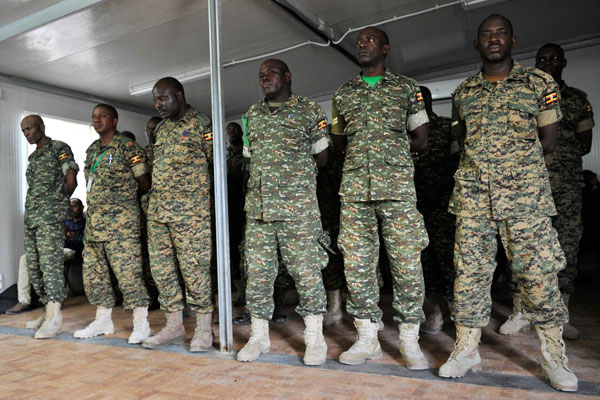
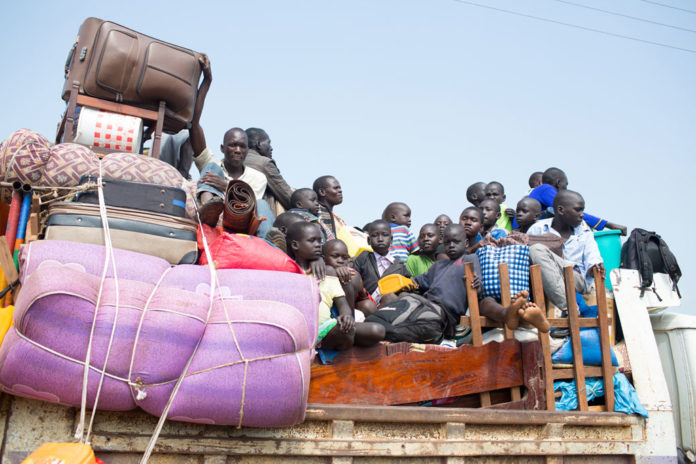
Uganda military personnel are seen a top military and police trucks driving towards Juba in South Sudan at Nimule border point on July 14, 2016. The Ugandan Army have started an evacuation mission to extract 3000 ugandan civilians stranded by the recent fighting between army loyal to President Salvar Kiir and first Vice-president Riek Machar. AFP PHOTO/ ISAAC KASAMANI
Uganda Peoples Defence Force (UPDF) will officially redeploy in war ravaged South Sudan.
According to a statement released today, the redeployment will be carried out in respect to the provisions of the August 2015 peace agreement which among other things demanded for UPDF’s withdrawal.
This comes after President Museveni and other African leaders on Monday backed plans to deploy regional troops in Africa’s youngest nation after recent fighting.
More than 300 people have died in the latest clashes between forces loyal to South Sudan’s President Salva Kiir and his rival, Vice President Riek Machar.
Now majority soldiers for the African Union (AU) force are to come from Uganda while supplementary troops will be drawn from Ethiopia, Kenya, Rwanda and Sudan.
A 12,000-strong UN peacekeeping force is already in the country, but the AU force would have stronger mandate, officials said.
South Sudan’s president has been reluctant to allow in foreign troops.
On Sunday, President Museveni also said he was opposed to a UN plan to impose an arms embargo to South Sudan, saying it would weaken the country’s army just as it was trying to contain a resurgence of violence.
Uganda first sent troops into South Sudan to back Kiir during the last conflict, which started in December 2013, and sent troops back again during this month’s resurgence in fighting, saying they would rescue Ugandan citizens there.
A year ago, the South Sudanese peace agreement brokered by the East African regional bloc, IGAD, and signed by top rival leaders, President Salva Kiir and opposition leader, Riek Machar, only allowed Ugandan troops based in Western Equatoria under the African Union (AU) mandate to continue hunting for rebels of the Ugandan Lord’s Resistance Army (LRA) under the leadership of Joseph Kony.
Deputy Speaker Jacob Oulanyah L’Okori has expressed dismay with the Ministers of Internal Affairs, Gen. Jeje Odong and Mario Obiga Kania, for failing to table the report on the beating of Dr. Kizza Besigye’s supporters by police.
Oulanyah, who is presiding over the plenary session this afternoon, said that the house will debate on the conduct of the police, including police brutality, on Thursday, with or without the ministers’ reports.
‘The Deputy Speaker expresses displeasure with the failure of ministers to present statements to the House,’ a release on Parliament’s Twitter handle, reads in part.
Recently, the police have come under attack after its officers were captured on video beating up people who had lined up along the streets in the city to catch a glimpse of opposition icon Besigye after his release from a two-month incarceration at Luzira Maximum prison.
Since then, four police officers and a ‘crime preventer’ have appeared before the police disciplinary committee.
Meanwhile, Justice and Constitutional Affairs Minister Severino Kahinda Otafiire has this afternoon taken oath as an ex-officio member of the house.
MTN shares have fallen sharply in trading at the Johannesburg Stock Exchange after the mobile phone firm said it expected to report a loss for the first half of this year as it pays a record fine imposed by Nigeria for failing to to disconnect unregistered Sim cards.
The shares of Africa’s biggest mobile phone company dropped 2.5% at 11:25 local time, after earlier slumping by as much as 3.8%, the most in three weeks on a closing basis, it reports.
Last month, South African-owned MTN said it would pay Nigeria $1.7bn (£1.1bn), dropping legal action against the Nigerian Communications Commission (NCC).
It was originally fined $5.2bn by the NCC but the two sides settled on a lower amount.OU
INVEST MORE IN EDUCATION: Education Minister Janet Kataha Museveni
Education Minister Janet Museveni is this afternoon expected to present a statement on the payment of salaries in public universities.
By press time details of the presentation by the First Lady were scanty but it is expected that she will announce fiscal measures that will help curb unrest at the universities, arising out of discontent over poor remuneration.
‘On the Order Paper today is a statement by the Education Minister on the payment of salaries of staff in public universities, a message on Parliament’s Twitter handle stated.
The issue of salaries at Uganda’s nine public universities has been a point on contention between government, the universities and teaching staff but last year, while installing Gulu University Chancellor Prof Fredrick Kayanja, then education minister Jessica Alupo said the salary increment for professors would take effect this financial year.
At the time a professor in public universities was earning between UgShs3.5m and 4m, but Maj Alupo said the government would raise the amount to about Shs15 million.
Uganda has nine public universities and these include Makerere, Mbarara University of Science and Technology (MUST), MUBS, Kyambogo, Busitema, Gulu, Muni, Soroti and Lira University.
Several Ugandan clubs have over the years been known as ‘selling teams’, something that still applies to some today.
They buy players on realistic sign on fees of about UShs5 million– real bargains, actually – and develop them for a season or two and then have to watch as they are sold for bigger money, or to their league rivals.
Reigning Uganda Cup champions SC Vipers, formerly Bunnamwaya FC, are one such club and in a way it is a shame to see this happen to a well organised club.
In the last two or three seasons you could argue that they have punched above their weight, as successive qualifications to the continent were obtained without too much fuss.
Indeed, last season, they came so very close to an African Champions League qualification place only to finish below rivals KCCA.
Every season the club appears to have to sell some of its most talented individuals and whilst the cash-in is a positive, you would think that the club would suffer, but that’s not been the case.
The recruitment of new players is as sound as you can find and not only do they fit straight into the team, they also seem to take the club to another level on every occasion.
Gor Mahia, TP Mazembe and Standard Liege have all plundered the Buikwe club in the last four years and during the coming season, it is expected to be a much bigger yard sale.
Each sale is logical, but when viewed together, it has the feel of an exodus and Vipers have the feel of a lost club, desperately scrambling to find its way again. The selling may continue, but Vipers are now struggling to spend the money they have in the bank from Farouk Miya’s lucrative move to Belgium in January. Miya is pedigree; the most outstanding footballer in the country today. He progressed through Kitende in 2013 to join Vipers and is now club captain, an established Uganda Cranes international.
Organisation and discipline, according to Mulindwa, are gospels preached when they are nurturing young footballers with fruits of those efforts reaped at the club later.
In the greater scheme of things, Ugandan football lovers should give a befitting approval to the Vipers-St Mary’s Kitende project that has been a long time in the making, spearheaded by Lawrence Mulindwa.
Mulindwa, the immediate former Fufa boss, has devotedly engineered his school, St Mary’s Kitende’s ascension to the apex of school football.
In turn the Kitende school football team have become a conduit for his club Vipers; more than 80 per cent of the team that started in the penultimate game against Villa has gone through Kitende.
Uganda Cranes forward Farouk Miya made a lucrative $400,000 move to Belgium from Vipers in January
Vipers may have won just two league titles in the last six years but with Kitende continuing to invest in good young players, the club’s future is in safe hands.
Club proprietor Mulindwa has also struck a balance between football and academics, duly getting his rewards in silverware for both school and club.
Organisation and discipline, according to Mulindwa, are ‘gospels preached’ when they are nurturing young footballers, with the fruits of such efforts reaped by the club later. In the mid or long term, such a model can do no harm to the national team.
Everything about the academy, from the amenities to the pedigree of the coaches — several of them former players for the powerful Kitende team — signifies quality.
Even at a time when the obsession with developing talent remains as urgent as ever, when scarcely a week passes without some prominent voice- during new head coach Abdallah Mubiru’s unveiling at Imperial Resort Hotel, Entebbe yesterday, club owner Lawrence Mulindwa vowed to sell off more players.
“Henceforth we are not entertaining irresponsive and non-productive players at the club. We want to export players on a seasonal basis so that we make gains in this big project,” he said.
Crane’s Yunus Sentamu (C) vies for the ball with Mauritania players during a friendly last year. The youngster played just half a season for Vipers before leaving the club for $120,000 (Shs420M)
Coach Mubiru’s job now is to prepare youngsters like Bashir Mutanda (Vipers U-17), Ashraf Mandela (Vipers U-17), Geoffrey Wasswa (Vipers U-17), Frank ‘Zagga’ Tumwesigye (Vipers U-17) and Alex Komakech (Vipers U-17) for sale by giving them enough playing time while their ‘father’ Edward Golola is now playing a ‘free role’ oscillating between the junior teams and the senior team.
The Vipers owner is right about concentrating on developing young talents who can break into the major European leagues.
In Uganda and Africa, clubs don’t have the facilities to train the players to a particular level so the Europeans find it very difficult working with already mature players aged 24 and 25.
In Europe, the market now is looking for young players aged 18 and 19; European coaches/managers want players they have developed themselves.
When these older players move to Europe, it becomes very difficult. So now we here have to train in the process of developing them very young.
What football does with its young players – and what exactly this is doing to them – has been a concern from the early professional days.
Nearly two years since striker Yunus Sentamu left Vipers, he has been embroiled in an endless transfer standoff between AS Vita of DR Congo and Tunisian side Sfaxien but reports say Sentamu is currently ‘grassing’ in Finland.
Mulindwa is wisely holding back from splashing the cash just yet, as he looks over who he has and decides on what he needs.
He has returned Harunah Kyobe, who was suspended for 16 months by Fufa in April and Thaddeus Kitandwe for pocketing Joseph Mpande’s transfer fee from Vipers to Horizon FC in Myanmar, who in turn only bought Ibrahim Kayiwa from Express and Brian Kakaire from Swedish outfit Vaxjo while the rest are promoted players from their under-17 set-up.
But it doesn’t work like that. It can be a harsh environment. There are so many variables. These people who make the decisions for you, they’ve got someone ahead of them making decisions pressuring them. At the end of the day a player’s well being gets pushed to the back. The European scouts will tell club, it’s a results business. In the end everyone’s out for themselves.
In part the Kitende academy is a kind of due diligence exercise, a necessary sweep just in case that one-in-a-million player turns up. A single genius redeems the whole process, never mind these precious gems seem to turn up only as part of a more thorough process.
Uganda Cubs and Vipers U17 midfielder Frank Tumwesigye is got everyone to think he is going to be the next one to earn Mulindwa millions of money
Last year Mulindwa revealed that part of the club’s 5-year work plan dubbed ‘Safari Yetu,’ is to construct a clubhouse which will also house a gym for the team staff. Also under the project the club intends to build structures, independent financing of the club as well as looking for donors and sponsors, building estates for the club and also investing club funds in some commercial activities like agriculture.
Optimism is high at Vipers for the coming season, though. A new coach and great expectations of more of the same make it an engaging season for their fans, but even with the positivity hovering in the air, the club need to hold onto the best players and build around them to compete on the continent like TP Mazembe or Enyimba.
Equally, Mulindwa, who has invested a lot of the money in Ugandan football, will become more enhanced among the football fraternity as a selling club owner.
Kitende, Vipers to other clubs
Farouk Miya (Standard Liege)
Yunus Sentamu (AS Vita, CS Sfaxien)
Tony Odur (Express, Bunnamwaya, Express, KCC, Nkana)
Kizito Luwagga (Leixões, Covilhã)
Yudah Mugalu (Bunnamwaya, Victors, Motema Pembe, KCC, Villa, Kira Young)
Murushid Juuko (Bunnamwaya, SCVU, Simba TZ)
Godfrey Walusimbi (SC Villa, Bunnamwaya/Vipers, Don Bosco, SC Villa, Gor Mahia ) among others
EagleOline is in possession of the much coveted Makerere University official 2016/2017 academic year lists of students admitted under the private sponsorship programme, 24 hours early.
The university has admitted a total 15,976 students on this programme. The University is also allocated more 2,000 students under the government sponsorship programme. The government sponsors 5,000 students in all the public universities with Makerere taking the lion’s share.
The university says the fresher’s are expected to report on August 6, 2016 to undergo the orientation week that will be on August 12
Gulu University has released admission lists of private sponsored students due for the 2016/2017 intake. The students are expected to report this August.
EFFECTS OF EL NINO: A maize garden submerged after heavy rains. Photo/scidev.net
The heads of the three Rome-based UN agencies, FAO, IFAD and WFP, along with the UN Special Envoy on El Niño & Climate, have warned that more than 60 million people worldwide, with about 40 million in East and Southern Africa alone, are projected to be food insecure due to the impact of the El Niño climate event.
To coordinate responses to these challenges UN agencies and partners on July 6 met at the Rome headquarters of the UN Food and Agriculture Organisation (FAO). The joint meeting included officials from the International Fund for Agricultural Development (IFAD) and the World Food Programme (WFP).
FAO Director-General José Graziano da Silva warned that the impact of El Niño on agricultural livelihoods has been enormous and that with La Niña on the doorsteps the situation could worsen.
“El Niño has caused primarily a food and agricultural crisis,” he said, announcing that FAO will mobilise additional new funding to ‘enable it to focus on anticipatory early action in particular, for agriculture, food and nutrition, to mitigate the impacts of anticipated events and to strengthen emergency response capabilities through targeted preparedness investments’.
Meanwhile, OXFAM international–a confederation of non-governmental organisations, reported that about 60 million people across Southern Africa and the Horn of Africa, Central America, and the Pacific now face worsening hunger and poverty due to droughts and crop failures in 2014/5 that have been exacerbated by the El Niño weather system in 2015/6.
“This number is likely to rise,” warns this international confederation of NGOs.
OXFAM has recently issued a short report giving a voice to some of the people that it is working with in Ethiopia, Malawi, Zimbabwe, El Salvador and Papua New Guinea. “They’ve told us that they have lived through bad times before, but that this drought is much worse than previous ones,” says the report, which is authored Debbie Hillier.
Edrisa Musuuza commonly known as Eddy Kenzo made Uganda proud last year by being the first East African artiste to win a BET award.
The ‘Sitya Loss’ singer is now further looking to add more accolades to his collection after he was nominated in 5 categories in the African Entertainment Awards USA (AEAUSA).
Kenzo is nominated in the categories of Best Male Artist of the year and is alongside musicians like Diamond Platnumz and WizKid. Best video of the year for his Viva Africa song, Best Male single for his “Maria” song, Best dance group – The Ghetto Kids and The People’s Choice Category in which he will battle with artistes like Jose Chameleon, Wiz Kid and Diamond Platinumz.
Comedian Anne Kansiime was as well nominated in the category of Best comedian with Kenya’s Eric Omondi, Clifford Owusu, Trevor Noah, Michael Blackson and the Comrade Fatso group.
Ziza Bafana was also nominated in the Best New artiste category and he will face competition with Teckno Miles, DenG, Harmonize, Jay oliver, Missy Bk, Togar Howard and Ayo jay.
Voting is already underway and it’s done online.
The awards use entertainment as a vehicle in supporting, celebrating, promoting, and uplifting the achievements and advancements, of all Africans and Africans of the Diaspora; be it through music, acting, sports, and an array of other entertainment forms world-wide.
The AEAUSA will be held on 22nd, October 2016 at the Liberty Theater Elizabeth in New Jersey.
IN FAVOUR OF THE ICC: Botswana Vice President Mokgweetsi Masisi
Botswana has defended the International Criminal Court, even as some of its African Union peers including Uganda and Kenya threaten to revoke their membership of the tribunal they accuse of being biased against Africans.
“The best defense is not to abuse, stick to the law,” Botswana’s Vice President Mokgweetsi Masisi said in a July 17 interview at an African Union summit in Rwanda’s capital, Kigali. “We would never allow our president to get away with murder. We are not being prescriptive; we are just asking that we up the game.”
All 23 cases brought before the Hague-based court have been against Africans — a record that has angered a number of the continent’s leaders who are reconsidering their membership. Although the 60 nations that have ratified the Rome Statute which established the ICC are obligated to honor its warrants, at least six African members have declined to arrest visiting Sudanese President Umar al-Bashir, who’s been indicted by the court on genocide and other charges.
Botswana, which has been led by President Ian Khama’s Botswana Democratic Party since independence from the UK in 1966, was ranked the third-best governed country in Africa by a foundation started by Sudanese billionaire Mo Ibrahim. Unlike several of its African peers that have squandered their mineral wealth, the diamond-rich nation has poured money into education, AIDS drugs and infrastructure.
“Our entrenched democratic dispensation instructs us that there are limits to power and we respect that,” said Masisi, who is expected to succeed Khama when his term ends in April 2018. “The test to limits to power is through open, free and fair elections. When there is strife or discomfort it affects your neighbors and the region, it affects trade, it affects prosperity and the potential for it.”