Stanbic Bank
Stanbic Bank
18.1 C
Kampala
Stanbic Bank
Stanbic Bank
Home Blog Page 255

US sanctions Speaker Among, Magogo, Elwelu and other ministers 

Three Ministers who were mentioned in iron sheet scandal.

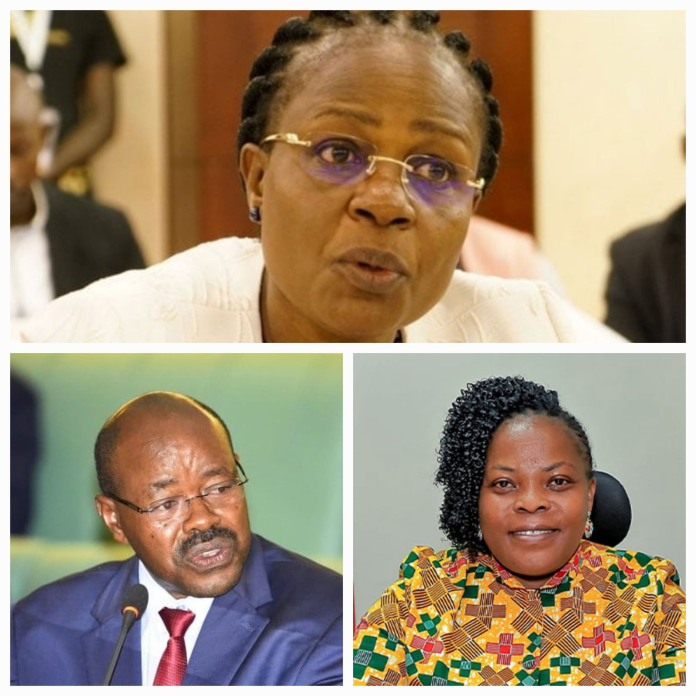
General Peter Elwelu, the former Deputy Chief of the Ugandan Peoples’ Defence Forces (UPDF) and Amos Lugoloobi, Minister of State for finance have also been designated by the United States government.

Others designated; are Speaker of Parliament Anita Among, former Minister of Karamoja Affairs Mary Goretti Kitutu and former State Minister for Karamoja Affairs Agnes Nandutu.

In a statement released on May 30, 2024 by Matthew Miller, U.S Spokesperson, noted the Department of State is publicly designating these five current and former Ugandan officials for their involvement in significant corruption or gross violations of human rights.

Peter Elwelu is designated due to his involvement in gross violations of human rights.  Specifically, Peter Elwelu was involved, while commanding UPDF forces, in extrajudicial killings that were committed by members of the UPDF.  As a result of these actions, the designated Ugandan officials are generally ineligible for entry into the United States.

Miller stated, “Speaker of Parliament Anita Among is designated due to involvement in significant corruption tied to her leadership of Uganda’s Parliament.  Former Minister of Karamoja Affairs Mary Goretti Kitutu, former Minister of State for Karamoja Affairs Agnes Nandutu, and Minister of State for Finance Amos Lugolobi are being designated due to their involvement in significant corruption related to conduct that misused public resources and diverted materials from Uganda’s neediest communities.  All four officials abused their public positions for their personal benefit at the expense of Ugandans.”

Matthew Miller revealed that the Department is also taking steps to impose visa restrictions on multiple other Ugandan officials for undermining the democratic process and repressing members of marginalized or vulnerable populations in Uganda.  These individuals are responsible for, or complicit in, the repression of Ugandan members of political opposition groups, civil society organizers, and vulnerable communities in Uganda.

The United States stands with Ugandans advocating for democratic principles, a government that delivers for all its citizens, and accountability for actions committed by those who abuse their position through corruption and gross violations of human rights.

 Impunity allows corrupt officials to stay in power, slows the pace of development, facilitates crime, and causes unequal distribution of resources, which can affect underrepresented and underserved populations disproportionately.  Today’s actions reaffirm the U.S. commitment to support transparency in Uganda’s democratic processes, counter corruption globally, and address the broader culture of impunity that prevents all Ugandans from enjoying their human rights and fundamental freedoms.

These public designations are made under Section 7031(c) of the Department of State, Foreign Operations, and Related Programs Appropriations Act, 2024 (Div. F, P.L. 118-47). 

The Department is also designating Among’s spouse, Moses Magogo Hassim; Kitutu’s spouse, Michael George Kitutu; and Lugolobi’s spouse, Evelyne Nakimera; they also are generally ineligible for entry into the United States.  The additional steps to impose visa restrictions on multiple other Ugandan individuals are being taken under Section 212(a)(3)(C) of the Immigration and Nationality Act under the policy

Stories Continues after ad

Tayebwa urges Assistant RDCs/RCCs to be decent while delivering services

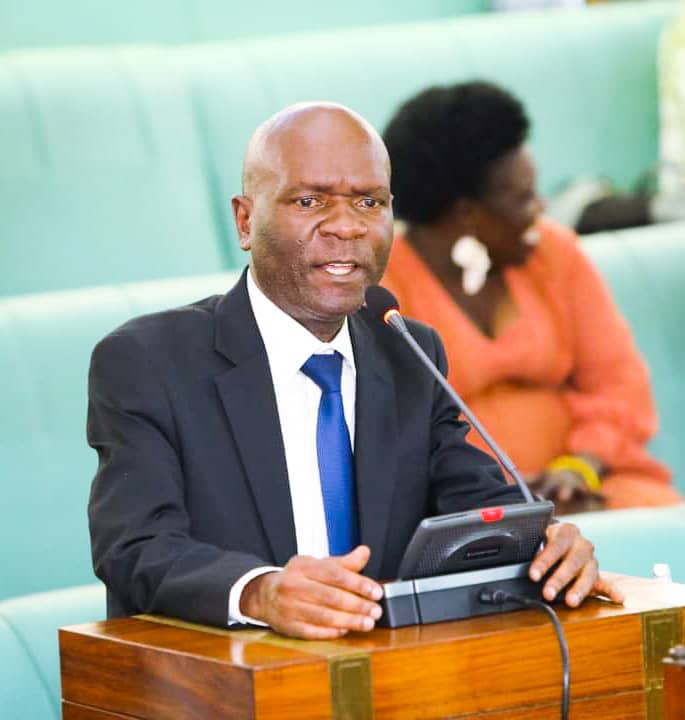
Deputy Speaker Thomas Tayebwa.

Thomas Tayebwa, the Deputy Speaker of Parliament has urged Resident District Commissioners (RDCs) and Resident City Commissioners (RCCs) to be decent while delivering services to the citizens, citing that parliament continues to receive complaints about the poor conduct of some of them, particularly those who use excessive force while performing their duties.

“Such behavior is not good for the image of the government and destroys our country’s democratic credentials,” he said.

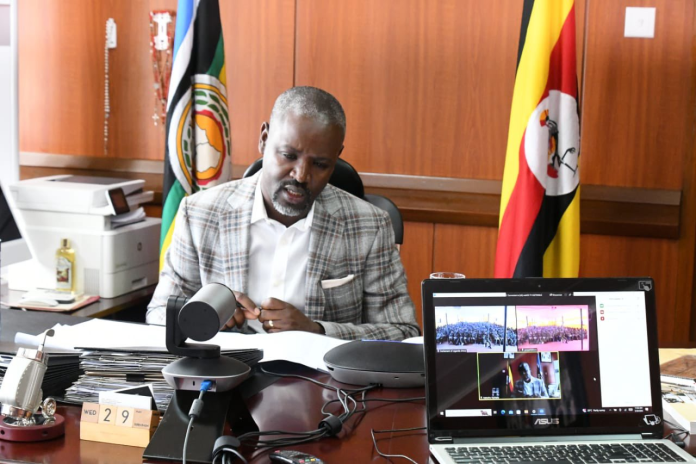
Tayebwa made these remarks on Wednesday, May 29, 2024, while addressing newly appointed Assistant RDC’s and RCC’s at the National Leadership Training Institute (NALI) in Kyankwanzi, who are undergoing a two-week induction course into their roles and functions.

Tayebwa, whose address was via Zoom, stated that the Office of RDC and RCC plays an important role in the country’s development, but if it is not managed properly, it can become a major impediment to the development of the communities.

Tayebwa also urged the RDCs to work hand in hand with the local and national leaders by holding regular consultations, monitoring and accountability findings, and resolving national and local issues that affect their constituencies

He further stated that the RDC’s have a key role to play in monitoring, communicating, and mobilizing the population to participate in government programmes, while the politicians are key in planning and evenly distributing public resources so that the communities can address their priority needs.

However, he stated that it is critical for RDCss and their assistants to understand the roles and responsibilities that the National Constitution and the Local Government Act (as amended) establish for RDC’s and political leaders.

“These roles were purposefully designed to deepen decentralization and provide an entry point for the central government to support, guide, and enforce accountability in local governments through the RDC’s office,” he added.

He also congratulated them on their appointments, which are enshrined in Article 203 of the Constitution.

Stories Continues after ad

 Museveni tasks Speaker Among to prove ownership of house in UK

President Museveni has tasked the Speaker of Parliament, Anita Among to explain whether she owns a house in the United Kingdom or she’s renting it on Waterden Road in London, UK.

In a letter dated May 23, Museveni demanded the Speaker to detail about the alleged ownership of a house located along Waterden Road in London, UK, which is said to be one of her properties in British territory.

“I have got information that is contrary to what you told me, that you, indeed, own a house in London in the form of Flat 4, Silk House, 7 Waterden Road, London, E20 3AL, United Kingdom. Do you own that house or are you renting it?,” Mr Museveni stated in a letter.

“By copies of this letter, I direct the Minister of Foreign Affairs to contact the UK Government and get details regarding this house. The IGG is also informed,” the letter reads further.

The letter which the President copied to the Inspector General of Government and Minister of Foreign Affairs is said to have been responded to two days ago according to parliament sources.

However, immediately after Museveni’s letter came out,  Speaker Among via her  X handle said that all these are allegations and instead insisted that the UK are forging the evidence table before the President.

“Since the UK government claims I own property, it should be prudent of them to state which property I own as Anita Annet Among. Forgery should be the least the world can expect from them,” Among said.

“I am sure this is the answer my President, our government, and myself want from them. Nothing else. The alleged house plot, Flat 4, Silk House, 7 Waterden Road, London, E20 3AL, United Kingdom, which they informed the President is owned by myself, surely has an owner who is registered in their own system (the UK Government), and this owner, as per their own record, is not Anita Among,” she added.

All these issues  are propelling following the UK sanctions against Among as and other former Karamoja ministers—Mary Goretti Kitutu and Agnes Nandutu—following their involvement in the iron sheets (mabaati) theft scandal.

Among further noted that the alleged house plot, Flat 4, Silk House, 7 Waterden Road, London, E20 3AL, United Kingdom, which they informed the President is owned by her surely has an owner who is registered in their own system (the UK Government), and this owner, as per their own record, is not Anita Among.

“Fellow Ugandans, while this matter is exciting to some because of our own internal political contradictions and intrigue, I insist and wish to alert all, soundly, that the issue is not the alleged corruption or ownership in the UK. The attempts to forge and claim that I own property when their own records show the contrary tell it all. The real crux of the matter is about targeting Anita Among for being vocal against homosexuality. The rest is a cover-up. The truth will set me free. (John 8:32),” Among said. 

Stories Continues after ad

Frank Baine urges prisons’ officers to be proactive in community outreach

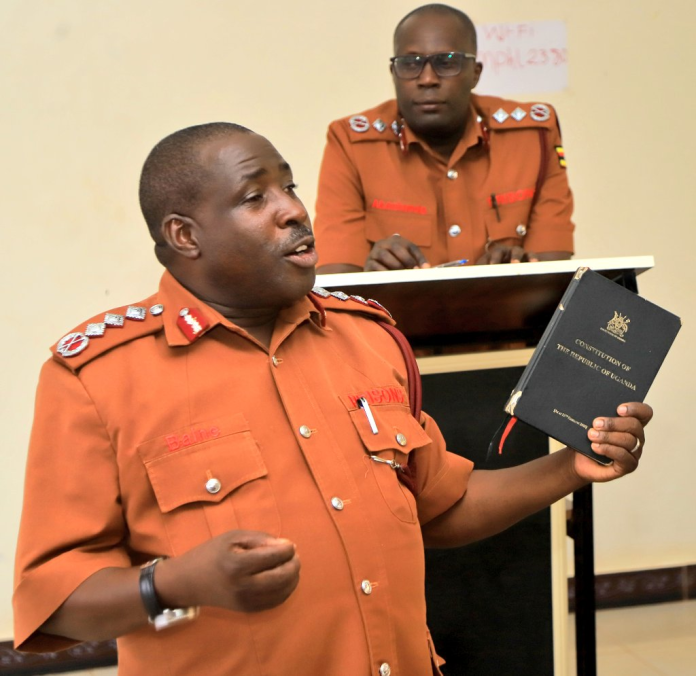
UPS Spokesperson, Mr Frank Baine.

Frank Baine, Uganda Prisons Spokesperson has encouraged officers to take a proactive role in community outreach, highlighting that their actions and interactions significantly influence public perceptions.

He reminded them that they serve as ambassadors of the service and their conduct and communication can positively impact how the community views the UPS’s efforts.

Baine made the remarks in the training which is aimed at enhancing the customer care and public relations skills of the officers, as well as promote community engagement and awareness of Uganda Prisons Service’s activities and initiatives.

He explained that the Uganda Prisons ability to communicate effectively and maintain positive relationships is vital for building trust and support, which is essential for the success of their initiatives.

SCP Frank Baine emphasized the importance of public relations in shaping the image and effectiveness of Uganda Prisons

“Effective communication and maintaining positive relationships with the public and stakeholders are significant for building trust and support, which are essential for the success of rehabilitation and reintegration programs,” Baine said.

Baine further defined the prison terms and aligned them to the context of emphasizing that customers include inmates, staff, visitors, neighboring communities, key stakeholders, supervisors, and families of staff.

“It is important to ensure humane treatment, active listening, and understanding, particularly towards prisoners, who are the primary customers of the prison system,” Baine noted.

He reminded officers to exercise caution, consideration, and humility in their interactions with all customers, promoting a culture of respect and empathy in Uganda Prisons Service.

Frank Baine also highlighted the essential duties of citizens as outlined in the 1995 Constitution of the Republic of Uganda. He encouraged the officers to embrace and uphold these principles, which are crucial for promoting national development, unity, and the well-being of all citizens. Adding, “By adhering to these duties, citizens can exercise and enjoy their rights and freedoms while contributing to the betterment of the nation.”

Baine noted that Uganda Prisons has undergone significant transformation, stating, “We have shifted from a punitive to a correctional service, with a development goal of transforming every prisoner into a productive and law-abiding citizen,” he explained.

In addition to mindset change, he emphasized the importance of financial literacy among prisons officers. “Money is earned, accumulated, hidden through savings, and multiplied through investments,” he highlighted.

“However, common mistakes such as making no budget, living beyond your means, seeking money miracles, and underestimating the value of small notes can hinder financial progress.”

To counter these mistakes, Mr. Baine stressed that financial discipline is essential for officers. “By capitalizing on the opportunities and benefits available through stability, officers can improve their financial well-being and support the transformation of Uganda Prisons Service,” he concluded.

Stories Continues after ad

IGP Byakagaba to work towards mindset change of officers in the provision security

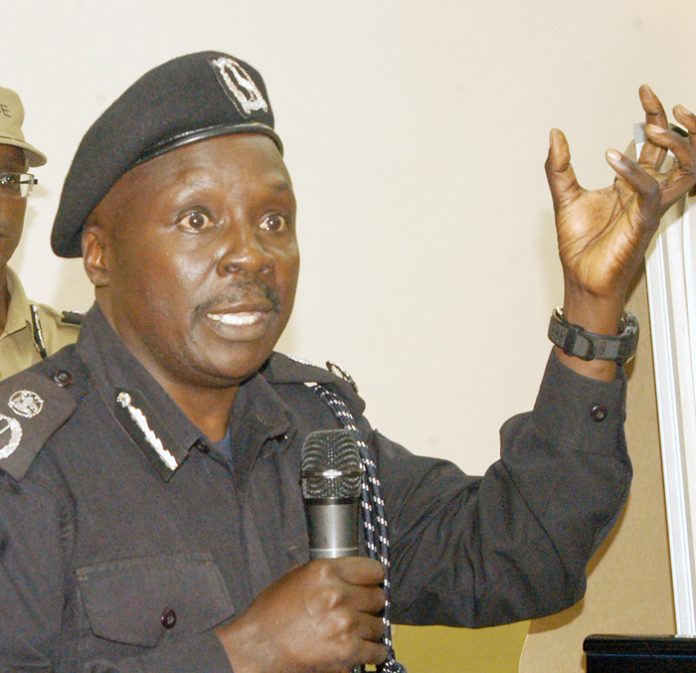
Police Counter Terrarisim boss, Abbas Byakagaba addressing business community on security matters as Police chief, Maj Gen. Kale Kayihura looks on at Imperial Royale Hotel Kampala, Tuesday (August 3, 2010). PHOTO BY AYIGA ONDOGA.

The Inspector General of Police (IGP), Byakagaba Abbas, has pledged to work towards changing officer mindsets in the provision of safety and security.

Byakagaba said this while assuming office as the IGP at Naguru Police Headquarters.

The former Director for Counter-Terrorism in the Police replaces former IGP Martin Okoth Ochola, who recently retired from the Police Force.

“I know what I am taking over is a very serious responsibility and I recognise it but I am very confident especially looking at my team from the lowest the constable. I am very sure we are going to deliver.” he noted

He said, “This is the time for me to take over. A lot of successes have been mentioned by the outgoing Deputy IGP, and a lot of challenges have been mentioned; therefore, I take cognizance of all those facts. I am energised and strengthened by your presence. I know upwards and down after the constable. I’m going to ensure that we are a very strong team.”

He reassured police officers that they were going to work together and consciously work on our mindset change. We need to change our mindset towards the provision of security, which is a very key ingredient as far as the development of this country is concerned.

“Through our activities, we are going to support the social and economic transformation of this country by contributing to the security, safety, and all of that is enshrined in our Constitution. I am going to have a very serious team. This will mainly be achieved through training and mentoring to ensure that the lowest person knows why he or she is in the Uganda police force and what his or her contributions are,” he said.

Stories Continues after ad

FDC party whip calls Mpuuga, colleagues to explain their ‘service award’ to the public  

Mr Yusuf Nsubuga.

Yusuf Nsibambi (Mawokota South) who doubles as FDC Party Whip has led his Party in appending his signature on the ongoing censure motion intended to recall the four Commissioners from their office over the allocation of Shs1.7Bn in service awards and extra Shs23 million monthly salary but denied having any personal vendetta against any of the accused Commissioners.

The targeted commissioners are Mathias Mpuuga, Solomon Silwany, Prossy Akampurira and Esther Afoyochan.

While addressing journalists after signing the motion, Nsibambi defended his move, saying it is intended to give the accused an opportunity to account to Uganda on how they have been conducting business in Parliament.

“I have appended my signature specifically not condemning the people involved but to call upon them to come and explain to the public. We are accountable to the people; this matter has raised eyebrows and a lot of anxiety and people want information on exactly what happened and the basis of these awards. So, I believe the people involved will get an opportunity to come and explain to the public exactly what is going on,” said Nsibambi.

“I have no personal vendetta against these individuals, I do respect them a lot because they are representatives of the people but I think the public has a right to know exactly how we conduct business in Parliament. Commissioners are our leaders, but they must be accountable to us, the people they lead, if they aren’t satisfied with the way matters are being conducted,” added Nsibambi.

Theodore Ssekikubo (Lwemiyaga County) who is leading the collection of signatures thanked Nsibambi for joining the cause against corruption noting, thank you on behalf of the people of Mawokota County for doing this noble duty. We aren’t after anybody but as Parliament, we should be leading by example in the fight against corruption.”

Additionally, Agnes Taaka (Bugiri DWR) also appended her signature to the censure motion, saying her move is based on the need to have Commissioners account and explain the various allowances they have been drawing as members of the Parliamentary Commission.

Gilbert Olanya (Kilak South) claimed without evidence that many of his colleagues from Acholi are actually running from the village, to come and sign and later move back to their villages noting, “This is the way to go, we shouldn’t be condoning corruption in our country, you can’t allocate funds to yourselves, this is impunity, so we should stop encouraging impunity in this country. Government resources must be used by the taxpayers; you can’t allocate Government funds just to benefit yourself.”

The minister of information and National Guidance Chris Baryomunsi has described the process by a section of MPs collecting signatures to censure commissioners of parliament for abuse of office as being healthy since parliament needs to be accountable to the public. His statement comes after her colleague in cabinet Persis Namuganza asked electorates to vote against any minister or MP who would refuse to sign the censure motion.

Stories Continues after ad

Ugandans demand for global treaty to address plastic pollution

A recent survey conducted by Ipsos, commissioned by WWF and the Plastic Free Foundation, reveals that an overwhelming majority of Ugandans support a global treaty to address plastic pollution. The survey, which polled 24,727 respondents in 32 countries, including Uganda, found that almost all Ugandan participants (97%) support specific rules to ensure accountability and action against single-use plastics.

The survey found that 97% of Ugandan participants believe it’s important to reduce global plastic production, a crucial step in mitigating the harmful effects of plastic pollution on the environment and human health. This overwhelming support indicates a strong desire among Ugandans to address the plastic pollution crisis, which has severe consequences on the country’s waterways, soil, and wildlife.

Furthermore, 96% of Ugandan participants believe it’s important to ban chemicals used in plastic that are hazardous to human health, wildlife, and the environment. This finding highlights the urgent need to address the harmful impact of plastic chemicals on human health and the environment.

Additionally, 93% of Ugandan participants believe it’s important to ban unnecessary single-use plastic products most likely to become plastic pollution. Single-use plastics, such as plastic bags, straws, and water bottles, are a significant contributor to plastic pollution, and banning them would significantly reduce the amount of plastic waste that ends up in the environment.

The survey also found that 96% of Ugandan participants believe it’s important to ban types of plastic that cannot be easily recycled in practice. This finding underscores the need for a more sustainable approach to plastic production and consumption, one that prioritizes recyclable and biodegradable materials.

Moreover, 96% of Ugandan participants believe it’s important to require transparent labeling on plastic products, indicating a strong desire for accountability and transparency in the plastic industry.

A significant 97% of Ugandan participants believe it’s important to require manufacturers and retailers to provide reuse and refill systems, a crucial step in reducing plastic waste and promoting sustainable consumption.

Furthermore, 93% of Ugandan participants believe it’s important to require all plastic manufacturers to pay fees that cover the costs of reuse, recycling, and safe management of plastic waste.

Moreover, 89% of Ugandan participants agree that a global treaty should include rules that ensure all participating countries have access to funding, technology, and other resources to comply with the rules, significantly higher than the global average.

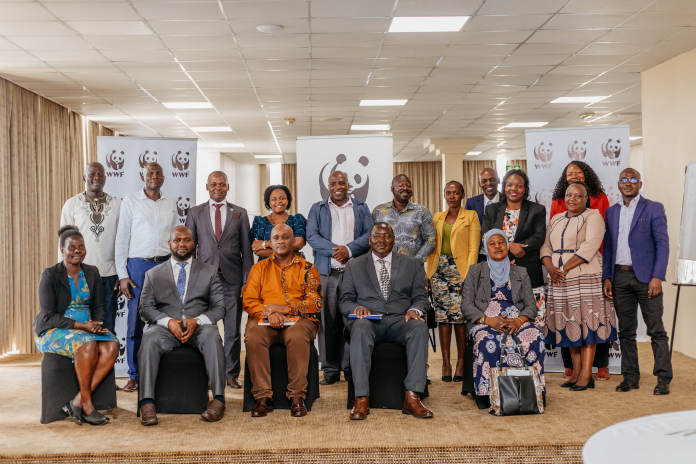
The survey report was released on Tuesday, May 28, at Skyz Hotel Naguru, and was attended by policymakers, civil society, and other stakeholders. The findings demonstrate that Ugandans are willing to take action to combat plastic pollution and support global efforts to reduce plastic waste. The survey’s results serve as a call to action for policymakers, manufacturers, and consumers to work together to address the plastic pollution crisis and create a more sustainable future.

Stories Continues after ad

 Kamwenge residents tasked to intensify efforts on fighting malnutrition

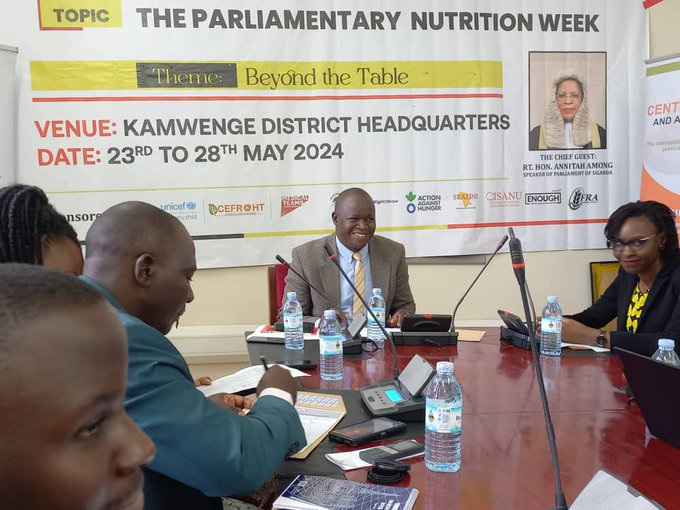
Legislators of Uganda Parliamentary Alliance on Food and Nutrition Security have urged residents in Kamwenge district to intensify efforts of fighting malnutrition, after a survey placed Kamwenge as the district with the second highest number of malnutrition cases in Uganda.

The lawmakers made the appeal while addressing residents at Biguri Town Council during the assessment of the burden of malnutrition in Kamwenge district.

“Stunting is brought on by prolonged periods of not having enough nutrients in the bodies and this is due to the fact that nutrition is very poor from pregnancy up to five years that is where the problem is. When you compare our stunting levels, they’re far beyond 30%, we are above. Even when you compare with the national levels at 26% and you can see at Kamwenge, we are at 41%. If there is a delay to seek management services, in some cases we lose them. Where I work, averagely, we lose 2-4 children in a year. For severe malnutrition cases, we have 1-2 cases a week, totaling to 6-10 in a month and when you multiply by 12 months, it’s usually 36-38 cases in a year,” Emmanuel Tumusiime, Nutritionist at Rukunyu Hospital.

Tumusiime also explained that the kind of malnutrition in Kamwenge is chronic, as it starts way back from pregnancy, and it’s carried into adulthood and if the same malnourished adults conceive, there are high chances of them giving birth to stunted babies

Tumusiime explained, “When we study about stunting, it is a generational problem. A mother who doesn’t feed well, will give birth to an underweight baby who will grow into an adult who is underweight and that underweight adolescent will become a malnourished mother, who will not grow well the embryo again now at pregnancy, you find that cycle continues. Because when the body isn’t well developed, you will find that the fetus will also not develop well.”

Robert Kato, Senior Clinical Officer at Buguri Health Center III in Kamwenge district said that as they are concentrating on under nutrition, there are also cases of over nutrition. 

“Sometimes we have 14 cases of children who are malnourished, so this is a significant number that should be well addressed. The good thing is that for clients who come to us with cases of HIV or Tuberculosis, malnutrition is subsiding, but for the community, we need a common approach that is aggressive to get these clients from the community,” Robert Kato said.

Stanley Mwesige, Village Health Team (VHT) in Buguri Town Council decried that whenever the residents harvest paw paws, all they think about is selling them. If they get eggs, instead of preparing it for the children to eat, they sell them in the market and buy pancakes for the kids.

“The residents have the food, but they don’t know how to prepare this food to benefit the kids. The parents don’t know that they can prepare lunch, supper, breakfast and change the foods like posho, matooke, all they do is cook food once for the week, they prepare matooke or cassava that they feed on the whole week,” Mwesige said.

He attributed the high malnutrition rates to poverty noting, “Many of the parents struggle to raise income and they ask us, if I give the kids eggs, where will I get money to buy salt? That is why some of them prefer selling the eggs. We would like Government and Parliament to send professional people to Kamwenge to teach people on how to prepare food for the children to come to the villages and teach our people on how to prepare nutritious food for the children.”

Milton Muwuma Chairperson Uganda Parliamentary Alliance on Food & Nutrition Security said that there is a lot of food production going on but the way it is consumed calls for awareness creation.

Muwuma said, “People have food, but most of the food is sold to get money, instead of retaining some food for domestic consumption, so we need to encourage farmers to do domestic gardening where some vegetables and fruits are missing. People can consume cassava or matooke for a full week, so we need to advise them that it isn’t about the quantity of what you can consume but the quality matters a lot for us to minimize on the cost of treatment because if you eat well, food is medicinal it can help in boosting the immunity of the bodies,”

“We found teenage mothers, a girl of 15-16 years being pregnant, this threatens her life specifically when it comes to giving birth, she has got maternal challenges she is bound to face, but also the care is wanting because the girl is living with her parents who feel this is an extra burden, we should do some more awareness about girls remaining in school because some of them are stunted and end up producing underweight babies. We need to salute Kamwenge because the national figures given don’t tally with what is on ground, so Kamwenge district began scanning, screening and documenting what other districts aren’t doing,” added Muwuma.

Stories Continues after ad

 Why Brig Charity Bainabaabo was sent for military course

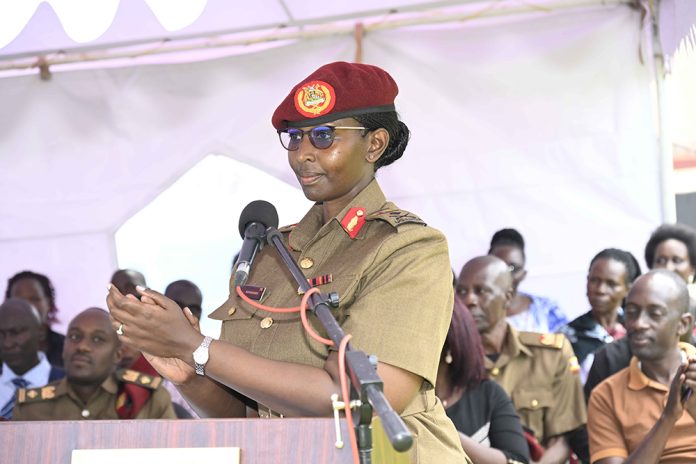
SFC Deputy Commander Brig Gen. Charity Bainababo making his remarks during the SFC Celebrations of the good 2023 PLE results of the Pupils from Nsamizi, Marine and Summit view Army Primary Schools at the SFC headquarters Entebbe on the 10th February 2024. Photo by PPU/Tony Rujuta.

Internal fights and intrigue at Special Forces Command have pushed the deputy commander Brig Charity Bainabaabo out of her job.

Brig Bainabaabo who is also a Member of Parliament will be away for one year to attend National Defence College in Buikwe in July this year.

With her absence for a year, it’s not clear how she shall balance being a Member of Parliament representing the UPDF and her absence from the House for the next one year.

According to sources close to SFC, the one-star General who is also related to the First Lady is an ambitious officer who was giving her boss, Maj Gen David Mugisha hard time to run the command.

“There were lots of fights and it was increasingly becoming a concern,” the source said.

In the UPDF, it’s a known secret when an officer is sent for a military course is always seen as an indirect way of sacking them.

Who is Brig Bainabaabo?

She joined the military in 1998 for basic training at Kabamba military School before doing a cadet course in Jinja in 1999. She attended Company Commander’s Course in Jinja in 2008 before doing Senior Command and Staff College at Kimaka.

Brig Bainabaabo has been accused of being rude to his subordinates and the reports reached the president who decided to send her for a course.

In 2023, there were media reports that she had insulted a Foreign Officer called Solomon Kasasira working at Uganda’s embassy in Burundi.

Brig Bainabaabo will be among the third lot of the officers who will be attending the new NDC which was opened two years ago.

The second cohort is finishing its one-year course in July this year. Among those attending the second cohort is the former UPDF Spokesperson Col Paddy Ankunda and the former Third Division Commander Brig Joseph Balikkudembe.

Stories Continues after ad

LoP, Minister Namuganza signs censure motion against Mpuuga and other commissioners 

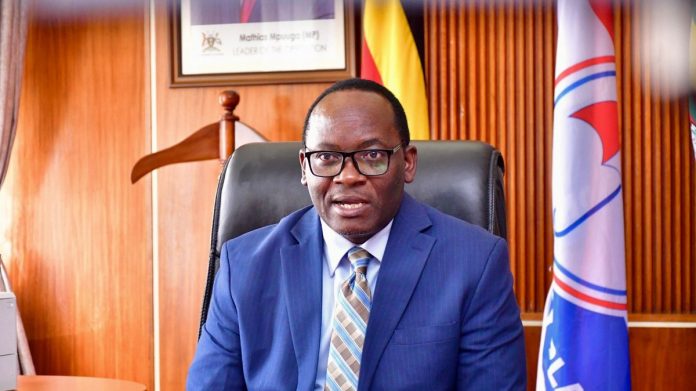
UNDERFIRE: Former LoP Mathias Mpuuga.

The Leader of Opposition in Parliament, Joel Ssenyonyi, Minister of State for Lands, Housing, and Urban Development, and a section of opposition MPs have appended their signatures to the motion seeking to censure parliamentary commissioners.

Last week, a section of legislators led by Lwemiyaga County MP Theodore Ssekikubo and Sarah Opendi embarked on collecting signatures to censure Parliamentary Commissioners. The commissioners are accused of allocating themselves Shs1.7 billion.

The Parliamentary Commission’s leaked resolutions from May 2022 implicated the former Leader of the Opposition (LoP), Mathias Mpuuga, commissioner Solomon Silwany, Prossy Akampurira, and Esther Afoyochan.

According to the leaked document, Mpuuga was awarded a one-off service payment of Shs500 million, while three commissioners from the National Resistance Movement each received Shs400 million. the National Unity Platform (NUP), resolved to recall Mpuuga as the Parliamentary Commissioner.

The party said that although he responded to the NEC’s request to show cause why he should not be recalled from the Parliamentary Commission, he did not provide any satisfactory explanation for engaging in this grave action, which goes against the mission, values, and objectives of the party. In particular, he did not make any attempt to respond to the specific accusations levelled against him.

“This is very imperative for us in the NUP, it vindicates us. We raise alarms against our commissioner; some people think it is an internal party fight. What happened is an irregularity for leaders to sit and award themselves money.”

He said the proposal has to go through the legal and parliamentary affairs committee before it is brought to the floor of parliament for discussion. Every individual who gets retirement benefits, be it the speaker, vice president, or others, was discussed and passed by parliament.

He noted that on matters to do with taxpayers’ money, MPs need to detach their parties and make the right decisions.

Namuganza urges other party members to sign the censure motion and warns individuals who are telling their colleagues that the president said they should not sign.

She noted that the president has formal ways of communicating, which include writing to them and calling the NRM caucus.

“Let’s stand against corruption. I was personally censured even when there were no grounds,” she said.

Stories Continues after ad