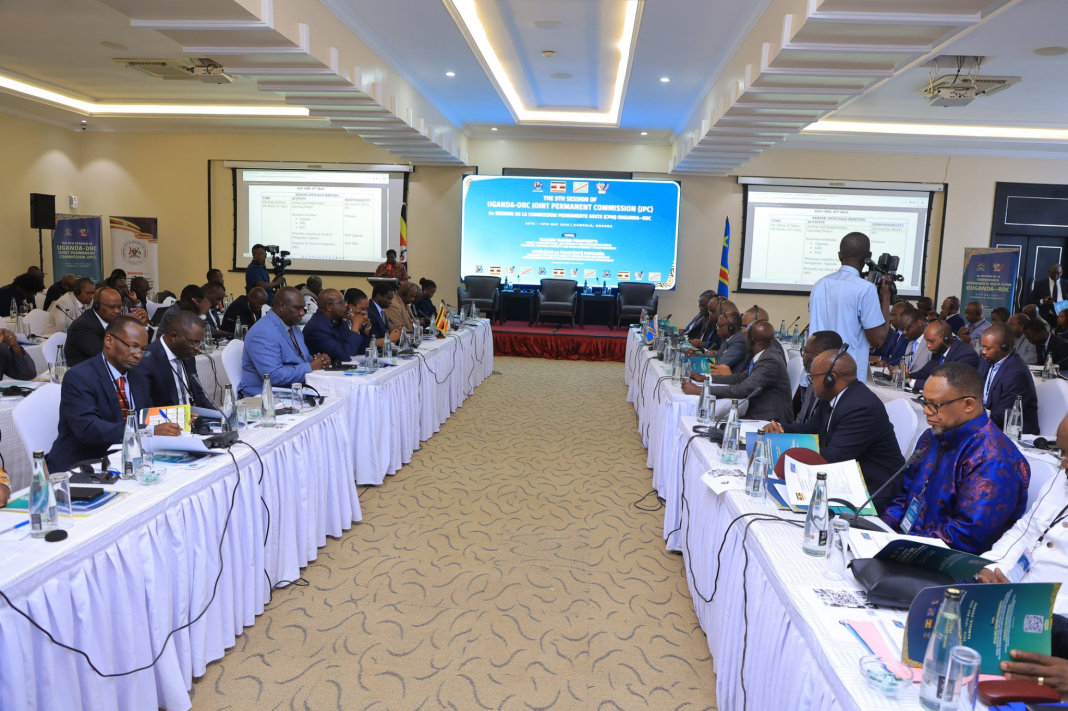
The 9th Session of the Uganda–Democratic Republic of Congo Joint Permanent Commission (JPC) has opened in Kampala at Hotel Méstil, with both countries setting an agenda to strengthen security cooperation, expand cross-border trade and accelerate strategic infrastructure projects seen as vital to regional stability and economic transformation.
The three-day meeting, running from 8th to 10th May 2026, is being held under the theme “Scaling Shared Prosperity: Trade Infrastructure and Security for Enhanced Bilateral Relations, Regional Stability and Socioeconomic Transformation.”

The session commenced today with technical officials’ discussions, which are expected to shape the direction of high-level negotiations in the coming days.
Opening the meeting, Ambassador John Leonard Mugerwa reaffirmed Uganda’s longstanding friendship with the Democratic Republic of Congo, describing the relationship as one anchored in shared history, cultural ties, and growing economic interdependence. He emphasized that the two countries continue to benefit from their geographic proximity, which has enabled steady growth in trade, investment flows, and people-to-people exchange.
Ambassador Mugerwa noted that bilateral trade between Uganda and the DRC has continued to expand, driven by strong demand across both markets. He said the movement of goods, services, and labour reflects the complementary nature of the two economies, adding that this creates significant opportunities for deeper regional integration and inclusive growth.

He further underscored the importance of the Joint Permanent Commission as a strategic platform for addressing shared priorities, including security, infrastructure development, and energy cooperation, agriculture and investment facilitation. He called on delegates to maintain a spirit of partnership, trust, and mutual responsibility as they pursue solutions that enhance peace and prosperity in the region.
The Kampala session builds on outcomes from a midterm review held in Mpondwe in February 2026, where both countries assessed progress in streamlining economic cooperation and advancing security coordination. Key among the earlier commitments was the operationalization of visa waivers and the simplification of cross-border trade systems.
Security cooperation remains a central focus of the current discussions, with delegations reviewing progress under Operation Shujaa, the joint military initiative targeting the Allied Democratic Forces and other armed groups operating in eastern DRC. The talks are also examining technical border verification processes, particularly in the Busanza sector, aimed at strengthening coordination and reducing cross-border insecurity.
On trade and economic integration, officials are working to eliminate persistent non-tariff barriers that continue to slow regional commerce. A revised memorandum of understanding on trade cooperation is expected to be concluded during the session, paving the way for smoother cross-border business operations and improved market access.
Infrastructure development is also taking centre stage. The Kasindi–Beni road project is now about 60 percent complete, while progress on the Beni–Butembo stretch remains at an early stage. These transport corridors are seen as critical lifelines linking eastern DRC to Ugandan markets and ports.
Both countries are also aligning technical studies and timelines for the proposed Standard Gauge Railway network, building on momentum from the March 2026 Uganda–Tanzania rail agreement aimed at strengthening regional connectivity. In the aviation sector, discussions are ongoing on the Bilateral Air Services Agreement alongside the finalization of a Search and Rescue framework to improve safety and emergency response coordination.
Energy cooperation features prominently on the agenda, with technical teams advancing plans for the Nkenda–Beni–Bunia–Butembo high-voltage transmission line. The project is expected to enhance electricity supply reliability and support industrial growth across border regions. Updates are also being made to hydrocarbons cooperation frameworks to support investment and resource development.
The session is also addressing sensitive social and legal matters, including the management of approximately 500,000 Congolese refugees currently hosted in Uganda. In addition, discussions are focusing on strengthening judicial cooperation and finalizing arrangements for the transfer of convicted persons, aimed at improving legal coordination between the two countries.
The Kampala meeting is a decisive moment in Uganda–DRC relations, the outcomes will reinforce security cooperation while unlocking greater trade, infrastructure development and long-term regional stability across the Great Lakes region.