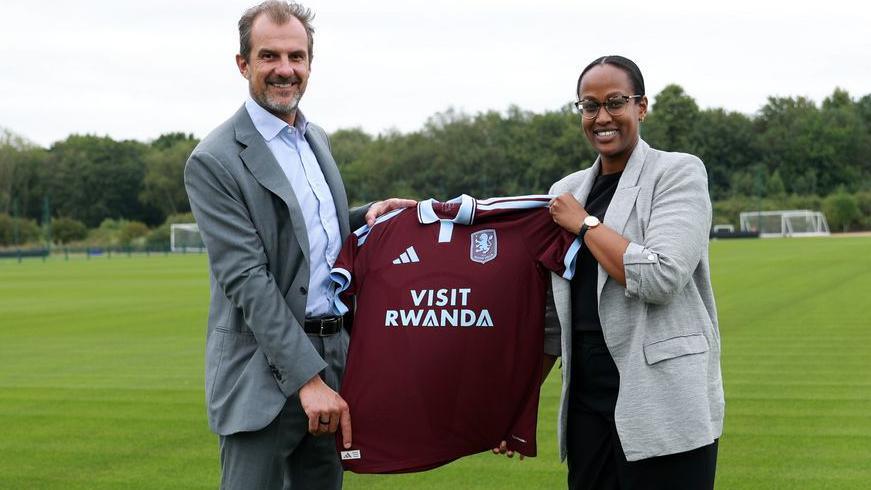
When Aston Villa announced Visit Rwanda as its new Principal Partner and shirt sponsor in July 2026, the deal was billed as the most lucrative commercial agreement in the club’s historyreportedly worth up to £20 million a year.
On paper, it looks like a straightforward tourism marketing win for Rwanda. Look a little closer, though, and the deal sits at the end of a long, messy story that stretches from Premier League shirt sleeves all the way to a UK government asylum policy that collapsed in ruins.

Rwanda’s Tourism Board first partnered with Arsenal back in 2018, putting “Visit Rwanda” on the club’s sleeve in a deal reportedly worth around £10 million a year Rwanda’s first-ever presence in English football.
The strategy worked, at least commercially. Rwanda went on to sign similar sponsorships with Paris Saint-Germain (2019, renewed in 2025) and Atlético Madrid (2025), and later a five-year deal with Bayern Munich in 2023 that replaced Qatar as the German club’s tourism sponsor.
What is in the Deal

Within the partnership, Visit Rwanda’s branding will appear on front of men’s, women’s and academy teams’ shirts. The brand will also appear in a number of other prominent spaces.
Alongside Rwanda tourism, the land of a thousand hills is a great destination for business, investment and international events.
Visit Rwanda and Aston Villa will also collaborate on a number of initiatives that are focused on football and coaching plus charitable initiatives.
Janet Karemera, the CEO of Rwanda Convention Bureau (RCB), said that the partnership is a powerful expression of Rwanda’s ambition to engage global audiences through one of the world’s most influential platforms. It also helps Rwanda to position itself as a destination to visit, invest and do business.
She asserts that bringing together the Land of a Thousand Hills and the City of a Thousand Trades celebrates a shared commitment to enterprise, innovation and ambition.
Where It Started Going Wrong/ The UK–Rwanda Asylum Scheme
Arsenal partnered with Visit Rwanda in 2018. The deal ran up to June 2026 when Arsenal and Visit Rwanda mutually terminated the partnership.
During the announcement of the end of the Arsenal and Visit Rwanda deal, the Gunners said that the partnership exceeded the original goals of the partnership which were to promote conservation and sustainable tourism while also supporting Rwanda’s ambition “to become an international sporting hub in Africa.
Throughout the partnership, Visit Rwanda gained extensive global exposure through branding on Arsenal’s matchday LED advertising boards, interview backdrops, digital platforms and at Emirates Stadium.
RDB says Rwanda’s tourism sector has recorded significant growth since the partnership began, with tourism revenues increasing by 47 percent over the period. Figures show that the country welcome more than 250,000 visitors annually.
Today, Rwanda is one of the fastest growing economies in Africa with a booming tourism sector. Rwanda’s national parks attract a record number of tourists who travel to the country to see incredible wildlife that include the famous mountain gorillas, chimpanzees, the big five etc.
Despite the achievements, some sources cite the end of the Arsenal and Visit Rwanda due to continuous warnings of “Rwanda’s sportswashing” while others cite other reasons and the trouble came from two directions at once.
First, Rwanda’s growing football sponsorship portfolio drew scrutiny over its alleged role in the conflict in the eastern Democratic Republic of Congo.
The United Nations experts and human rights groups have accused Rwanda of backing the M23 rebel group, which has seized territory in the mineral-rich east of the DRC allegations Rwanda has consistently denied. In February 2025, DRC’s foreign minister wrote directly to Bayern Munich, Arsenal and PSG, urging them to drop what she called “blood-stained sponsorship deals.”
Second, and separately, Arsenal’s sponsor was also the name of a country the UK government had chosen as the destination for a hugely controversial asylum policy and the two stories became impossible for the club to keep apart in the public eye.
The Migration and Economic Development Partnership was struck in 2022 under Boris Johnson’s government. The plan was to send people who arrived in the UK “illegally” mainly via small boats across the Channel to Rwanda, where their asylum claims would be processed instead of in Britain. Those granted asylum would settle in Rwanda rather than return to the UK.
The scheme never really got off the ground. Legal challenges blocked every attempted flight, and in November 2023 the UK Supreme Court ruled the policy unlawful, finding that Rwanda could not be treated as a safe third country given the risk of asylum seekers being wrongly sent back to danger in their home countries. The Conservative government responded by passing the Safety of Rwanda Act in April 2024, which simply declared Rwanda safe by law and overrode the court’s findings.
It didn’t survive the change of government. When Keir Starmer became Prime Minister in July 2024, he scrapped the scheme on his first full day in office, calling it “dead and buried” and an expensive gimmick that had never worked as a deterrent. In the end, only four people were ever sent to Rwanda under the plan and all four went voluntarily.
The financial toll was steep. The UK government put the total cost of the scheme at around £700 million, including roughly £290 million paid directly to the Rwandan government, plus money spent on chartered flights that never took off and on processing officials. Rwanda has said it is under no obligation to repay any of it. In fact, in January 2026 Rwanda took the UK to the Permanent Court of Arbitration seeking £50 million in damages over what it called the improper termination of the deal a case the court ruled in the UK’s favor in June 2026.
None of this was Arsenal’s doing, but the club’s shirt-sleeve sponsor shared a name with the country at the centre of one of the most divisive immigration debates in recent British politics and that proved impossible to separate from public perception.
A few things kept the pressure on:
Political Optics: Critics pointed out the awkwardness of a wealthy London club taking millions from a country the UK government was simultaneously paying to take migrants off its hands.
Fan Pressure: A supporter campaign called Gunners for Peace protested the deal for years, and in March 2025 fans even launched a crowdfunding campaign aiming to raise £10 million to try to buy the club out of the sponsorship.
Diplomatic Pressure: DRC’s foreign minister publicly urged Arsenal to end the partnership over the M23 allegations.
The Arsenal’s Deal with Visit Rwanda ultimately ran its course and ended after the 2025/26 season, with the club moving to software firm Deel as its new sleeve sponsor.
Bayern Munich moved first, announcing in August 2025 that it was stepping back from Visit Rwanda as a commercial sponsor though not cutting ties completely.
The club reshaped the arrangement into a youth-development partnership centered on its academy in Kigali, with the underlying contract still running to 2028. PSG and Atlético Madrid, by contrast, have kept their Visit Rwanda sponsorships in place.
Rwanda’s Entry into the Villa Park
With Arsenal gone and Bayern scaling back, Rwanda’s Development Board (RDB) found its next Premier League partner in Aston Villa, unveiled in July 2026 as Principal Partner, Official Tourism Partner and Official Coffee Provider replacing betting firm Betano as the club’s main shirt sponsor. The Aston Villa’s ownership described it as the biggest commercial deal in the club’s history, and it comes at a time when Villa needs stronger commercial revenue to stay comfortably within Premier League and UEFA financial rules.
The reaction has followed a familiar script. Amnesty International UK criticized the move within a day of the announcement, arguing that Rwanda is using elite football sponsorships for “sportswashing” using the visibility and goodwill of the sport to smooth over questions about its human rights record and its alleged role in the DRC conflict, which Rwanda denies. Aston Villa’s own former chief executive has also questioned why the club didn’t pursue a less controversial sponsor.
Strip away the football headlines, and what’s left is a pattern, Rwanda has built a genuinely effective tourism marketing strategy around European football sponsorship, and it has kept doing so even as individual partners have come and gone under pressure.
Arsenal’s exit wasn’t really a rejection of Rwanda as a tourism brand. It was a club deciding it could no longer carry the political weight the sponsorship had picked up, weight that had almost nothing to do with Rwanda tourism and everything to do with an unrelated UK asylum policy and an unresolved regional conflict thousands of miles from North London.