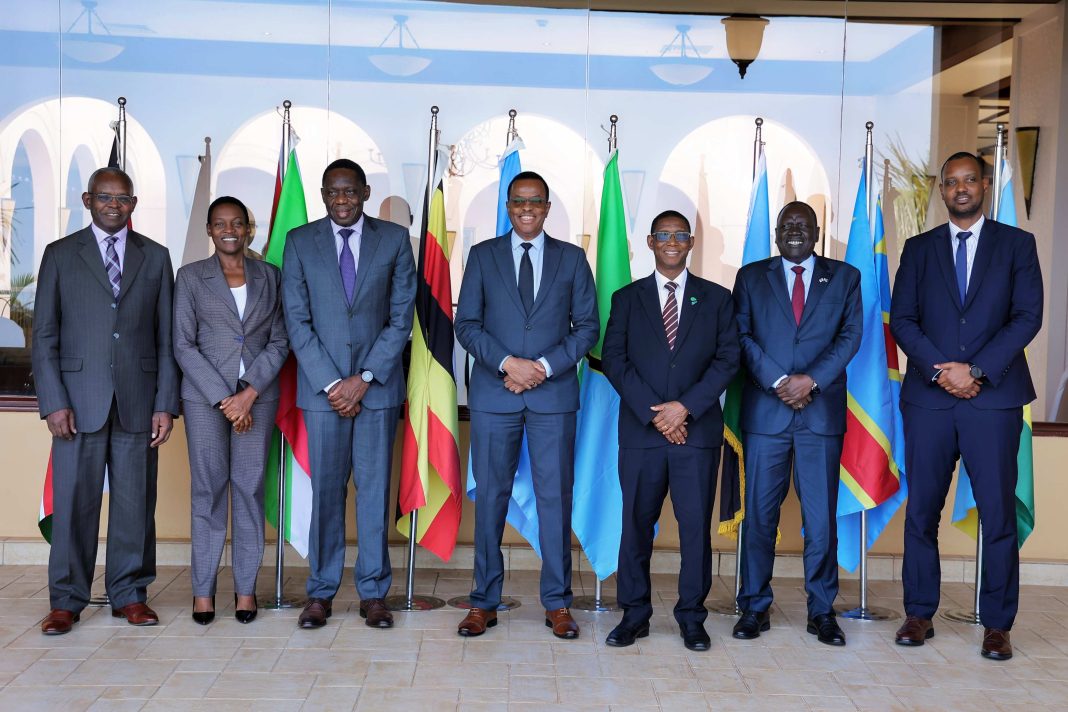
Governors of central banks from across the East African Community (EAC) have reaffirmed their commitment to introducing a single regional currency by 2031, even as they acknowledged that Partner States remain behind schedule in meeting key macroeconomic convergence targets.
The commitment was made during the 29th Ordinary Meeting of the East African Community Monetary Affairs Committee (MAC), held at Lake Victoria Serena Golf Resort and Spa in Kampala on Friday.

The meeting was chaired by Bank of Uganda Governor Michael Atingi-Ego, who currently serves as Chairperson of the Committee.
The meeting brought together governors and senior officials from the central banks of Uganda, Kenya, Tanzania, Rwanda, Burundi, South Sudan and Somalia, alongside officials from the EAC Secretariat. The Governor of the Central Bank of the Democratic Republic of the Congo, Andre Wanes Nkualoloki, was unable to attend and sent his apologies.
Opening the meeting, Atingi-Ego said East African economies continue to face mounting external pressures, including geopolitical tensions, shifting global trade policies and heightened financial market uncertainty, all of which are weighing on economic stability.

“In our economies, geopolitical tensions continue to increase, and trade policies are constantly changing. We are living in an environment of global financial market uncertainty, which is pushing up commodity prices. As a result, current account deficits have widened, exerting pressure on exchange rates and constraining reserve accumulation in some countries,” he said.
He said the evolving global environment demands stronger policy responses from regional central banks.
“These conditions call for sound and adaptive policy frameworks, robust early warning systems, stronger forecasting and stress testing capacity, clearer policy communication to anchor expectations, and continued use of our regional platforms to coordinate policy responses,” Atingi-Ego added.
Despite the global challenges, the governor said the region’s economies have continued to demonstrate remarkable resilience.
Quoting the International Monetary Fund’s Regional Economic Outlook released in April 2026, he noted that EAC economies expanded by an estimated 5.3 percent in 2025 and are projected to grow by 5.4 percent in 2026 and 5.6 percent in 2027, outperforming the Sub-Saharan African average.
“I am encouraged by the resilience that our economies continue to demonstrate. Sustaining this momentum will require continued prudent macroeconomic management and closer fiscal and monetary policy coordination to help our economies withstand future shocks,” he said.
The Committee noted that although the global economy continues to be affected by rising oil prices, increased shipping costs linked to conflict in the Middle East and slowing global growth, East Africa is expected to remain among the fastest-growing regions on the continent.
Regional economic growth is projected at about 5.2 percent in 2026, well above the Sub-Saharan African average of 4.3 percent, while average headline inflation across the region declined to 6.7 percent during the 2025/26 financial year from 9.6 percent the previous year.
The governors also expressed confidence that regional currencies will remain broadly stable, supported by diversified foreign exchange inflows, domestic foreign exchange market reforms and stronger investor confidence.
Atingi-Ego urged central banks to prepare for the growing influence of artificial intelligence and digital technologies on financial systems, saying they present enormous opportunities but also introduce new regulatory risks.
“As we advance the East African Community Monetary Integration agenda, we must also reckon with the growing role of artificial intelligence, big data and digital innovation in finance and the wider economy. These technologies are reshaping labour productivity, financial products and payment systems, while transforming how we assess inflation, monitor economic activity and detect financial sector vulnerabilities,” he said.
He called on Partner States to develop a shared regional strategy on artificial intelligence, including harmonised regulatory frameworks, innovation hubs and regulatory sandboxes to prevent regulatory arbitrage while promoting responsible innovation.
The governors also stressed the need to deepen regional financial markets to improve savings mobilisation, investment and monetary policy transmission, while ensuring innovations such as derivatives markets are backed by strong regulation and consumer protection.
The meeting reviewed progress in implementing the revised roadmap towards establishing the East African Monetary Union and introducing a single currency by 2031.
Members noted that Partner States have made significant progress in harmonising monetary policy frameworks, improving analytical capacity, strengthening risk management systems, enhancing policy coordination, expanding the East African Payment System and investing in human capital development.
However, they acknowledged that no Partner State has yet met all four primary macroeconomic convergence criteria required before the monetary union can become operational.
“Our commitment to a monetary union is not in question, but a candid review shows that we are consistently falling short of the convergence criteria, including reserve and inflation targets that fall squarely within the central bank mandate,” Atingi-Ego said.
“To correct course, we must strengthen peer review mechanisms and anchor binding national action plans in rigorous fiscal consolidation timelines and harmonised policy frameworks enforced through transparent regional surveillance and compliance protocols,” he added.
The Committee agreed to accelerate implementation of the monetary union roadmap by establishing a peer review mechanism to strengthen macroeconomic surveillance and by developing operational frameworks to implement the EAC Five-Year Development Strategy for 2026/27 to 2030/31.
Governors also reviewed progress on implementing the EAC Cross Border Payment System Masterplan, which aims to reduce transaction costs, improve interoperability among national payment systems, promote seamless cross-border transactions and boost intra-regional trade.
The Committee said implementation of the master plan has already begun, with annual work plans prepared, priority projects identified and financial and technical resources being mobilised.
On financial stability, the governors observed that the region’s banking sector remains adequately capitalised and liquid, although they warned that cyber security threats continue to pose growing risks to financial systems.
They pledged to strengthen regional cooperation in tackling cyber threats while continuing efforts to expand financial inclusion through digital financial services, particularly mobile money.
Atingi-Ego also called for closer cooperation between fiscal and monetary authorities as public debt levels continue to rise across the region.
“Preserving macroeconomic stability increasingly depends on close coordination between monetary and fiscal authorities while safeguarding the operational independence of our central banks. Such coordination is essential to keep debt on a sustainable path, anchor inflation expectations and preserve policy space needed to respond to future shocks,” he said.
The meeting concluded with governors expressing appreciation to the Bank of Uganda for hosting the event and reaffirming their commitment to strengthening monetary cooperation, deepening regional financial integration and keeping the East African Monetary Union on course for the 2031 target.