
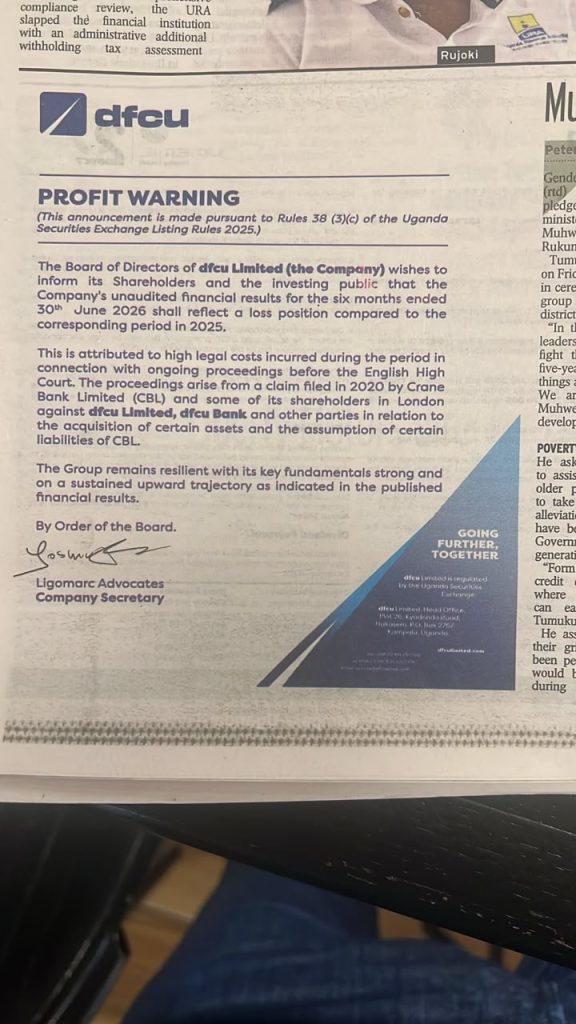
DFCU Limited has revealed that it slipped into a loss during the first six months of 2026 after incurring substantial legal costs in the ongoing Crane Bank case before the English High Court in London.
The listed financial services group disclosed the development in a profit warning issued under Rule 38(3)(c) of the Uganda Securities Exchange Listing Rules, 2025, informing shareholders and investors that its unaudited financial results for the six months ended June 30, 2026 indicate a loss compared to the corresponding period last year.

“The Board of Directors of DFCU Limited wishes to inform its shareholders and the investing public that the Company’s unaudited financial results for the six months ended June 30, 2026 indicate a loss position compared to the corresponding period in 2025,” the company said.
According to DFCU, the loss has been driven by the significant legal expenses incurred in defending the high-profile commercial dispute before the English High Court.
“This is attributed to the legal costs incurred during the period in connection with ongoing proceedings before the English High Court. The proceedings arise from a claim filed in 2020 by Crane Bank Limited (CBL) and some of its shareholders in London against DFCU Limited, DFCU Bank and other parties in relation to the acquisition of certain assets and the assumption of certain liabilities of CBL,” the company said.

Despite the financial setback, the bank maintained that its core business remains financially sound.
“The Group remains resilient with its key fundamentals on a sustained upward trajectory as indicated in the published financial results,” the statement added.
The London proceedings stem from one of Uganda’s longest-running banking disputes. The case was filed in 2020 by Crane Bank Limited and some of its former shareholders, challenging the circumstances under which selected assets and liabilities of Crane Bank were transferred to dfcu following the Bank of Uganda’s takeover of the lender in October 2016.
After Crane Bank was placed under statutory management and later receivership by the central bank, selected assets and liabilities were transferred to dfcu Bank in January 2017 under a Purchase and Assumption Agreement. Crane Bank Limited and its former shareholders contend that the takeover and subsequent sale were unlawful and that the assets were disposed of at a gross undervalue, claims that the defendants have consistently denied.
The latest development in the case came earlier this month when the English High Court handed down a significant procedural ruling that limited how dfcu can rely on forensic reports prepared by PricewaterhouseCoopers (PwC) in its defence.
Deputy High Court Judge Paul Stanley KC dismissed key parts of dfcu’s application to amend its defence, ruling that the bank cannot treat the findings contained in the PwC reports as established facts unless they are proved through evidence during the trial.
In his ruling, the judge said dfcu may refer to the existence of the PwC reports and the fact that the Bank of Uganda considered them when making regulatory decisions, but “cannot rely on the contents of those reports as evidence of the truth of the matters asserted in them” without formally proving those facts during the trial.
Judge Stanley further observed that the proposed amendments created “a dangerous ambiguity” by blurring the distinction between allegations contained in the PwC reports and facts that would ultimately have to be established before the court.
He also warned that incorporating extensive portions of the reports into the defence would unnecessarily broaden the litigation by introducing numerous additional factual disputes, making the already complex proceedings even more difficult to resolve.
The ruling did not determine liability or the merits of the dispute but instead clarified the evidentiary boundaries that will govern the trial as the parties continue preparing their cases before the English High Court.
For dfcu, however, the cost of defending the litigation has already had a financial impact, with the bank confirming that the legal expenses incurred during the reporting period pushed its half-year results into a loss, even as it insists that its underlying business remains resilient and on a sustained growth trajectory.
In July, 2025, the court found that the forensic report on which dfcu sought to rely existed in multiple versions, with some copies unsigned or backdated, while others lacked appendices and supporting data. The judge held that these issues raised concerns about the reliability of the material the bank wanted to introduce into its defence.
The court also observed that Crane Bank and its former shareholders had been denied access to some of the records they needed to challenge the report’s findings because those records were in the possession of the Bank of Uganda and dfcu. “Justice requires that both parties have equal access to the evidence. Denying the claimants access to their own records while seeking to use those records against them is not just unfair, it is unacceptable,” the court said.
As a result, the English High Court dismissed dfcu’s application to amend its defence and ordered the bank to pay the claimants’ legal costs. The ruling did not determine the merits of the main suit, which is still pending, but set the parameters for how evidence will be presented when the case proceeds to trial.
The London proceedings come as dfcu continues to face related litigation in Uganda arising from its acquisition of selected Crane Bank assets and liabilities in 2017.
In January, 2026 , the High Court ruled that Meera Investments Limited’s claim seeking about Shs40 billion from dfcu Bank over restoration and refurbishment costs linked to properties formerly associated with Crane Bank remains valid but cannot be enforced until the bank’s pending appeal is determined.
In his ruling, Justice Samuel Emokor stressed that the decision was procedural rather than a determination of the merits of the claim, explaining that ordering payment before the appeal is concluded could conflict with the Court of Appeal’s eventual decision.
The judge, however, made it clear that the claim itself remains intact pending the outcome of the appellate process.