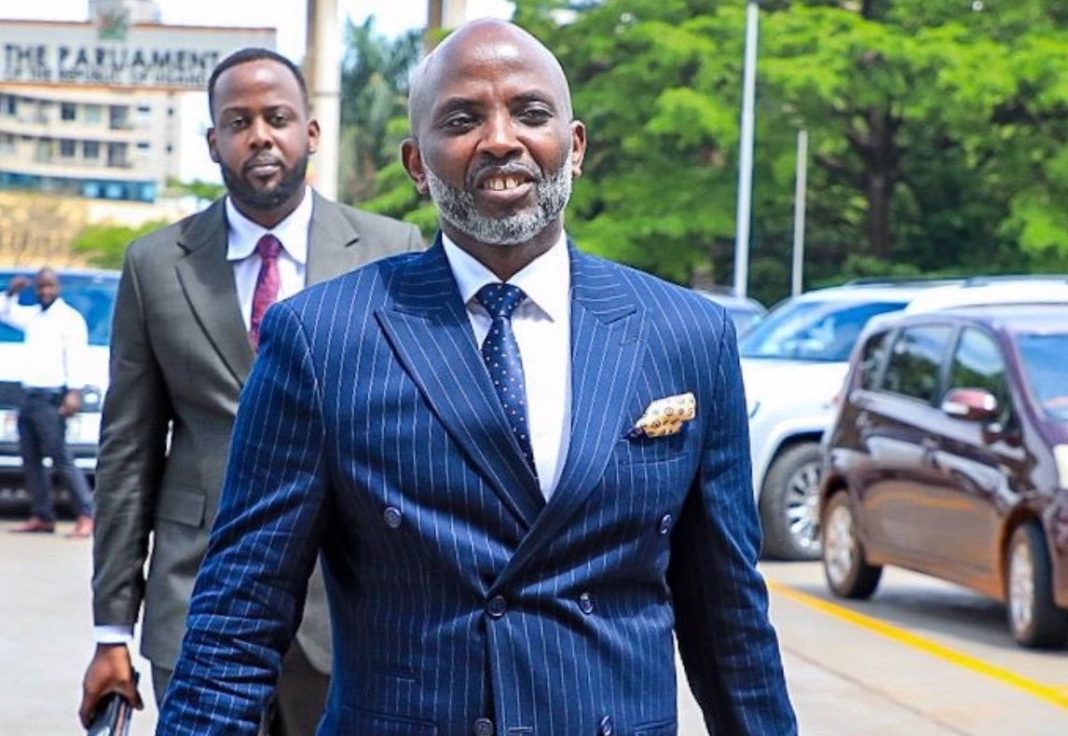
According to an official gazette published by the Directorate General of Immigration and Emigration of Rwanda and seen by Eagle Online, the Government of Rwanda has formally approved the voluntary renunciation of Dr. Lawrence Muganga’s Rwandan nationality.
The notice, published in the Official Gazette Special Bis of July 24, 2026, lists “MUGANGA Lawrence, son of Kayonga Leonard and Mukampfizi Immaculate, born in Mukono, Uganda, on February 14, 1976,” among individuals whose applications to voluntarily renounce Rwandan nationality were approved.

The development comes amid sustained debate over Muganga’s citizenship status following his recent replacement as State Minister for Internal Affairs by Juma Witonze Kisekka.
Breaking his silence on the matter, Muganga dismissed claims that he had ever held three passports at the same time, insisting the allegations were false.
“To begin with, it is wrong. There is no time in my life when I have ever had three passports. I have never had three passports,” Muganga said.

He explained that after graduating from Makerere University in 2001, he struggled to secure employment in Uganda and decided to seek opportunities in neighboring Rwanda, just as many Ugandans continue to look for work abroad.
“In July 2001, I completed my university education from Makerere. I expected to get a job like every young person in this country. Unfortunately, I did not get one. So I tried to go abroad several times,” he said.
“Like every young person right now, there are so many Ugandans at the airport trying to go to the UAE and different countries to earn a living. Me too, like every other young person, I went to Rwanda. I was fortunate, I got a job.”
Muganga said he later acquired Rwandan citizenship because it made it easier to work and access better employment opportunities in the country.
“I actually worked in three or four different organizations. To successfully work in that country, if you have their papers, you are better off because you’ll get better jobs and be able to survive and take care of your people,” he explained.
He added that he left Rwanda in 2009 to pursue a master’s degree in Canada, where he later became a Canadian citizen.
According to Muganga, he never became a dual citizen of Rwanda and Canada because he did not complete the legal procedures required by the Rwandan authorities after acquiring Canadian citizenship.
“It is very important to note that when you become a Canadian citizen, the Rwanda government requires you to communicate to the immigration department or the Rwandan embassy in order to obtain dual citizenship. I did not do that,” he said.
He added, “So what I did, I gathered the passport I had and the ID, handed them over to the Rwandan Embassy in Ottawa, and I remained with Canadian citizenship.”
Muganga said he later returned to Uganda after being invited by former Vice President Edward Ssekandi, former Speaker Rebecca Kadaga and Dr. Hillary Musoke to contribute to the country’s education sector.
“They asked me to come back and support the education sector. I told them I would do that with honor. When they sent me the invitation, I returned to Uganda,” he said.
The citizenship controversy has attracted renewed attention after Security Minister Kahinda Otafiire previously acknowledged facilitating Muganga’s acquisition of Ugandan citizenship.
“I gave him citizenship, but I’m not the one who appointed him as a minister. That means the people who appointed him found him to be useful,” Otafiire said.
The publication of Rwanda’s official gazette formally confirming the renunciation of Muganga’s Rwandan nationality is expected to add a new chapter to the long-running debate over his citizenship history.