The Minister of Defence and Veterans Affairs, Kiryowa Kiwanuka, has appealed to Parliament to support key Uganda People’s Defence Forces (UPDF) priorities, including peace support operations, improved funding and legislative reforms aimed at strengthening the country’s defence capabilities.
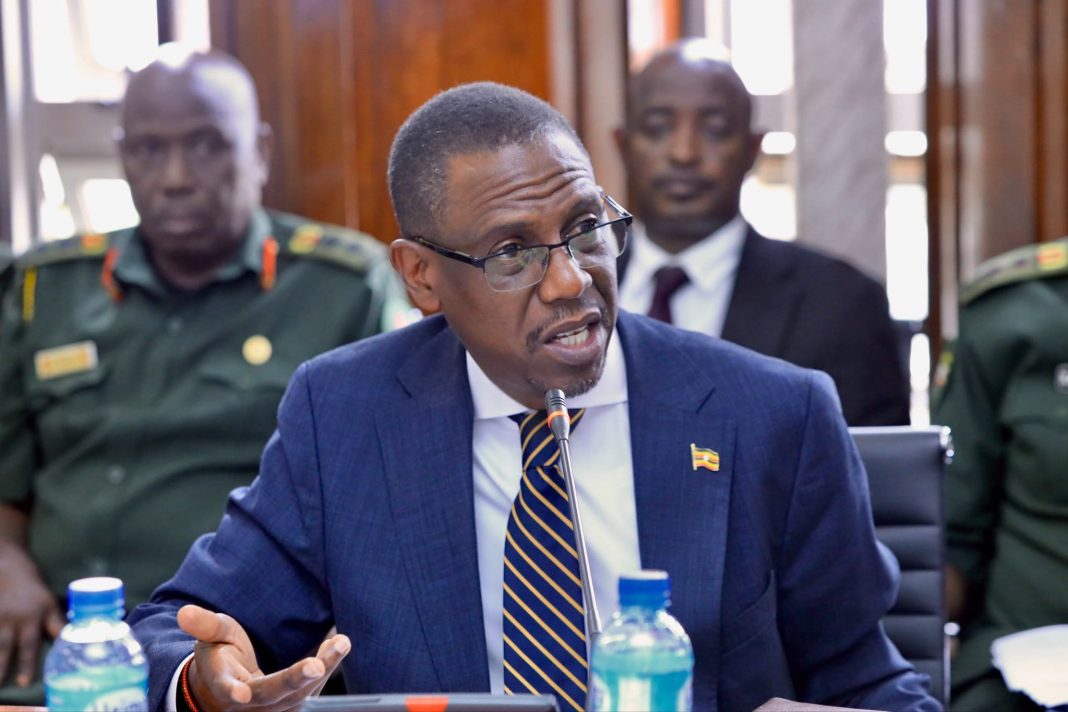
Kiwanuka made the appeal on Tuesday while appearing before Parliament’s Committee on Defence and Internal Affairs, chaired by Robina Rwakoojo, to present the state of the Ministry of Defence and Veterans Affairs, account for its performance and outline its resource requirements.

He was accompanied by the Minister of State for Defence and Veterans Affairs (Defence), Grace Akifeza Ngabirano, the Minister of State for Defence and Veterans Affairs (Veteran Affairs), Huda Abason Oleru, senior ministry officials led by Undersecretary for Finance and Administration Edith Buturo, and the Chief of Joint Staff, Lt Gen Jack Bakasumba.
Addressing the committee, Kiwanuka reaffirmed the constitutional mandate of the UPDF under Article 208 of the 1995 Constitution, saying the force remains a national, professional and disciplined institution charged with protecting Uganda’s sovereignty and territorial integrity.
“There shall be armed forces known as the Uganda Peoples’ Defence Forces, which shall be non partisan, national in character, patriotic, professional, disciplined, productive and subordinate to the civilian authority as established under the Constitution,” Kiwanuka told the committee.

He added that the UPDF is mandated to safeguard the country’s territorial integrity while ensuring the protection of people’s rights, the rule of law and good governance.
The minister said the ministry had registered significant achievements during the 2021 to 2026 period, citing the maintenance of peace and security during elections through a proactive security posture that prevented major disruptions to public order.
He also highlighted the acquisition, refurbishment and maintenance of strategic military equipment to strengthen the force’s ability to respond to emerging security threats, as well as the consistent recruitment of an average of 10,000 personnel annually over the past five years to meet manpower requirements.
Kiwanuka said the ministry had continued investing in professional military training both locally and abroad, including the establishment of the National Defence College Uganda in 2022 to provide advanced military and strategic training for senior military officers and civilian leaders.
“Since its establishment, the National Defence College has graduated 83 students in four intakes, averaging about 20 students annually, and we expect this to increase to 30 with the inclusion of participants from other Ministries, Departments and Agencies,” he said.
On the welfare of serving and retired personnel, the minister said phased salary and pension enhancements introduced since 2022 had improved the livelihoods of soldiers and veterans.
He revealed that the ministry had paid Shs540.46 billion in pensions while ensuring timely payment of pension benefits.
Kiwanuka also pointed to continued investment in healthcare services for soldiers, their families and neighbouring communities, including the construction of the 250 bed UPDF National Referral Hospital, where outpatient services are already operational.
He said the ministry had expanded housing and administrative infrastructure, including the construction of 30,000 housing units for UPDF personnel, new joint strategic headquarters office blocks, a new administration block at the Air Force Headquarters and an administration block for the Special Forces Command Airborne Unit.
The minister added that the ministry had strengthened logistics by ensuring a steady supply of food, fuel, clothing, accommodation and maintenance of military equipment, while veterans had benefited from improved gratuity payments before retirement, timely pensions and income generating initiatives through the National Enterprise Corporation and veterans’ SACCOs.
Looking ahead, Kiwanuka told MPs that the ministry is implementing strategic programmes, including a Shs1.863 trillion salary enhancement plan aimed at achieving full target pay by the 2027/28 financial year.
Other ongoing projects include the automation of logistics and pension management systems, construction of the new Ministry of Defence and UPDF headquarters scheduled for completion by September 30, 2026, establishment of in house fuel storage facilities and the continued implementation of the 30,000 housing unit programme, with 1,000 units already completed.
Despite the progress, the minister said the ministry continues to face major challenges, including inadequate funding, delayed disbursement of AUSSOM funds, inflationary pressures, global geopolitical instability, inadequate housing for UPDF personnel, the lack of duty free status for the Defence Forces Shop and limited capitalisation.
“I am calling upon the committee to help the ministry to support us on initiatives and missions on peace and security of the army and ministry to enhance our capacity and status and continue monitoring our projects because these activities sit within your constituencies,” Kiwanuka said.
He further asked Parliament to support legislation establishing an autonomous body to manage the UPDF National Referral Hospital, grant duty free status to the Defence Forces Shop and continue overseeing flagship defence projects to ensure their timely implementation.