Uganda and Denmark have established a Government to Government partnership to modernise Uganda’s firefighting and emergency rescue services following a high level technical mission to Danish firefighting institutions.
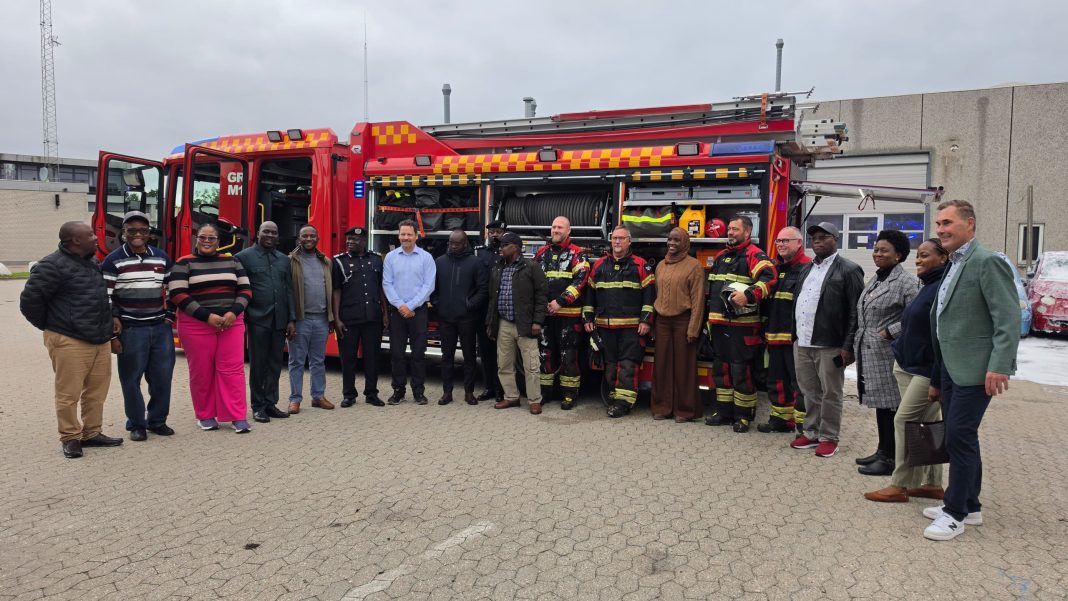
A delegation of Ugandan officials concluded a fact finding visit to the Franck Fire Training School in North Zealand and Falck Fire Denmark, where they studied advanced firefighting techniques, rescue operations, emergency preparedness, specialised equipment and institutional management as Uganda prepares for commercial oil production and expanded industrial development.

The initiative was coordinated by the Uganda Embassy in Copenhagen under Ambassador Margaret M. Otteskov and is intended to develop a structured cooperation framework that will strengthen Uganda’s emergency response capacity.
The proposed partnership comes as Uganda accelerates preparations for the Tilenga, Kingfisher and East African Crude Oil Pipeline projects, which are expected to increase demand for specialised firefighting and rescue services around petroleum facilities, industrial parks, transport infrastructure and surrounding communities.
During the visit, the Ugandan delegation observed Denmark’s firefighting systems and training methods at Falck, a company with more than 100 years of experience providing firefighting, rescue and emergency response services.

The delegation also visited the Franck Fire Training School to examine practical training programmes designed for firefighters operating in high risk environments.
Officials said the visit was designed to move beyond a traditional study tour by identifying practical areas where Denmark’s technical expertise can support Uganda’s national development priorities through a long term Government to Government arrangement.
The proposed cooperation is expected to cover professional training for Ugandan firefighters, modern fire prevention and risk management systems, emergency command and coordination structures, acquisition and maintenance of specialised firefighting equipment, industrial and petroleum fire preparedness, hazardous materials rescue capabilities, urban fire safety planning and technology transfer.
Ambassador Otteskov said the embassy was working to ensure that bilateral relations produce tangible benefits for Uganda’s institutions and economy.
“The Embassy is working to ensure that Uganda Denmark relations translate into practical partnerships that strengthen Uganda’s institutional capacity, protect lives and property, and support investment. As Uganda enters a new phase of industrial and petroleum development, modern emergency response systems are an essential part of national preparedness,” she said.
The ambassador has been leading engagements between Ugandan ministries and Danish institutions on strategic infrastructure, emergency response, health, environmental protection, agro industrialisation and investment.
The firefighting initiative follows earlier discussions between Uganda and Denmark on possible Government to Government investments in fire prevention and rescue services.
Those discussions outlined an indicative investment framework of between 50 million euros and 70 million euros, equivalent to about Shs206 billion to Shs289 billion, subject to feasibility studies and government prioritisation.
Officials said the technical mission provides the practical foundation needed to turn those policy discussions into implementable programmes.
Uganda’s petroleum sector is transitioning from development towards production, making emergency response capacity increasingly important for protecting workers, communities and critical infrastructure.
Government planning documents identify fire prevention, health and safety systems, oil spill preparedness and emergency response as essential components of the country’s petroleum development agenda.
Following the Danish mission, the Uganda Embassy plans to coordinate further technical engagements aimed at identifying Uganda’s priority fire and rescue capacity gaps, assessing equipment and infrastructure needs, developing firefighter training programmes, exploring financing models and identifying pilot projects for implementation.
The embassy said its objective is to convert the knowledge gained in Denmark into long term institutional capacity and investment opportunities that will strengthen Uganda’s emergency response system.
The Ugandan delegation included officials from the Office of the Prime Minister, the Ministry of Finance, Planning and Economic Development, the Ministry of Works and Transport, the Ministry of Local Government, the Ministry of Internal Affairs, the Ministry of Energy and Mineral Development, the Office of the Inspector General of Police, the Public Private Partnerships Unit, the Uganda Investment Authority and Stratus Medical Supplies Ltd.