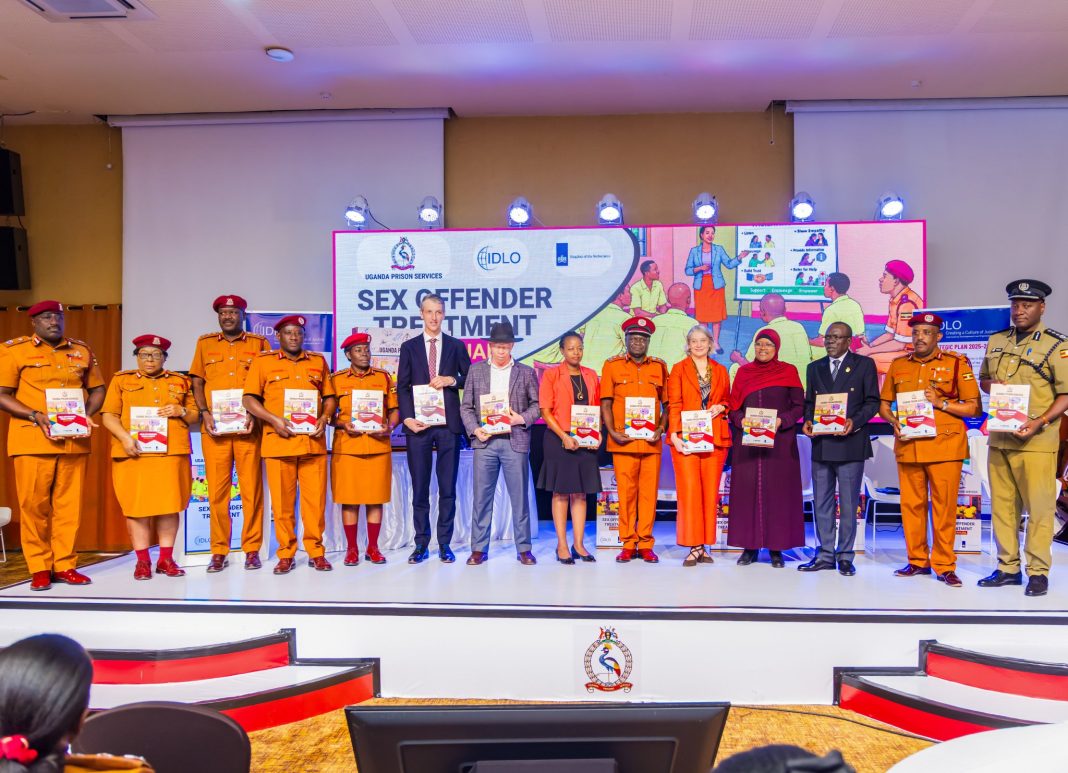
The Uganda Prisons Service (UPS) has launched a new Sex Offenders Treatment Manual to guide the assessment, treatment and rehabilitation of prisoners convicted of sexual offences, as the Service moves to strengthen interventions aimed at reducing re-offending and supporting reintegration.
The manual was launched on Wednesday, September 23, 2026, at Speke Resort Munyonyo in partnership with the International Development Law Organization (IDLO), with financial support from the Embassy of the Kingdom of the Netherlands in Uganda.

Speaking at the launch, Deputy Commissioner General of Prisons Samuel Akena said the manual would provide prison officers and social workers with a clear and structured framework for working with offenders convicted of sexual offences.
Akena said about 19,500 people convicted of sex-related offences are currently part of Uganda’s prison population, making effective treatment and rehabilitation programmes important in addressing the behaviour associated with sexual offending.
“The main objective is to help break the cycle of sexual offences through effective treatment, rehabilitation and reintegration, while ensuring that the rights and safety of victims remain an important consideration,” Akena said.

He urged prison officers and social workers who had undergone training on the programme to immediately begin applying the skills they had acquired in their work.
“The implementation of the manual must now begin in earnest,” Akena told officers and social workers attending the launch.
He said the officers had already been equipped with the knowledge and skills required to implement the programme, calling on them to ensure that the new approach translates into practical rehabilitation work inside prisons.
The manual will be rolled out across all 270 prison units in Uganda, allowing prison officers, social workers and other professionals involved in rehabilitation to use a common approach when assessing offenders, preparing treatment plans and monitoring progress.
The launch is part of a wider effort by UPS to strengthen rehabilitation and correctional services through evidence-based programmes. The Service’s mandate includes providing safe, secure and humane custody while rehabilitating and preparing offenders for reintegration into society.
Uganda Prisons Service has previously implemented treatment programmes targeting sex offenders. Its 2023/24 ministerial performance plans, for example, included sex-offence treatment programmes and entrepreneurial skills training for inmates.
The Head of the IDLO Country Office in Uganda, Barbara Kilei, said the organisation was pleased to support Uganda in strengthening its response to sexual offending through a structured rehabilitation approach.
She said sexual offences remain a serious concern for criminal justice systems and require interventions that go beyond imprisonment to address behaviour, rehabilitation and reintegration.
The manual provides a structured approach to assessing offenders, delivering treatment and monitoring rehabilitation, with the intention of strengthening correctional interventions and addressing factors that may contribute to sexual offending.
Presiding over the launch, the Ambassador of the Kingdom of the Netherlands to Uganda, Angèle Samura, said the support provided to Uganda should result in practical improvements within the correctional system.
Samura described the partnership as part of the Netherlands’ continued support for effective correctional services, rule of law and human rights in Uganda, stressing the importance of turning such cooperation into programmes that produce practical results.
Akena also thanked IDLO, the Netherlands Government and other partners for supporting the development and implementation of the manual, saying such partnerships were helping UPS strengthen its correctional system.
The partnership also extends to vocational skilling programmes within UPS, including initiatives at Kitalya Mini Max and Soroti Main Prisons, where inmates are being equipped with practical skills such as shoemaking and tailoring.
Recent parliamentary oversight of UPS has also highlighted the Service’s emphasis on rehabilitation, vocational training and preparation of inmates for life after prison. At Kitalya Mini Max, inmates are involved in garment and tailoring production, while UPS is also developing other prison industries including leather, furniture, textile and garment production.
For UPS, the launch represents an effort to strengthen the correctional component of imprisonment by ensuring that offenders receive interventions tailored to their behaviour and rehabilitation needs rather than relying solely on custody.
The new manual will guide prison officers and social workers through the assessment of offenders, development of treatment plans and monitoring of progress as inmates undergo rehabilitation.
The launch brought together senior Uganda Prisons Service officers, social workers, criminal justice stakeholders and development partners involved in strengthening rehabilitation and reintegration programmes.
UPS says its main objective is to ensure that prisoners leave custody better prepared to return to society as responsible and productive citizens, in line with its mandate to place rehabilitation and human rights at the centre of correctional services.