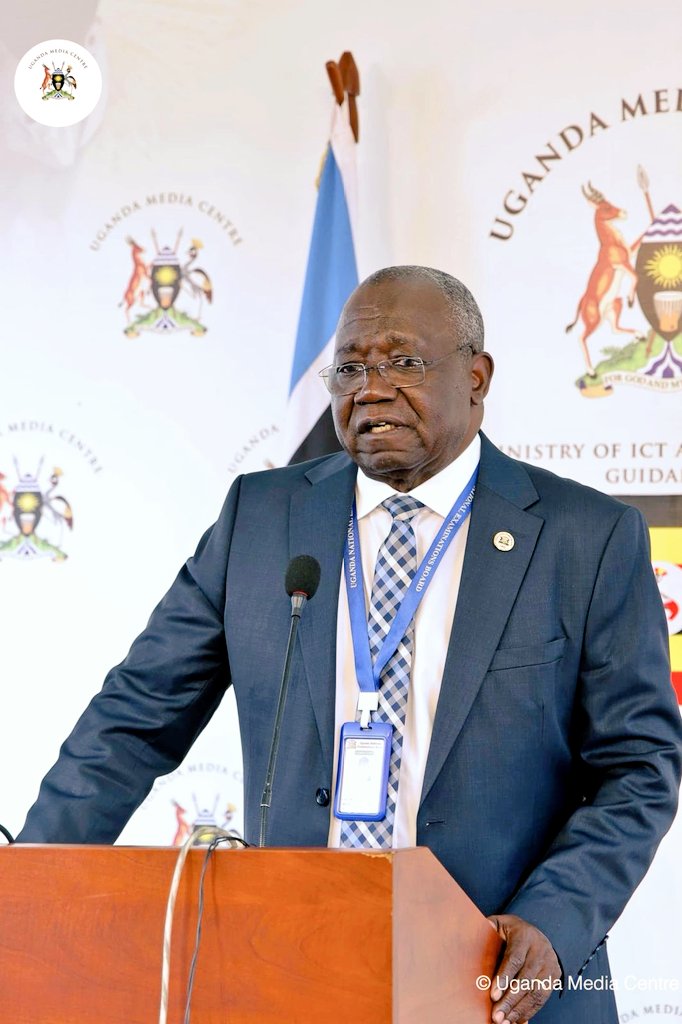
The Uganda National Examinations Board (UNEB) has released the 2026 timetables for the Primary Leaving Examination (PLE), Uganda Certificate of Education (UCE) and Uganda Advanced Certificate of Education (UACE), with Executive Secretary Dan Odongo announcing a record provisional candidature of 1,627,885 learners.
The figure represents an increase of 211,437 candidates, or 14.9 percent, compared to last year’s 1,416,448 candidates, with girls accounting for 52 percent of the total candidature and boys 48 percent.

Speaking during the release of the timetables on today, Odongo said the examination period would begin with the briefing of UCE candidates on October 8, followed by PLE briefing on October 30, while UACE candidates will be briefed on November 7 before their examinations begin.
“This year’s UCE candidates form the third cohort of learners to be assessed under the Competency Based Curriculum,” Odongo said.
“The UACE candidates were the pioneers of CBC at lower secondary school level. This time, they will be assessed based on a curriculum that has been aligned to the CBC and assessment modalities,” he said.

According to the timetable, UCE examinations will run from October 8 to November 3, PLE from October 30 to November 4, and UACE from November 7 to December 5.
The release comes as schools continue implementing the Ministry of Education and Sports’ official 2026 academic calendar, under which third term began on September 14 and ends on December 4 for primary and secondary schools, providing the framework within which the national examinations are being conducted.
Odongo said the Board had adopted the theme “Advancing Excellence in Assessment and Certification through Secure, Credible, Inclusive and Innovative Processes,” emphasizing that examination security, public confidence, inclusiveness for learners with disabilities and innovation remain central to UNEB’s work.
He urged schools to ensure every candidate receives a copy of the timetable and that copies are displayed on school notice boards. Braille versions have also been provided for visually impaired candidates.
The Board also reminded schools that the display of candidates’ registers remains mandatory until October 7 to enable learners to verify their names, dates of birth, photographs and registered subjects before examinations begin.
“Candidates MUST sign on a parallel register to confirm correctness of the registration data,” Odongo said.
The biggest increase in candidature was recorded at UACE, where candidate numbers rose by 22.5 percent from 166,400 in 2025 to 203,875 this year. UCE candidature increased by 16.4 percent to 503,214, while PLE grew by 12.4 percent to 920,796.
Odongo attributed the growth to improved completion rates and increased transition of learners from one education level to another.
“There is a sharp increase in candidature at all levels, which we may attribute to higher completion rates with more learners staying on in school and transitioning to the next level,” he said.
The Board also reported an unprecedented rise in enrolment for traditional science subjects at UACE, with Biology registrations increasing by 80.3 percent, Chemistry by 73.7 percent and Physics by 64.4 percent.
On the Competency Based Curriculum, Odongo said schools must complete submission of Continuous Assessment scores by September 30, warning that candidates whose final Continuous Assessment and project scores are not submitted will not be graded. Current submission stands at 82 percent.
UNEB also cautioned head teachers against falsely registering learners as Special Needs Education candidates in order to obtain extra examination time or additional support personnel.
“All these are meant to give such candidates extra time and possibly a transcriber. This gives the candidate an unfair advantage over the others,” Odongo warned.
The Board further warned parents and teachers against fraudsters selling fake examination papers as the examination season approaches, stressing that official examination papers remain secure and inaccessible before the scheduled examinations.
Candidates were urged to maintain discipline throughout the examination period, with UNEB stating that it would not intervene where learners are suspended or dismissed by schools for misconduct.
Odongo also revealed that investigations are underway into schools that failed to register candidates this year despite presenting candidates in 2025, with a final list expected to be published after September 30.
In addition, the Board accused some government UPE schools of fraudulently registering private candidates under the Universal Primary Education programme while retaining fees paid by parents instead of remitting them to UNEB.
“Government has therefore been defrauded,” Odongo said.
He called on Resident District Commissioners, Chief Administrative Officers and District Internal Security Officers to identify the culprits and ensure the money is recovered.
He also asked schools to adhere to Ministry of Education guidelines on teaching hours to ensure learners get adequate time to rest as they prepare for the national examinations.