All Senior Six leavers in Uganda will be required to undergo a six-month patriotism and leadership training programme at the National Leadership Institute (NALI) in Kyankwanzi, the National Secretariat for Patriotism Corps (NSPC) has announced.
The programme is expected to start this year and will bring together school leavers for training in patriotism, discipline, national identity, leadership, ideology and responsible citizenship.

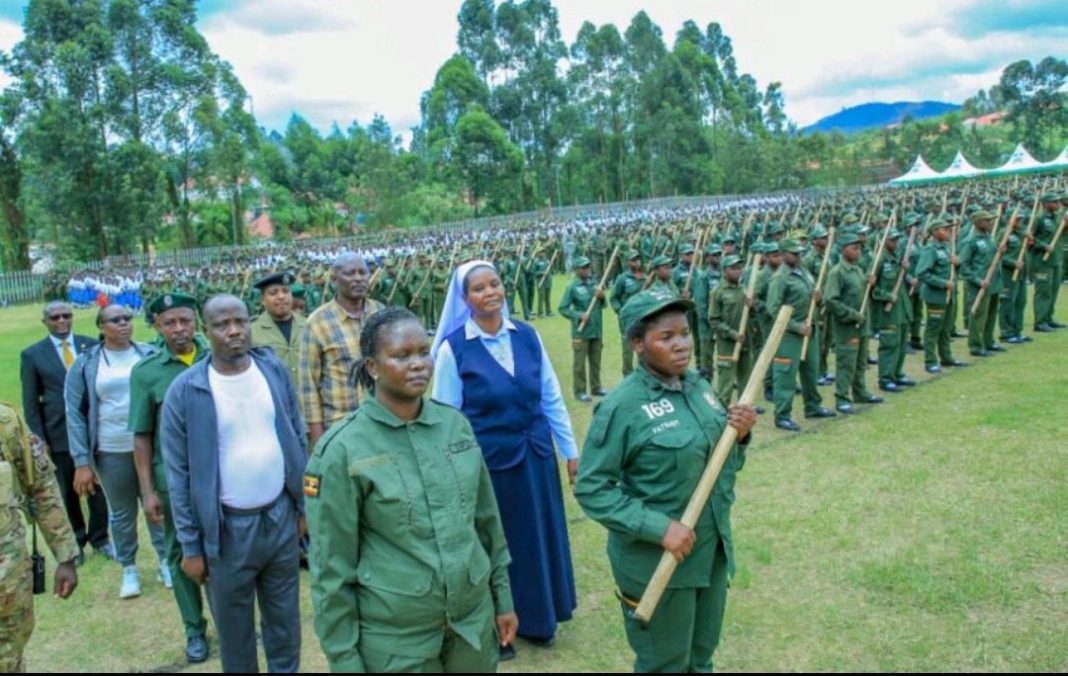
Hellen Seku, the Commissioner of the NSPC, announced the plan on Saturday while speaking at Immaculate Heart Girls’ Secondary School Nyakibale in Rukungiri District, where more than 1,700 students from four institutions completed a week-long patriotism training programme.
“I can assure you, head teacher, we are going to begin this year. So, this year we agreed with Jaaja (President Museveni) that all Senior Six vacists are going to Kyankwanzi. You’re going to go for about six months,”Seku said.
The announcement marks a major expansion of the government’s patriotism programme, which has previously targeted selected students, teachers, youth groups and other categories of Ugandans through training conducted at Kyankwanzi and other centres.

Seku said the programme would not only target students but also teachers and school administrators who have not received patriotism training or require refresher courses.
“All patrons and coordinators are going to do a refresher course, including teachers and head teachers who have not yet trained, even those who have taken long. We want everybody to undergo the training,”she said.
The commissioner said the government was seeking to extend ideological and patriotism training to a wider section of the population, including students in higher institutions of learning and young people working in the informal sector.
“That’s what we are doing here, and we want to thank His Excellency once again, for he has now given us the mandate to go to higher institutions, to go to all the youth in the informal sector. That’s why you saw us taking boda boda men to Kaweweta for training,”Seku said.
She added that Ugandans returning from South Africa had also been taken through the programme as part of efforts to expose more citizens to patriotism and ideological education.
“So, we want every Ugandan to get a dose of ideology. This is the time when this country needs an ideological direction for everybody,”she said.
Seku also credited the Chief of Defence Forces, Gen Muhoozi Kainerugaba, for supporting the programme by providing military instructors whenever the NSPC requests them.
“We want to thank the CDF because every time we write to him asking for instructors from a certain region, he is always quick to respond,”she said.
The commissioner told the students that patriotism was not optional but a responsibility provided for under Uganda’s Constitution.
“Patriotism is a calling for all Ugandans. When you read our Constitution, Article 17, Clause 2, says every Ugandan shall undergo patriotism training, and the Government shall ensure that such facilities are provided,”Seku said.
She urged the students to work hard, maintain discipline and use their education to contribute to the country’s development.
“You must work hard. That’s why you are in school: to begin working hard. Working hard begins with you in school,”she said.
Seku also challenged health workers and teachers to view their professions as forms of patriotic service, urging them to treat the people they serve with integrity and respect.
“You shouldn’t only be doctors and nurses of diseases, but even ideology. Handle clients very well. Teaching is a patriotic calling,”she said.
The students who completed the week-long training were drawn from Immaculate Heart Girls’ Secondary School Nyakibale, Karoli Lwanga Institute of Health Sciences, Kinyasano Girls’ High School and Makobore High School.
The programme included lessons on security and ideological patriotism, national identity, discipline, HIV/AIDS awareness, Pan-Africanism, political history, citizenship, patriotism cooperatives, environmental protection, entrepreneurship, integrity and resilience.
The students also participated in early morning physical drills and parades, with the programme facilitated by senior Uganda People’s Defence Forces (UPDF) officers, lecturers and NSPC coordinators.
Among the military instructors was Brig Gen Justus Rukundo, while Capt Richard Owaruhanga, the NSPC Assistant Commissioner in charge of training, was also involved in the programme.
Mercy Okuyangabire, the Speaker of the Students’ Council at Immaculate Heart Girls’ School Nyakibale, said the training had helped students develop discipline, responsibility and a stronger sense of patriotism.
She said bringing together students from different institutions had also enabled them to make new friends, exchange experiences and appreciate their shared responsibility towards Uganda.
The students highlighted the use of Kiswahili during parades and army songs as one of the most notable aspects of the training.
“Initially, Kiswahili would stop in classes, but now we get to use the Kiswahili language out of class, and it has helped us to understand very well,” Okuyangabire said.
She said the students had also learnt about Uganda’s history, survival skills, resilience and perseverance, while the early morning drills helped them develop physical and mental endurance.
The trainees were further encouraged to protect the environment, become job creators rather than relying solely on employment and uphold integrity in their daily lives.
“We were sensitised on environmental protection and preservation. We were guided on being job creators, not just job seekers. We also learned about living lives of integrity, doing the right thing even when no one is watching,” Okuyangabire said.
Richard Ndyamuhaki, the Regional Coordinator for Patriotism in Kigezi, challenged the students to demonstrate the values they acquired during the training in their homes, schools and communities.
“What I expect from the participants is that, from what you have undergone, we should see a positive change in your families, in your community, in society, and also in Uganda in general,” Ndyamuhaki said.
He urged them to demonstrate love for their country, unity and a spirit of service.
The programme was welcomed by school administrators, who said patriotism training could help young people develop discipline and a stronger sense of responsibility at a time when many graduates face difficulties finding employment.
Sr Tumusiime Sabino, the head teacher of Immaculate Heart Girls’ School Nyakibale, said the programme would help learners develop love for Uganda while preparing them to deal with challenges in society.
Monica Kobusingye, the Deputy Principal of Karoli Lwanga Institute of Health Sciences, called for the programme to be extended to more students and institutions, particularly those training future health workers.
“A person who holds integrity will not destroy their nation. So, we expect integrity from our health workers,” Kobusingye said.
The Deputy Resident District Commissioner of Rukungiri, Wilberforce Ongom Ahimbisibwe, also urged the students to make discipline and integrity part of their lives, saying academic qualifications alone cannot guarantee success.
He warned them against corruption and bribery, which he said undermine service delivery and national development.
“As young patriots, make sure you desist from corruption,” Ongom said.
He also urged the students to take an active role in protecting the environment, including discouraging their families from cultivating or using wetlands.
“As a patriot, go and tell your parents that using a wetland is wrong,” he said.
The expansion of the patriotism programme means that thousands of students completing Senior Six could soon be required to spend several months at NALI as part of their transition from secondary school into higher education, employment or other forms of work.
The government says the training is intended to instil discipline, patriotism, national identity and a sense of responsibility among young people while preparing them to contribute to Uganda’s social and economic development.