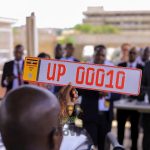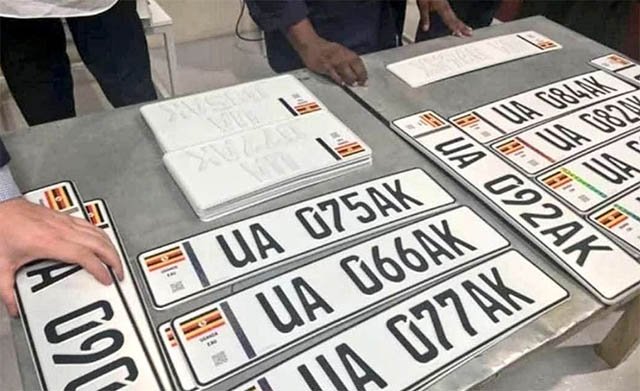
Two government officials have been arrested by Parliament CID officers after failing to provide satisfactory explanations to MPs investigating the Shs714,300 fee charged for Uganda’s digital number plates.
The officials are Nathan Negesa, a public officer attached to the Office of the President, and Moses Bekabye, a Technical Advisor for Economic Affairs at the Ministry of Finance.

They were arrested on Monday after appearing before the Parliamentary Committee on Physical Infrastructure, which is investigating the cost and implementation of the Intelligent Transport Monitoring System (ITMS), under which the digital number plates are being introduced.
Negesa was questioned about how the Shs714,300 fee for a digital number plate was calculated but failed to provide the committee with a clear breakdown of the charge.
A cost breakdown subsequently presented to the MPs reportedly amounted to Shs624,000, leaving Shs90,300 unaccounted for.

The committee also questioned Bekabye over claims he made during an earlier appearance before the MPs regarding international benchmarking of digital number plate prices.
Bekabye had told the committee under oath that government officials had travelled to China, Russia and India to benchmark the cost of digital number plates before the Ugandan price was determined.
However, when he returned before the committee on Monday, Bekabye admitted that the officials had not travelled to the three countries as he had previously claimed.
The admission prompted Parliament CID officers to arrest him for further questioning.
The committee is now seeking to establish how the Shs714,300 fee was arrived at and the basis for the pricing model adopted by government.
Committee chairperson Mwine Mpaka has previously questioned why motorists are required to pay Shs714,300 for a new digital number plate and demanded that officials explain who approved the figure.
“Who determined these costs on our behalf? Tell us which ministry, which individuals established that a motor vehicle should pay Shs714,300,” Mpaka asked officials during an earlier committee hearing.
The committee has also raised concerns about the financial arrangement between government and Joint Stock Company Global Security, the Russian company contracted to implement the digital number plate component of the ITMS.
According to information presented to Parliament, the company committed to invest $257 million in the project and recover its investment over a 10-year period.
Officials told MPs that the company had invested about $115 million by July 20, 2026.
Bekabye previously told the committee that the digital number plate kit was estimated to cost about $150 on the international market, but Uganda adopted a $200 pricing model for new vehicle and motorcycle registrations.
He explained that the higher charge was intended to subsidise the cost of replacement plates, which are charged at Shs150,000 for vehicles and Shs50,000 for motorcycles.
The pricing has faced criticism from MPs and motorcycle riders, with Namisindwa County MP Metrine Nanzala questioning why new motorcycles and motor vehicles were subjected to the same pricing model despite differences in their owners’ ability to pay.
Nanzala also questioned why boda boda riders, many of whom depend on motorcycles for their livelihoods, should pay the same digital plate fee as vehicle owners.
The inquiry has also examined delays in the issuance of the plates and the financial impact of the project.
The Ministry of Works and Transport previously told Parliament that delays in the digital number plate rollout had contributed to significant losses in government revenue, while manufacturers and business groups have questioned the decision to give one company exclusive rights to produce the plates.
The Uganda Manufacturers Association has also raised concerns about the monopoly granted to Global Security, arguing that local manufacturers could have participated in the production of the plates.
Despite the concerns over cost and implementation, security officials have told MPs that the tracking system has helped recover stolen vehicles.
Police previously told Parliament that 337 out of 375 stolen vehicles had been tracked and recovered using the system, representing a recovery rate of about 90 percent.