Victoria University is set to expand its footprint in Kampala with the construction of a new campus in Naguru, with work to begin this year as the institution continues to grow its academic and practical learning programmes.
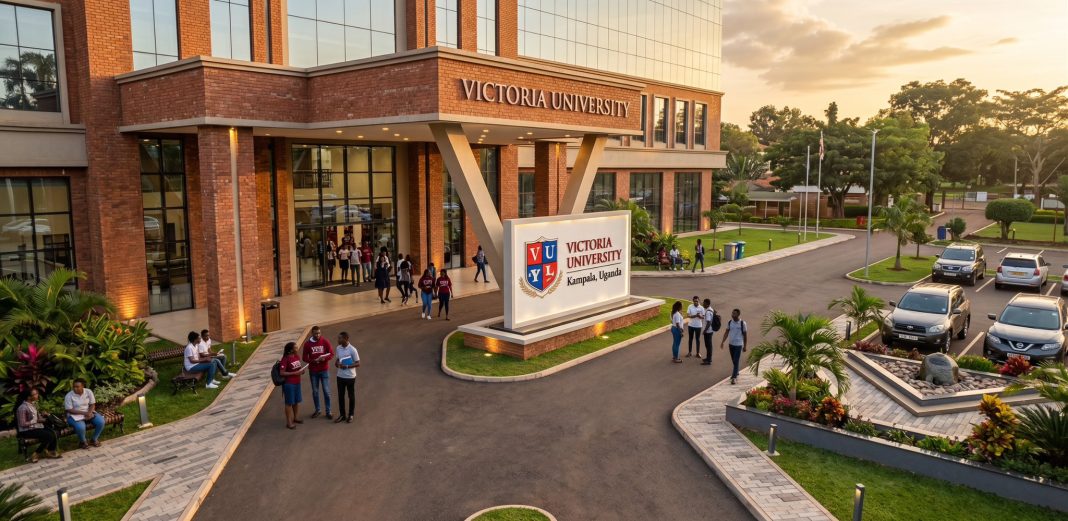
The university’s Vice Chancellor, Prof. Lawrence Muganga, has unveiled impressive architectural designs for the planned campus, giving students, staff and the wider public a glimpse of what is expected to become the institution’s new home in one of Kampala’s rapidly developing areas.

The campus will be located in Naguru, close to Phaneroo, in an area that has increasingly become home to major institutions, businesses and residential developments.
Sharing the architectural impressions, Muganga said the designs were so modern that they could easily be mistaken for images created using artificial intelligence, but stressed that they represent the actual plans for the new Victoria University campus.
“At first glance, you might think someone got a little too creative with AI. But no, these are the actual design impressions of the upcoming Victoria University Kampala, Uganda, campus in the heart of Kampala, Naguru to be exact, close to Phaneroo,” Muganga said.

The Vice Chancellor said the project is no longer just an idea on paper, revealing that construction is expected to commence this year.
“Yes, this is happening, and I am excited to share that work begins this year,” Muganga said.
The announcement marks another expansion phase for Victoria University, which has built its identity around practical, experiential and technology-driven education since it began operations in August 2013.
The university was granted a charter in August 2022, a recognition that Victoria University says affirmed its compliance with national and international higher education standards.
According to the university, its education model is designed to go beyond classroom-based theoretical teaching by giving students opportunities to gain practical experience and develop skills that can be applied directly in the workplace.
Victoria University says its work-integrated learning model enables students to combine academic study with workplace experience, with students potentially gaining between two and three years of work experience during a three-year programme.
The university currently offers programmes across several areas, including health sciences, business and management, science and technology, humanities and social sciences, law, education, hospitality and tourism, among others.
Its undergraduate programmes include courses in medicine-related fields such as Nursing, Pharmacy and Public Health, alongside programmes in Information Technology, Computer Science, Software Engineering, Artificial Intelligence and Data Science, Journalism and Media Studies, Law, Business Administration, Tourism and Hospitality Management and several other disciplines.
The institution also provides postgraduate, diploma, certificate, professional development and flexible learning options, including online and blended education.
Victoria University has increasingly positioned digital technology and innovation at the centre of its academic approach, with its digital learning platform allowing students to participate in learning remotely while maintaining interaction with lecturers and other students.
The university also promotes a student-centred approach that it says is intended to prepare graduates for employment, entrepreneurship and the changing demands of the modern workplace.
Muganga said the university community is looking forward to seeing the designs transformed from architectural impressions into a physical environment where students can study, interact and build their university experience.
“We cannot wait to see these images become something you can actually walk into, experience, and call home. This one is going to be beautiful,”he said.
The new Naguru campus comes at a time when Victoria University is seeking to strengthen its position as a modern institution offering what it describes as transformational education.
The university says its mission is to provide an environment for learning, innovation, research and community engagement, while its academic model places emphasis on experiential and work-integrated learning.
Victoria University has also sought to attract students from outside Uganda, with the institution saying its community includes learners from more than 50 countries, giving it an increasingly international character.
The institution’s approach has also included partnerships with organisations and workplaces to expose students to practical environments and improve their readiness for employment after graduation.
The planned Naguru campus is therefore expected to add to the university’s physical infrastructure as it continues expanding its programmes and student population.
Beyond classrooms and academic facilities, the new development is expected to provide students with a modern environment that reflects Victoria University’s emphasis on technology, innovation and hands-on learning.
The university has not yet publicly disclosed the full construction cost, completion date or the detailed facilities that will be contained in the new Naguru campus.
However, the release of the architectural impressions and confirmation that construction will begin this year signal that the project has moved closer to implementation.
The next stage is to see the designs become a physical campus that students can experience rather than simply view in pictures.
The Naguru project will become another major development in Victoria University’s expansion and its efforts to provide a modern learning environment for a new generation of students.