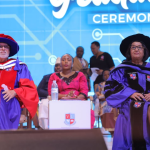

Victoria University will hold its 10th graduation ceremony on October 19 and 20, 2026, at Speke Resort Convention Centre in Munyonyo, Kampala, as the institution marks a decade of growth while placing artificial intelligence, digital skills and practical education at the centre of its preparations for the future workforce.
The two-day ceremony will bring together graduands, parents, university officials and other guests to celebrate academic achievements across the institution’s faculties, with the milestone highlighting Victoria University’s emphasis on producing graduates equipped to compete in an increasingly technology-driven economy.

The university has promoted the occasion under the message “The Future Is Here”, reflecting its focus on preparing students for emerging opportunities in technology, innovation, entrepreneurship and professional practice.
The first day, Monday, October 19, will be dedicated to graduates from the Faculty of Science and Technology and the Faculty of Health Sciences, while Tuesday, October 20, will feature graduands from the Faculty of Business and Management and the Faculty of Humanities and Social Sciences.
The ceremony will be held at Speke Resort Convention Centre, Munyonyo, beginning at 7am on both days, according to announcements about the event.

The 10th graduation marks another stage in the university’s development since its establishment and comes as higher education institutions face growing pressure to equip students with skills that go beyond traditional classroom learning.
Artificial intelligence has become a central part of Victoria University’s academic direction, with the institution integrating AI into its learning experience and expanding its technology-oriented programmes to respond to changes in the workplace.
The university offers a Bachelor of Science in Artificial Intelligence and Data Science, designed to equip students with skills in data analysis, intelligent systems, machine learning and the responsible application of AI. Its curriculum is intended to prepare graduates for opportunities in sectors including finance, healthcare, cybersecurity, telecommunications, government and business.
The institution also offers programmes in Cyber Security and Digital Forensics, Software Engineering, Information Technology and Computer Science, reflecting the growing demand for professionals who can support digital transformation and protect organisations against technology-related risks.
Victoria University’s Bachelor of Science in Artificial Intelligence and Data Science is built around practical application, including work-integrated learning, practical laboratory work and industry-based projects. The programme is intended to develop graduates capable of applying technological knowledge to real-world problems rather than relying solely on theoretical instruction.
The university’s emphasis on AI comes amid the rapid adoption of digital tools in education, public administration, healthcare, financial services and other industries. As employers increasingly seek workers who can use emerging technologies responsibly, universities are under pressure to ensure that graduates leave with both academic qualifications and applicable professional skills.
In May 2025, Victoria University highlighted its efforts to integrate artificial intelligence into the learning experience, describing the approach as part of its strategy to prepare students for a changing technological environment.
The institution’s wider academic offering also includes health sciences, pharmacy, nursing, public health, business administration, law, journalism and media studies, agriculture, education, tourism and hospitality management, among other disciplines.
This range of programmes places the university in a position to train graduates for different sectors of Uganda’s economy, from healthcare and financial services to media, education, agriculture and the digital economy.
Beyond its technology programmes, Victoria University has emphasised experiential learning and work-integrated learning as key elements of its education model.
The approach seeks to connect classroom instruction with practical experience, allowing students to apply concepts acquired during their studies to professional settings and real-world assignments.
The university has also promoted work-integrated learning transcripts as a way of documenting students’ practical competencies alongside their academic qualifications, reinforcing its stated ambition to produce graduates who are prepared for employment, entrepreneurship and further professional development.
The focus on employability is particularly relevant in Uganda, where young people entering the labour market must compete for jobs while employers increasingly demand practical skills, digital competence, communication abilities and the capacity to adapt to changing working environments.
Victoria University’s 10th graduation therefore comes at a time when the debate about higher education is increasingly centred on how institutions can bridge the gap between qualifications and the skills required by employers.
The university’s previous graduation ceremonies have reflected a similar emphasis on innovation, professional development and national growth.
At its eighth graduation ceremony, held on September 20, 2024, at Speke Resort Convention Centre in Munyonyo, the university awarded qualifications to 1,471 graduands, according to reports published at the time.
Deputy Speaker of Parliament Thomas Tayebwa, who officiated at the ceremony, urged the institution to maintain its focus on quality education, research and innovation. He also challenged university leaders to pay attention to quality assurance, student-lecturer ratios, teaching space and mentorship.
Tayebwa argued that innovation was important in advancing research capable of addressing Africa’s development challenges, while urging the institution to continue strengthening the quality of its training.
The 2024 ceremony demonstrated the institution’s continued use of Munyonyo as a venue for celebrating its graduates and bringing together academic leaders, public officials, families and other stakeholders.
A year later, the university held its ninth graduation ceremony on October 28, 2025, under the theme “Shaping the Future: Innovation, Digitality and Employability”.
Reports from the ceremony indicated that 2,029 students graduated with degrees, diplomas and certificates in various fields, including law, nursing, midwifery, journalism and mass communication.
The 2025 ceremony also attracted attention for a scholarship initiative by businessman Sudhir Ruparelia and his wife, Jyotsna Ruparelia, who offered 100 full scholarships to outstanding undergraduate students in memory of their late son, Rajiv Ruparelia.
The initiative highlighted the role of private support in helping students access higher education and pursue their professional ambitions.
The eighth and ninth ceremonies provide a measure of the university’s recent graduation activity, although the figures alone do not establish the institution’s total enrolment or cumulative number of graduates since its establishment.
The 10th graduation now offers another opportunity for the university to showcase its academic programmes, the achievements of its students and its evolving approach to preparing young professionals for the workplace.
As artificial intelligence reshapes how businesses operate and how knowledge is acquired and applied, the institution’s emphasis on digital skills is expected to remain an important part of its academic direction.
AI and data science skills can support applications ranging from business forecasting and financial analysis to healthcare technology, agricultural innovation and cybersecurity. However, the growing use of these technologies also places greater responsibility on universities to train students in ethical practice, critical thinking and the responsible handling of information.
Victoria University’s programmes in artificial intelligence, data science and cyber security reflect some of the emerging areas in which Uganda will require specialised talent as businesses and public institutions expand their use of digital systems.
The university’s broader challenge will be to ensure that its graduates can translate the knowledge acquired during their studies into practical solutions, employment opportunities and businesses that contribute to the country’s development.
The two-day graduation will bring together students from science and technology, health sciences, business and management, and humanities and social sciences, highlighting the breadth of disciplines through which the institution seeks to contribute to Uganda’s human capital development.
The ceremony will mark the culmination of years of study and the beginning of a new stage in their professional lives for the graduands. For the university, it will be a milestone in a decade-long journey and an opportunity to demonstrate how its academic programmes are responding to the demands of a rapidly changing world.