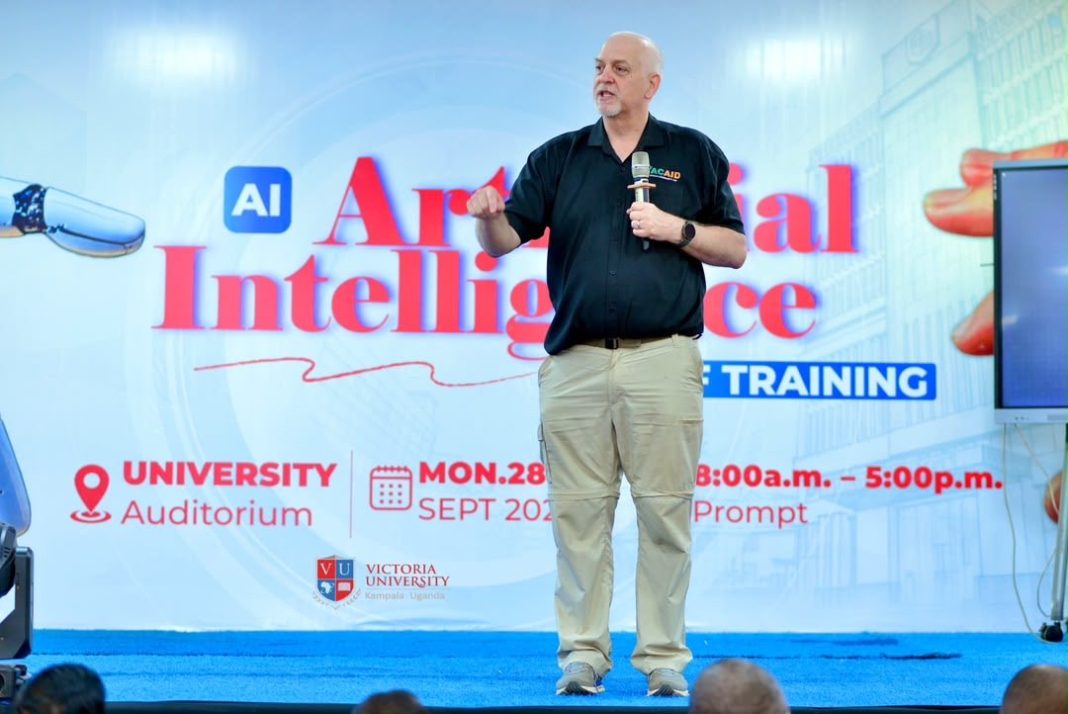
Victoria University has intensified its push to integrate artificial intelligence into higher education after training its academic and administrative staff in the practical use of AI tools, with the session led by technology executive Tim Abel, who has held senior roles at Google, Microsoft and Dell.
The four hour training was held at the university’s main auditorium along Jinja Road in Kampala and brought together deans, heads of departments and executive support staff as the institution seeks to make AI skills part of its wider workforce rather than limiting them to students or technology specialists.

Abel used the session to demonstrate how artificial intelligence can be applied to routine university work, including developing curriculum outlines, preparing case studies, supporting academic research and handling administrative processes.
The training also exposed staff to practical applications such as workflow automation, data processing, scheduling and the use of carefully designed prompts to produce outputs relevant to their respective departments.
Rather than presenting AI as a replacement for lecturers and other professionals, Abel encouraged the university staff to view the technology as an additional tool that can improve productivity while leaving key responsibilities such as judgement, mentorship and human interaction in the hands of educators.

“AI will never replace the empathy, intuition, and mentorship of a dedicated educator,” Abel said.
He also challenged staff to acquire the skills required to work alongside emerging technologies, arguing that familiarity with AI will increasingly influence how professionals perform in the workplace.
“AI will not replace humans. But human beings who master AI will inevitably lead those who do not,” he said.
The workshop moved beyond presentations into practical exercises, with participants testing AI prompts, developing lesson plans and creating administrative templates to see how the technology could be adapted to their daily responsibilities.
For lecturers and researchers, the applications demonstrated included assistance with curriculum development, case studies and research activities, while administrative teams explored ways of reducing repetitive work and improving the handling of information.
The training comes as Victoria University expands its academic focus on artificial intelligence and other emerging technologies. The university currently offers a Bachelor of Science in Artificial Intelligence and Data Science, a three year programme delivered through both on campus and online learning.
The programme covers areas including machine learning, data analytics, programming, intelligent systems, ethical AI and practical industry based projects.
The programme was accredited by the National Council for Higher Education in 2025 alongside the university’s Bachelor of Science in Cyber Security and Digital Forensics. The AI and Data Science programme was approved for an annual intake of 85 students and accredited for seven years.
Victoria University has also expanded its technology related academic offerings as demand grows for skills in artificial intelligence, data science and cybersecurity. Its current undergraduate programmes include Artificial Intelligence and Data Science, Cyber Security and Digital Forensics, Information Technology and Software Engineering.
The university’s AI focus has also extended beyond its degree programmes. It has been running an AI Discovery Programme aimed at providing free AI training to 10,000 learners, with the initiative covering areas such as prompt engineering, generative AI, digital productivity and responsible use of artificial intelligence.
Vice Chancellor Lawrence Muganga said the decision to train staff was linked to the university’s wider objective of ensuring that AI knowledge reaches students through the people who teach and support them.
“When our staff understand AI and become comfortable using it, that knowledge does not stop with them. It finds its way into the classroom, into student support, and into the everyday experiences we create for our students,” Muganga said.
“Our goal goes beyond simply teaching students about AI. We want our graduates to leave Victoria University with the AI literacy, practical skills, and confidence to take on today’s labour market, create opportunities for themselves, and contribute wherever they find themselves,” he said.
Muganga said the university had brought in experts with international technology industry experience to expose its workforce to lessons from the global technology sector and help staff understand how AI can be applied in practical settings.
The development comes as higher education institutions increasingly confront the need to adapt teaching, research and administration to the rapid growth of generative AI. Victoria University’s approach combines staff training with formal academic programmes, allowing the institution to address AI skills among both educators and students.