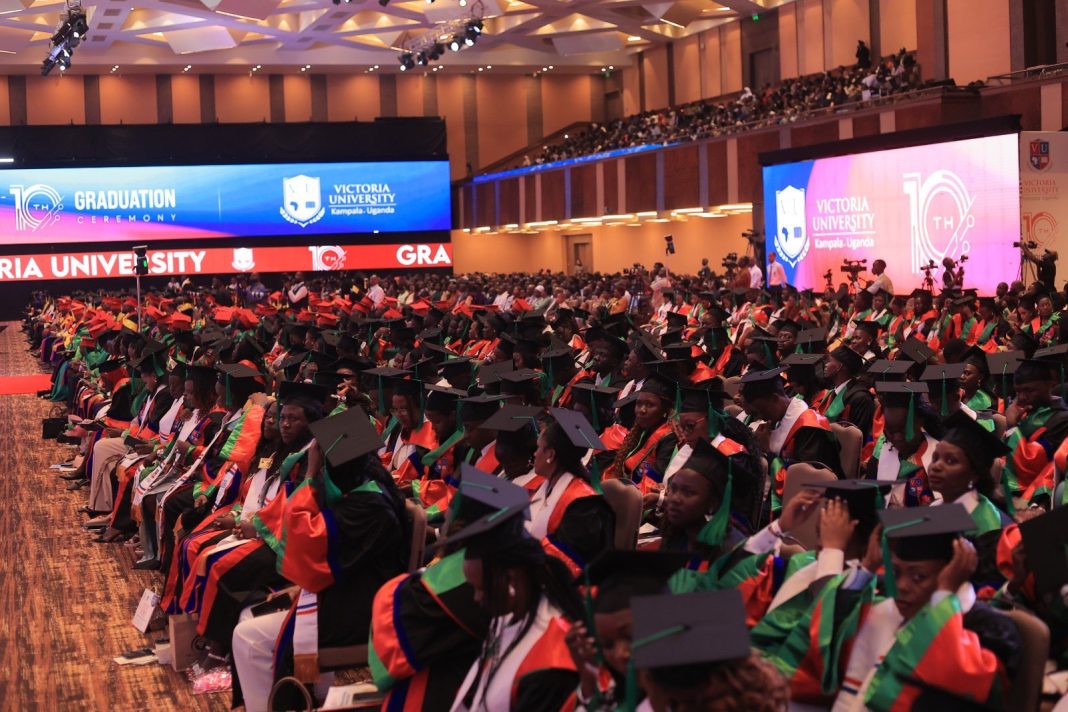
Victoria University has graduated about 2,600 students, with Vice Chancellor Dr. Lawrence Muganga urging the government to equip learners with laptops to prepare Uganda for an economy increasingly shaped by artificial intelligence (AI).
Muganga appealed on Monday, October 19, 2026, during the university’s 10th graduation ceremony at Speke Resort Munyonyo in Kampala, where he argued that access to digital technology must become a priority if Uganda is to improve productivity, create jobs, and compete in the global economy.

Speaking through the university’s Chancellor, Muganga called for a nationwide “One Laptop Per Child” policy covering learners from Primary Five through university, including those enrolled in technical and vocational education and training institutions.
“Uganda is our ship. Africa is our ship. It has struck an iceberg. And the iceberg has a name. Artificial Intelligence,” Muganga said.
He warned that countries that fail to adapt to the technology risk being left behind.

He said the rapid development of AI was changing how people study, work, and conduct business, making digital skills essential for young people entering the labour market.
Muganga linked the proposal to the government’s Tenfold Growth Strategy, which seeks to expand Uganda’s economy to $500 billion by 2040, arguing that the ambition would require a substantial improvement in the productivity of workers across different sectors.
“There is only one way to grow 10 times. Every Ugandan must become 10 times more productive,” he said.
He also urged the government, parents, educational institutions and employers to work together to prepare young people for the changing world of work.
He proposed using solar-powered laptops in communities with unreliable electricity supplies and satellite internet to extend connectivity to underserved areas, saying technological access should not be limited by a learner’s geographical location.
“This is not a dream. This is a decision,” Muganga said.
He challenged policymakers to translate Uganda’s digital transformation ambitions into practical measures that benefit learners.
The call places digital access at the centre of a wider debate about how Uganda can equip its growing population with skills needed in an economy where automation and AI are changing traditional employment opportunities.
Muganga’s proposal is not new. In March 2026, he publicly urged President Yoweri Museveni to embrace the One Laptop Per Child policy as part of efforts to achieve the country’s $500 billion economic ambition. His latest appeal at the graduation ceremony renewed the call for technology to become a more central component of education policy.
Beyond digital access, the Vice Chancellor used the ceremony to highlight Victoria University’s growth and its emphasis on preparing students for employment.
He said the institution had expanded from approximately 180 students in 2020 to about 16,000, while its graduating class had grown from 48 students at his first graduation ceremony in 2021 to approximately 2,600 at the 10th ceremony.
According to Muganga, 89 per cent of the graduating students were leaving the university with jobs or placements, up from 87.2 per cent the previous year.
The figures point to the institution’s stated focus on employability, although the university’s reported employment and placement rates were not accompanied by independently verified supporting data in the information available for this report.
Muganga also said 53 per cent of the graduates had studied science-related disciplines, describing the proportion as evidence of the university’s efforts to respond to demand for technical and scientific skills.
He nevertheless emphasised that graduates in the arts and humanities remained important to national development, arguing that economic transformation requires a combination of scientific, technical, creative and social skills.
Artificial intelligence was another central theme of the ceremony, with Muganga saying the university had integrated AI into its programmes, including law, business, nursing and hospitality.
“Not ready to pass. Ready to live,” he said, stressing that education should prepare students to address real-world challenges rather than focus exclusively on passing examinations.
The university’s approach reflects its stated emphasis on experiential and work-integrated learning, through which students are expected to combine classroom instruction with practical workplace experience.
Victoria University’s official academic information lists programmes in science and technology, business and management, health sciences, law, humanities and social sciences. Its offerings include a Bachelor of Science in Artificial Intelligence and Data Science, a programme designed to develop skills in data analysis, machine learning, intelligent systems and responsible AI use.
The university was established in Kampala in August 2013 and received its charter in August 2022, according to its official website. It operates from Victoria Towers on Jinja Road and promotes practical learning as a central part of its education model.
Muganga also announced plans for further infrastructure expansion, saying construction of a new campus in Naguru, Kampala, would begin in January 2027. The proposed development is expected to include a teaching hospital to support the university’s medical school and expand its capacity to train health professionals.
The Naguru project follows the university’s earlier unveiling of architectural designs for the planned facility near Phaneroo. The development is intended to provide additional academic space as the institution expands its programmes and student population.
The graduation ceremony brought together university officials, representatives of the business community, parents, and students to mark the institution’s 10th graduation milestone.
Muganga’s address placed the focus beyond the number of graduates receiving qualifications, calling for changes in how Uganda prepares learners for a future in which digital competence, practical skills and the ability to work with emerging technologies are increasingly important.
His proposed laptop policy, however, would require decisions on funding, device procurement, internet access, maintenance, teacher training, and the long-term support needed to ensure that learners can use the technology effectively.
The challenge for Uganda, therefore, is not only to expand access to digital devices but also to ensure that schools and training institutions have the infrastructure and teaching capacity to turn that access into measurable learning and employment outcomes.