Stanbic Bank
Stanbic Bank
19.1 C
Kampala
Stanbic Bank
Stanbic Bank
Home Blog Page 1304

UNBS launches celebrations to mark 30 years of service

Trade Minister Amelia Kyambadde

The Uganda National Bureau of Standards (UNBS) has launched celebrations to mark 30years of service with a blood donation drive in partnership with Uganda Blood Transfusion Services to cater for the increasing demand for blood among health centres across the country.

Speaking at the function as the Chief Guest, the Minister of Trade Industry and Cooperatives, Amelia Kyambadde, commended UNBS for the initiative to address the increasing demand for blood in hospitals. “Our hospitals are in constant need of blood and I want to thank you for undertaking such an activity as part of your corporate social responsibility,” Kyambadde said.

Kyambadde also commended UNBS for introducing the Use of Distinctive Mark Regulation 2018 which makes it mandatory for goods covered by compulsory standards to be certified before they are allowed on the market.

“This regulation will go a long way in improving the competitiveness of locally manufactured products. It is in line with the policy target of certifying 75 per cent of locally manufactured products,” she said.

The Executive Director, UNBS, Dr. Ben Manyindo highlighted key achievements of UNBS over the 30 years. Dr Manyindo noted that UNBS started by offering limited services but it has since transformed into fully fledged standardization body offering a full range of services including standards development, product and management systems certification, product testing, calibration of equipment, verification of measuring equipment, imports inspection, and market surveillance, among others.

“In 1994 UNBS developed the first Uganda Standard US 201:1994 portable drinking water; to-date we have developed 3,621 standards which have contributed to government efforts to promote locally manufactured products under the Buy Uganda, Build Uganda (BUBU) policy,” Dr. Manyindo said.

He noted that UNBS laboratory testing at UNBS has grown from carrying out relatively simple tests like PH, moisture content and product dimensions, to offering complicated tests such as pesticide residue analysis of foods and detection and quantification of veterinary drug residues in foods of animal origin and detection and quantification of pathogenic (disease causing) microorganisms in food and non-food products.

Dr. Manyindo added that the UNBS labs are now internationally accredited which means their results are recognized globally. “Our labs now act as centers of excellence in training other laboratory practitioners from industry and other government institutions both from Uganda, the EAC region, and many African countries,” Dr. Manyindo added.

He said UNBS has also decentralized its services to regional offices in Gulu, Mbale and Mbarara to increase access of its services upcountry. UNBS also has offices Lira, Katwe, Jinja that focus on weights and measures.

Dr. Manyindo noted that UNBS has automated most of its services to improve efficiency and accessibility. “All our electronic services can be accessed on the UNBS mobile app and website,” he said.

Stories Continues after ad

Fresh Kid nominated in America’s Music Video Awards

Fresh Kid

Uganda’s youngest rapper Patrick Ssenyonjo commonly known by his stage name ‘Fresh Kid’ has been nominated in the 2019 Carolina Music Video Awards.

The seven-year old rapper earned his nomination in the category of the best video for the month of April 2019.

His song entitled ‘Bambi’ that displayed the ghetto livelihood in its video helped him get the nod.

Other Ugandans that got a nomination include Feffe Bussi for his song ‘Yes, No’, Lydia Jazmine for ‘You & Me’, and Ykee Benda for ‘Singa’.

The goal of the “Carolina Music Video Awards” is aimed at offering worldwide recognition to artists who deserve to be honored for not only their creative works but also as hardworking individuals who excel in debuting their talents through visual performance and media.

The awards are slated to happen on July 20th 2019 at the NASCAR Hall of Fame High Octane Theater in Charlotte, North Carolina.

Stories Continues after ad

Five great Champions League comebacks

Liverpool pulled off one of the most stunning fightbacks in Champions League history on Tuesday as Divock Origi and Georginio Wijnaldum both scored twice in a 4-0 victory over Barcelona.

Having trailed 3-0 after last week’s first leg at the Camp Nou, Origi’s 79th-minute strike sent Jurgen Klopp’s men into the final in Madrid on June 1.

Here, AFP Sport looks at five other famous Champions League comebacks:

Barcelona stun PSG

Last 16, 2016/17

First leg: Paris Saint-Germain 4 (Di Maria 18, 55 Draxler 40, Cavani 72) Barcelona 0

Return leg: Barcelona 6 (Suarez 3, Kurzawa 40-og, Messi 50-pen, Neymar 88, 90+1-pen, Roberto 90+5) Paris Saint-Germain 1 (Cavani 62)

Barcelona won 6-5 on aggregate

Barcelona were on the right side of history two years ago, becoming the first team to come back from a four-goal first-leg deficit in the Champions League on a dramatic night at the Camp Nou when Neymar punished his future side PSG with two goals.

If PSG’s demolition of Luis Enrique’s Barcelona in Paris was a shock, the fightback was mind-blowing with the crucial last two goals coming in stoppage time.

Sergi Roberto came off the bench to write himself into Spanish football folklore with Barcelona’s sixth goal in the fifth minute of added time.

“I didn’t know if I was dreaming –- I have never known a noise like that,” said a shell-shocked Roberto after the final whistle.

Barca’s luck runs out in Rome

Quarter-finals, 2017/18

First leg: Barcelona 4 (De Rossi 38-og, Manolas 55-og, Pique 59, Suarez 87) Roma 1 (Dzeko 80)

Second leg: Roma 3 (Dzeko 6, De Rossi 58-pen, Manolas 82) Barcelona 0

4-4 on aggregate; Roma won on away goals

Barcelona’s luck ran out in dramatic style 12 months after their PSG heroics with Edin Dzeko’s away goal at the Camp Nou proving crucial.

The Bosnia striker struggled to express his joy at Roma’s achievement after his sixth-minute goal in the return game sparked an incredible turnaround by the Italians.

“We did it when definitely nobody believed in us,” said Dzeko.

There appeared to be no way back for Roma after they were routed in Barcelona.

However, after Dzeko’s early goal, a Daniele De Rossi penalty set the scene for Kostas Manolas’s 82nd-minute header to spark wild celebrations led by Roma president James Pallotta, who jumped into Rome’s Piazza del Popolo fountain.

Liverpool’s night in Istanbul

Final, 2004/05

Liverpool 3 (Gerrard 54, Smicer 56, Alonso 60-pen) AC Milan 3 (Maldini 1, Crespo 39, 44)

3-3 after extra time; Liverpool won 3-1 on penalties

Liverpool are no strangers to fightbacks in Europe, producing arguably the most staggering in a final against a mighty AC Milan side in Istanbul 14 years ago.

They trailed 3-0 at half-time against the star-studded Italians after Paolo Maldini scored inside a minute and Hernan Crespo’s excellent double. But talismanic captain Steven Gerrard gave his side hope with a header early in the second period, and substitute Vladimir Smicer drilled in two minutes later.

A breathtaking six-minute spell was completed on the hour mark as Xabi Alonso scored the rebound after his own penalty had been saved by Milan goalkeeper Dida.

Rafael Benitez’s underdogs hung on to force a penalty shootout, and Andriy Shevchenko, who had scored the winning spot-kick in the 2003 final against Juventus, saw his effort saved by Jerzy Dudek to confirm Liverpool’s fifth, and most recent, Champions League title.

Irureta’s miracle

Quarter-finals, 2003/04

First leg: AC Milan 4 (Kaka 45, 49, Shevchenko 46, Pirlo 53) Deportivo La Coruna 1 (Pandiani 11)

Second leg: Deportivo La Coruna 4 (Pandiani 5, Valeron 35, Luque 44, Fran 76) AC Milan 0

Deportivo won 5-4 on aggregate

After his side were trounced 4-1 at the San Siro, Deportivo coach Javier Irureta admitted there was no rational reason to believe in a miracle.

However, his side burst out of the blocks in the second leg, holding a 3-0 lead at half-time thanks to goals from Walter Pandiani, Juan Carlos Valeron and Albert Luque.

Substitute Fran Gonzalez added a fourth with 14 minutes to go and, having prayed for success, Irureta honoured his pre-match promise by taking the pilgrim trail to Santiago de Compostela after Deportivo’s unlikely victory.

Di Matteo orchestrates Chelsea escape

Last 16, 2011/12

First leg: Napoli 3 (Lavezzi 38, 65, Cavani 45+2) Chelsea 1 (Mata 27)

Second leg: Chelsea 4 (Drogba 28, Terry 47, Lampard 75-pen, Ivanovic 105) Napoli 1 (Inler 55) – after extra time

Chelsea won 5-4 on aggregate

Chelsea rode the momentum of a stirring last-16 comeback against Napoli to the club’s maiden Champions League title under interim coach Roberto Di Matteo.

Trailing 3-1 from the first leg after two Ezequiel Lavezzi goals and an Edinson Cavani strike, Chelsea sacked Andre Villas-Boas ahead of the return leg. The Blues roared back at Stamford Bridge through efforts from Didier Drogba and John Terry, before Gokhan Inler briefly put the Italians back on top only for a Frank Lampard penalty to force extra time.

Drogba then teed up Branislav Ivanovic to blast home a 105th-minute winner, and Chelsea would go on to beat Bayern Munich on penalties in that season’s final at the Allianz Arena.

Stories Continues after ad

Total to control Tilenga oil project

Tilenga Project logo

French oil major Total’s chief executive Patrick Pouyanné revealed his company’s plans to accelerate development of the company’s Tilenga project in Buliisa and Nwoya districts.

Mr Pouyanné made the announcement during an earnings call in Paris,according to reports from TND NEWS

The Tilenga project lies at the northern end of Lake Albert in Nwoya district, and is part of Exploration Area 2 in Buliisa district. Tilenga includes eight oil fields, and will feature about 419 oil wells at full production.

The project was expected to be sanctioned in 2018 but “has been delayed due to disagreements over field development strategy, tax disputes and a lack of infrastructure such as a refinery or export pipeline,” Reuters said.

“It is a difficult project because it is landlocked. It is a new country to oil, we have to create everything,” according to Mr Pouyanné.

He added that agreements had been reached on the refinery and pipeline while engineering on the project is also complete.

Stories Continues after ad

Tariffs Fall as Kenya and Uganda shares power

Isimba dam

Kenya and Uganda have signed a new power purchase agreement (PPA) that facilitates bilateral power trade and takes into account new dynamics in the energy sector, including increased generation capacity.

The agreement, which is designed to facilitate two-way electricity imports and exports between the two countries, marks the end of the previous pact that only focused on Kenya’s imports from Uganda, and limited supply to emergency situations.

The signing of the PPA last month was necessitated by investments by both countries in electricity generation facilities resulting in excess capacity, a development that has prompted a downward revision of tariffs.

“The new PPA that has been negotiated with Uganda is good for Kenya because the tariffs have come down drastically,” Jared Othieno, the acting Managing Director of Kenya Power, told Eagle Online.

He added that under the new agreement, Kenya intends to import a maximum of 50MW from Uganda annually.

POWER SHARING

The agreement was signed by Kenya’s Energy and Petroleum Regulatory Authority and Uganda’s Electricity Regulatory Authority (ERA).

ERA Chief Executive Ziria Wako said the two countries still had the old agreements for sharing power when the Nalubaale Dam was commissioned in 1954.

“One of the conditions was that we share the surplus within the region, but first with Kenya. The limitation to emergency situations was because of power supply constraints at that time,” Ms Wako said . A transmission line from Tororo in Uganda connects to Kenya, which enables bulk power transmission.

The Nalubaale dam was built by the colonial government to generate electricity for Uganda’s growing industry and for domestic use, but with limited export volumes.

Under the old regime, Uganda has imported electricity to Kenya, more during dry seasons and less when the country experiences good rainfall.

In recent years Kenya has invested in other energy sources, particularly geothermal and wind, to stabilise generation. The current installed capacity is 2,711MW, against a demand of 1,640MW. Geothermal has become the leading contributor of electricity, accounting for 47 per cent of the total generation, followed by hydro and thermal plants at 30 per cent and 20.6 per cent respectively.

Uganda also has excess capacity after the commissioning of the 183MW Isimba hydropower dam, pushing its power generation capacity to 1,179MW, way above its peak demand of 656MW.

The regional excess capacity has seen Kenya reduce its imports, with distributor Kenya Power’s financial results for the year ending June 2018 showing a $35.1 million bill from Uganda Electricity Transmission Company Ltd in 2017/18 down from $37.1 million in the previous financial year. During the period, the company purchased 168GWh from Uganda, a decrease from 180GWh the previous year.

SUPPLY

Kenya paid $0.20 per unit of electricity imported from Uganda. Although both Kenyan and Ugandan officials declined to state the tariffs agreed in the new agreement, sources told The EastAfrican that the new tariffs will average $0.15, excluding forex fluctuation.

Uganda’s installed capacity is expected to rise to 2,000MW by 2020, when projects like the 600MW Karuma hydropower plant and the 800MW Ayago along the River Nile are connected to the grid. The country’s target is to achieve a generation capacity of 4,000MW.

“Power supply security is very good for this country. Isimba and Karuma are not enough. We need a lot of generation capacity to be able to extend power to all Ugandans and to fuel large industries and our neighbours under the regional interconnection project,” said Ms Wako.

The expected decline in electricity earnings from Kenya could force Uganda to explore the possibilities of increasing exports to Tanzania, where current exports stand at 14MW. With an installed capacity of 1,513 MW, Tanzania has a deficit of 485MW. Uganda’s exports to Tanzania are however, being curtailed by the lack of a high-voltage interconnector.

Ms Wako said that Uganda is also in talks to supply 45MW to Rwanda, which has a deficit of 13MW.

Negotiations to supply power to the neighbours are part of Uganda’s strategy to meet regional requirements for interconnectivity. Due to differences in natural endowment in power generation resources, the connectivity is intended to mutually benefit countries. For example, during prolonged droughts that affect hydro sources, geothermal or solar generators can transmit power with countrie

Stories Continues after ad

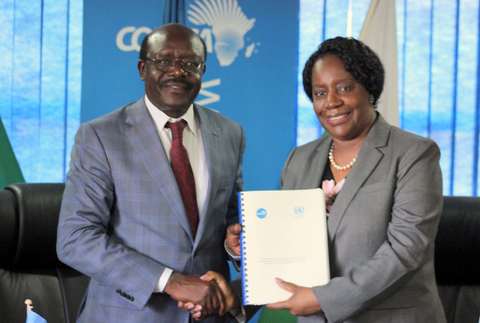
UN and African Union in common battle for development and climate change financing

Mozambique floods are some of the negative climate changes.

UN Secretary General, Antonio Guterres has declared that the Organization, will work to promote peace and security, human rights, development and climate action, can only progress in Africa

The UN chief emphasized the alignment between the UN’s and African Union’s respective plans to ramp up inclusive and environmentally responsible economic development: the UN’s 2030 Agenda for Sustainable Development, and the African Union’s Agenda 2063.

“The common battle they face, is to secure necessary financing for development, particularly for Africa.” Mr. Guterres said adding that the fundamental precondition for a more peaceful world and for well-managed migration that improved funding in the interests of the whole international community.

He warned that more ambition is needed, because they are not winning the battle and Africa is disproportionately affected: “the African continent practically does not contribute to climate change, but the African continent is one of the areas of the world where the impact of climate change is more dramatic and devastating.”

African Union welcomed the strong cooperation and collaboration between the two organizations and committed to continue working together in addressing peace and security issues and achieving sustainable development issues in Africa.

UN is scheduled to hold Climate Action Summit that will take place in September aimed at mobilize the needed partnerships, resources to achieve international climate action goals.

Stories Continues after ad

UCC insists 35 journalists must step aside for 30 days

Eng. Mutabazi

Uganda Communications Commission (UCC) and National Association of Broadcasters (NAB) have resolved that 39 journalists should step aside for 30 days to allow the Commission conduct its investigations in regard to alleged breaching of minimum broadcasting standards.

Early this month, UCC directed for suspension of Producers, head of news and head of programmes in various broadcasting stations; Akaboozi FM, BBS TV, Beat FM, Bukedde TV, Capital FM, CBS FM, Kingdom TV, NBS TV, NTV, Pearl FM, Salt TV, Sapientia FM and Simba FM.

According to Executive Director of UCC, Godfrey Mutabazi, investigations will reveal whether the contested journalist acted below broadcasting standards.

“We don’t care whether journalists are put in other position as long as they step aside from the current position to allow for investigations to take place,” he said after the meeting.

“The commission has previously engaged and warned broadcasters over similar complaints, but it is now apparent that they have refused and or ignored these warnings.”

He said media houses Misrepresents information, views, facts and events in a manner likely to mislead or cause alarm to the public and extremist or anarchic messages, including incitement of violence for political and/or other purposes.

He said air programs that Incites the public against other members of the public based on their political, religious, cultural and tribal affiliations which are likely to create public insecurity or violence.

He implored them to air documentaries and other developmental programs other than hate speeches of opposition leaders in the country.

The concern of Ugandan government is the manner in which independent Television channels and radio stations cover live news in which opposition politicians or people with divergent views are given undue prominence.

The 39 journalists are accused of airing live videos and sound bites as police arrested Kyadondo East MP, Robert Kyagulanyi aka Bobi Wine on April 29, at Kalerwe market as he proceeded to Kibuli Police Criminal Investigation Department (CID) where he was summoned over allegations of breaching of police guidelines and traffic rules.

Stories Continues after ad

Cabinet approves creation of Terego district

Minister Jennifer Namuyangu

Minister of State for Local Government, Jennifer Namuyangu, has said the ministry is set to move a motion seeking the approval of Parliament to create the new Terego District out of Arua District.

This is after Cabinet approved the creation of Terego District comprising of two counties of Terego East and west. The people of Terego requested for District status in accordance with Article 179 of the Constitution of the Republic of Uganda and their request was endorsed by Arua District Council.

Currently Uganda has 127 districts with Kampala as it’s the capital city.

Remarking in Kampala, the Namuyangu said the proposed new district of Terego is located in the Northern part of the current Arua district and once approved by parliament, it will take effect from July 1, 2020.

“It has a total of 67 government aided primary schools, with a total enrollment of 68,845 pupils, six government aided Secondary Schools with a total enrollment of 2,067 and one Technical Institute. It has one hospital, one Health Centre IV, eight Health Centre IIIs and Ten Health Centre II’s. Such a stock of social service delivery facilitates is significant.” She said.

The proposed location of Terego District headquarters is Leju Trading Center, in Ayivu sub-county, which is approximately 27 Kilometers away from Arua district headquarters.

She said agriculture is the main economic activity in the proposed Terego District, with the main cash crops being tobacco and maize, while the food crops include cassava, sorghum, beans, groundnuts and sweet potatoes.

Stories Continues after ad

Bobi Wine unveils Joel Ssenyonyi as spokesperson for People Power

Joel Ssenyonyi being unveiled

Kyadondo East Member of Parliament, Robert Kyagulanyi aka Bobi Wine, has unveiled former NTV journalist, Joel Ssenyonyi as the spokesperson for People power, a political pressure group that was formed to converse support against the incumbent, president Yoweri Museveni.

Ssenyonyi who recently quit his NTV Uganda job, first appeared in protest against exercise duty tax that was on social media platforms such as WhatsApp, Twitter, Facebook, You Tube, Viber and Skype among others that were subjected to a daily levy of Shs200 as mobile money transactions were been subjected to a 0.5 per cent excise duty.

He started criticizing government programs, firing hard questions to government officials whenever he had a chance at various NTV programs especially Morning at NTV and interviews during news bulletins.

Speaking at a press briefing, Bobi Wine, said there was a need and urgency to communicate with a unified voice on a number of issues that goes around People Power.

“I have the pleasure to unveil our spokesperson chosen after engagement and consultation with all our allies. A gentleman that has impeccable character, a gentleman that comes from the line of professionals, join me to welcome Joel Ssenyonyi.” said Mr. Kyagulanyi.

During his turn, Ssenyonyi revealed that he has decided to join the forces interested in having a better country and he will actively work towards achieving it.

“I was in born in December in 1986 after president Museveni had assumed power. He was a hero and my parents wanted to name after this Yoweri however, they thought better and named me Joel, the English version of it. But after sometime the hero become a shadow of his former .” He said.

Adding “That is the struggle that I have decided to get involved in. I am not naive but hope that the country is going to get better. It is going to get better as we wish, by only tweeting, posting on face book. That is a good start but it is better to wake up as citizens and ask ourselves, what more can we do for a better country.” He said.

Stories Continues after ad

UPL rewards Juma Balinya and James Alitho

Juma Balinya receives his award

Uganda Police Football Club midfielder Juma Balinya and URA FC goalkeeper James Alitho were rewarded on Monday for finishing as the 2018/19 Uganda Premier League season’s top scorer and goalkeeper with the most clean sheets respectively.

Balinya ended the season with 19 league goals and received a golden boot while Alitho got the golden glove accolade for keeping 15 clean sheets nad conceding only 13 goals this season for the Tax Collectors.

On top of the accolades they received, they were topped up with one million Ugandan shillings each.

James Alitho receives reward

The prizes were represented to the players by the Uganda Premier League Chief Executive Officer Bernard Bainamani at Namboole stadium two days after the season ended.

Balinya’s goals helped Police FC finish in the 11th position with 37 points while Alitho’s heroics helped URA finish 3rd position with 51 points.

KCCA were crowned the champions of the season finishing top of the 16-ta

Stories Continues after ad