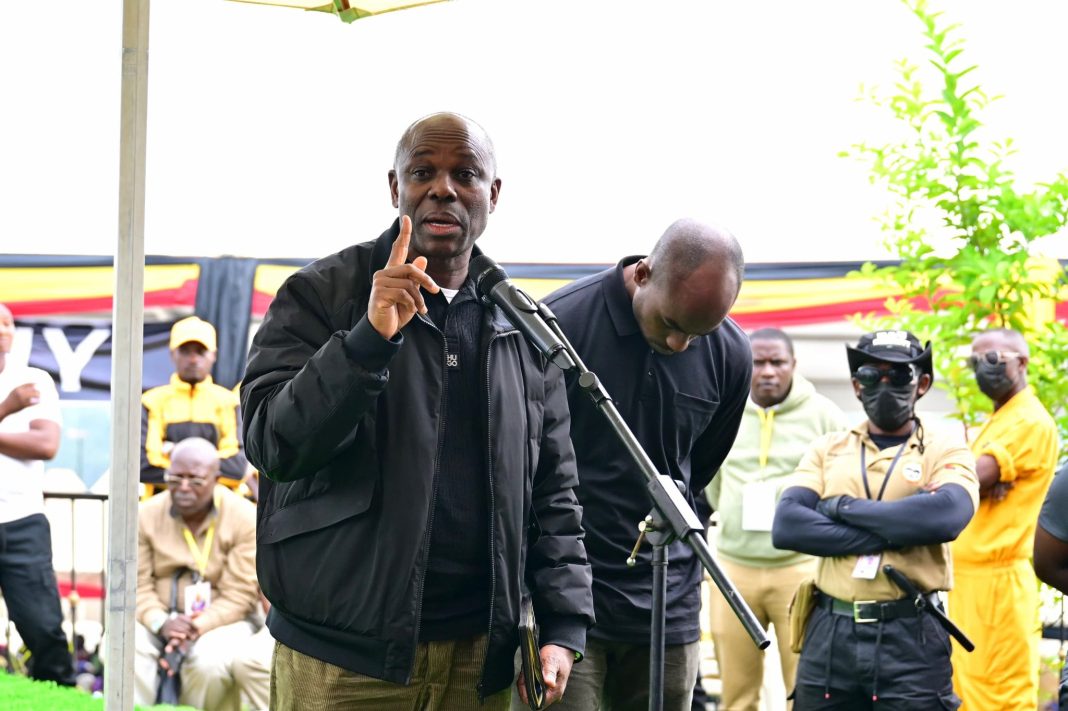
Businessman Hassan Basajjabalaba has urged the government to urgently prioritize the establishment of a national medical insurance scheme, saying the absence of such a system continues to expose Ugandans, especially the poor, to unbearable medical costs and preventable deaths.
He made the call on Saturday, November 16, during the burial of his mother, Hajjat Azida Basajjabalaba, who was laid to rest at the family home in Ishaka–Bushenyi. Amid grief, Basajjabalaba recounted the painful journey the family endured as they tried to save their mother, who battled a complicated heart condition.

In his testimony, he narrated the desperate attempt he made to secure a heart transplant abroad.
“I asked Ambassador Mubiru, can’t you use your office, and I get a heart for this old woman? I wanted him to talk to the government so that I could get the heart,” he said.
He revealed that Ambassador Mubiru later received an emergency call from Kampala and could not advance the matter, while the medical authorities abroad refused to bend any rules.

He recalled, “The commission said it is unethical to smuggle a heart and that we could be arrested for that. Having failed to secure the heart, we gave up, and I sought ways of saving the life of my mother.”
Basajjabalaba said the cost of his mother’s medical care was overwhelming, even for a wealthy family like his.
He disclosed that he spent a minimum of €20,000 (about Shs1 billion) per trip, an amount he said is beyond the reach of an ordinary Ugandan.
“We went to Germany more than ten times, the UK five times, and South Africa five times,” he said, describing the emotional, physical and financial strain his family endured.
He appealed to Parliament and the government to fast-track the national health insurance scheme, saying Ugandans deserve a system that cushions them from catastrophic medical bills.
“I request Deputy Speaker Thomas Tayebwa to tell President Museveni to sign the medical insurance. In Germany, if one falls sick and insurance helps a lot. Instead of striking for political reasons, let’s strike for medical insurance. If my mother had insurance, I would have paid only 40% of the money,” he said.
He cited several regional examples to show the urgency and importance of universal medical insurance.
“In Tanzania, a person above 70 years is treated for free, and a child under five is also treated for free. A woman giving birth receives free medical care,” he said.
Basajjabalaba also noted that the cost of modern medical equipment makes it impossible for hospitals to rely on patient fees alone.
“For instance, the only PET scan in East Africa is at Aga Khan Hospital. It costs $9 million, and no one will pay that money without assurance of recovering it,” he added.
He emphasized that even in neighbouring countries, private hospitals outperform public ones because of limitations in government healthcare systems.
He said, “Even if you go to Kenya or Tanzania, the best hospitals are private. You cannot expect government hospitals to be the best because the process of equipping and supervising them is long and most doctors are always absent.”
Basajjabalaba proposed a bold financing model in which government acquires partial ownership of mission hospitals to subsidize services.
“I propose that since we have Nsambya, Mengo, and Kibuli hospitals, the government should invest 30% of the national budget, about Shs1 trillion, and get ownership so that people are treated at a subsidized cost,” he said.
He cited Kenya’s example, where the government bought 49% of Nairobi Hospital, resulting in more affordable healthcare for citizens.
“These cancer institutes being built won’t work,” he warned, arguing that without an insurance system and proper investment model, many specialized health projects will fail to serve their intended purpose.
Reflecting on his final attempt to save his mother, Basajjabalaba described the heartbreaking moment when he was ready to spend an extraordinary amount of money to secure a heart transplant.
He recounted, “I even walked with $2 million, and I could double it to $4 million to get a heart for my mother. The professor looked at me and asked, Are you sure you can pay $2 million for the 86-year-old woman? I said yes. If it’s not allowed here, we take her to Germany.”
However, the German commission blocked the transplant due to age restrictions.
He added, “The professor told me a person of 80 years cannot be given a heart. And at that time, my mother could not fly to another place.”
Basajjabalaba said this painful experience should compel the country to rethink its health system so that no Ugandan rich or poor has to go through such anguish again.