The First Lady Janet Kataaha Museveni, who also serves as the Minister of Education and Sports, is expected to officially commission the newly constructed Uganda Vocational and Technical Assessment Board (UVTAB) National Skills Assessment Centre tomorrow, marking a milestone in Uganda’s technical and vocational education and training (TVET) reforms.
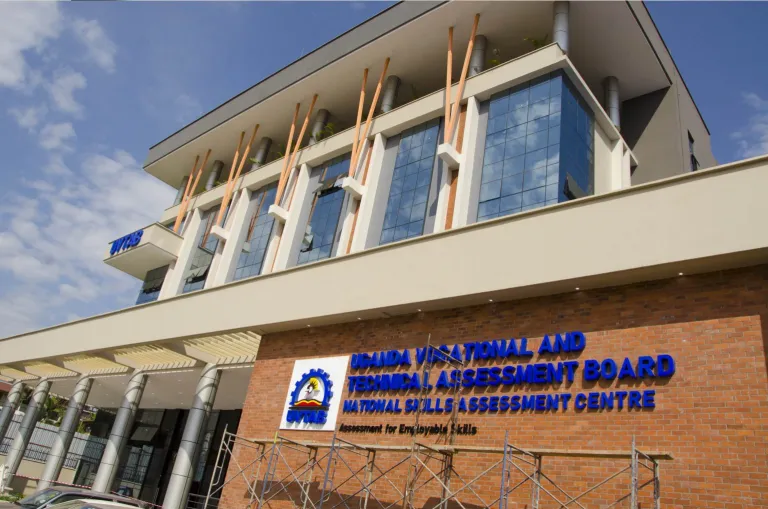
Located on Kyambogo Hill in Kampala, the eight-storey complex has been purpose-built as a national hub for skills assessment, bringing together all UVTAB operations that had been scattered across rented premises for years.

Education sector officials say the consolidation is expected to significantly enhance coordination, operational efficiency, and the quality of services offered to candidates and training institutions nationwide.
Constructed in a record three years, the Shs25.6 billion facility broke ground on March 23, 2022, and was completed on February 21, 2025, with full funding from the Government of Uganda.
The development comes at a time when the country is repositioning TVET as a central pillar for skilling youth and meeting labour market demands. UVTAB’s printery services, however, will continue to operate separately at Namanve Industrial Park, according to project managers.

UVTAB Executive Secretary Onesmus Oyesigye described the new centre as a turning point for national skills assessment, noting that housing all assessment services under one roof will result in faster turnaround times and improved service delivery.
“With the completion of this Assessment Centre, UVTAB is expected to save at least Shs189.8 million annually in rental costs,” Oyesigye said, adding that the savings will be redirected toward improving assessment quality and expanding access.
The commissioning coincides with the early implementation of the TVET Act, No. 3 of 2025, under which UVTAB has already assessed 275,963 candidates since national assessments commenced on March 15, 2025.
Officials say the growing numbers underscore both the rising demand for certified skills and the pressure that previously overstretched, decentralised facilities placed on the Board.
Architecturally, the complex comprises a main block and a three-storey Short Tower, together offering 6,499.6 square metres of floor space.
The building houses a state-of-the-art auditorium, two boardrooms, several mini meeting rooms, and dedicated innovation and incubation hubs designed to support skills development, assessment research, and collaboration with training institutions.
Staff welfare was also prioritised in the design. A crèche on the ground floor caters to breastfeeding staff, while the sixth-floor building features wellness facilities, including a gym and sauna. The centre provides parking for 60 vehicles and is equipped with advanced ICT and security systems, including access control, lifts, fire detection and suppression systems, UPS power backup, air conditioning, and a public address system to support large-scale assessments and events.
The building’s central atrium allows for natural lighting and ventilation—a design choice aimed at reducing dependence on mechanical cooling and lowering long-term operational costs. Sector experts say such features reflect a growing emphasis on sustainability in public infrastructure.
The project was executed by Seyani Brothers & Co. (U) Ltd, with architectural and engineering oversight provided by Cornerstone Design and Engineering Ltd. With the commissioning of the centre, UVTAB’s full relocation to Kyambogo Hill is complete, a development officials describe as a foundational step in strengthening Uganda’s national skills assessment framework and restoring public confidence in vocational certification systems.