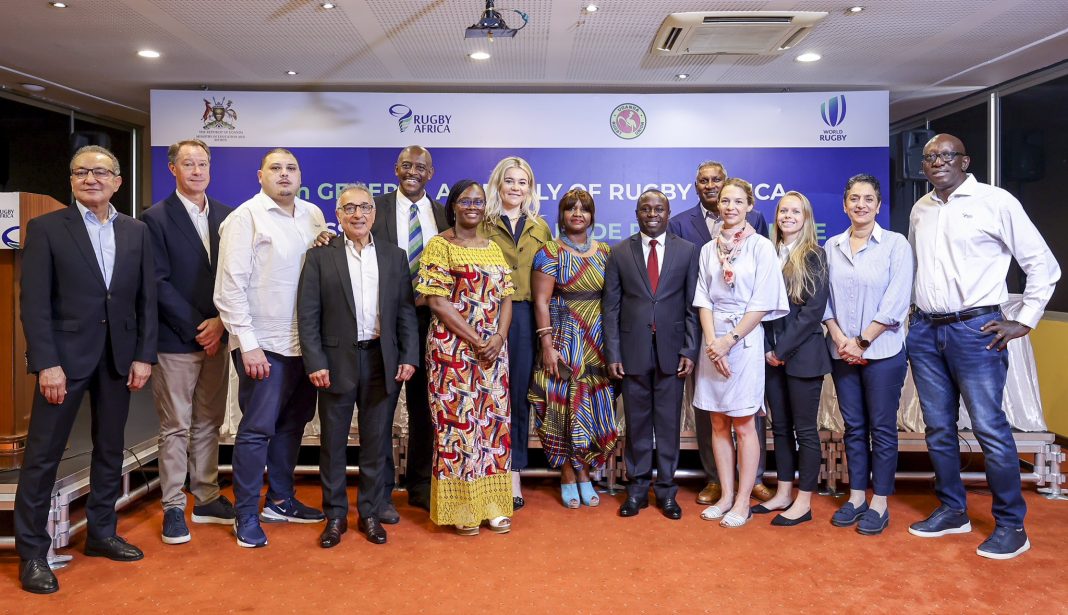
Kabira Country Club today opened its doors to Africa’s top rugby leaders as the 17th Annual General Meeting of Rugby Africa officially got underway in the Ugandan capital.
The three day high level assembly, held in collaboration with Uganda’s Ministry of Education and Sports and the Uganda Rugby Union, has drawn senior decision makers from 32 national unions for what is expected to shape the future governance and strategic direction of the sport across the continent.

Presidents, executive members and official delegates convened in Kampala to review the organisation’s progress, exercise their voting rights and deliberate on major constitutional reforms aimed at strengthening leadership and accountability structures.
Among those in attendance are Rugby Africa President and World Rugby Executive Board Member Herbert Mensah, Vice President Nasser Bougja, and senior representatives from World Rugby, including Director of International Relations, Investment and Member Services Clare Barrell and Regional Partnerships Manager for Africa Coralie Van Den Berg. Rugby Africa General Manager Maha Zaoui, General Secretary Jurie Roux and Uganda Rugby Union President Godwin Kayangwe are also participating in the proceedings.
Addressing delegates at the opening session, Herbert Mensah underscored the urgency of reform.

“We are in Kampala with a clear objective, to modernise our structures and strengthen the foundations of African rugby. Governance sits at the heart of everything we do, and good governance is not optional, it is essential,” Mensah said.
At the centre of the meeting are proposed amendments to Rugby Africa’s Constitution, the organisation’s supreme governing document that defines how decisions are made, how leaders are elected and how accountability is maintained. Delegates are expected to debate and vote on reforms designed to reinforce governance systems, enhance gender representation in leadership and align the body with international best practice.
“These proposed reforms are about unity, integrity, gender inclusion and independent expertise, ensuring Rugby Africa is future focused and ready for the next phase of growth. Africa must stand eye to eye with the world. With limited resources we have delivered extraordinary tournaments, and now we must build the structures that allow us to grow sustainably and create opportunity for all 40 Member Unions. The future of African rugby will be shaped by us, together,” Mensah added.
Elections for key positions on the Executive Committee are also on the agenda, including the role of Treasurer and a potential Executive Committee Member seat, in line with constitutional requirements.
World Rugby has expressed strong backing for the reform process.
“World Rugby fully supports Rugby Africa’s ambitious constitutional reform process, a robust and inclusive journey that reflects the continent’s commitment to excellence. These forward looking reforms align with global best practice while celebrating Africa’s identity, strengthening the game and empowering all members to shape a bright future for rugby across the region,” said Coralie Van Den Berg.
Uganda Rugby Union President Godwin Kayangwe said hosting the continental gathering marks a defining moment for the country’s rugby development.
“Hosting the 17th Rugby Africa AGM in Kampala marks a pivotal milestone in Uganda’s rugby journey, showcasing our nation’s growing stature on the continental stage. This event unites African rugby leaders to shape the sport’s future while accelerating our domestic development through investment pathways, talent nurturing and infrastructure growth,” Kayangwe said.
Rugby Africa General Manager Maha Zaoui described the Assembly as a testament to the organisation’s growing institutional strength.
“This Annual General Meeting reflects the maturity and institutional strength Rugby Africa has built in recent years. Our governance reforms, strategic clarity and operational discipline demonstrate that we are not only growing the game but managing it with accountability and vision,” Zaoui noted.
The meeting comes at a time when African rugby continues to gain momentum, driven by a youthful population and expanding grassroots and women’s programmes. The continent’s competitive edge was highlighted in 2023 when South Africa claimed their fourth Rugby World Cup title, becoming the most successful men’s team in the tournament’s history.
Deliberations will continue over the next two days before concluding with an official press conference at Kabira Country Club, where leaders are expected to communicate the key resolutions reached in Kampala.