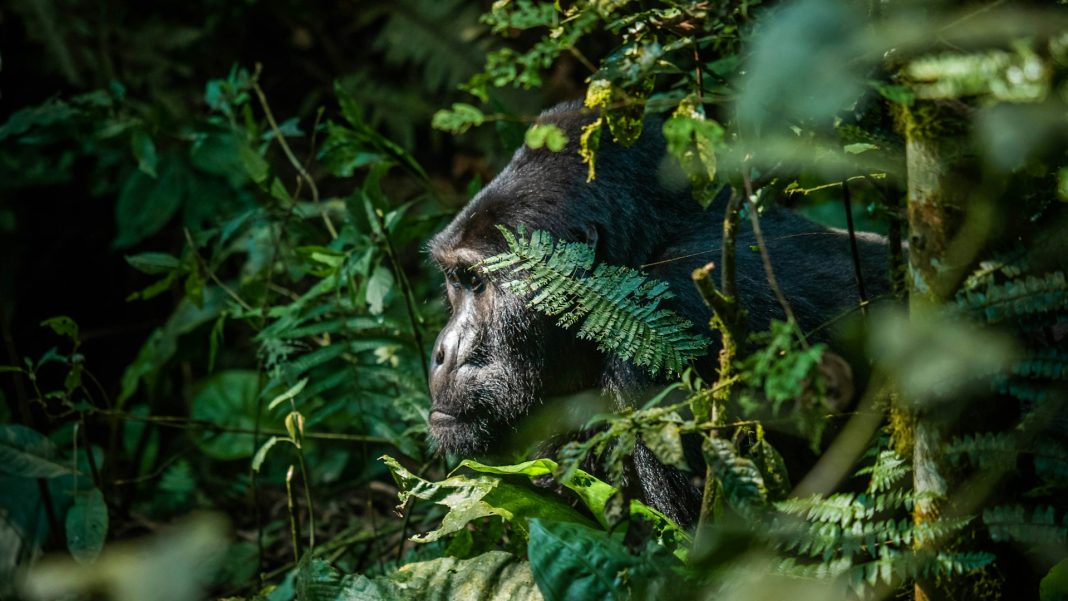
The chimpanzee counting exercise that was carried out in Bwindi Impenetrable National Park last year has confirmed the existence of a total of 426chimpanzees.
The Bwindi Chimpanzee Census Results was launched by Hon. Bahinduka Mugarra Martin, Uganda’s Minister of State for Tourism, Wildlife and Antiquities on 24th February 2026 at the Uganda Wildlife Authority headquarters in Kampala.

This is the first ever Chimpanzee Census in Bwindi Impenetrable National Park, a renownedhome of the endangered mountain gorillas.
The 2025 Census was carried out by the Uganda Wildlife Authority in partnership with the Jane Goodall Institute Uganda (JGI-Uganda) and the Greater Virunga Transboundary Collaboration (GVTC). The census aimed at establishing the size, population density and distribution of chimpanzees in Bwindi.
The results indicate that chimpanzees are widely distributed across all four sectors of Bwindioccupying habitats ranging from mixed Afromontane to higher montane elevation montane forest.

The JGI-Uganda team leader, James Byamukama, says that the census was conducted between May and June 2025. Byamukama says he is optimistic that the census findings offers scientific data that is needed to monitor and manage chimpanzee conservation in Bwindi.
The results will offer the long-standing knowledge gaps and clarify the conservation status of chimpanzees in Bwindi while contributing to the overall national chimpanzee conservation strategy.
“We, therefore, believe that this census will guide conservation planning, protected area management and regional biodiversity strategies while also supporting Uganda’s alignment with international conservation and climate commitments,” he said.
Who Conducted the Census?
The census was carried out by the Jane Goodall Institute (JGI)- Uganda in partnership with the Uganda Wildlife Authority (UWA) and the Greater Virunga Transboundary Collaboration.
Experts moved through the forest between May and September 2025 and census covered 320.9 square kilometres across Bwindi’s four sectors; Buhoma, Ruhija, Nkuringo and Rushaga. The team used the line‑transect nest counts, the same method used in condicting the park’s sixth mountain gorilla census in 2018. They did not just sit and wait for chimpanzees to appear. They tracked nests, feeding remains, sounds, and direct sightings. It was serious scientific work not a guessing game.
Why Is 426 Such a Big Deal?
Numbers may look simple, but they tell powerful stories. In a press statement released at the launch by the Uganda Wildlife Authority, a government parastatal that manages Uganda’s national parks, Bwindi is a global model for great ape conservation in the world. Confirming 426 chimpanzee’s means a lot! The forest habitat is still healthy and conservation efforts are working. In addition to that the future protection plans will be based on real data.
When wildlife authorities know how many animals live in an area, they can plan better patrols, protect key habitats, and involve nearby communities in conservation programs.
Bwindi is already a UNESCO World Heritage Site because of its rich biodiversity. This new chimpanzee data adds even more value to its global importance.
Where Else Can You See Chimpanzees in Uganda?
Uganda is one of the best places in Africa for chimpanzee watching in the world. Currently, the most popular destination for chimpanzees watching is the Kibale National Park, in Western Uganda. Other locations visited by tourists interested in chimpanzee tracking are BudongoForest, Bugoma Forest, the Kyambura Gorge in Queen Elizabeth National Park and the KalinzuForest.
Though Kibale National Park is often called the “Primate Capital of the World”, Bwindi is proudly stepping into the spotlight too.
The Challenges They Still Face
Even with positive news from the census, chimpanzees face serious threats.
Habitat loss due to farming and settlement.
Human-wildlife conflict when chimpanzees enter gardens.
Poaching and snares meant for other animals.
This is why conservation must continue. Protecting forests is not just about saving animals it is about protecting ecosystems that support people as well.
The Role of Uganda Wildlife Authority
The Uganda Wildlife Authority plays a major role in protecting chimpanzees. Rangers patrol the forest every day. They remove illegal snares and prevent poaching within the tropical rain forests.
Working with partners like the Jane Goodall Institute, they ensure that decisions are based on research and science.
This teamwork shows that conservation succeeds when government, researchers, and communities work together.
Why Bwindi Is Now Even More Special
Bwindi Impenetrable Forest’s thick vegetation, steep hills, and ancient trees make it unique. The name “Impenetrable” is not a joke the forest is truly dense. The park is one of the only three UNESCO world heritage sites in Uganda.
With 426 confirmed chimpanzees, Bwindi is now:
• A mountain gorilla sanctuary
• A chimpanzee stronghold
• A biodiversity treasure
Bwindi is home to nearly half of the world’s population of mountain gorillas. It is also home monkeys, forest elephants, birds etc.
What Does the Future Hold?
The confirmation of 426 chimpanzees in Bwindi is good news. But conservation never stops. Forests must remain protected. Communities must continue benefiting from tourism so that sustainable conservation for not only the present but also future generations can be attained. Research must continue so that there is better management of the endangered wildlife protected in Uganda’s national parks, forest reserves and wildlife sanctuaries.
Uganda has shown that wildlife conservation works when there is leadership, science, and local community support.