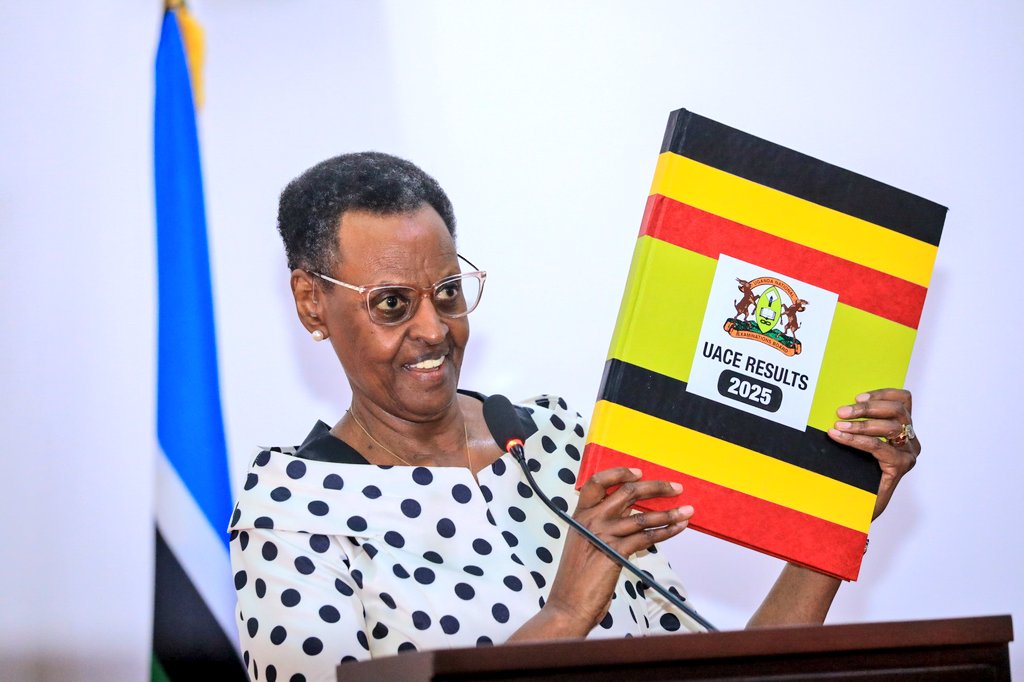
More than 113,000 candidates have qualified for university admission after the Uganda National Examinations Board (UNEB) released the 2025 Uganda Advanced Certificate of Education (UACE) results.
A total of 166,400 candidates registered for the 2025 examinations compared to 141,996 in 2024, representing an increase of 24,404 candidates or 17.2 percent. Of those registered, 165,172 candidates sat for the examinations, including 72,374 females and 92,798 males.

Speaking during the official release of the results in Kampala, the Minister of Education and Sports, Janet Museveni, urged parents and guardians to take a more active role in shaping the future of their children.
“Parents and guardians, I intentionally call upon you to embrace your God-given roles, be present and actively involved in your children’s lives. Play a key role in nurturing your children,” she said.
She emphasised that education should not only focus on knowledge acquisition but also equip learners with practical skills to address societal challenges.

“Education must not be about the acquisition of knowledge per se, but about how knowledge helps us to be creative, productive, and able to find solutions to the problems in our communities and country,” she said.
The First Lady also expressed gratitude for the learners who successfully completed the three national examinations in 2025.
“We thank God for 1,402,434 of our children who completed the three levels of our basic and secondary education,” she said.
According to UNEB Executive Secretary Dan N. Odongo, female candidates continued to outperform their male counterparts overall, particularly in Humanities subjects.
“Female candidates have continued to perform commendably better than their male counterparts, maintaining stronger performance grades at several subject levels in the Humanities and demonstrating lower overall failure proportions,” Odongo said.
However, he noted that male candidates still dominated the highest grade A passes in Mathematics and Science subjects, partly because more male students register for those subjects.
“There is still a higher concentration of female candidates in the Humanities than in the Sciences. Broader participation of both male and female candidates in Science subjects will enhance equity and balance across future professional fields,” he added.
Performance analysis released by UNEB shows improvement in several subjects including Mathematics, Chemistry, Agriculture, Geography, Economics, Biology and Literature in English. However, declines were recorded in Entrepreneurship Education, Christian Religious Education, Fine Art and Physics.
Examiners reported that in Science subjects, some candidates struggled with practical experiments, interpretation of data, drawing conclusions from observations and writing correct chemical equations. Limited practical exposure and misunderstanding of experimental procedures were also cited as major challenges.
In Humanities subjects, examiners observed difficulties in interpreting questions and applying theoretical knowledge to real-life situations. In History, for instance, many candidates displayed weak analytical skills and failed to provide relevant examples, while Religious Education candidates struggled to apply teachings from sacred texts to contemporary issues.
UNEB said 113,291 candidates, representing 68.6 percent, obtained the minimum requirement of two Principal passes needed for admission to degree programmes. This is an increase from 92,273 candidates (65.5 percent) who qualified for university admission in 2024.
Odongo noted that the rise in qualifying candidates could require additional university spaces.
“This improvement aligns with the significant increase in entries for the 2025 examination, indicating that an additional 21,018 university places may be required to accommodate the increased number of qualifying candidates,” he said.
For diploma programmes in Technical and Vocational Education and Training institutions, candidates require at least one Principal pass and two Subsidiary passes. Under this category, 145,129 candidates, representing 87.9 percent, qualify for admission.
The Chairperson of UNEB, Celestino Obua, said the Board assessed a total of 1,402,434 candidates across the three national examinations — Primary Leaving Examination, Uganda Certificate of Education and UACE — in 2025, up from 1,294,731 candidates in 2024.
“As candidature expands, the Board remains mindful of its responsibility to safeguard standards, ensure comparability over time and maintain fairness in assessment,” Obua said.
He added that the number of candidates who register but fail to sit examinations continues to decline, reflecting improved supervision and completion rates in schools.
Meanwhile, UNEB reported relatively low cases of examination malpractice. A total of 351 candidates, representing 0.2 percent of the total candidature from 47 examination centres, had their results withheld over suspected malpractice.
According to Odongo, the cases mainly involved candidates receiving assistance during Science practical examinations, possession of unauthorised materials and impersonation.
UNEB said investigations into the suspected malpractice cases are ongoing and hearings will begin for some examinations in the coming days.
The release of the 2025 UACE results clears the way for thousands of successful candidates to pursue university and other tertiary education opportunities across the country.