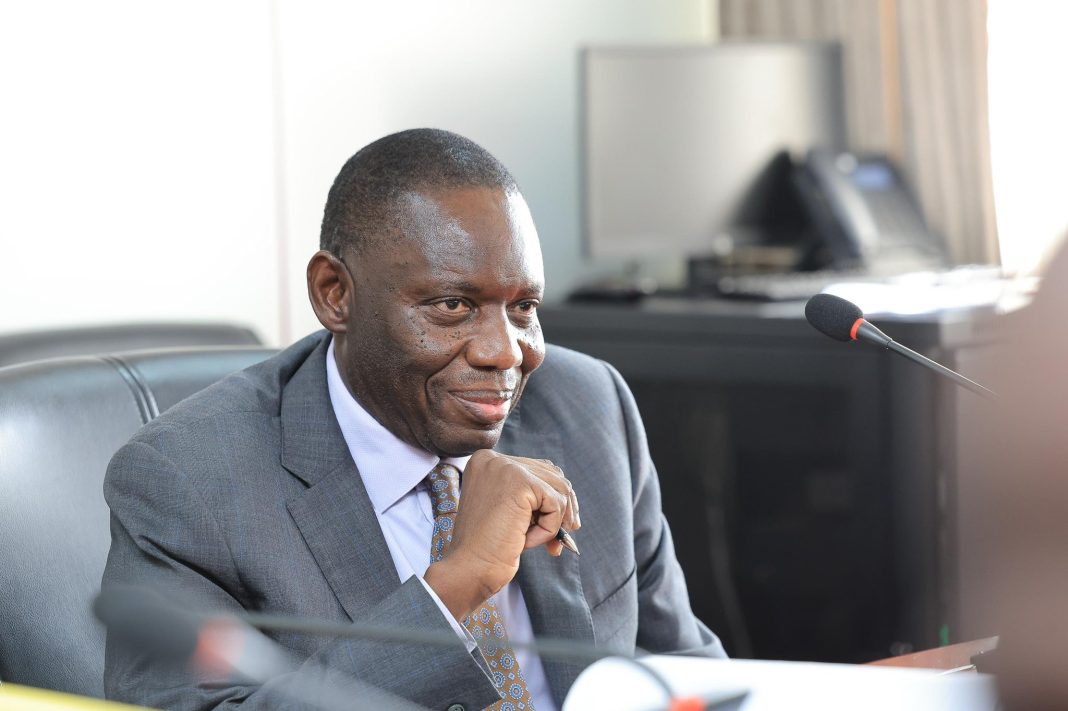
The Governor of the Bank of Uganda, Michael Atingi-Ego has cautioned Parliament that passing the Protection of Sovereignty Bill, 2026 in its current form could destabilize Uganda’s economy, weaken the shilling, choke financial inflows and severely strain the country’s ability to service public debt.
Appearing alongside his deputy, Augustus Niwagaba, before Parliament’s Joint Committee of Defence and Internal Affairs and the Legal and Parliamentary Affairs Committee, Atingi-Ego laid out the central bank’s strongest objections yet to the controversial legislation.

He told legislators that the bill directly interferes with cross border financial flows, which are central to sustaining Uganda’s balance of payments and overall macroeconomic stability.
“Chairman, let me be very clear from the outset. This bill is about cross border payments, and cross border payments is about the balance of payments,” Atingi-Ego said.
He explained that Uganda has consistently run a current account deficit driven by a higher import bill than export earnings, making the country heavily reliant on external financial inflows to bridge the gap.

“The case of Uganda is that the current account balance has always been in the negative because our imports are far much greater than exports. So how do we close this? It is through financial flows,”he said.
According to the Governor, the proposed restrictions in the bill risk cutting off these critical inflows, with immediate and far reaching consequences.
“This bill is bringing restrictions on cross border transactions, meaning that it is bringing restrictions on the inflows to this country. We run the risk of reducing substantially the inflows into Uganda,”he warned.
He cautioned that such a move would widen the external imbalance and force painful adjustments in the economy, particularly through the exchange rate.
“So how then does the balance of payments balance? We are going to have a substantial depreciation of the currency, because you need to make imports more expensive to equate imports to exports,” he said.
Atingi-Ego further warned that Uganda’s foreign exchange reserves, currently estimated at nearly 6 billion dollars, could be quickly eroded if inflows decline.
“The moment you tamper with these inflows, we risk running down our reserves, and that is an economic disaster for a country. A country without reserves is not sovereign,”he said.
He pointed out that just last financial year, Uganda recorded a balance of payments surplus of about 1.5 billion dollars, which helped strengthen reserve buffers.
On remittances, the Governor expressed concern over provisions that could classify Ugandans in the diaspora as foreigners and impose registration requirements on recipients of large transfers.
“For remittances that are sustaining the livelihoods of Ugandans, we are likely to see a reduction. Last year we got remittances of 1.5 billion dollars,”he said.
He warned that any disruption in remittance flows would increase pressure on both household incomes and the national currency.
The Governor also highlighted the risk of an abrupt exit by foreign investors from Uganda’s government securities market, noting that non residents currently hold about 3 billion dollars, roughly 12 percent of the total stock.
“Experience in other jurisdictions shows that it leads to immediate exit of the offshore investors. And when they exit, it means that we cannot fully finance our deficit through borrowing,”he said.
He added that such a scenario would force the government to borrow at higher interest rates, escalating the cost of debt and tightening credit conditions across the economy.
Atingi-Ego also raised strong objections to clause 13 of the bill, which criminalizes publication of information deemed to weaken the economy, warning that it could distort financial markets and investor decision making.
“By criminalizing economic research that identifies fiscal instability, the bill destroys what we call price discovery,” he said.
He explained that investors rely on transparent and credible information to price risk, and limiting such information would increase uncertainty and borrowing costs.
“If I was bidding for a 25 year bond at 17 percent, I am going to end up bidding at 20 percent just in case I have got it wrong. Why? Because I don’t have information,” he said.
The Governor further questioned whether routine central bank communication could fall foul of the proposed law.
“When we publish a report about maybe inflation is projected to rise or the currency may depreciate, will I be charged with economic sabotage?” he asked.