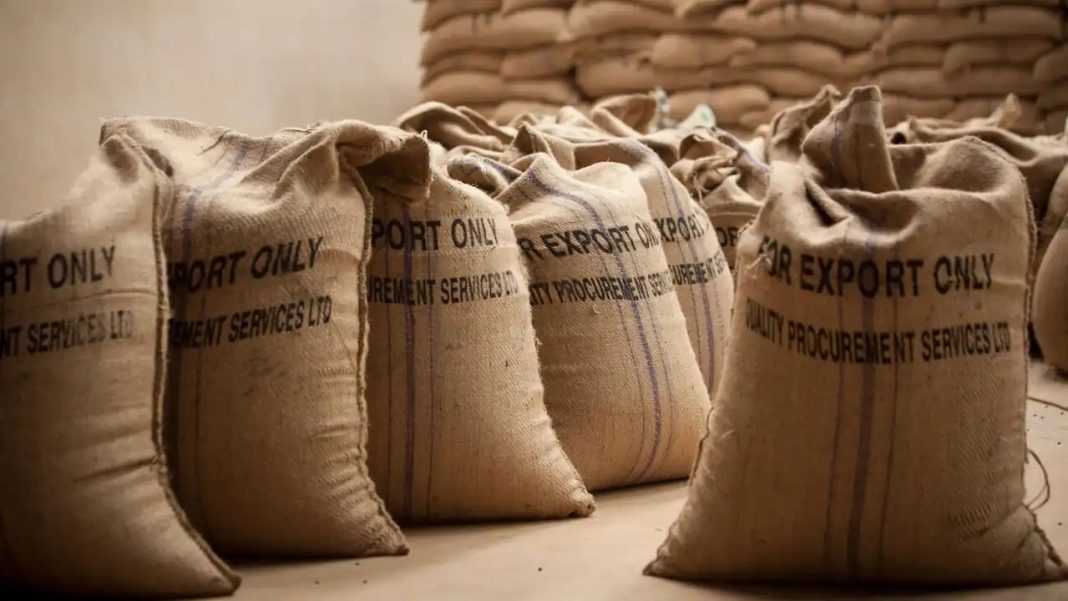
Uganda’s coffee export earnings declined in March 2026 despite a modest rise in volumes, as falling global prices weighed on the country’s top agricultural export, according to the Ministry of Agriculture, Animal Industry and Fisheries.
The country exported a total of 671,152 60-kilogramme bags of coffee in March, earning $173.37 million [about Sh646.75 billion]. This represented a 3.19 per cent increase in volume compared to March 2025, but a 13.56 per cent drop in value.

The average export price fell to $4.31 per kilogramme, down from $4.63 in February and significantly lower than $5.14 recorded in March last year, reflecting a broader decline in global coffee prices.
Robusta coffee dominated shipments, accounting for 567,405 bags worth $134mln, while Arabica exports totalled 103,747 bags valued at $39.36mln. Robusta volumes rose by 7.04 per cent year-on-year, but earnings dropped by 20.8 per cent, while Arabica exports declined in both volume and value.
The ministry attributed the higher export volumes to increased domestic production, but noted that prices had softened in line with improved global supply prospects.

Over the 12 months to March 2026, Uganda exported 8.8 million bags worth $2.4 billion [Shs8.8 trillion], marking a sharp increase from 6.9 million bags valued at $1.8 billion in the previous year. This represents growth of 28 per cent in volume and 36 per cent in value.
Italy remained Uganda’s largest coffee market, taking a 32.17 per cent share of exports in March, followed by Sudan, Germany, India and Morocco. Europe continued to dominate as the primary destination, accounting for 62 per cent of exports, while African markets took a 21 per cent share.
Globally, coffee production for the 2025/26 season is projected to reach a record 178.8 million bags, driven by higher output in countries such as Vietnam, Indonesia and Ethiopia. The improved supply outlook has contributed to downward pressure on prices, even as global consumption continues to rise.
Locally, the government intensified efforts to boost productivity and quality across the sector. During March, more than 7,300 farmers received training in good agronomic practices, while hundreds of farm inspections were carried out to strengthen pest and disease control.
Authorities also stepped up quality assurance, inspecting processing facilities and supporting traders, alongside distributing over 500,000 coffee plantlets to farmers as part of ongoing replanting efforts.
Looking ahead, coffee exports are projected to rise slightly to about 680,000 bags in April 2026, supported by peak harvests in the Greater Masaka and south-western regions.