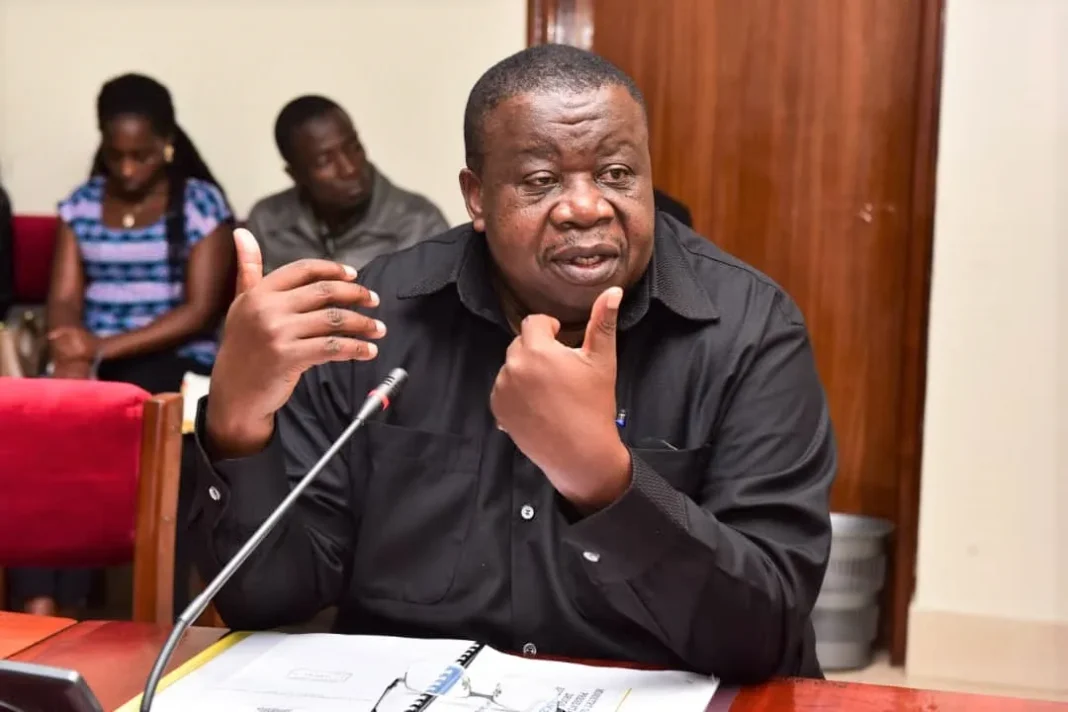
The Minister of Water and Environment, Gen. Kahinda Otafiire has dismissed allegations that he illegally grabbed land belonging to the government-owned Njeru Stock Farm in Buikwe District, insisting that his ownership is lawful and backed by legally acquired land titles.
In a statement released on Tuesday, 7, Otafiire accused some sections of the media and social media users of deliberately misrepresenting the facts to portray him as the principal land grabber, despite being only one of several investors who purchased land from the same private estate.

“I have read with interest the several social media tweets and the recent articles in respect to my ownership of land located in Njeru, Buikwe District. There has been a deliberate drive to distort the facts and portray a specific narrative as me being a land grabber of the whole stock farm land,” Otafiire said.
The minister explained that he owns land situated on the former Plots 3 and 4, Block 295 in Njeru, which he purchased in 2016 from the late Fred Lukwajju and Christopher Lule, administrators of the estates of the late Enoka Sebowa and Guster Seruwo.
According to Otafiire, the administrators lawfully obtained Letters of Administration and High Court orders in Jinja in 2011, paving the way for the creation of certificates of title before selling portions of the land to investors.

He said the original estate measured about 640 acres, most of which was sold to more than 25 companies and individuals, many of whom have since established factories and other commercial developments in the area.
Among the companies he listed were Modern Titles Limited, Modern Laminates Limited, Modern Agro Industries Limited, Modern Organizers Limited, Kiira Plastics Limited, A-One Limited, PAO Products, Sino Glass Manufacturing Limited, Shreeji Glass (U) Limited, Seyani Brothers, Parie G Sweets Limited and Keshwala & Sons. Individual purchasers include former Chief Justice Steven Kavuma, businessman Mandala Mafabi and several other private investors.
“All these companies and individuals have developed their parcels of land, creating an industrial complex and enjoying quiet possession of the land since 2018. Yet I have been intentionally singled out as the biggest land grabber simply because my land is the easiest target for the stock farm management to use as a ploy to divert attention from the truth about their occupation of the land,” he said.
Otafiire maintained that his land has never formed part of the area occupied by the government livestock farm.
He argued that the Njeru Stock Farm historically occupied former Plot 2, measuring approximately 190 acres, whereas his property lies on Plots 3 and 4, which he says are legally distinct.
“The stock farm only occupied former Plot 2, approximately 190 acres, and this has been well documented. The Minister of State for Animal Industry later admitted that the stock farm lost all interest and claim over the land after failing to pay rent to the estate of Barbara Lakeri Nalubaale in 2009,”he said.
The minister further claimed that the High Court in Jinja upheld an order of re-entry after the Ministry of Agriculture and the stock farm failed to honour the lease terms by paying ground rent.
He added that the farm vacated the disputed land on May 30, 2026, removing livestock, liquid nitrogen equipment and other property, which he says demonstrated that it no longer had any legal interest in the land.
“It is rather interesting why the stock farm management and the Ministry of Agriculture, who have never paid any rent since 2011 despite budgeting and withdrawing money for the same, have continuously cried foul and tried to claim that I am occupying former Plot 2, yet in reality my land is situated on Plots 3 and 4 that have nothing to do with the former stock farm,”he noted.
The Njeru land dispute has been one of Uganda’s most contested public land conflicts for years, involving competing claims by government agencies, private proprietors, estate administrators and investors. Court battles, parliamentary inquiries and investigations have repeatedly been launched over the ownership of the land, with government insisting that parts of the property are critical national assets.
The stock farm itself is regarded as a strategic national livestock facility. It hosts an artificial insemination breeding centre, a liquid nitrogen plant serving eastern Uganda and livestock genetic improvement programmes. Government has consistently argued that the facility is vital to the country’s agricultural sector and has sought to protect it from further encroachment.
The dispute has also attracted allegations of forged land documents, disputed titles and competing court orders. Previous reports indicate that investigations by the Inspectorate of Government, Parliament, the Attorney General and other state agencies have examined how parts of the land changed hands over the years, while the National Animal Genetic Resources Centre and Data Bank (NAGRC&DB) has continued to challenge several private ownership claims in court.
Despite the longstanding controversy, Otafiire insists he is being unfairly singled out while dozens of other investors who acquired land from the same vendors have remained largely out of the spotlight.
He said, “My land was lawfully purchased and is supported by valid titles. I cannot be labelled a land grabber simply because I have become the convenient target in a dispute whose history stretches back many years.”
His statement comes as the decades-old battle over ownership of the former Njeru land enters another chapter, with rival claims continuing to be contested through the courts and other government institutions, while both private investors and public authorities maintain competing interpretations of the land’s legal status.