The Permanent Secretary and Secretary to the Treasury (PSST), Ramathan Ggoobi, has called on officials in the Ministry of Finance’s Directorate of Debt and Cash Policy to strengthen Uganda’s debt management by ensuring that every financing decision supports the country’s long-term economic growth while safeguarding debt sustainability.
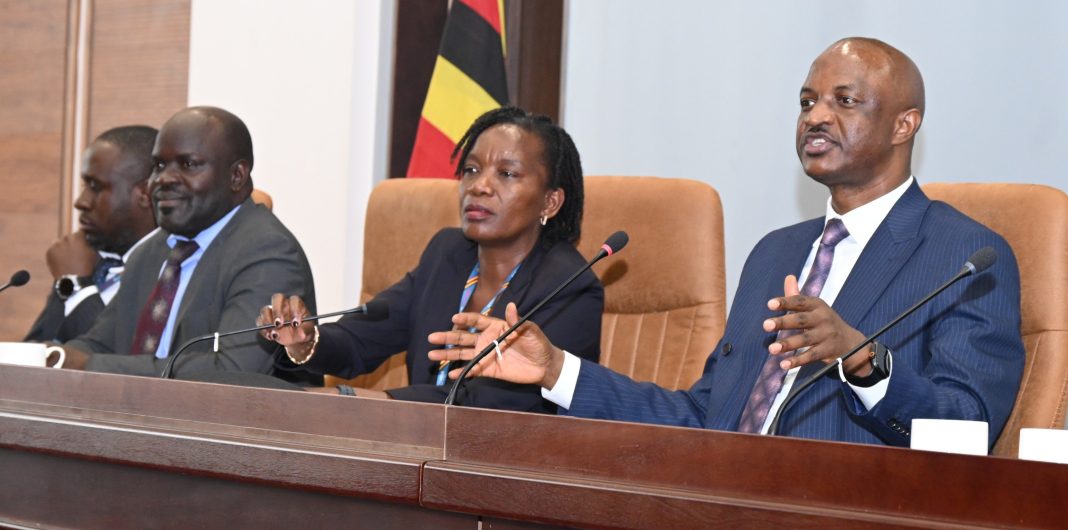
Speaking while officiating at the Directorate Meeting held at the Ministry of Finance, Planning and Economic Development in Kampala, Ggoobi said the country is entering a crucial phase of economic transformation that requires careful and strategic financial management.

He warned that one of the biggest concerns among government leaders, development partners, investors and citizens is the rising cost of servicing public debt, which continues to consume resources that could otherwise be directed towards development priorities.
“One of the greatest concerns among leaders, investors, and citizens is the increasing cost of debt servicing, which continues to reduce the fiscal space,” Ggoobi said.
Uganda has in recent years increased borrowing to finance major infrastructure projects, including roads, energy generation, water systems, industrial parks and other strategic investments aimed at supporting long-term economic growth. While government maintains that the country’s public debt remains sustainable, international financial institutions, including the International Monetary Fund (IMF), have repeatedly urged authorities to strengthen domestic revenue mobilisation, improve public investment efficiency and borrow cautiously to preserve fiscal stability.

Ggoobi stressed that Uganda’s reputation in international financial markets has been built over many years through responsible debt management and fiscal discipline, warning that this credibility must be protected.
“Uganda’s reputation in international financial markets has been built on responsible debt management. The Directorate must protect that credibility,” he said.
He noted that as Uganda pursues its ambitious Tenfold Growth Strategy, the role of the Directorate of Debt and Cash Policy should extend beyond processing financing arrangements to providing strategic financial guidance that protects the country’s long-term economic interests.
“As Uganda enters a period of accelerated economic growth, your role must evolve beyond facilitating financing transactions. You are expected to serve as Government’s strategic financial advisors, providing objective, evidence-based and courageous advice that safeguards the country’s long-term economic interests,” Ggoobi said.
The PSST challenged the Directorate to anticipate emerging financial risks, propose practical solutions and prevent fiscal challenges before they escalate.
“The Directorate has the responsibility of detecting emerging risks, recommending practical solutions and preventing problems before they escalate. Economic managers should respond to challenges while focusing on creating opportunities for sustainable growth,” he said.
He further outlined what he described as the Directorate’s core mission.
“Your mission is clear: protect debt sustainability, preserve macroeconomic stability, borrow prudently and only when necessary, finance high-impact investments, provide clear, objective, and evidence-based advice and uphold the highest standards of integrity and professionalism,” Ggoobi emphasized.
The Acting Director of Debt and Cash Policy, Maris Wanyera, presented the Directorate’s strategic priorities and reaffirmed its commitment to mobilising affordable financing to support Uganda’s Tenfold Growth Strategy, which seeks to expand the country’s economy through increased investment, industrialisation, value addition, exports and private sector-led growth.
The Directorate of Debt and Cash Policy is responsible for managing Uganda’s public debt portfolio, advising government on borrowing strategies, overseeing debt sustainability analysis and coordinating cash management to ensure government meets its financial obligations while maintaining macroeconomic stability.
The meeting comes at a time when Uganda is intensifying efforts to balance financing for critical development projects with maintaining sustainable public debt levels amid growing pressure from rising debt servicing obligations and increasing demands for investment in infrastructure, health, education and wealth creation programmes.
Ggoobi reiterated that prudent borrowing, sound financial advice and disciplined debt management will remain essential if Uganda is to achieve its long-term development ambitions without compromising future generations.