The Uganda National Bureau of Standards (UNBS) has called for stronger collaboration among government agencies to improve service delivery and embed a culture of quality as the country pursues its ambitious plan to grow the economy to $500 billion by 2040.
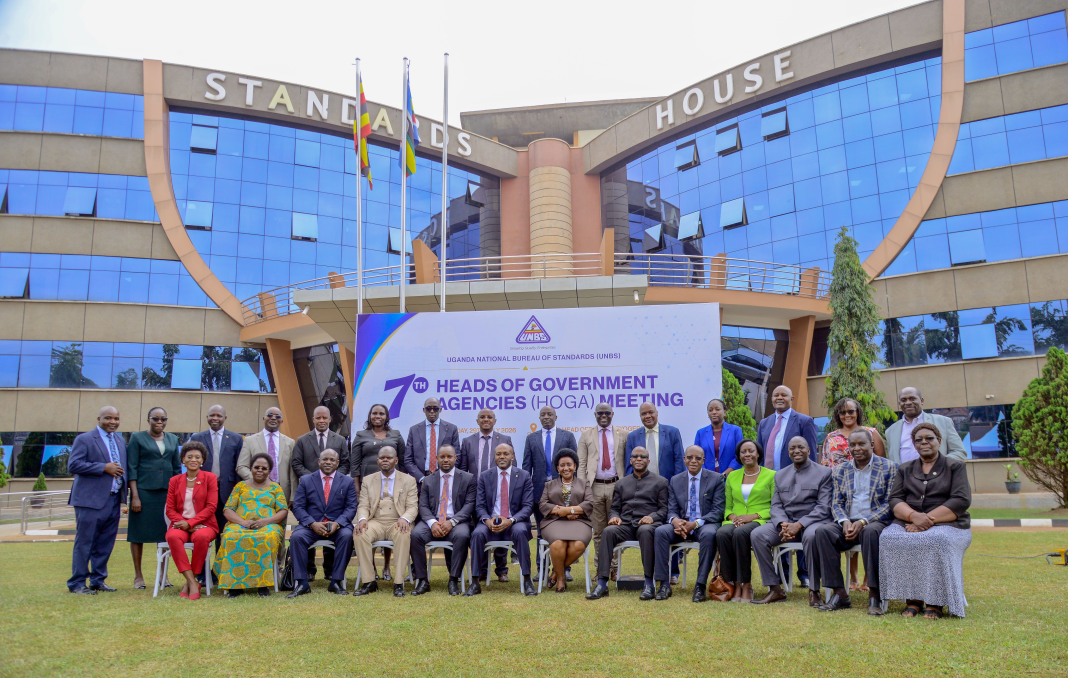
The call was made on Thursday as UNBS hosted the 7th Heads of Government Agencies (HOGA) Forum at its headquarters in the Bweyogerere Industrial Area, bringing together accounting officers and chief executives from Ministries, Departments and Agencies (MDAs) to strengthen inter-agency coordination in line with the government’s operational directive, “Kisanja No Sleep.”

The forum focused on accelerating implementation of Uganda’s Ten-Fold Growth Strategy, a long-term economic transformation agenda aimed at expanding the country’s economy through agro-industrialisation, increased export competitiveness and science-driven infrastructure.
Before the meeting, the HOGA delegation toured UNBS’s internationally accredited testing laboratories and quality infrastructure, including the Food Safety Laboratories, National Metrology Laboratories and the National Energy Meters Laboratory, which play a critical role in ensuring consumer safety, industrial precision, fair trade and the competitiveness of Ugandan products in regional and international markets.
Speaking during the meeting, UNBS Executive Director James Kasigwa said harmonising standards and processes across government institutions is critical to achieving the country’s economic transformation agenda.

“As the custodian of national standards, UNBS remains committed to promoting and enforcing compliance to standards to guarantee product quality, consumer safety and fair trade,” Kasigwa said.
He added: “We must foster an inter-agency ecosystem where quality is not just a regulatory mandate, but a culture that is embedded across every value chain.”
Kasigwa also addressed recent public concerns over reports of underweight cement on the market, assuring Ugandans that the bureau continues to work closely with manufacturers and other stakeholders to safeguard product quality.
“We have engaged certified cement manufacturers nationwide to ensure strict adherence to relevant weight and safety standards requirements,” he said.
He explained that findings from recent UNBS market surveillance indicate that most cases of underweight cement arise from unauthorized tampering, siphoning and repackaging during transportation and at the retail level rather than at the manufacturing stage.
“Eliminating these illicit practices requires a synchronized effort from all stakeholders—regulators, security agencies and consumers. Every player across the value chain should demand and deliver quality products,” Kasigwa said.
Deputy Head of Public Service in charge of Performance and Service Delivery Jane Kyarisima Mwesiga commended UNBS for investing in internationally accredited laboratories, saying the facilities are helping position Ugandan products to compete effectively in both domestic and export markets.
She said the Heads of Government Agencies Forum is intended to strengthen accountability, improve performance and accelerate service delivery across the public sector.
“Government’s deliberate investments in state-of-the-art quality infrastructure, such as the accredited laboratories witnessed here at UNBS, are fundamental to industrialisation,” Mwesiga said.
She urged Ugandans to embrace standards as a key driver of industrial growth, export promotion and sustainable socio-economic transformation, noting that quality assurance will remain central to the country’s efforts to achieve ten-fold economic growth over the coming years.