Government has mobilized its diaspora in the Republic of Korea to invest back home, urging Ugandans living there to channel capital, skills and technology into the country’s priority sectors ahead of a major Uganda-Korea Trade and Investment Meeting that opened this weekend.
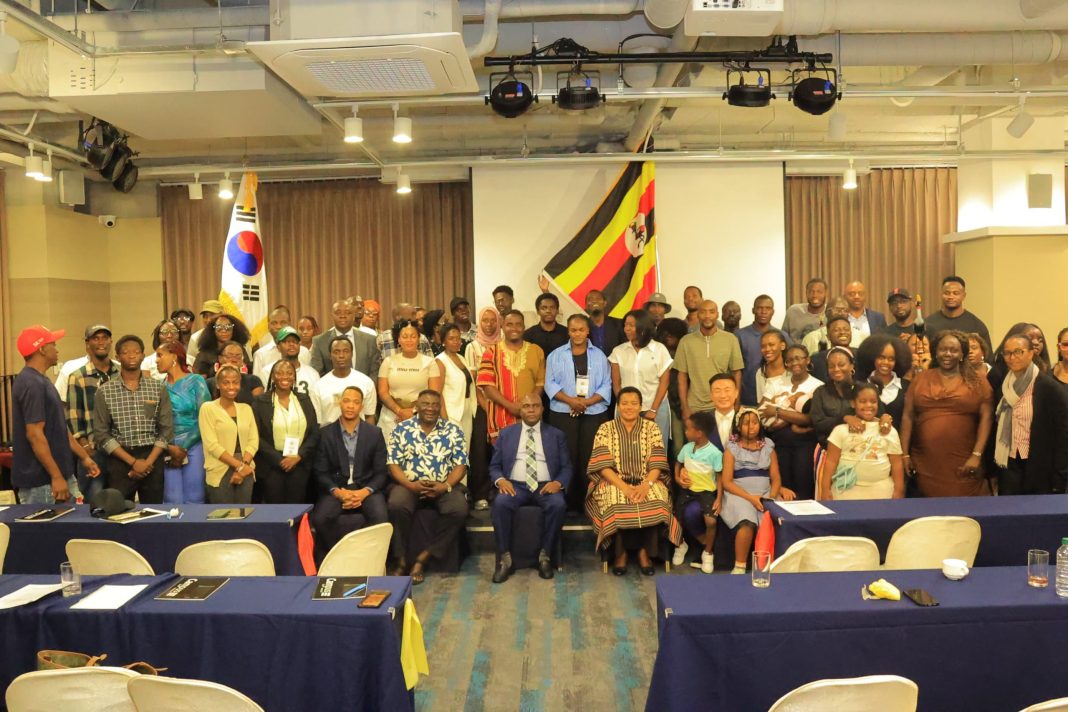
The call was made during a diaspora outreach hosted by Uganda’s Embassy in Tokyo, which is accredited to South Korea, at the 88 Hotel in Seoul on Saturday. The engagement formed part of activities leading to the Uganda Korea Trade and Investment Meeting running from September 6 to 10 in partnership with the Korea International Trade Association (KITA), with the aim of expanding trade and investment between the two countries.

The meeting brought together Ugandans living in South Korea, government officials and other stakeholders to discuss how the diaspora can play a greater role in Uganda’s economic transformation through investment, technology transfer, tourism promotion and trade.
Uganda’s Ambassador to Korea, H.E. Tophace Kaahwa, described Ugandans abroad as an important force in advancing the country’s economic diplomacy agenda.
“The diaspora are grassroots ambassadors whose remittances, investment and expertise are central to Uganda’s national growth,” Kaahwa said.

She urged Ugandans in Korea to seize opportunities in tourism, mineral development, science and technology, and agribusiness, adding that increased electricity generation in Uganda had strengthened the country’s investment environment.
Kaahwa also encouraged members of the diaspora to register for national identification cards and assured them that the embassy remained committed to serving Ugandans despite operating from Tokyo.
She noted that a high level government delegation led by Second Deputy Prime Minister Dr Crispus Kiyonga had travelled to South Korea for the engagements, describing the Ugandan community including its footballers and marathon runners as an important bridge between the two nations.
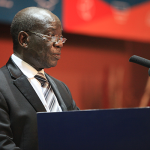
Delivering the keynote address, Dr Kiyonga conveyed greetings from President Yoweri Museveni and commended Ugandans in Korea for their unity and patriotism.
“Uganda is secure and stable, and we are building an economy that will grow from about US$70 billion today to US$500 billion by 2040,” Kiyonga said.
He said government had made major investments in road infrastructure to ease transport and support business growth, while railway connectivity between Nairobi and Kampala was also being expanded to improve regional trade.
Kiyonga encouraged Ugandans in Korea to remain proud ambassadors of their country and maintain close ties with Uganda’s diplomatic mission.
The outreach also highlighted government’s ongoing work on a comprehensive diaspora policy aimed at improving coordination, communication and access to government services for Ugandans abroad.
Presenting the initiative, Ambassador Muhindo said consultations had already been substantially completed in North America and Europe and were now shifting to Asia and other regions.
“The new diaspora policy will strengthen engagement with Ugandans abroad and ensure their knowledge, technology and expertise contribute more directly to national development,” Muhindo said.
He urged the community to participate in the Uganda Diaspora Convention scheduled for December 18 to 22, 2026, saying the event had already encouraged many Ugandans living abroad to reconnect with opportunities back home since its launch in 2024.
Representing the Permanent Secretary of the Ministry of Foreign Affairs, Ambassador Henry Mayega praised the diaspora’s growing contribution through remittances, investment and professional expertise.
He said Ugandans abroad remained critical partners in delivering government’s priority sectors of agro industrialization, tourism, mineral development, and science, technology and innovation.
“Our development agenda requires the contribution of Ugandans everywhere, regardless of where they live or their political affiliation,” Mayega said.
The Honorary Consul of Uganda in Busan, Dr Kim Jin Bo, welcomed the strengthening relationship between Uganda and South Korea, urging Ugandans to apply the skills and experience acquired in Korea to support Uganda’s development.
Earlier, Hamza Kyamanywa, President of the Ugandans in South Korea Association, said the community had grown into a vibrant network of students, workers and entrepreneurs.
He revealed that as of July 31, 2026, South Korea was home to 654 Ugandans, comprising 407 men and 247 women.
“Many Ugandans here remain closely connected to home and continue contributing to Uganda directly and indirectly through investment, knowledge and entrepreneurship,” Kyamanywa said.
During the open dialogue, participants raised concerns about professional development opportunities, sports cooperation and the welfare of Ugandans married to Korean nationals.
Several members also highlighted the absence of a resident Ugandan embassy in South Korea, noting that consular services are currently administered from Tokyo.
The diaspora outreach marked the opening of a series of engagements designed to strengthen commercial, diplomatic and people to people ties ahead of the Uganda Korea Trade and Investment Meeting, where government hopes to attract new partnerships in investment, technology and trade between Kampala and Seoul.