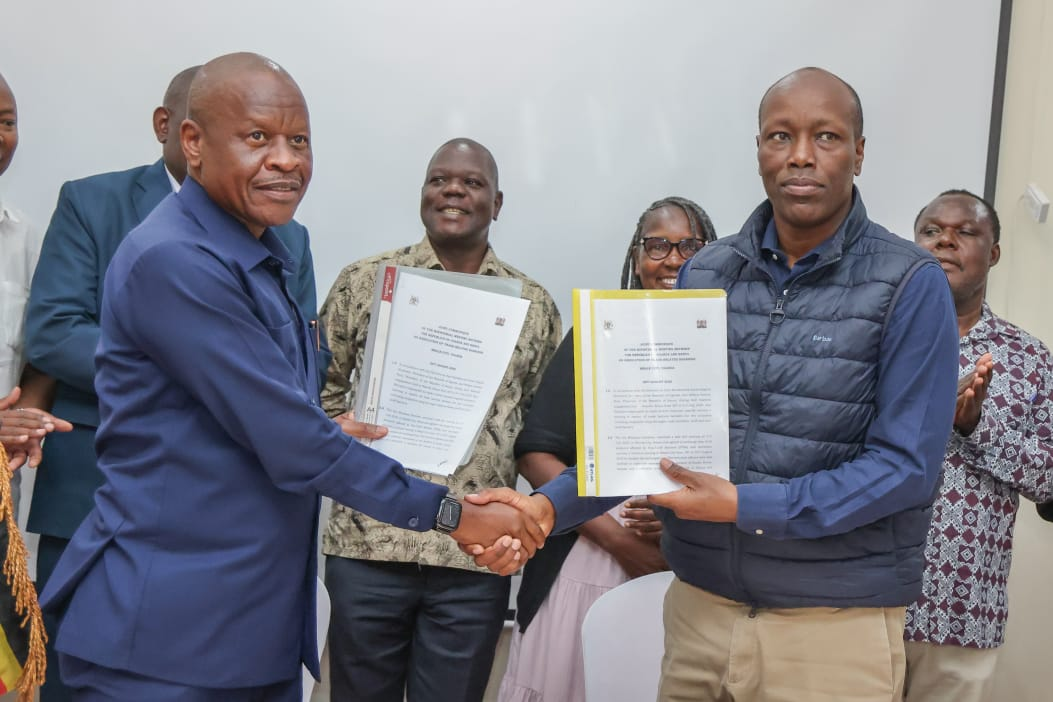
The governments of Uganda and Kenya have signed a landmark free trade agreement aimed at eliminating trade barriers, decongesting border posts, and boosting economic cooperation between the two East African neighbours.
The deal, signed last Friday in Mbale City, follows a directive by President Yoweri Kaguta Museveni and his Kenyan counterpart, Dr. William Samoei Ruto, who in July instructed their respective trade ministers to urgently resolve all obstacles hindering bilateral trade.

Kenyan Cabinet Secretary for Investments, Trade and Industry, Lee Kinyanjui, said the agreement ensures that all products between the two countries will now be treated as domestic transfers rather than imports.
“We have adopted that Kenya will treat products from Uganda as though they are from Kenya. So it will just be a transfer from Uganda to Kenya, or Kenya to Uganda, which means it will not attract any duties,” Kinyanjui said.
The Joint Communiqué issued after the ministerial meeting in Mbale on August 30, 2025, underlined that the two countries had agreed to eliminate all tariff and non-tariff barriers, including discriminatory excise duties, levies, and other charges, in line with East African Community (EAC) protocols.

Uganda’s State Minister for Trade, Gen. Wilson Mbasu Mbadi, welcomed the deal, noting that it would break down long-standing obstacles to the free movement of goods and services.
“We are now able to remove or break these non-tariff barriers that were coming through the levy of certain duties that go against the East African Community Treaty and Protocols,” Mbadi said.
The ministers also conducted joint inspections at key border points, including Suam, Busia, Malaba, and Lwakhakha, where they identified operational, infrastructural, and logistical challenges behind persistent congestion.
To address this, they directed border agencies to immediately clear backlogs: at Malaba, congestion must be reduced within 24 hours and maintained at no more than four kilometres, while at Busia, queues should not exceed 500 metres. They also ordered 24/7 operations at all border posts and the removal of unnecessary checkpoints.
On infrastructure, both governments pledged to mobilize resources for critical upgrades, including road works and bridge construction, while fast-tracking the completion of the Suam One-Stop Border Post (OSBP) and improving facilities at Lwakhakha. Uganda also committed to resolving delays linked to weighbridge operations along major corridors.
Kinyanjui acknowledged that past disputes—including Kenya’s bans on Ugandan eggs in 2021 and powdered milk earlier this year—had strained relations but said the new agreement, backed by clear timelines and monitoring mechanisms, marked a turning point.
“We want to ensure that nobody wastes more than two hours at the border… so that our people can trade,” he said, adding that delays had reduced the efficiency of cargo trucks traveling between Mombasa and Kampala.
The communiqué further directed the operationalization of Joint Border Committees (JBCs) and the establishment of a standing joint technical committee to monitor and resolve emerging trade concerns, while also keeping the private sector fully engaged in the process.
Truck drivers, however, raised concerns during the Mbale meeting, alleging that Uganda Revenue Authority officers were demanding bribes of 2,000 shillings (about 50 cents) per truck to expedite clearance.
“They cannot allow you to proceed until you have paid the money,” one driver said.
In response, Kinyanjui announced the formation of a joint team to investigate and address such grievances.
The ministers concluded by expressing appreciation to Presidents Museveni and Ruto for their leadership and reaffirmed that all products originating from either country will henceforth be treated as transfers in line with EAC protocols.