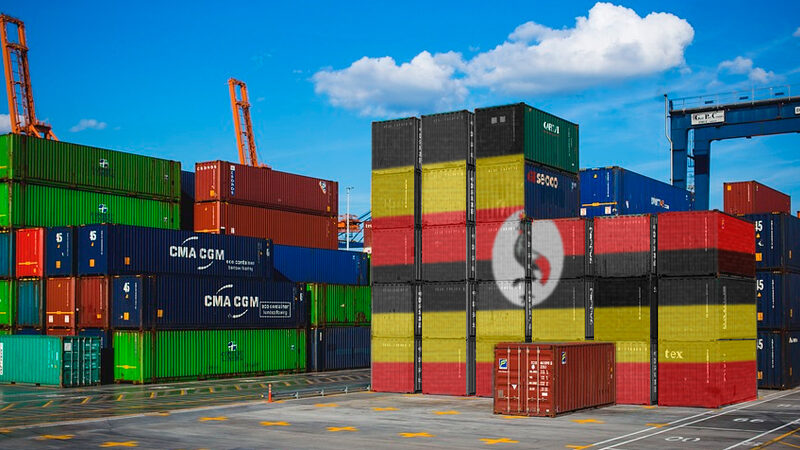
Uganda’s exports almost doubled on a year-on-year basis, rising by 94.4 percent from $769.62 million (about Shs2.7 trillion) in October 2024 to approximately $1.5 billion (about Shs5.3 trillion) in October 2025, according to the latest report by the Ministry of Finance.
The Performance of the Economy Monthly Report for November 2025 attributes the strong growth mainly to higher export earnings from coffee, gold, crude oil from simsim, palm oil and sunflower, industrial products, cocoa beans and flowers, among others.

The report shows that earnings from coffee exports increased by $46.06 million (about Shs163 billion), representing a 33.1 percent rise from $139.05 million (about Shs491 billion) in October 2024 to $185.10 million (about Shs654 billion) in October 2025.
“This increase was attributed to higher export volumes despite declining global coffee prices. Export volumes rose by 37.7 percent to 680,000 60-kilogramme bags, up from 500,000 60-kilogramme bags, largely due to increased production from harvests in the Central and Eastern regions,” the report says.
By contrast, coffee export earnings declined on a month-on-month basis due to a reduction in the quantity of coffee exported between September 2025 and October 2025, which more than offset a marginal increase in the unit price of coffee.

According to the report, Italy and Germany were the main destinations for Uganda’s coffee exports in October 2025. Overall export earnings rose by 55.9 percent to $1.496 billion (about Shs5.28 trillion) in October 2025, up from $959.89 million (about Shs3.39 trillion) in September 2025.
“Higher earnings from gold, cocoa beans, crude oil from simsim, palm oil, sunflower, and tobacco, among others, largely drove this growth. Gold and coffee together accounted for 76.8 percent of Uganda’s total exports, highlighting the need to diversify the export base,” the report notes.
The Middle East remained Uganda’s leading export destination in the month under review, accounting for 49.1 percent of total exports. At a country level, the United Arab Emirates dominated the region, receiving 98.8 percent of Uganda’s exports to the Middle East. Other key destinations included Asia at 19.8 percent, the East African Community at 17.5 percent, and the European Union at 8.8 percent.
On the import side, Uganda’s merchandise imports grew by 53.8 percent compared with the same month in the previous year, rising from $1.021 billion (about Shs3.6 trillion) in October 2024 to about $1.6 billion (about Shs5.6 trillion) in October 2025. This increase was mainly driven by higher formal private sector imports, which more than offset a decline in government imports.
Key private sector imports included mineral products excluding petroleum, base metals and their products, vegetable and animal products, beverages, fats and oils, among others. On a month-on-month basis, merchandise imports rose by 7.6 percent, increasing from approximately $1.5 billion (approximately Shs5.3 trillion) in September 2025 to $1.6 billion (approximately Shs5.6 trillion) in October 2025, largely due to higher non-oil formal private sector imports.
In October 2025, Asia remained Uganda’s largest source of imports, accounting for 30 percent of the total import bill. Within Asia, China, India, and Japan were the leading sources, accounting for 50.6 percent, 22.3 percent, and 8.1 percent, respectively. Other significant sources included the East African Community, the rest of Africa, and the Middle East, contributing 29.2 percent, 23.8 percent, and 9.7 percent.
Compared with October 2024, Uganda’s merchandise trade deficit with the rest of the world narrowed by 70.4 percent, falling from $251.56 million (about Shs888 billion) to $74.46 million (about Shs263 billion) in October 2025. “This improvement was driven by an increase in exports of $726.84 million (about Shs2.57 trillion), which more than offset a $549.74 million (about Shs1.94 trillion) rise in imports over the same period,” the report says.
On a month-on-month basis, the trade deficit narrowed by 85.1 percent between September 2025 and October 2025, reflecting a $536.56 million (about Shs1.9 trillion) surge in export earnings against a $110.72 million (about Shs391 billion) increase in the import bill.
Uganda’s trade deficit with its East African Community partner states widened significantly in October 2025, reflecting a sharp rise in imports from the region compared with only a marginal increase in export earnings. During the month, the deficit expanded from $103.08 million (about Shs364 billion) in September 2025 to $196.29 million (about Shs693 billion) in October 2025.
The deterioration was driven by a substantial increase in the import bill, which rose by $99.42 million (about Shs351 billion), while exports increased by only $6.21 million (about Shs22 billion). As a result, imports from the region reached $458.65 million (about Shs1.62 trillion), compared with exports of $262.36 million (about Shs926 billion).
At a country level, Uganda recorded trade surpluses with the Democratic Republic of Congo of $112.42 million (about Shs397 billion), South Sudan of $41.47 million (about Shs146 billion), Rwanda of $25.11 million (about Shs89 billion), and Burundi of $6.12 million (about Shs22 billion). However, the country posted trade deficits with Kenya and Tanzania of $81.62 million (about Shs288 billion) and $299.80 million (about Shs1.06 trillion), respectively.
On a year-on-year basis, Uganda’s trade balance with the region deteriorated from a surplus to a deficit. In October 2024, the country recorded a trade surplus of $8.26 million (about Shs29 billion) with the EAC, compared with a deficit of $196.29 million (about Shs693 billion) in October 2025. The decline was largely attributed to a steep rise in imports, which increased from $222.10 million (about Shs784 billion) in October 2024 to $458.65 million (about Shs1.62 trillion) in October 2025, while export earnings rose only modestly from $230.36 million (about Shs814 billion) to $262.36 million (about Shs926 billion).
The surge in imports was driven mainly by Tanzania and Kenya, where imports more than doubled, rising by 111.0 percent and 105.6 percent, respectively, while Uganda’s exports to the two countries declined over the same period, falling by 38.4 percent to Tanzania and by 10 percent to Kenya.