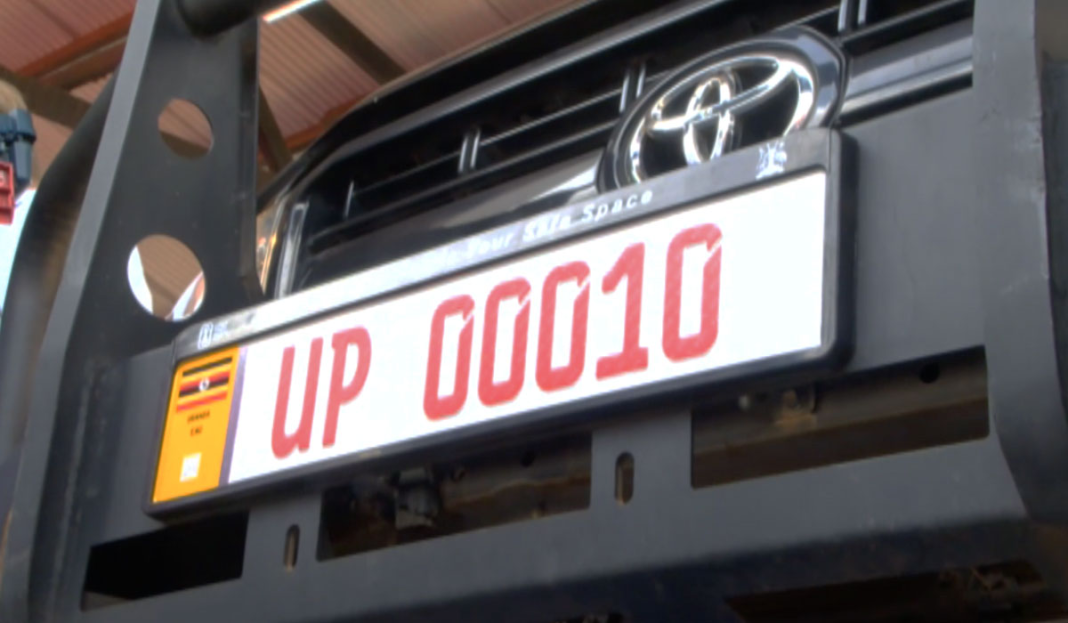
The Ministry of Works and Transport (MoWT) has announced that all government vehicles operating without digital number plates are illegally on the road, as authorities aim to enforce mandatory smart registration systems.
Speaking before ministry officials and stakeholders, the Commissioner for Transport Regulation and Safety, Winston Katushabe delivered a firm and detailed directive, urging immediate compliance across all government fleets.

“I really need to speak to this. Any government vehicle without the digital plate on the road is illegal. So maybe take note,” Mr. Katushabe said. “Those who have not registered, I think it is important for the government to lead by example.”
He emphasized that the responsibility lies first with public institutions, adding that enforcement can no longer be delayed.
“I know that is not a matter we always want to say, but now I am making this statement before the minister and before the stakeholders that any vehicle not registered is operating illegally. If you are driving any government vehicle, please comply. I think it is time we start enforcing this directive,” he said.

Mr. Katushabe, however, clarified that certain specialised units would not be immediately affected by the directive to avoid misinterpretation.
“Of course, you remove the presidential fleet. I do not want to be misquoted. But I am only saying, for all other government vehicles, compliance is no longer optional,” he stressed.
The digital number plate system, officially introduced in Uganda in 2023, is under the government effort to modernise transport management, enhance road safety and strengthen national security through technology-driven vehicle identification. The plates are embedded with electronic features capable of supporting real-time tracking and verification of vehicles.
The project is being implemented by Joint Stock Company Global Security in partnership with the government, under the supervision of the Ministry of Works and Transport.
Since its rollout, the system has been gradually implemented, beginning with newly registered vehicles, government fleets and motorists replacing old plates. Authorities argue that once fully operational, the system will play a critical role in curbing vehicle theft, improving traffic law enforcement and supporting crime detection.
However, the programme has not been without controversy. Motorists and sections of the public have raised concerns over the cost of acquiring the new plates, which currently stands at about Shs714,300 for motor vehicles and approximately Shs134,300 for motorcycles.
Others have pointed to delays in issuance, logistical bottlenecks at installation centres and limited sensitization, which have slowed down uptake among private motorists. There have also been debates around data privacy, with some critics questioning how securely the tracking data will be managed.
Despite these concerns, the government maintains that the system is necessary and long overdue. Officials insist that the technology will significantly improve national security and accountability on the roads.
Mr. Katushabe reiterated that enforcement will now be stepped up, particularly within government institutions, to set a standard for the rest of the country.
“We must lead by example as a government. That is the only way this system will succeed,” he said.
The government agencies are urged to comply with the enforcement campaign in order to extend it firmly to private motorists in the coming months, as the country pushes toward full adoption of the digital number plate system.