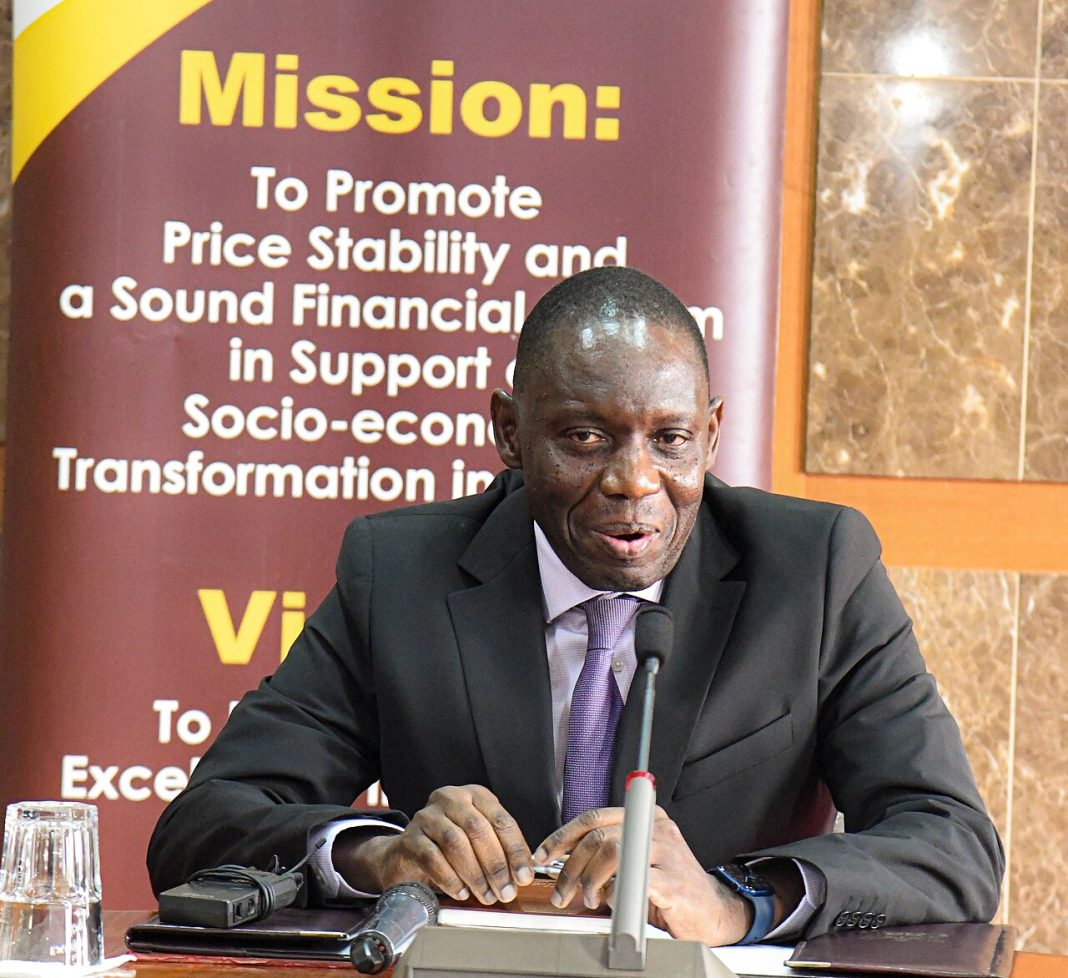
The governor of Bank of Uganda, Michael Atingi-Ego, has called for the effective use of Alternative Dispute Resolution (ADR) mechanisms in commercial disputes.
Speaking during the Commercial Court Users ADR Round Table on Wednesday, Atingi-Ego said prolonged litigation continues to burden financial institutions, tie up capital, and weaken efforts aimed at expanding financial inclusion.

He said that faster and less costly settlement processes are critical for maintaining financial sector stability and supporting Uganda’s broader economic growth.
The round table brought together leaders from the Judiciary, the banking sector, and financial institutions ahead of the forthcoming Settlement Fortnight scheduled for May 18-29, 2026.
“I am honoured to join you this morning and extend my sincere appreciation to the Honourable Chief Justice and the Judicial Training Institute for convening this important ADR Round Table,” Atingi-Ego said in his opening remarks.

He commended the Judiciary for what he described as sustained efforts to promote quicker and more effective resolution of commercial disputes through ADR mechanisms.
“At the outset, allow me to commend the Judiciary for its sustained commitment to fostering faster and more effective resolution of commercial disputes,” he said.
According to the Governor, the upcoming Settlement Fortnight and the ADR round table are direct outcomes of resolutions adopted during the recent Judicial Officers’ Colloquium on Alternative Dispute Resolution.
“This demonstrates a clear and commendable commitment to translating policy discussions into practical action, an approach that is both timely and necessary,” he noted.
Atingi-Ego stressed that the effectiveness of Uganda’s judicial system is directly linked to the stability of the financial sector because banks and other financial institutions depend heavily on enforceable contracts and timely settlement of disputes.
“Prolonged litigation ties up capital in non-performing assets, constrains the banking sector’s capacity to support economic activity, and can significantly impede efforts to deepen financial inclusion,” he said.
He added that ADR mechanisms offer “a faster, less costly, and value-preserving pathway” that benefits financial institutions, customers, and the wider economy.
The Governor revealed that through its supervisory engagements with financial institutions, the central bank has witnessed the strain caused by lengthy court battles on financial institutions’ balance sheets and operational efficiency.
“Through our supervisory engagement with financial institutions, we have observed first-hand the institutional strain that protracted litigation imposes on balance sheets, on operational focus, and on strategic resource allocation,” he said.
He explained that unresolved disputes often force financial institutions to become more risk-averse, a situation that increases the cost of accessing financial services and ultimately undermines financial inclusion goals.
“This initiative is critically important for both the Bank of Uganda and the institutions we supervise. It strengthens confidence in dispute resolution mechanisms, supports prudent balance sheet management, improves risk management across the financial sector, and addresses some of the critical obstacles to expanding access to financial services,” Atingi-Ego said.
The Governor also welcomed the involvement of Chief Executive Officers and Boards of financial institutions in the ADR process, saying leadership commitment is necessary to ensure ADR becomes embedded within institutional governance and practice.
“Leadership commitment at the highest level is essential to ensure that ADR is embedded in institutional practice, supported by clear mandates and robust governance frameworks, so that it becomes the norm rather than the exception,” he emphasized.
He applauded the Judiciary for championing reforms aimed at improving commercial justice and expressed optimism that the initiative would yield positive outcomes for the courts, financial institutions, and the wider economy.
“The Bank of Uganda looks forward to the positive outcomes it will generate for the courts, for the banking sector, and for the wider economy,” he said.