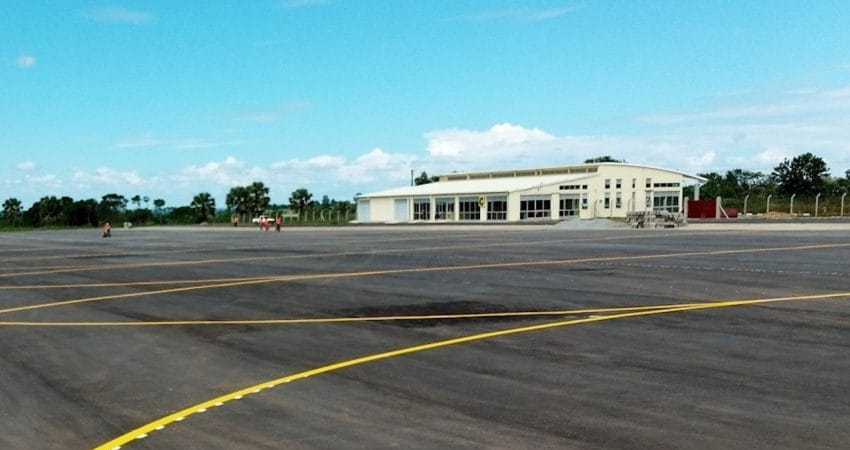
The African Development Bank Group’s Board of Directors has approved Shs674.1 billion (€155.99 million) in financing to upgrade Arua Airport into an international-standard facility.
The funding falls under Phase 1 of the Uganda Airports Development Programme. Arua, situated about 450 kilometres from Kampala, serves as a key entry point to West Nile and neighbouring markets in South Sudan and the Democratic Republic of Congo, but the region’s growth has long been constrained by inadequate domestic and international air-travel infrastructure.

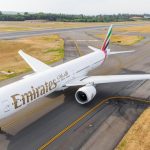
The programme is designed to strengthen both domestic and regional connectivity through safer, more efficient and climate-resilient aviation facilities. Planned works include a 3.5-kilometre paved runway capable of accommodating wide-body aircraft such as the Boeing 777, new taxiways and aprons, and a passenger terminal built to handle 700,000 travellers a year. A cargo terminal with capacity for 25,000 tonnes annually is also part of the design, alongside a new control tower, access roads, parking facilities and upgraded safety systems.
The total cost of the programme stands at Shs681.5 billion (€157.76 million). Of this, the African Development Bank will provide a loan of Shs609.9 billion (€141.15 million), with a further Shs64.1 billion (€14.84 million) coming from the African Development Fund, the Bank Group’s concessional financing window. The Ugandan government will contribute Shs7.6 billion (€1.77 million) in kind.
Mike Salawou, the Bank Group’s Director for the Infrastructure and Urban Development Department, said the project carries significance beyond the airport’s physical upgrade. He described it as a step toward linking communities to economic opportunity, opening up new markets for businesses, boosting tourism, and reinforcing Uganda’s position as a regional hub for trade and logistics.

Implementation will fall under the Uganda Civil Aviation Authority, which operates under the Ministry of Works and Transport. The Authority’s Director General, Fred Bamwesigye, described the upgrade as a major milestone for the country’s aviation sector, one likely to deepen regional connectivity and drive social and economic transformation in West Nile.
Bamwesigye noted that Arua Airport already ranks as the second busiest in Uganda after Entebbe International Airport, with substantial room for further growth. He added that the upgraded facility would also function as a backup for Entebbe during emergencies, and expressed appreciation for the Bank’s continued partnership on the project.
West Nile, of which Arua is the regional capital, is rich in mineral resources and holds considerable potential in agriculture, tourism, culture, trade, regional integration and logistics. As the most remote major city from Kampala, Arua stands to gain significantly from improved connectivity across these sectors. Faster, cheaper air access is expected to help farmers and traders move perishable produce to both regional and international markets, while also easing access to the region’s tourist attractions.
The programme is projected to directly benefit more than half a million residents of Arua City and District, with the broader West Nile region — home to over 3.3 million people — set to gain from improved transport links and expanded investment opportunities.
During construction, the project is expected to generate roughly 500 direct jobs and more than 1,400 indirect jobs in sectors such as tourism, agriculture and trade. It will also fund skills training for at least 100 young people, including women, in engineering, construction and equipment operation.
The initiative aligns with the Bank’s Ten-Year Strategy 2024-2033 and the transport and infrastructure priorities outlined in the Uganda Country Strategy Paper 2022-2026, both of which emphasise building well-maintained, sustainable infrastructure to improve market access and competitiveness in support of industrialisation.